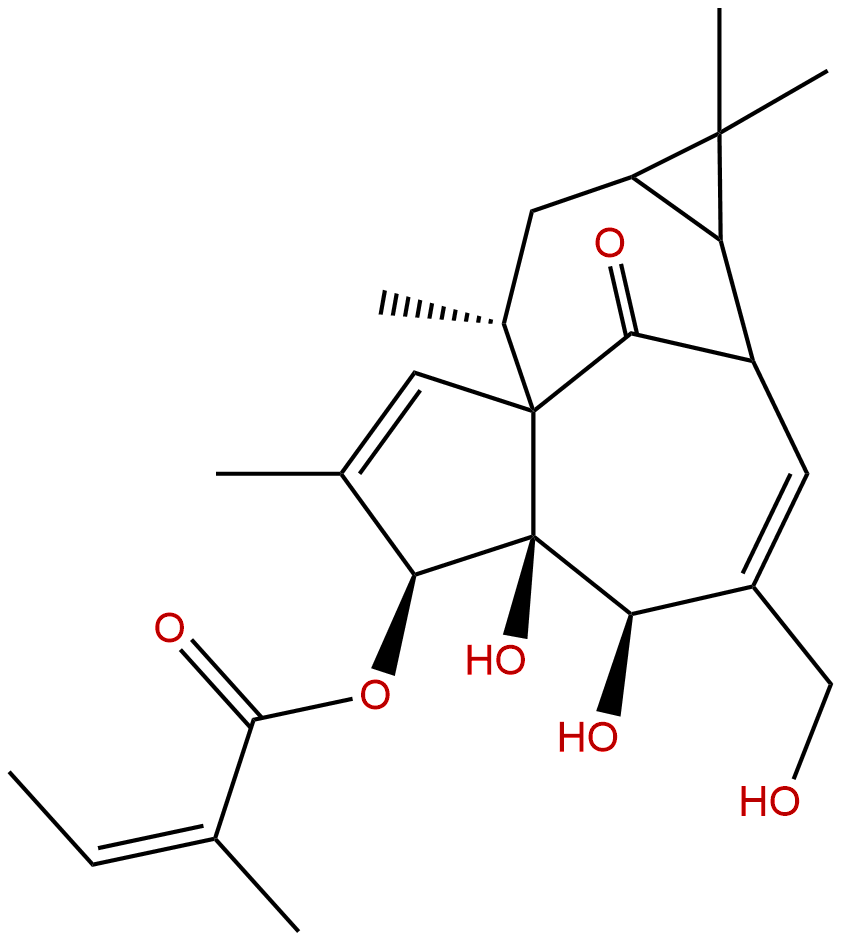


Product name: Ingenol Mebutate
Synonym name: 3-Angeloyl Ingenol; 3-Angelyl Ingenol; 3-Ingenyl Angelate; Ingenyl 3-Angelate; Ingenol 3-Angelate; PEP005
Catalogue No.: BP1635
Cas No.: 75567-37-2
Formula: C25H34O6
Mol Weight: 430.541
Botanical Source: Synthesis
Physical Description:
Type of Compound: Diterpenoids
Purity: 95%~99%
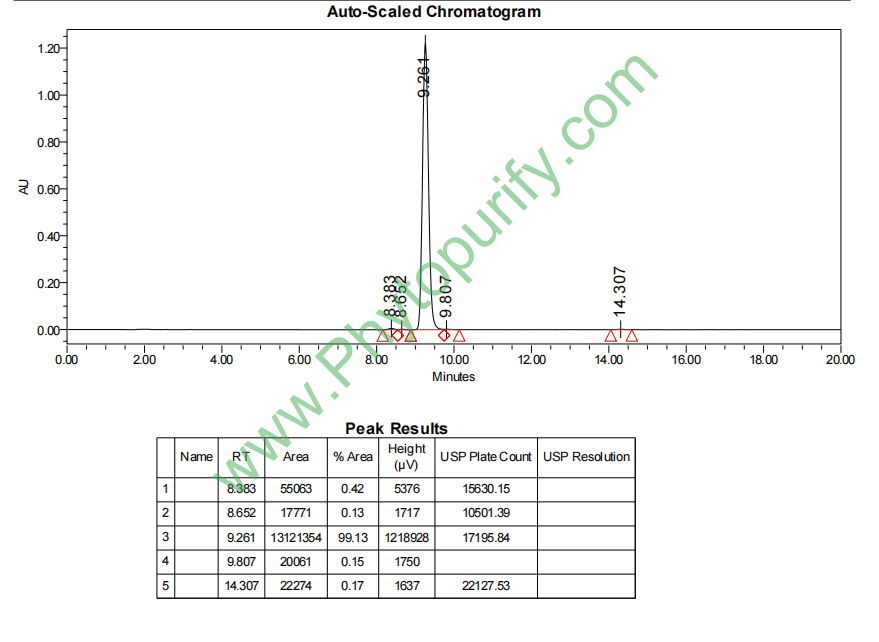
Analysis Method: HPLC-DAD or/and HPLC-ELSD
Identification Method: Mass, NMR
Packing: Brown vial or HDPE plastic bottle
The product could be supplied from milligrams to grams. Inquire for bulk scale.
We provide solution to improve the water-solubility of compounds, thereby facilitating the variety of activity tests and clinic uses.
For Reference Standard and R&D, Not for Human Use Directly.
Description:
Ingenol-3-angelate shows anticancer activity, and P-gp-mediated absorptive transport, dermal penetration, and vascular damage contribute to the anticancer activity of ingenol-3-angelate in vivo; it activates a broad range of PKC isoforms and induces apoptosis in acute myeloid leukemia cells by activating the PKC isoform PKCdelta. Ingenol-3-angelate suppresses HIV infection of primary CD4+ T cells through down-modulation of cell surface expression of HIV co-receptors. Ingenol-3-angelate emerges as a unique local chemotherapeutic immunostimulatory debulking agent that could be used in conjunction with immunotherapies to promote regression of metastases.
References:
PLoS Pathog. 2015 Jul 30;11(7):e1005066.
Synergistic Reactivation of Latent HIV Expression by Ingenol-3-Angelate, PEP005, Targeted NF-kB Signaling in Combination with JQ1 Induced p-TEFb Activation.
Although anti-retroviral therapy (ART) is highly effective in suppressing HIV replication, it fails to eradicate the virus from HIV-infected individuals. Stable latent HIV reservoirs are rapidly established early after HIV infection. Therefore, effective strategies for eradication of the HIV reservoirs are urgently needed.
METHODS AND RESULTS:
We report that Ingenol 3-Angelate (PEP005), the only active component in a previously FDA approved drug (PICATO) for the topical treatment of precancerous actinic keratosis, can effectively reactivate latent HIV in vitro and ex vivo with relatively low cellular toxicity. Biochemical analysis showed that PEP005 reactivated latent HIV through the induction of the pS643/S676-PKCδ/θ-IκBα/ε-NF-κB signaling pathway. Importantly, PEP005 alone was sufficient to induce expression of fully elongated and processed HIV RNAs in primary CD4+ T cells from HIV infected individuals receiving suppressive ART. Furthermore, PEP005 and the P-TEFb agonist, JQ1, exhibited synergism in reactivation of latent HIV with a combined effect that is 7.5-fold higher than the effect of PEP005 alone. Conversely, PEP005 suppressed HIV infection of primary CD4+ T cells through down-modulation of cell surface expression of HIV co-receptors.
CONCLUSIONS:
This anti-cancer compound is a potential candidate for advancing HIV eradication strategies.
Cancer Res. 2010 Jun 1;70(11):4509-19.
The skin cancer chemotherapeutic agent ingenol-3-angelate (PEP005) is a substrate for the epidermal multidrug transporter (ABCB1) and targets tumor vasculature.
Ingenol-3-angelate (Ing3A), extracted from Euphorbia peplus, is currently in clinical trials for eradicating basal cell carcinoma, actinic keratosis, and squamous cell carcinoma (SCC) in situ by topical application.
METHODS AND RESULTS:
Although structurally related to phorbol esters and a protein kinase C activator, topical Ing3A, but not phorbol 12-myristate 13-acetate (PMA), inhibited the growth of subcutaneous tumors derived from PAM212 (mouse SCC) and B16 (mouse melanoma). Ing3A and PMA both induced acute neutrophilic inflammation on mouse skin, but only Ing3A caused subcutaneous hemorrhage and vascular damage. Both Ing3A and PMA activated extracellular signal-regulated kinase 1/2 (ERK1/2) in epidermis, but Ing3A also activated ERK1/2 in skin dermal fibroblasts and endothelial cells. Pretreatment with topical cyclosporin A (CsA), verapamil, or XR9576, modulators of P-glycoprotein (P-gp), prevented Ing3A-induced hemorrhage but not neutrophil infiltration. CsA also impaired the anticancer activity of Ing3A, whereas the anti-inflammatory dexamethasone did not. Ing3A, but not PMA, blocked photoaffinity labeling of human P-gp with [(125)I]iodoaryazidoprazosin and inhibited P-gp-mediated drug resistance to HCT-15 cells. The intracellular levels of Ing3A were significantly lower in P-gp-expressing cells, and treatment with XR9576 increased the levels to those of cells that do not express P-gp, showing that Ing3A binds to and is transported by P-gp.
CONCLUSIONS:
Taken together, our results suggest that P-gp-mediated absorptive transport, dermal penetration, and vascular damage contribute to the anticancer activity of Ing3A in vivo.
Vaccine. 2009 May 18;27(23):3053-62.
Immunostimulatory cancer chemotherapy using local ingenol-3-angelate and synergy with immunotherapies.
Ingenol-3-angelate is a new local chemotherapeutic agent in clinical trails that induces primary necrosis of tumour cells and transient local inflammation.
METHODS AND RESULTS:
Here we show that cure of subcutaneous tumours with ingenol-3-angelate (PEP005) resulted in the generation of anti-cancer CD8 T cells that could regress metastases. Furthermore, PEP005-mediated cure synergized with several CD8 T cell-based immunotherapies to regress further distant metastases. PEP005 was shown to have adjuvant properties, being able to upregulate CD80 and CD86 expression on dendritic cells in vivo, and to promote CD8 T cell induction when co-delivered with a protein antigen.
CONCLUSIONS:
PEP005 thus emerges as a unique local chemotherapeutic immunostimulatory debulking agent that could be used in conjunction with immunotherapies to promote regression of metastases.
HPLC of Ingenol Mebutate
Storage conditions:Short-term storage at 2~8℃, long-term storage at -20 ~ -80℃
104.0600
2.5532
2.5532
.1210
1.4215
7.6758
High
75.7263
6.2588
No
No
No
No
No
No
0.0
Yes
Yes
Yes
Yes
Natural products have long been an important source of innovative drug discovery, among which Euphorbiaceae plants have attracted much attention due to their rich secondary metabolites and diverse biological activities. Giant Euphorbian-3-O-Angelica sinensis ester, also known as Giant Euphorbian-methylbutenoate, is a plant species derived from the Euphorbiaceae genus (e.g Euphorbia peplus)The diterpenoid compounds. This compound has become a star molecule in the field of anti-tumor drug development due to its unique chemical structure and significant pharmacological activity, especially as a highly efficient regulator of protein kinase C. Its most remarkable achievement is the successful development of Picato as a topical prescription drug (trade name Picato) ®), Used to treat solar keratosis, a common precancerous lesion of the skin, marking a classic transformation from traditional herbal experience to modern precision treatment. This article aims to provide a systematic review of the chemical properties, plant sources, pharmacological activities, molecular mechanisms of action, pharmacological properties, and clinical application prospects of the compound Jujinol-3-O-Angelica sinensis, in order to provide comprehensive academic references for the in-depth research and related drug development of this compound.
The molecular formula of giant halberin-3-O-Angelica sinensis ester is C25H34O6, with a molecular weight of 430.5410. The core of its structure is the giant halberin, which is a tetracyclic diterpene mother nucleus with a unique tigliane skeleton. The characteristic of this compound is that its C-3 hydroxyl group is connected to Angelica acid (also known as Tigaric acid, an unsaturated short chain fatty acid) through ester bonds, forming 3-O-Angelica acid ester. This esterification modification is crucial for its biological activity, greatly enhancing its ability to penetrate cell membranes and affinity for protein kinase C.
From the analysis of physical and chemical properties, the calculated lipid water partition coefficient of this compound is 2.5532, indicating that it has moderate lipophilicity, which is beneficial for its penetration through the stratum corneum of the skin. Its topological polar surface area is approximately 104.0600 Å ², reflecting the presence of multiple polar functional groups in the molecule. The water solubility is relatively low, about 0.1210 mg/mL, which is consistent with its hydrophobic diterpenoid ester characteristics. Based on its properties, it is predicted that the compound has a high blood-brain barrier permeability potential, but this characteristic is not the main consideration under its approved local topical administration method. It is crucial that preliminary drug screening shows no hERG potassium channel inhibitory activity (indicating low potential risk of cardiac toxicity), and the Ames test result is negative (0.0), indicating no mutagenicity under the test conditions, providing early support for its clinical safety.
Giant Euphorbian-3-O-angic Acid Esters are mainly derived from plants in the Euphorbiaceae family and Euphorbiaceae genus White bud halberd It is the most abundant natural source known. This plant is distributed in many parts of the world, and its milk has traditionally been used by the public to treat skin warts and cancerous lesions, providing important clues for modern research.
Its extraction and separation is a multi-step precision process. Usually, the aboveground parts or milk of plants are first collected, and organic solvents such as methanol, dichloromethane, or ethyl acetate are used for cold soaking or reflux extraction to obtain crude extracts rich in diterpenes. Subsequently, various chromatographic techniques were used for separation and purification, including silica gel column chromatography, reverse phase high-performance liquid chromatography, etc. Due to the presence of other diterpenoid esters with similar structures and strong activity (such as phorbol esters) in Euphorbia plants, extra caution is required during the separation process to obtain high-purity target compounds. In recent years, in order to meet the growing demand for research and development and reduce dependence on wild plant resources, researchers have also explored alternative pathways such as plant cell culture, synthetic biology techniques (such as heterologous biosynthesis), and total chemical synthesis to produce the compound or its key intermediates. However, most of these methods are currently in the laboratory research stage, and cost and efficiency remain challenges.
Giant Euphorbian-3-O-Angelica sinensis ester exhibits extensive and strong pharmacological activity, with its core being its anti proliferative and pro apoptotic effects, especially significant in skin related diseases.
The mechanism of action of giant jasmonal-3-O-Angelica sinensis ester is complex and multi-target, and its core initial event is Efficiently and specifically bind to and activate protein kinase C subtypes。
In summary, its mechanism of action is triggered by PKC and involves BCL2、MAPK1、CASP9、TP53、NFKB1、PTGS2、SPHK1、EGFR The cascade reaction network of multiple key targets ultimately leads to rapid clearance of diseased cells and reshaping of the local immune environment.
The successful development of giant jasmonal-3-O-Angelica sinensis ester is a model for transforming its potent but potentially systemically toxic molecule into a safe and effective local drug.
The clinical application of giant jasmonal-3-O-Angelica sinensis ester has shown broader prospects starting from the indication of photokeratosis, but also faces challenges.
Giant Euphorbian-3-O-Angelica sinensis ester is a successful example of modern medicine derived from traditional medicinal plants. It, with its unique tigliane diterpene ester structure, efficiently targets PKC and triggers a unique "activation depletion" mode, thereby regulating a multi-target signaling network involving apoptosis, inflammation, and immunity, ultimately achieving efficient clearance of skin precancerous lesions. Its research and development process fully reflects the wisdom of optimizing the structure of natural products and rational drug administration strategies (topical application) to maximize the therapeutic index by leveraging strengths and avoiding weaknesses. At present, this compound has become an important weapon in the field of dermatology. In the future, through combination therapy, dosage form innovation, and mechanism deepening, Jujijun-3-O-Angelica sinensis ester is expected to open up new horizons in the treatment of a wider range of skin diseases and even systemic tumors, continuously demonstrating the immortal value of natural products in drug discovery. Its research paradigm also provides valuable reference for the translational medicine research of other highly active natural products.
