


Synonym name: Deoxypicrosalvinic acid
Catalogue No.: BP0316
Cas No.: 3650-09-7
Formula: C20H28O4
Mol Weight: 332.44
Botanical Source: Salvia officinalis (sage), Salvia canariensis, Salvia apiana and Rosmarinus officinalis (rosemary)
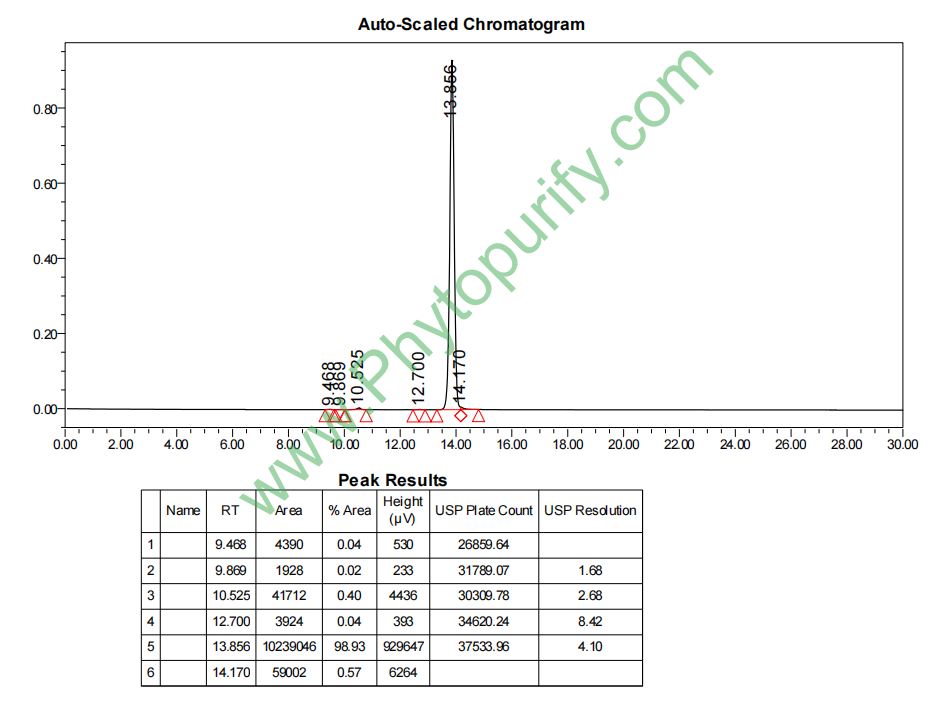
Purity: 90%~99%
Analysis Method: HPLC-DAD or/and HPLC-ELSD
Identification Method: Mass, NMR
Packing: Brown vial or HDPE plastic bottle
Can be supplied from milligrams to grams,up to kilograms.
Inquire for bulk scale.
Two studies, led by Stewart Lipton, MD, PhD, from the Burnham Institute for Medical Research, in La Jolla, California, and Takumi Satoh, MD, PhD, from Iwate University, in Japan, which are published in the October 2007 issue of Nature Reviews Neuroscience and online November 8 in the Journal of Neurochemistry, show that CA activates a novel signaling pathway that protects brain cells from free radical damage, seen in stroke and other neurodegenerative conditions such as Parkinson's and Alzheimer's diseases.[1] [2]
Carnosol and carnosic acid have been suggested to account for over 90% of the antioxidant properties of rosemary extract. 2. Purified carnosol and carnosic acid are powerful inhibitors of lipid peroxidation in microsomal and liposomal systems, more effective than propyl gallate. 3. Carnosol and carnosic acid are good scavengers of peroxyl radicals (CCl3O2.) generated by pulse radiolysis, with calculated rate constants of 1-3 x 10(6) M-1 s-1 and 2.7 x 10(7) M-1 s-1 respectively. 4. Carnosic acid reacted with HOCl in such a way as to protect the protein alpha 1-antiproteinase against inactivation. 5. Both carnosol and carnosic acid stimulated DNA damage in the bleomycin assay but they scavenged hydroxyl radicals in the deoxyribose assay. The calculated rate constants for reaction with .OH in the deoxyribose system for carnosol and carnosic acid were 8.7 x 10(10) M-1 s-1 and 5.9 x 10(10) M-1 s-1 respectively. 6. Carnosic acid appears to scavenge H2O2, but it could also act as a substrate for the peroxidase system. 7. Carnosic acid and carnosol reduce cytochrome c but with a rate constant significantly lower than that of O2(-.). [3] From Wikipedia
References:
Storage conditions:Short-term storage at 2~8℃, long-term storage at -20 ~ -80℃
Carnosic acid (CAS number: 3650-09-7) is a typical natural product of rosin terpenes, mainly derived from rosemary(Rosmarinus officinalis)And sage(Salvia officinalis)Obtained through separation. As a natural compound with multiple biological activities, oxalic acid has shown significant pharmacological potential in antioxidant, anti-tumor, anti angiogenic, and antiviral aspects. In recent years, with the deepening of research on neurodegenerative diseases, the mechanism of action and related molecular targets of oxalic acid in the field of neuroprotection have gradually been revealed, demonstrating its potential applications in neurological diseases such as Alzheimer's disease and Parkinson's disease. In addition, the good safety and low toxicity of carnitine make it an important candidate molecule for natural drug development. This article aims to provide a systematic review of the chemical structure, physicochemical properties, plant sources, extraction processes, pharmacological activities, and mechanisms of action of oxalic acid from rat tail. By combining its pharmacological parameters and pharmacokinetic characteristics, it explores its clinical application potential and future research directions.
Rat tail oxalic acid belongs to the class of diterpenoid compounds with a molecular formula of C20H28O4 and a molecular weight of 332.44. Structurally, salvianolic acid is composed of a rosin 8,11,13-tiene skeleton, which is substituted by hydroxyl groups at positions 11 and 12, respectively, and has a carboxyl functional group at position 20. This structure endows it with strong polarity and a certain degree of lipophilicity, with a LogP value of 4.4412, indicating that it has good lipid solubility and is conducive to penetrating cell membranes.
In terms of physical and chemical properties, the polar surface area (TPSA) of oxalic acid is 77.76 Å ², indicating that it has certain polar groups that facilitate the binding of molecules with biomolecules such as proteins. The low water solubility (0.0264 mg/mL) limits its solubility and bioavailability in aqueous phase, but its lipid solubility facilitates membrane permeation. The low permeability of the blood-brain barrier (BBB) suggests that its direct action in the central nervous system may be limited, but the potential to exert neuroprotective effects by regulating relevant targets still exists. The hERG channel inhibition experiment was negative, indicating a low risk of cardiac toxicity from oxalic acid in mice; The Ames mutagenicity test result was 0, indicating no significant genetic toxicity.
Oxalic acid is mainly found in plants of the Lamiaceae family, such as rosemary and sage, and is particularly abundant in the leaves of rosemary. Rosemary and sage, as traditional herbs and spice plants, are widely distributed in the Mediterranean region and have attracted much attention due to their abundant diterpenes and phenolic compounds.
There are various methods for extracting oxalic acid from rat tail, including solvent extraction, ultrasound assisted extraction, microwave-assisted extraction, and supercritical fluid extraction. Traditional solvent extraction often uses ethanol, methanol, or ethyl acetate as solvents to improve extraction efficiency. Ultrasound assisted extraction promotes cell rupture through acoustic vibration, significantly reducing extraction time and increasing yield. Microwave assisted extraction utilizes microwave energy to heat plant cells, enhance solvent penetration and solute dissolution, and has the characteristics of fast and efficient extraction. Supercritical carbon dioxide extraction has gradually become the preferred technology for industrial extraction of oxalic acid from rat tail due to its advantages of green environmental protection and no solvent residue.
After extraction, salvianolic acid is often separated and purified by liquid chromatography (HPLC), and its structure is identified by combining mass spectrometry (MS) and nuclear magnetic resonance (NMR) techniques. The high purity of carnitine provides a reliable material basis for subsequent pharmacological activity research and drug development.
Rat tail oxalic acid has a wide range of pharmacological activities, including antioxidant, anti-tumor, anti angiogenic, antiviral, and neuroprotective effects.
Oxalic acid, as a natural phenolic antioxidant, can effectively eliminate free radicals, inhibit lipid peroxidation, and protect cells from oxidative stress damage. Its hydroxyl and carboxyl structures give it strong electron donor ability, which can neutralize reactive oxygen species (ROS) and nitrogen radicals (RNS). In vitro studies have shown that oxalic acid significantly increases intracellular antioxidant enzyme activity (such as superoxide dismutase (SOD) and glutathione peroxidase (GPx)), reduces oxidative damage markers, and delays the process of cellular aging.
Several in vitro and in vivo studies have shown that murine oxalic acid has inhibitory effects on a variety of tumor cell lines, including breast cancer, colon cancer, lung cancer, etc. Its anti-tumor mechanism involves inducing cell apoptosis, inhibiting cell proliferation, blocking tumor angiogenesis, and regulating the tumor microenvironment. Oxalic acid can downregulate VEGF expression, inhibit neovascularization, and limit tumor nutrition supply and growth. In addition, oxalic acid exerts its anti-tumor effect by regulating the NF - κ B, PI3K/Akt, and MAPK signaling pathways.
Oxalic acid has shown certain activity in anti HIV research, which can inhibit the activity of HIV reverse transcriptase and protease, and block the virus replication cycle. Its multi-target mechanism of action makes it a potential candidate molecule for antiviral drug development.
Neuroprotection is a hot topic in the study of oxalic acid in mice. Oxidative stress and neuroinflammation are the common pathological basis of various neurodegenerative diseases, and oxalic acid in rat tail reduces neuronal damage through antioxidant and anti-inflammatory effects. In vitro and animal model studies have shown that oxalic acid can alleviate neurotoxicity induced by β - amyloid protein (A β), reduce neuronal apoptosis, and improve cognitive function. Its protective effect on dopaminergic neurons in Parkinson's disease models has also been confirmed.
The multi-target mechanism of action of oxalic acid in mice is the basis of its pharmacological activity, especially in terms of neuroprotection involving multiple key proteins and signaling pathways.
Oxalic acid activates nuclear factor erythroid associated factor 2 (NRF2), promoting the expression of antioxidant enzyme genes and enhancing cellular antioxidant capacity. At the same time, inhibiting the NF - κ B signaling pathway reduces the release of pro-inflammatory cytokines and alleviates neuroinflammation.
In summary, oxalic acid in rat tail exerts multiple pharmacological effects such as neuroprotection and anti-tumor effects through multi-target and multi pathway synergistic effects.
The pharmacological parameters of oxalic acid in rat tail indicate that it has certain potential for drug development. The molecular weight of 332.44 conforms to Lipinski's rule, and LogP 4.44 suggests that it has good lipid solubility, which is beneficial for cell membrane penetration. However, its low water solubility (0.0264 mg/mL) may limit its oral bioavailability. Its TPSA is 77.76, and moderate polarity facilitates binding to target proteins.
The low permeability of the blood-brain barrier suggests its limited ability to directly enter the central nervous system, but it can still exert neuroprotective effects by regulating the peripheral nervous system or indirect mechanisms. The negative inhibition of hERG channel and the absence of mutagenicity in Ames test indicate that oxalic acid in rat tail is relatively safe, with lower risks of cardiac toxicity and genetic toxicity.
Pharmacokinetic studies have shown that oral absorption of oxalic acid in mice is limited, and metabolism in the body is mainly carried out through the liver enzyme system. Metabolites are mostly hydroxylated and glucuronic acid conjugates. Its half-life is moderate and suitable for daily administration. The development of new drug delivery systems such as nanocarriers, liposomes, and solid dispersions has become a research hotspot to improve bioavailability.
Rat tail oxalic acid, as a multifunctional natural product, has shown broad clinical application prospects due to its significant antioxidant, anti-tumor, and neuroprotective effects. In the field of neurodegenerative diseases, carnitine has the potential to become an adjuvant therapy for diseases such as Alzheimer's and Parkinson's, alleviating pathological processes and improving patients' cognitive and motor functions. Its anti-tumor properties also provide new ideas for cancer treatment, especially in combination chemotherapy and targeted therapy, which may play a synergistic effect.
However, the clinical translation of carnitine still faces many challenges, including poor water solubility, low bioavailability, and insufficient blood-brain barrier permeability. Future research needs to focus on optimizing the route of administration and dosage form design to enhance its pharmacokinetic performance. Meanwhile, in-depth analysis of its mechanism of action, especially the molecular networks related to neuroprotection, will provide a theoretical basis for the development of precision drugs.
In addition, the preclinical safety evaluation and clinical trial design of the system are also key to achieving the clinical application of oxalic acid in mice. Interdisciplinary collaboration, combined with modern medicinal chemistry, pharmacology, and pharmaceutical formulation, will promote the transition of carnitine from laboratory to clinical use, benefiting patients.
Oxalic acid, as a natural diterpenoid compound with unique structure and rich pharmacological activity, has become a hot topic in natural product pharmacology research due to its multiple biological functions such as antioxidant, anti-tumor, and neuroprotective effects. Its multi-target mechanism of action provides new ideas for the treatment of various diseases. Despite limitations such as water solubility and bioavailability, the clinical potential of oxalic acid in rat tail is becoming increasingly prominent with the continuous advancement of extraction and purification technologies and drug delivery systems. In the future, in-depth research on the optimization of its drug properties and mechanisms will lay a solid foundation for the development and clinical application of oxalic acid, and promote it to become an important member of the natural medicine field.
