Introduction/Overview
Squamous cell carcinoma of the skin (cSCC) is the second most common non melanoma skin cancer. Its incidence rate continues to rise worldwide, especially in the elderly and immunosuppressed people. Although most cSCC can be cured by surgical resection, the treatment options for advanced, metastatic, or recurrent cases are limited and the prognosis is poor. There is an urgent need for new, efficient, and low toxicity therapeutic drugs. In this context, exploring natural products with anti-tumor activity from traditional medicinal plants has become one of the important strategies for new drug development. As a treasure trove of traditional medicine, Euphorbiaceae plants secrete milk rich in various diterpenoid compounds, among which giant Euphorbiaceae diterpenoid esters have attracted much attention due to their significant cytotoxicity and pro apoptotic activity.
13-O-Dodecanoate (CAS: 54706-70-6) is a member of the family of diterpenoid esters in Euphorbia macrocephala. Although this compound is not newly discovered, its research has long focused on chemical structure identification and preliminary cytotoxicity screening. In recent years, with the deepening understanding of the molecular pathological mechanism of cSCC, especially the analysis of key links such as apoptosis dysregulation, abnormal signal transduction (such as EGFR, STAT3 pathway), and cell cycle disorders, 13-O-n-dodecanoic acid macrolide has re entered the research field due to its regulatory potential on multiple key targets. Its unique chemical structure endows it with biological characteristics that distinguish it from other giant esters, making it exhibit remarkable pharmacological activity in targeting the specific disease model of cSCC. This article aims to systematically review the chemical properties, plant sources, anti cSCC pharmacological activity, mechanism of action, pharmacological evaluation, and clinical application prospects of this compound, in order to provide comprehensive scientific references for the development of anti-tumor drugs based on this natural product.
Chemical structure and physicochemical properties
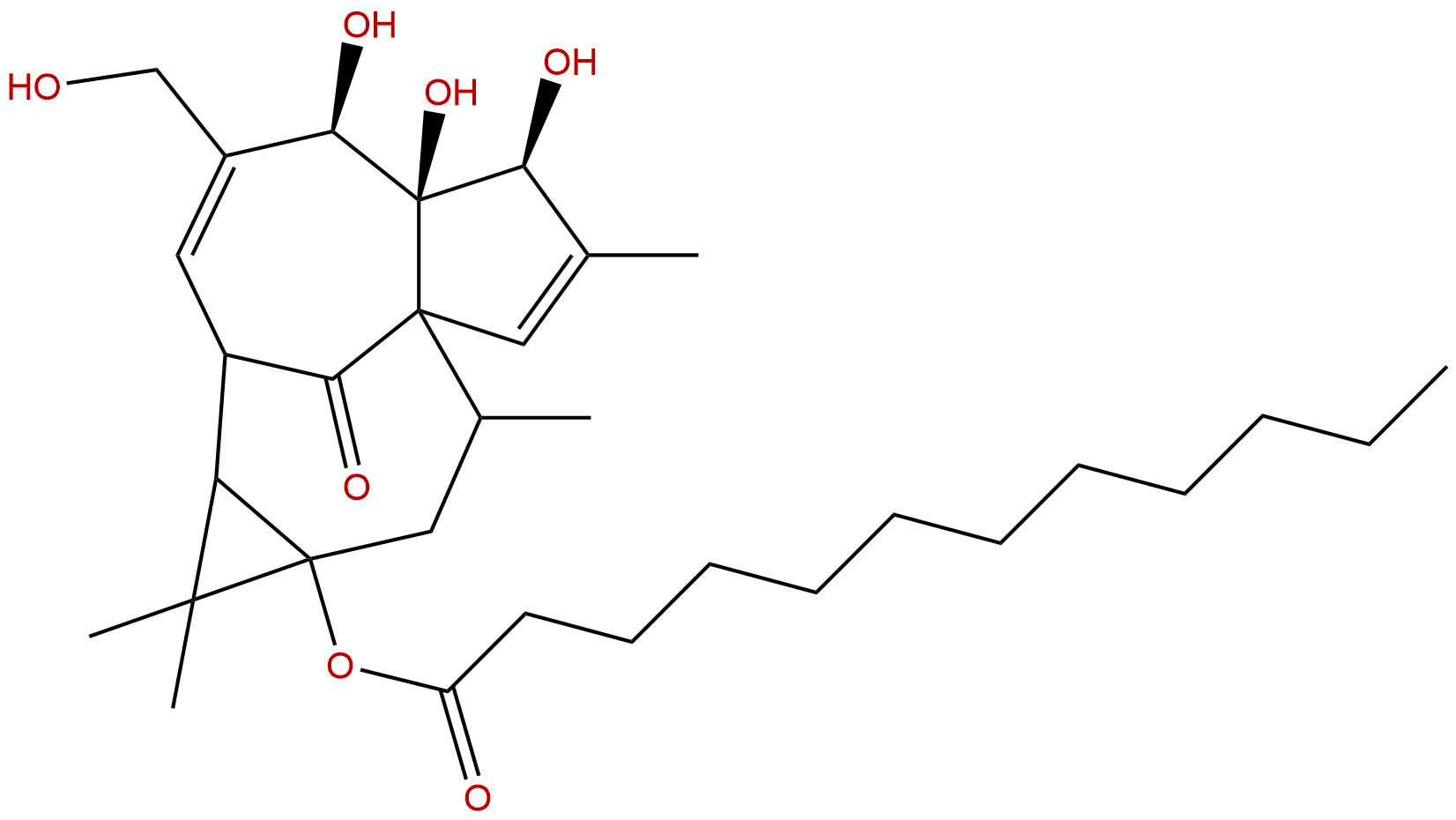
13-O-n-dodecanoic acid macrolide belongs to the class of macrolide diterpenoid esters. Its core skeleton is a giant diterpenoid alcohol, which is a tetracyclic diterpenoid structure with a tigliane mother nucleus, characterized by a highly oxidized 5/7/6/3 tetracyclic system. The specificity of this compound lies in its C-13 hydroxyl group being linked to n-dodecanoic acid (lauric acid) through an ester bond, forming a 13-O-esterified derivative. This esterification modification significantly alters the polarity, lipid solubility, and biofilm permeability of the parent nucleus, thereby affecting its biological activity and metabolic fate.
According to the provided pharmacological parameters, the molecular weight of this compound is 546.7450 g/mol, which belongs to the category of medium molecular weight. The calculated lipid water partition coefficient (LogP) is 5.0222, indicating that the compound has high lipophilicity, which is closely related to the introduction of long-chain alkyl esters in its structure. A high LogP value indicates that it is easy to penetrate cell membranes, but it may also bring challenges such as poor water solubility and a tendency to distribute in adipose tissue within the body. The topological polar surface area (TPSA) is 124.29 Å ², reflecting the total exposed area of polar groups such as ester bonds and remaining hydroxyl groups in the molecule, which is at a moderate level. Its water solubility is extremely low, only 0.0096 mg/mL, which constitutes the primary difficulty in the development of its formulation. In terms of blood-brain barrier penetration, it is predicted to be "low", which means that it is not easily able to enter the central nervous system. This may reduce the risk of central neurotoxicity for the treatment of peripheral solid tumors (such as skin cancer), which is a favorable characteristic. In addition, preliminary toxicity predictions indicate that the risk of hERG inhibition is "no", suggesting a lower potential risk of causing QT interval prolongation in the heart; The Ames test predicted a value of 0.0, indicating that it may not have direct genetic toxicity. These preliminary pharmacological parameters outline its subsequent development: high activity but facing challenges in solubility and delivery, and preliminary safety predictions are relatively optimistic.
Plant sources and extraction methods
13-O-n-dodecanoic acid macroester is mainly derived from various plants in the Euphorbiaceae family, Euphorbia genus. This genus of plants is widely distributed worldwide, and many species are used in traditional medicine in Asia, Europe, and Africa to treat warts, skin tumors, and other proliferative diseases. Their medicinal parts are usually stems, leaves, or milk. Specific species containing this compound may include but are not limited to Euphorbia kansui(Gan Sui)Euphorbia peplus(Pearl Grass) and Euphorbia lathyris(Continued with children) and so on. The milk (latex) of these plants is the most abundant part of diterpenoid esters, which exist as chemical defense substances for plants.
Its extraction and separation usually follow the classic process of natural product chemistry. Firstly, fresh milk or dried whole plants are collected and subjected to cold soaking or reflux extraction using organic solvents such as methanol, ethanol, or acetone to obtain the total extract. Subsequently, the total extract was preliminarily separated using solvent partitioning method (commonly using gradient extraction with petroleum ether, ethyl acetate, n-butanol, and water), and 13-O-dodecanoic acid macrolide was mainly enriched in the extraction sites of petroleum ether or ethyl acetate due to its high lipid solubility. Further purification is highly dependent on various chromatographic techniques. Silica gel column chromatography is commonly used for crude separation, gradually separated using solvent systems of different polarities (such as petroleum ether ethyl acetate or chloroform methanol gradient elution). The obtained fraction is further refined by high performance liquid chromatography (HPLC), especially reverse phase HPLC (commonly C18 column, using methanol water or acetonitrile water as mobile phase), to obtain high-purity monomer compounds. Structural identification involves the comprehensive use of spectroscopic methods such as mass spectrometry (MS) and nuclear magnetic resonance (NMR, including 1H NMR, 13C NMR, 2D NMR such as COSY, HSQC, HMBC) to confirm its planar structure and relative configuration through comparison with literature data or de novo analysis. Modern technologies such as high-speed countercurrent chromatography (HSCCC) have also shown high efficiency in the separation of such compounds.
Pharmacological activity research
The core pharmacological activity of 13-O-dodecanoic acid macrolide is its anti-tumor effect against skin squamous cell carcinoma (cSCC) and related models. Numerous in vitro studies have shown that this compound exhibits strong proliferative inhibitory activity against various human cSCC cell lines (such as A431, SCC-12, SCC-13), with a half maximal inhibitory concentration (IC50) typically at the micromolar or even nanomolar level, demonstrating significant efficacy.
Its anti-tumor effect is multifaceted:
1. Inhibit cell proliferation and colony formation This compound can dose dependently inhibit DNA synthesis in cSCC cells, reduce the ability to form cell colonies (clones), indicating that it not only kills existing tumor cells but also inhibits their long-term proliferation potential.
2. Inducing cell cycle arrest Flow cytometry analysis showed that 13-O-dodecanoic acid macrolide can block cSCC cells at specific phases of the cell cycle, mainly the G2/M phase. The blockade of G2/M checkpoint prevents cells from entering mitosis, providing a time window for initiating repair or apoptosis programs.
3. Inducing cell apoptosis This is the key mechanism by which the compound exerts anti-tumor effects. By using Annexin V/PI double staining, Hoechst 33258 staining to observe nuclear condensation and fragmentation, and detecting the activation of Caspase-3/7/9, it was confirmed that the compound can effectively activate the endogenous (mitochondrial pathway) and exogenous apoptotic pathways of cSCC cells.
4. Inhibit cell migration and invasion In scratch healing and Transwell invasion experiments, the compound significantly inhibited the migration ability of cSCC cells and their ability to penetrate matrix gel, indicating its potential for anti metastasis.
5. In vivo anti-tumor activity In nude mouse transplant tumor models (such as subcutaneous inoculation of A431 cells), local or systemic administration of 13-O-dodecanoic acid macrolide can significantly inhibit tumor growth, reduce tumor volume and weight, and pathological examination shows an increase in apoptotic cells and a decrease in the expression of proliferation markers (such as Ki-67) in tumor tissue.
In addition to direct anti cSCC activity, this compound may also have certain effects on other hyperproliferative skin diseases (such as psoriasis) or other epithelial derived tumors driven by the same target, but existing research mainly focuses on cSCC.
Mechanism of action and molecular targets
The anti cSCC effect of 13-O-dodecanoic acid macrolide is not achieved through a single target, but through a complex signaling network involving the regulation of multiple key oncogenes, tumor suppressor genes, and signaling pathways. According to the provided target information, its mechanism of action can be summarized as follows:
-
Regulating the Bcl-2 family and inducing mitochondrial apoptosis pathway This compound can Downregulation of anti apoptotic protein BCL-2 The expression, at the same time Upregulation of pro apoptotic protein BAX The expression. The imbalance of Bcl-2/Bax ratio leads to an increase in mitochondrial outer membrane permeability, release of cytochrome C, activation of Caspase-9 and effector Caspase-3/7, ultimately resulting in cell apoptosis. This is one of the core pathways through which it induces apoptosis.
-
Inhibition of STAT3 signaling pathway STAT3 is a key oncogenic transcription factor in the occurrence and development of cSCC. Continuously activated STAT3 promotes cell proliferation, survival, and immune escape. Research has shown that 13-O-dodecanoic acid macrolide can inhibit the phosphorylation (activated form) of STAT3, prevent its nuclear translocation, and inhibit the transcription of downstream target genes (such as Survivor, Mcl-1, Cyclin D1), thereby suppressing tumor growth.
-
Interference with cell cycle regulatory proteins This compound causes G2/M phase blockade and regulation CDK1(Key kinase driving mitosis) and CDKN1A (p21) The expression is closely related. It may upregulate p21 through activation of p53 dependent or independent pathways. p21, as a CDK inhibitor, can inhibit the activity of CDK1/Cyclin B1 complex, leading to the inability of cells to enter the M phase.
-
Affects growth factor receptor signaling CSCC is often accompanied by EGFR and FGFR1 Overexpression or abnormal activation of receptor tyrosine kinases. This compound may inhibit these growth promoting signals by interfering with its ligand binding, receptor dimerization, or downstream signal transduction (such as RAS-MAPK, PI3K Akt). Especially for KRAS The indirect inhibition of EGFR downstream key signaling molecule activity helps to block abnormal proliferation signals.
-
Inhibit extracellular matrix degradation and invasion This compound can Downregulation of matrix metalloproteinase MMP-9 Expression and activity. MMP-9 plays a crucial role in tumor invasion and metastasis by degrading basement membrane components such as type IV collagen. Inhibition of MMP-9 is the molecular basis for its anti migration and anti invasion activity.
-
Activation of p53 pathway Although TP53 often undergoes mutations in cSCC, in wild-type p53 cells, this compound may stabilize by TP53 (p53) Protein enhances its transcriptional activity, thereby upregulating downstream target genes such as p21 and BAX, synergistically exerting cell cycle arrest and pro apoptotic effects.
In summary, 13-O-n-dodecanoic acid macrolide synergistically inhibits the proliferation, survival, cell cycle progression, and invasion ability of cSCC cells through multi-target and multi pathway mechanisms, ultimately leading to tumor cell death. This "multi-target" characteristic may help overcome the problem of resistance that single target drugs are prone to develop.
Evaluation of drug properties and pharmacokinetics
Based on existing data, a preliminary evaluation of the pharmacological properties of 13-O-n-dodecanoic acid macrolide is conducted
Advantage:
1. Efficient activity Strong inhibitory effect on cSCC cell lines at the nanomolar level.
2. Multi-target effect May reduce the risk of drug resistance.
3. Preliminary safety prediction is good No hERG inhibition and Ames mutagenicity warning, low blood-brain barrier penetration may reduce central side effects.
4. Clear plant sources Provided a foundation for sustainable acquisition or chemical synthesis/semi synthesis.
Challenges and Shortcomings:
1. Very poor water solubility This is the biggest obstacle to its development as a systemic drug delivery formulation (such as oral or injection). Advanced formulation technologies such as nanocrystals, liposomes, micelles, cyclodextrin inclusion complexes, or prodrug strategies may be required to enhance their solubility and bioavailability.
2. High LogP value May lead to a large distribution volume in the body, easy accumulation in adipose tissue, slow clearance, and potential long-term toxicity needs to be evaluated.
3. Lack of systematic pharmacokinetic data Currently, research on the absorption, distribution, metabolism, and excretion (ADME) of this compound is very limited. Its ester bonds are easily hydrolyzed by esterases in the body, and may be rapidly metabolized into giant diterpenoid alcohols and lauric acid. The systemic exposure of the prototype drug may be very low. It is necessary to study its main metabolites, metabolic enzymes (such as carboxylesterase), as well as the activity and toxicity of metabolites.
4. Potential local irritation As diterpenoid esters of Euphorbia, these compounds typically have strong skin and mucosal irritations. This is both an opportunity for the development of topical formulations for the treatment of cSCC (which can directly act on the lesion) and a need for careful control of concentration and dosage form to alleviate irritation reactions.
5. Unknown treatment window The range between effective anti-tumor dose and toxic dose has not been established in complete preclinical toxicology studies.
Future pharmacokinetic studies require the use of sensitive LC-MS/MS methods in small animals (rats, mice) and even large animals to quantitatively analyze the concentration changes of the prototype drug and its main metabolites in plasma and tissues over time, calculate key PK parameters (such as Cmax, Tmax, AUC, t1/2, CL, Vd), and investigate their tissue distribution characteristics, especially the concentration at the skin target site.
Clinical application prospects and prospects
The clinical application prospects of 13-O-dodecanoic acid macrolide mainly revolve around the local treatment of squamous cell carcinoma (cSCC) of the skin, and may be extended to other skin proliferative diseases.
-
Local topical preparations for early or in situ cSCC treatment Given its potent anti proliferative and pro apoptotic activity, as well as its low blood-brain barrier penetration, it has been developed Topical preparations (such as cream, gel, tincture or nano carrier delivery system) It is a highly attractive direction. This is particularly applicable for the treatment of solar keratosis (cSCC precancerous lesions), Bowen's disease (in situ cSCC), and superficial, low-risk cSCC, which can be used as an alternative or complementary option to surgery, cryotherapy, or photodynamic therapy. The key challenge lies in balancing therapeutic efficacy and local irritation through formulation technology.
-
Combination therapy strategy This compound can be considered for combination with existing cSCC treatment methods. For example, with EGFR inhibitor(such as cetuximab)chemotherapeutic drugs(such as cisplatin, 5-fluorouracil) or Immune checkpoint inhibitors Combined use may produce a synergistic effect, improve the therapeutic efficacy of late stage or refractory cSCC, and may reduce the dosage of each to reduce toxicity.
-
New drug delivery system To address its water solubility and targeting issues, it is possible to explore nanotechnology The application. For example, encapsulating it in liposomes, polymer nanoparticles, or microneedle arrays can achieve sustained release to the tumor site, enhance skin penetration, increase local concentration, and reduce systemic side effects caused by systemic absorption.
-
Structural optimization and derivative development Based on its parent core structure, carry out reasonable Pharmaceutical chemical modification For example, modifying the ester chain length at position C-13 or introducing hydrophilic groups to improve its solubility and pharmacokinetic properties; Or by synthesizing prodrugs to improve their stability and targeting. Aim to obtain candidate compounds with higher activity, lower toxicity, and better drug properties.
-
Expand indications Its targets (such as STAT3, EGFR) are also involved in other epithelial derived tumors (such as head and neck squamous cell carcinoma, lung cancer) and inflammatory diseases (such as psoriasis). On the basis of fully verifying its safety, its potential applications in a wider range of disease fields can be explored.
Looking ahead to the future, to promote the clinical application of 13-O-n-dodecanoic acid giant ester, a series of systematic preclinical studies need to be completed, including comprehensive In vitro and in vivo pharmacological validation(More cell lines and animal models)ADME and PK research、GLP Toxicological Evaluation(Acute toxicity, chronic toxicity, reproductive toxicity, etc.) and Pharmaceutical research Finally, the safety, pharmacokinetics, and preliminary efficacy of the drug in humans will be gradually evaluated through clinical trials (IIT) or new drug clinical trial applications (IND) initiated by researchers.
Conclusion
As a natural diterpenoid ester derived from Euphorbiaceae plants, 13-O-n-dodecanoic acid macrolide exhibits significant anti-tumor potential due to its strong regulatory ability against multiple pathological processes (proliferation, apoptosis, cycle, invasion) in skin squamous cell carcinoma. It exerts a multi pathway inhibitory effect by synergistically targeting multiple key targets such as BCL-2/BAX, STAT3, and cyclin, providing a new approach to overcome tumor heterogeneity and drug resistance. Despite its prominent challenges in drug formation, such as poor water solubility and potential irritation, the development of modern medicinal chemistry, pharmacy, and nanotechnology provides powerful tools for addressing these issues. Through in-depth analysis of the mechanism of action, systematic preclinical development, and innovative formulation design, 13-O-n-dodecanoic acid macrolide is expected to evolve from a promising natural active molecule into an innovative drug candidate for the treatment of cSCC, especially for local administration, providing patients with new treatment options. Continuous in-depth research on it will not only help to reveal the scientific connotation of the traditional medicinal value of Euphorbia plants, but also provide valuable examples for the development of innovative natural product drugs.