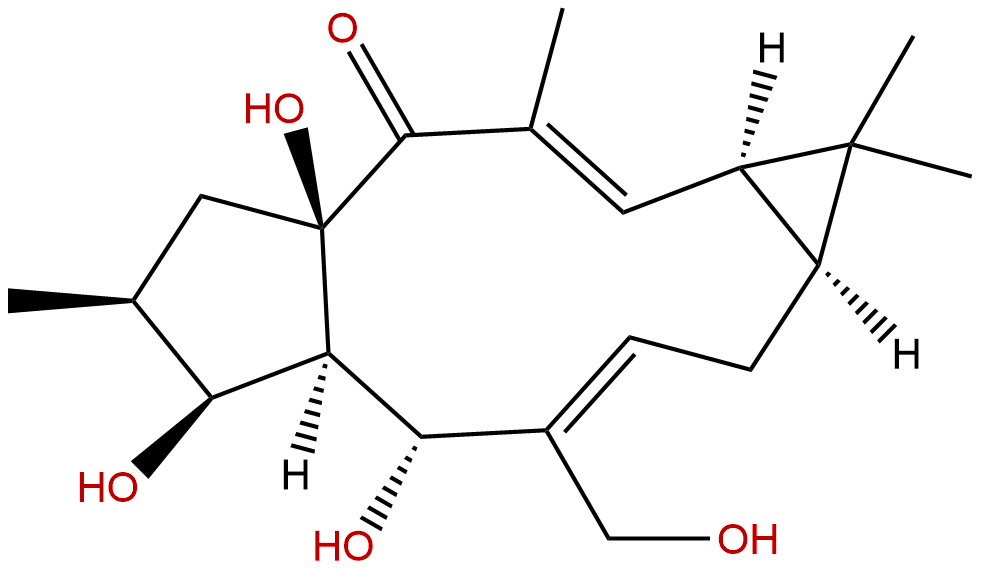


Product name: 17-Hydroxyisolathyrol
Synonym name:
Catalogue No.: BP1841
Cas No.: 93551-00-9
Formula: C20H30O5
Mol Weight: 350.455
Botanical Source:
Physical Description:
Type of Compound: Diterpenoids
Purity: 95%~99%
Analysis Method: HPLC-DAD or/and HPLC-ELSD
Identification Method: Mass, NMR
Packing: Brown vial or HDPE plastic bottle
The product could be supplied from milligrams to grams. Inquire for bulk scale.
We provide solution to improve the water-solubility of compounds, thereby facilitating the variety of activity tests and clinic uses.
For Reference Standard and R&D, Not for Human Use Directly.
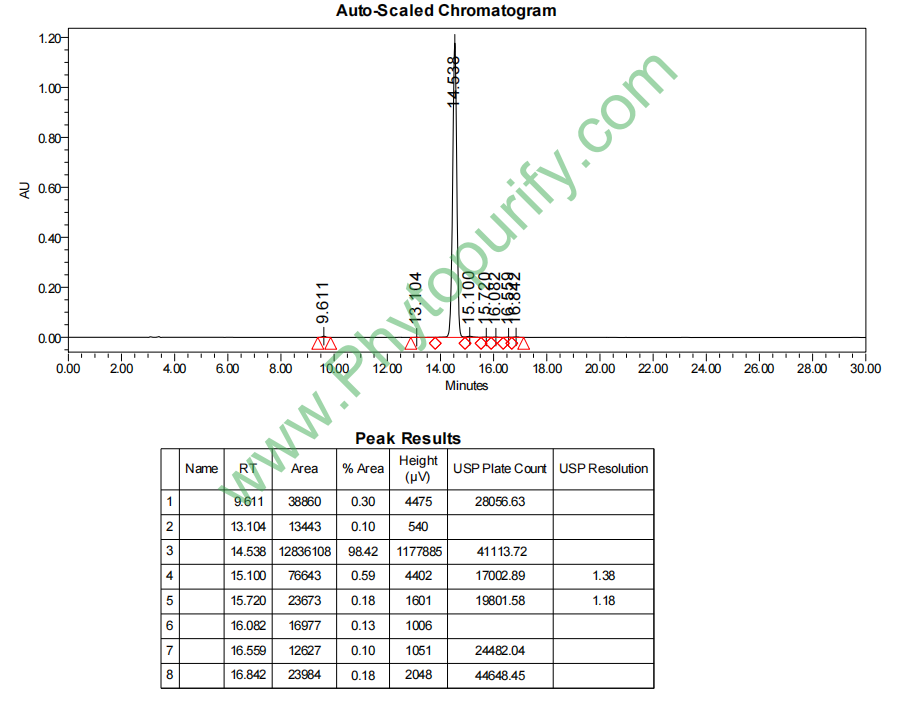
HPLC of 17-Hydroxyisolathyrol
Storage conditions:Short-term storage at 2~8℃, long-term storage at -20 ~ -80℃
97.9900
1.5199
1.5198
1.0593
1.2243
6.7905
Low
55.9562
5.4449
No
No
No
No
No
No
0.0
Yes
Yes
Yes
Yes
17 Hydroxyisomerol (CAS number: 93551-00-9) is a natural product of macrocyclic triterpenoids isolated from the seeds of the Euphorbiaceae plant Croton tiglium. As a class of diterpenoid compounds with complex structures and significant biological activity, quercetin and its derivatives have long been of great concern in the field of natural product medicine research. The molecular formula of this compound is C20H30O5, with a molecular weight of 350.4550 g/mol, and it belongs to the highly oxidized diterpenoid skeleton. Its unique chemical structure endows it with a variety of biological activities, especially in recent years, research has found that it interacts with several key targets closely related to the occurrence and development of cancer (such as BCL2, ESR1, HER2, etc.), showing its potential application value in the field of breast cancer treatment. This article will provide a systematic and professional scientific introduction to this natural compound with potential for development, including its chemical structure, plant origin, pharmacological activity, mechanism of action, medicinal evaluation, and research prospects.
The chemical structure of 17 hydroxyisoquercetin is the material basis for its biological activity. Its molecular formula is C20H30O5, indicating that it is a complex molecule composed of 20 carbon atoms, 30 hydrogen atoms, and 5 oxygen atoms. The molecular weight of 350.4550 g/mol is within the common range of small molecule drugs. From SMILES string (C/C1=C [C @ @ H] 2 C@H C2 (C) C) can be interpreted as a stereoisomer with multiple chiral centers (represented by the @ symbol), containing an alpha, beta unsaturated ketone structure (C1=O), multiple hydroxyl groups (- OH), and a cyclic skeleton. This highly functionalized structure, especially the presence of multiple hydroxyl groups, significantly affects its physical and chemical properties.
According to the provided pharmacological parameters, its topological polar surface area (TPSA) is 97.99 Å ², which is closely related to the presence of 5 oxygen atoms (mainly from hydroxyl and carbonyl groups) in its molecule. A higher TPSA usually means that the molecule has strong polarity, which may affect its transmembrane permeability. Its lipid water partition coefficient (LogP) is 1.5199, indicating that the compound has moderate lipophilicity, neither highly hydrophobic nor highly hydrophilic, which is beneficial for its distribution balance in organisms. The predicted value of water solubility is 1.0593 (usually measured in mg/mL or mol/L, not specified here, but the value is relatively small), indicating limited water solubility, which may be the result of the combined effect of high TPSA and moderate LogP. These physicochemical properties collectively determine its absorption, distribution, metabolism, and excretion (ADME) behavior within the organism.
The plant source of 17 hydroxyisoqianjin diterpenoid alcohol is Qianjin gold, scientific name Croton tiglium L., belonging to the Euphorbiaceae family and the genus Croton. Qianjin gold has a long history of medicinal use in China and many Asian countries. Its dried and mature seeds are used as medicine, with a warm nature, pungent taste, and toxicity. It is found in the liver, kidney, and large intestine meridians. In traditional Chinese medicine theory, Qianjinzi has the effects of purging and removing water, breaking blood and eliminating symptoms. It is commonly used to treat edema, phlegm retention, stagnation and fullness, obstruction of bowel movements, blood stasis and meridian closure, external treatment of stubborn ringworm, wart warts and other diseases. Due to its strong medicinal power and toxicity, it is traditionally used in pill powders or externally. When taken orally, the dosage is strictly controlled and often processed (such as oil removal and cream making) to reduce toxicity.
Modern plant chemistry research has revealed that the main active ingredients of Scutellaria baicalensis are a series of diterpenoid compounds, including 17 hydroxyisoquercetin, such as Scutellaria baicalensis sterols and Euphorbiaceae diterpenoid esters. These diterpenoid substances are considered to be the common material basis for the pharmacological effects and toxicity of Qianjin gold. The "blood breaking and disease eliminating" effect in traditional applications may be related to the anti-tumor activity discovered in modern research, reflecting the resonance between traditional experience and modern science. However, traditional applications are mainly based on the macroscopic effects of the entire medicinal herb, while modern research focuses on isolating single active ingredients, clarifying their targets and mechanisms of action, and developing safer and more effective modern drugs.
The most remarkable pharmacological activity of 17 hydroxy isoqiangin diterpenoid alcohol focuses on its anti-tumor potential, especially for breast cancer. The database information shows that the compound is associated with five key targets: BCL2, ESR1, PGR, HER2, and BAX. These targets constitute a network closely related to the proliferation, survival and apoptosis of breast cancer cells.
Detailed explanation of the mechanism of action:
Regulating the balance of cell apoptosis (BCL2 and BAX): BCL2 and BAX are core proteins that regulate the intracellular apoptotic pathway. BCL2 is a major anti apoptotic protein that inhibits the release of cytochrome C by suppressing mitochondrial outer membrane permeability, thereby suppressing apoptosis. BAX is a pro apoptotic protein that can form pores on the mitochondrial membrane, promote the release of cytochrome C, and initiate the apoptotic cascade reaction. Many cancer cells, including some breast cancer cells, gain survival advantages and resist apoptosis by overexpressing BCL2. Research has shown that 17 hydroxyisoquercetin may induce programmed cell death in cancer cells by inhibiting the function of BCL2 and/or promoting the activation of BAX, disrupting the balance of apoptosis inhibition in cancer cells. This is a possible core mechanism by which it exerts anti-tumor effects.
Intervention in hormone receptor signaling pathways (ESR1 and PGR): ESR1 (estrogen receptor α) and PGR (progesterone receptor) are members of the nuclear receptor superfamily and play a key driving role in about 70% of breast cancer (that is, hormone receptor positive breast cancer). After estrogen binds to ESR1, it activates downstream gene transcription and promotes cell proliferation. 17 hydroxy isoqianjin diterpenol may act as a modulator of these receptors (possibly an antagonist or a selective modulator), interfere with the normal binding of estrogen or progesterone to its receptors, or affect downstream events such as receptor dimerization, coactivator recruitment, thereby inhibiting the growth of hormone dependent breast cancer cells. This is the molecular basis of its possible selectivity against specific breast cancer subtypes.
Affects growth factor signaling (HER2): HER2 (human epidermal growth factor receptor 2) is another important breast cancer driver gene, which is overexpressed or amplified in about 20% of breast cancer, and is associated with strong tumor invasion and poor prognosis. Overexpression of HER2 continuously activates downstream survival and proliferation signaling pathways such as MAPK and PI3K/Akt. The 17 hydroxy isodaughter diterpenol may inhibit the malignant phenotype of HER2 positive breast cancer cells by interfering with the tyrosine kinase activity, dimerization process or downstream signal transduction of HER2.
Comprehensive mechanism and disease association:
Breast cancer is a highly heterogeneous disease, and the above targets often play a leading role in different subtypes. 17 hydroxyisoquercetin can simultaneously act on multiple key targets, suggesting its potential multi-target anti-tumor properties. This multi target mode of action may bring the following advantages: (1) It may be effective for breast cancer subtypes with different driving genes; (2) Possible synergistic effects through multiple pathways can produce stronger anti-tumor effects; (3) May help overcome the problem of drug resistance that can easily arise from single target drugs. Of course, these mechanisms are mainly based on bioinformatics associations and research on similar compounds. Specific interaction patterns, binding sites, and signaling pathway details still need to be further validated through biochemical and cellular biology methods such as molecular docking, surface plasmon resonance, reporter gene experiments, Western blot, etc.
Based on the provided pharmacokinetic parameters, we can conduct a preliminary evaluation of the potential of 17 hydroxyisoqianjin di-naphthol as an oral candidate drug, and analyze it in conjunction with the famous "Lipinski Rule of Five".
Lipinski's Five Rules Compliance Analysis:
1. Molecular weight (MW):350.455 g/mol < 500 Da,Comply with。
2. Lipid water partition coefficient (LogP):1.5199 < 5,Comply with。
3. Number of hydrogen bond donors (HBDs)From the structural formula, it can be inferred that there are multiple hydroxyl groups (- OH) present, with a possible quantity of 3-4 (accurate calculation is required), and it is generally considered preferable to have ≤ 5,May meet or approach the upper limit。
4. Number of hydrogen bond acceptors (HBA)There are 5 oxygen atoms (all potential HBAs) in the molecule, with a total of 5,Comply with(The standard is ≤ 10).
5. Number of rotatable keys From a structural perspective, it has a certain degree of rigidity, and the expected number of rotatable keys is moderate, usually with a standard of ≤ 10,May meet。
Preliminary judgment shows that 17 hydroxyisoqianjin diterpenoid alcohol basically conforms to Lipinski's five rules, which provides a favorable chemical spatial basis for its good oral absorption potential.
Interpretation of other key pharmacological parameters:
- Membrane permeability and absorption The predicted value of Caco-2 cell permeability (Caco2_permeability) is 6.7905 (usually measured in units of 10 ⁻⁶ cm/s, with higher values indicating better permeability), suggesting that it has a moderate preference for intestinal permeability, which is beneficial for oral absorption. The predicted value of effective permeability (Peff) is 1.2243, which also supports its potential for acceptable oral bioavailability.
- distribution The predicted plasma protein binding rate (PPB) is 55.96%, which is at a moderate level, indicating that approximately 44% of free drugs in the blood are available for distribution to tissues to exert their effects. The blood brain barrier (BBB) penetration is predicted to be "low", which is usually not a problem for the treatment of peripheral system diseases such as breast cancer, but may reduce the potential side effects of the central nervous system.
- Metabolism and toxicity The prediction of key risk indicators for genetic toxicity and cardiac toxicity, such as Ames test, chromosomal aberration, hERG inhibition, etc., were all negative ("0.0", "none", "no"), which is a very positive signal indicating a low potential risk of genetic toxicity and cardiac toxicity. Skin sensitization, respiratory sensitization, and phototoxicity risks are also predicted to be negative.
- Potential liver injury warning The parameters show that it has an effect on serum alkaline phosphatase (Ser_LK), gamma glutamyltransferase (Ser_GGT), aspartate aminotransferase (Ser_ST), and alanine aminotransferase (Ser_LT) ("Yes"), indicating that the compound may affect liver function indicators in vivo and pose a potential risk of liver injury. This is a key safety issue that requires high attention and experimental verification in the development of its medicinal properties.
Comprehensive Assessment: 17 hydroxyisoquercetin exhibits good drug like properties in terms of molecular size, lipophilicity, and membrane permeability, with a good prediction of core toxicity risk. However, its potential risk of liver damage is a "red flag" signal that needs to be examined through preclinical toxicology studies, such as repeated dose toxicity tests in rodents. In addition, its actual water solubility, metabolic stability (CYP enzyme inhibition/induction, metabolic sites), pharmacokinetic characteristics, etc. still need to be further clarified through experiments.
At present, research on 17 hydroxyisoquercetin is still in a relatively early stage. The existing literature mainly focuses on the chemical isolation, structural identification, and preliminary biological activity screening of its plant origin. The database information related it to multiple key targets of breast cancer, suggesting a clear research direction, but the experimental evidence, specific structure-activity relationship, anti-tumor activity in vivo and in vitro and the mechanism of these interactions still need to be systematically and deeply explored.
Future research directions may include:
1. Deep verification of the mechanism of action: Use breast cancer cell lines (especially different molecular types, such as ER+, HER2+, triple negative, etc.) to confirm their anti proliferation and pro apoptosis activities through cell viability, cloning, cell cycle, apoptosis detection and other experiments. Further utilize techniques such as gene knockdown/overexpression, luciferase reporter genes, immunoprecipitation, and kinase activity assays to elucidate the specific regulatory mechanisms of BCL2, ESR1, HER2, and other targets at the molecular level.
2. Structure Activity Relationship (SAR) Study Using it as the core structure, chemical modification or synthesis of its analogues is carried out to study the effects of different functional groups (especially multiple hydroxyl groups) on its activity, selectivity, and drug properties, aiming to optimize candidate molecules with stronger activity, lower toxicity, and better pharmacokinetic properties.
3. Preclinical development research: On the basis of clarifying the activity in vitro, establish the model of breast cancer transplantation in mice or rats, and evaluate its anti-tumor efficacy and preliminary toxicity in vivo. Systematically conduct pharmacokinetic studies (absorption, distribution, metabolism, excretion) and comprehensive toxicological evaluations, especially conducting detailed investigations on the predicted risk of liver injury.
4. Exploration of combination therapy In view of its multi-target characteristics, explore its combined application with existing clinical anti breast cancer drugs (such as tamoxifen, trastuzumab, chemotherapy drugs, etc.), and observe whether it has synergistic effect or reversal of drug resistance.
Application prospects: As a natural product derived from traditional Chinese medicine, 17 hydroxy isophilin diterpenol has become an attractive lead compound due to its unique chemical structure and multi-target anti breast cancer potential. If subsequent studies can successfully verify its activity and overcome its potential hepatotoxicity and other problems, it is expected to develop into a new generation of anti breast cancer drugs, especially for patients resistant to existing targeted therapies. In addition, in-depth research on its mechanism of action will deepen our understanding of the traditional pharmacological substance basis of Qianjin and the anti-tumor effects of diterpenes, and promote the development of natural product drugs.
Disclaimers This article is based on the provided compound data information for professional interpretation and popular science writing. All analyses are based on existing predictive data and publicly available scientific knowledge frameworks. The pharmacological mechanisms and pharmacological evaluations mentioned in the article are mostly based on known target associations and computational parameters, and cannot replace actual experimental research results. The development of drugs is a long and uncertain process, and any candidate compound must undergo rigorous preclinical and clinical trials to verify its safety and efficacy before it can be applied in clinical practice.
