


Synonym name: Betulinol (obsol;); Trochol
Catalogue No.: BP0269
Cas No.: 473-98-3
Formula: C30H50O2
Mol Weight: 442.728
Botanical Source: Birch bark.
Purity: 95%~99%
Analysis Method: HPLC-DAD or/and HPLC-ELSD
Identification Method: Mass, NMR
Packing: Brown vial or HDPE plastic bottle
Can be supplied from grams to kilograms, up to tons.
Inquire for bulk scale.
Reference
Betulin in birch bark appears to provide metabolic benefits
An ingredient found in abundance in birch bark appears to have an array of metabolic benefits, according to new studies in animals that are reported in the January issue of Cell Metabolism, a Cell Press publication. In mice, the compound known as betulin lowered cholesterol, helped prevent diet-induced obesity, and improved insulin sensitivity. Betulin-treated mice were also more resistant to developing atherosclerotic plaques in their arteries.
Betulin works by targeting so-called sterol regulatory element-binding proteins (SREBPs), transcription factors that are known to be important for activating the expression of genes involved in the biosynthesis of cholesterol, fatty acids, and triglycerides.
"Our study shows that the SREBP pathway is a good target for several metabolic diseases," said Bao-Liang Song of the Shanghai Institutes for Biological Sciences. "We also identify a leading compound."
In the new study, Song and his colleagues went in search of a compound that might act directly on SREBP. That chemical screen turned up betulin as a top contender. They then confirmed in cells that betulin lowered the activity of genes that are normally switched "on" by SREBP. It also lowered lipid levels within cells.
Song's team then treated mice on a high-fat, Western diet with betulin, the cholesterol-lowering statin known as lovastatin, or a placebo (saline) for 6 weeks. Compared to placebo, both drugs led the mice to gain less weight on the high-fat diet, though by different means. Betulin caused the animals to burn more calories while lovastatin appeared to reduce the amount of lipid taken up from the diet.
Further investigations showed that betulin also lowered lipid levels in blood, liver, and fat tissue. Betulin also made the animals more sensitive to insulin. Mice with a mutation that makes them prone to develop atherosclerosis showed fewer plaques when treated with either lovastatin or betulin.
From: http://www.news-medical.net/news/20110105/Betulin-in-birch-bark-appears-to-provide-metabolic-benefits.aspx
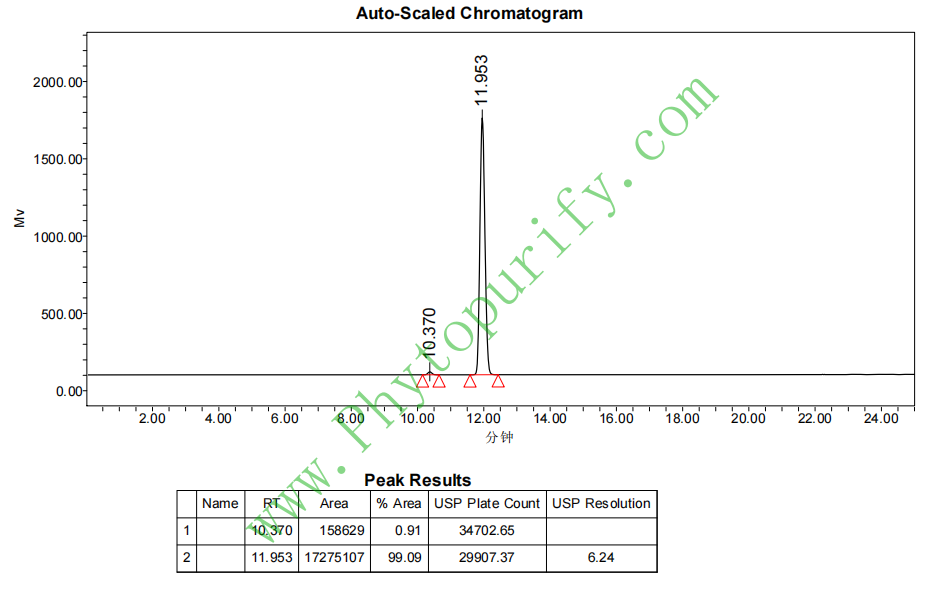
HPLC of Betulin
Storage conditions:Short-term storage at 2~8℃, long-term storage at -20 ~ -80℃
40.4600
6.8595
6.8595
.0002
7.5342
9.3827
High
91.8109
4.7612
No
No
No
No
No
No
0.0
No
No
No
No
Natural products are an important treasure trove for the discovery and development of new drugs, among which pentacyclic triterpenoids have attracted much attention due to their structural diversity and wide range of biological activities. Betulin, also known as birch bark, is a typical lupine type pentacyclic triterpenoid widely present in various plants, especially in the bark of birch trees. Since its discovery, betulin has attracted the attention of researchers in medicinal chemistry, pharmacology, and clinical medicine due to its unique chemical structure and diverse pharmacological activities. Early research mainly focused on its traditional applications such as anti-inflammatory and antibacterial properties. However, with the development of modern molecular biology technology, its deep-seated antiviral, anti-tumor, and metabolic regulating activities and their mechanisms of action have gradually been revealed. Especially its discovery as an inhibitor of sterol regulatory element binding protein (SREBP) provides new ideas for the treatment of metabolic diseases and certain cancers. This article aims to systematically review the chemical properties, plant sources, pharmacological activities, molecular mechanisms of action, pharmacological evaluation, and clinical application prospects of betulinic acid, in order to provide comprehensive academic references for the in-depth development and transformation research of this natural product.
The chemical name of betulin is lupine-20 (29) - ene-3 β, 28 diol, with a molecular formula of C ∝₀ H ₅₀ O ₂ and a CAS number of 473-98-3. Its molecular weight is 442.7280, belonging to the lupine type of pentacyclic triterpenoids. Its core structure consists of five rings (A-E) with one isopropyl side chain. Its characteristic structure includes: a double bond at C-20 (29) position (Δ②⁰ (②⁹)), a β - configured hydroxyl group at C-3 position (3 β - OH), and a hydroxymethyl group at C-28 position (- CH ₂ OH). This diol structure is the basis for many of its biological activities.
In terms of physicochemical properties, betulin appears as white needle shaped crystals or powder. Its lipophilicity is high, and the calculated lipid water partition coefficient (LogP) is 6.8595, indicating its high lipophilicity. Correspondingly, its water solubility is extremely low, about 0.0002 mg/mL, which to some extent limits its bioavailability. Its topological polar surface area (TPSA) is 40.4600 Å ², which is relatively small and consistent with its high lipid solubility characteristics. Based on its physicochemical properties, it is predicted that betulinic acid has a high blood-brain barrier permeability, which provides potential for the treatment of central nervous system related diseases such as certain viral encephalitis and glioma. Preliminary safety assessment shows that it has no significant hERG potassium channel inhibitory activity (indicating a low risk of cardiac toxicity), and the Ames test result is negative (0.0), indicating that it is non mutagenic and has a good safety basis.
Betulin is widely distributed in nature and is one of the main secondary metabolites in the epidermis or bark of various plants. Its most abundant and well-known source is the bark of Betula genus plants, especially Betula pendula and Betula pubescens, which can account for 10% -30% of dry weight. In addition, it has also been found in the bark, leaves, and root bark of the genera Huangqi, Lanren, Salvia, and some Rosaceae plants.
There are various methods for extracting betulin from plant materials, and traditional and modern technologies coexist. Traditional methods mainly include organic solvent extraction, with commonly used solvents including chloroform, methanol, ethanol, ethyl acetate, etc. Among them, ethanol is often used for industrial preliminary extraction due to its low cost and low toxicity. Subsequently, purification was carried out through methods such as silica gel column chromatography and recrystallization. In recent years, green and efficient extraction techniques have been widely used, such as supercritical CO ₂ fluid extraction method. This method has low operating temperature, no solvent residue, and good selectivity, which can effectively extract high-purity betulin. Microwave assisted extraction and ultrasound assisted extraction can also significantly shorten extraction time and improve extraction efficiency. The optimization of extraction processes usually focuses on factors such as solvent type, concentration, solid-liquid ratio, temperature, and time. Further derivatization or semi synthesis of derivatives with higher activity from betulinic acid, such as betulinic acid, is also a research hotspot, providing an important pathway for improving its medicinal properties.
Numerous in vitro and in vivo studies have confirmed that betulinic acid has broad and significant pharmacological activities, covering multiple fields such as antiviral, anti-tumor, anti-inflammatory, analgesic, antibacterial, and hepatoprotective effects.
Antiviral activity This is one of the most highly regarded activities of betulinic acid. Research has shown that it exhibits inhibitory effects on various viruses. Its anti human immunodeficiency virus (HIV) activity is related to the inhibition of HIV-1 protease (HIV1-PR) and integrase (INT), and can inhibit virus entry by blocking the binding of the virus to host cell co receptors CCR5 and CXCR4. Betuline may exert its effect on herpes simplex virus (HSV) by interfering with the function of early viral proteins such as UL42 (DNA polymerase helper subunit), UL54 (ICP27, immediate early protein), and viral thymidine kinase (TK). In addition, research suggests that it may indirectly exert antiviral effects by regulating host factors such as myeloperoxidase (MPO).
Antitumor activity Betulin has cytotoxicity or growth inhibition effect on many human tumor cell lines, including leukemia (such as K562 cells), melanoma, neuroblastoma, liver cancer, lung cancer, breast cancer, etc. Its function is selective and has low toxicity to certain normal cells. In animal models, betulin can inhibit tumor growth and metastasis.
Anti inflammatory and analgesic activity Betulin can significantly inhibit inflammatory responses in acute and chronic inflammation models, such as carrageenan induced paw swelling and cotton ball granuloma in rats. Its analgesic effect has been confirmed in experiments using acetic acid writhing method and hot plate method. These activities are related to their inhibition of the production of pro-inflammatory factors (such as TNF - α, IL-1 β, IL-6) and the synthesis of prostaglandins.
Metabolic regulatory activity As an SREBP inhibitor (with an IC ₅₀ of 14.5 μ M in K562 cells), betulinic acid can interfere with the synthesis pathways of cholesterol and fatty acids in cells. SREBP is a key transcription factor that regulates the expression of genes related to lipid synthesis. Inhibiting its activity helps to reduce blood lipids, and has potential therapeutic value for metabolic diseases such as atherosclerosis and nonalcoholic fatty liver.
Other activities It also includes antibacterial, antioxidant, hepatoprotective, and antimalarial properties. Its antibacterial spectrum covers some Gram positive bacteria and fungi.
The multiple pharmacological activities of betulin stem from its interactions with multiple molecular targets, forming a multi-target action network.
SREBP pathway inhibition This is the core mechanism by which it regulates metabolism. Betuline can inhibit the shear activation of SREBP and its transport to the nucleus, thereby downregulating the expression of downstream target genes such as HMG CoA reductase and fatty acid synthase, ultimately inhibiting de novo synthesis of cholesterol and fatty acids.
Mitochondrial pathway and induction of cell apoptosis In terms of anti-tumor effects, betulin and its derivatives (such as betulinic acid) can induce a decrease in mitochondrial membrane potential, promote the release of cytochrome C, activate the caspase cascade reaction, and thus initiate the endogenous apoptotic pathway. This process may be related to directly acting on the mitochondrial membrane or regulating Bcl-2 family proteins.
Antiviral targets As mentioned earlier, its antiviral effect involves multiple direct and indirect targets. The direct targets include key enzymes encoded by the virus (HIV-1 PR, INT, HSV TK) and co receptors required for entry into host cells (CCR5, CXCR4). Indirect effects may involve regulating host immune responses or oxidative stress responses (such as through MPO).
Regulation of inflammatory signaling pathway The anti-inflammatory effect of betulin is closely related to the inhibition of nuclear factor kappa B (NF - κ B) and mitogen activated protein kinase (MAPK) signaling pathways. It can inhibit the degradation of I κ B α, prevent nuclear translocation of NF - κ B p65 subunit, and thereby reduce the transcriptional expression of inflammatory mediators.
Other potential targets This also includes topoisomerases, microtubules, STAT3 signaling pathways, etc. These targets may play important roles in their anti-tumor and anti proliferative activities.
Although betulin has a wide range of pharmacological activities, its medicinal properties face challenges, mainly due to its extremely low water solubility and resulting low bioavailability.
Pharmacokinetic properties Animal pharmacokinetic studies have shown that oral absorption of betulinic acid is poor and its bioavailability is low. This is mainly attributed to its high lipid solubility and low solubility. After entering the body, it is widely distributed in various tissues. Due to its high lipid solubility and small molecular weight, it can penetrate the blood-brain barrier well, which is an advantage in the treatment of central nervous system diseases. Betuline is mainly metabolized in the liver through the cytochrome P450 enzyme system (such as CYP3A4), undergoing hydroxylation, oxidation, and other reactions, mainly producing metabolites such as betulinic acid. Its prototype and metabolites are mainly excreted through bile and feces, with less excretion by the kidneys.
Optimization strategy for drug properties To enhance its medicinal properties, researchers have adopted various strategies:
1. Structural modification Introducing hydrophilic groups (such as phosphate esters, amino acid esters, glycosides) at positions C-3 and C-28 to synthesize a series of derivatives aimed at improving water solubility and biological activity.
2. Formulation technology The use of advanced drug delivery systems is an effective means of addressing their solubility and bioavailability issues. including:nano-formulation(such as liposomes, solid lipid nanoparticles, polymer nanoparticles)Cyclodextrin inclusion complex、Self microemulsion drug delivery system(SMEDDS) and Phospholipid complex Wait. These technologies can significantly increase the apparent solubility of betulin, promote its intestinal absorption and lymphatic transport, improve oral bioavailability, and potentially achieve targeted delivery.
3. Prodrug strategy Design prodrugs that release active parent drugs only in specific parts or environments of the body to enhance targeting and stability.
The clinical application prospects of betulin are broad, but most of them are still in the preclinical research or early clinical exploration stage.
Betulin, as a natural pentacyclic triterpenoid compound with abundant resources, unique structure, and diverse activities, has shown great medicinal potential in antiviral, anti-tumor, anti-inflammatory, and metabolic regulation fields. Although its inherent low water solubility and bioavailability pose challenges to drug development, these obstacles are gradually being overcome through structural modifications in modern medicinal chemistry and advanced delivery technologies in pharmacy. The research process of betulinic acid, from traditional medicinal plants to modern multi-target drug lead compounds, is a model for the development of innovative natural product drugs. With further analysis of its mechanism of action and continuous breakthroughs in formulation technology, betulinic acid and its optimized products are expected to provide new effective weapons for the treatment of major diseases such as viral infections, malignant tumors, and metabolic syndrome in humans in the future. Its clinical application prospects are promising. Continuous interdisciplinary research will be the key to driving the realization of the maximum medical value of this valuable natural resource.
