


Product name: Euphorbiasteroid
Synonym name: Euphorbia factor L1
Catalogue No.: BP0578
Cas No.: 28649-59-4
Formula: C32H40O8
Mol Weight: 552.664
Botanical Source: Euphorbia lathyris L
Physical Description:
Type of Compound: Diterpenoids
Purity: 95%~99%
Analysis Method: HPLC-DAD or/and HPLC-ELSD
Identification Method: Mass, NMR
Packing: Brown vial or HDPE plastic bottle
Storage: Store in a well closed container, protected from air and light. Put into refrigerate or freeze for long term storage.
Whenever possible, you should prepare and use solutions on the same day. However, if you need to make up stock solutions in advance, we recommend that you store the solution as aliquots in tightly sealed vials at -20℃. Generally, these will be useable for up to two weeks.
The product could be supplied from milligrams to grams
Inquire for bulk scale.
Chengdu Biopurify Phytochemicals Ltd. is a leading company in the research, development, manufacture and marketing of High Quality Phytochemicals and Extracts(especially Active Ingredients from Traditional Chinese Medicine,TCM), Natural Active Pharmaceutical Ingredients worldwide.
The main services:
A. Supply active ingredients and reference standards of TCM, from mgs to kgs scale
B. Custom extraction and purification, target Herb Active Ingredients
C. Custom synthesis and semi-synthesis for Natural Active Ingredients
D. CR(contract research), CM(contract manufacture) and PD(process development) services from lab scale, pilot scale to commercial scale(GMP is also available)
E. TCM compounds library for drug screen,more than 3000 compounds available, many of them are rare and unique.
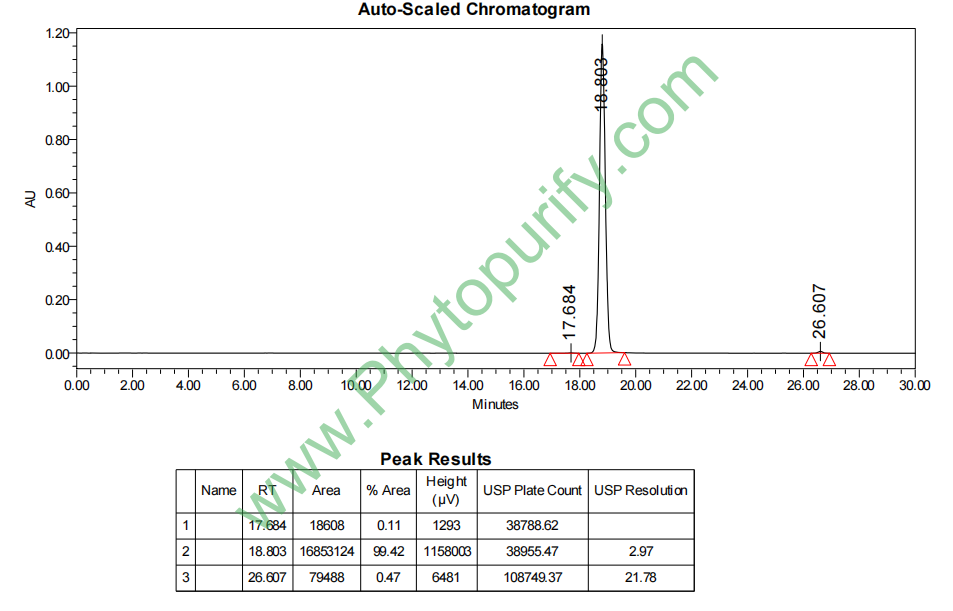
HPLC of Euphorbiasteroid
Storage conditions:Short-term storage at 2~8℃, long-term storage at -20 ~ -80℃
Euphorbia sterol, CAS number 28649-59-4, is a typical natural steroid product derived from the Euphorbia genus in the Euphorbiaceae family. In recent years, with the deepening development of natural product pharmacology, quercetin has received widespread attention due to its unique chemical structure and significant biological activity, especially its potential application value in the treatment of malignant tumors such as liver cancer. As one of the malignant tumors with high incidence rate and mortality worldwide, liver cancer urgently needs to develop new effective and low toxic therapeutic drugs. Qianjingzi sterol exhibits anti-tumor activity by regulating multiple key molecular targets, making it a research hotspot in the field of natural product anti-cancer drug development.
This article aims to systematically review the chemical structure and physicochemical properties, plant sources and extraction methods, pharmacological activity and mechanism of action, drug evaluation and pharmacokinetic characteristics of kilosterols. Combining current research progress, it explores the clinical application prospects and development directions of kilosterols in the treatment of liver cancer, providing theoretical basis and reference for subsequent related research and drug development.
Qianzijin sterol is a typical steroid compound with a molecular formula of C30H48O7 and a molecular weight of 552.6640. Its structure contains a classic steroid tetracyclic skeleton with multiple hydroxyl and ester modifications, giving it high polarity and specific spatial configuration. The LogP value is 4.0174, indicating that it has moderate lipid solubility, which is beneficial for cell membrane penetration and bioavailability. The topological polar surface area (TPSA) is 108.5 Å ², indicating that the molecule has certain polar groups that may affect its binding properties and in vivo distribution with target proteins.
The extremely low water solubility (0.0034 mg/mL) suggests that the solubility of quercetin in aqueous phase is limited, and its bioavailability needs to be improved through appropriate pharmaceutical techniques. This compound has a high blood-brain barrier penetration ability, suggesting that it may affect central nervous system function or have the potential to treat brain diseases. The negative result of hERG channel inhibition experiment indicates a low risk of cardiac toxicity. The Ames mutagenicity test showed a value of 0.0, indicating a low risk of genotoxicity and meeting safety requirements.
Chitose sterols are mainly found in Euphorbia, a plant species in the Euphorbiaceae family, with high concentrations in Euphorbia kansui, Euphorbia lathyris, and other species. The genus Qianjin is widely distributed in northern and temperate regions of China, and its rhizome is commonly used in traditional Chinese medicine to treat symptoms such as edema and constipation.
The process of extracting quercetin mainly includes the following steps:
In recent years, ultrasound assisted extraction and supercritical fluid extraction techniques have also been applied to the extraction of kilosterols, significantly improving extraction efficiency and purity, reducing the use of organic solvents, and in line with the concept of green chemistry.
The pharmacological activity research of quercetin mainly focuses on its anti-tumor, anti-inflammatory, and immunomodulatory properties. Especially demonstrated significant inhibitory effects in in vitro and in vivo experiments on liver cancer.
In vitro cell experiments have shown that quercetin can significantly inhibit the proliferation and migration of liver cancer cell lines such as HepG2 and Huh7, and induce cell apoptosis. Its dosage dependence is obvious, and the IC50 value is generally in the low micromolar range. In the in vivo liver cancer transplant tumor model, the tumor volume and weight were significantly reduced, survival was prolonged, and there were no significant toxic side effects in the group treated with quercetin.
Qianjingzi sterol reduces liver inflammation and improves liver tissue damage by downregulating the expression of inflammatory mediators such as PTGS2 (COX-2). In addition, its regulatory effect on immune cell function helps to enhance the body's anti-tumor immune response.
Some studies have shown that quercetin has antioxidant and anti fibrotic effects, and is expected to be used as an adjuvant therapy for liver fibrosis and other chronic liver diseases.
The anti liver cancer mechanism of quercetin involves multiple signaling pathways and key molecular targets, mainly including:
Overall, quercetin exerts its comprehensive anti liver cancer effect through multi-target and multi pathway synergistic effects, reflecting the advantages of natural multi-target drugs.
The pharmacological parameters of quercetin show that it has certain potential for development:
In terms of pharmacokinetics, existing studies have shown that quercetin is slowly absorbed after oral administration, has a long plasma half-life, and is widely distributed in the body. It is mainly metabolized through the liver, and the excretion pathway still needs further clarification. In the future, it is necessary to strengthen the identification of metabolites in the body and systematic research on pharmacokinetic parameters to guide clinical dose design and safety evaluation.
As a multi-target natural product for anti liver cancer, Qianziziaosterol has significant pharmacological activity and good safety, showing broad clinical application prospects. Future research directions include:
In addition, given its blood-brain barrier penetration ability, the potential application of quercetin in neurological diseases is also worth paying attention to.
As a natural product with a unique steroid structure, Qianzijin sterol exhibits multi-target and multi mechanism anti-tumor activity in the field of liver cancer treatment. Its good safety and pharmacological parameters have laid the foundation for the development of new anti liver cancer drugs. In the future, through improvements in pharmacology, mechanism research, and clinical validation, quercetin is expected to become an important candidate drug for the treatment of liver cancer, promoting further development in natural product pharmacology and tumor therapy. Continuous and in-depth research will provide solid scientific support for its clinical translation, and assist in the innovation and application of natural product drugs.
