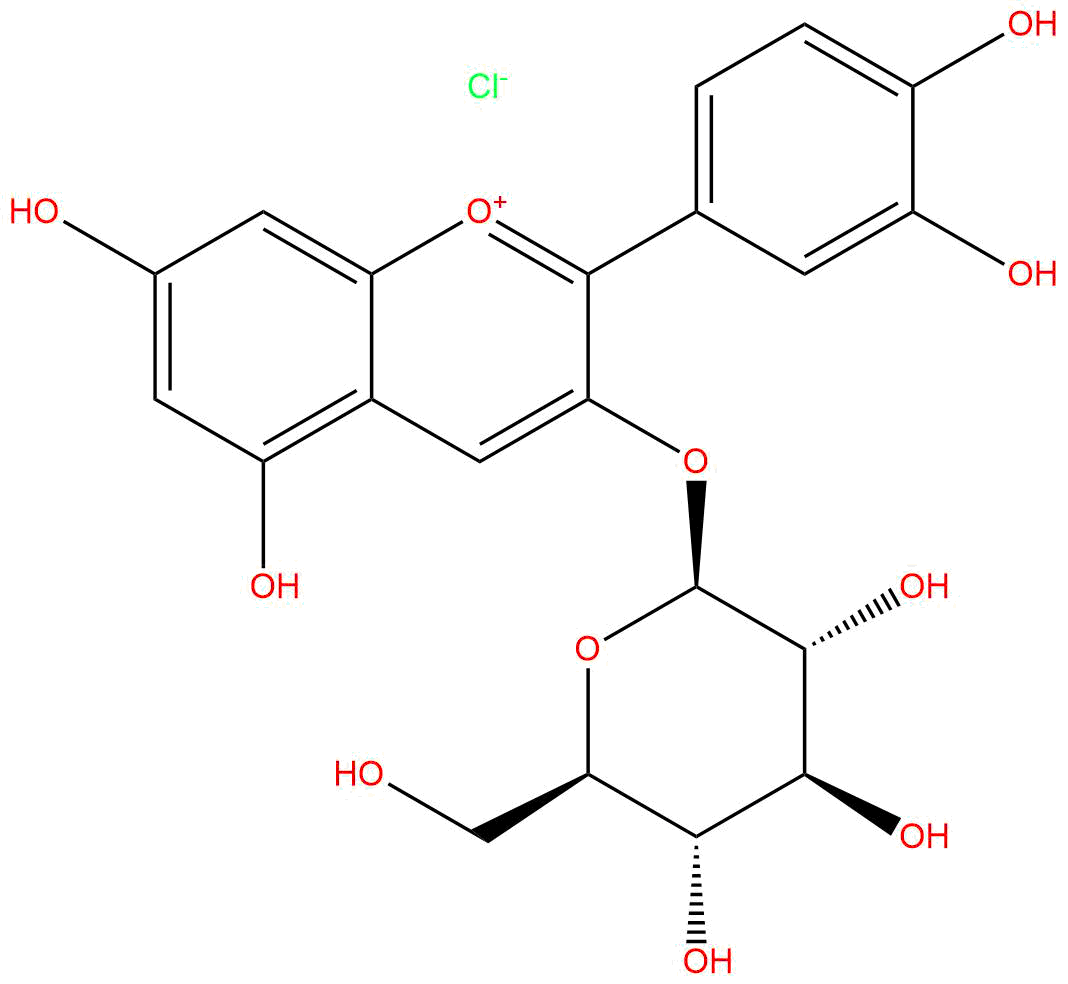


Product name: Cyanidin-3-glucoside chloride
Synonym name: Kuromanin; Chrysanthemin
Catalogue No.: BP0430
Cas No.: 7084-24-4
Formula: C21H21ClO11
Mol Weight: 484.838
Botanical Source: Found in many plants and fruits, e.g. cherries, olives, grapes, Allium spp., Cotoneaster spp. and Ilex spp. First Chrysanthemum indicum.
Physical Description: Yellow powder
Type of Compound: Anthocyanins
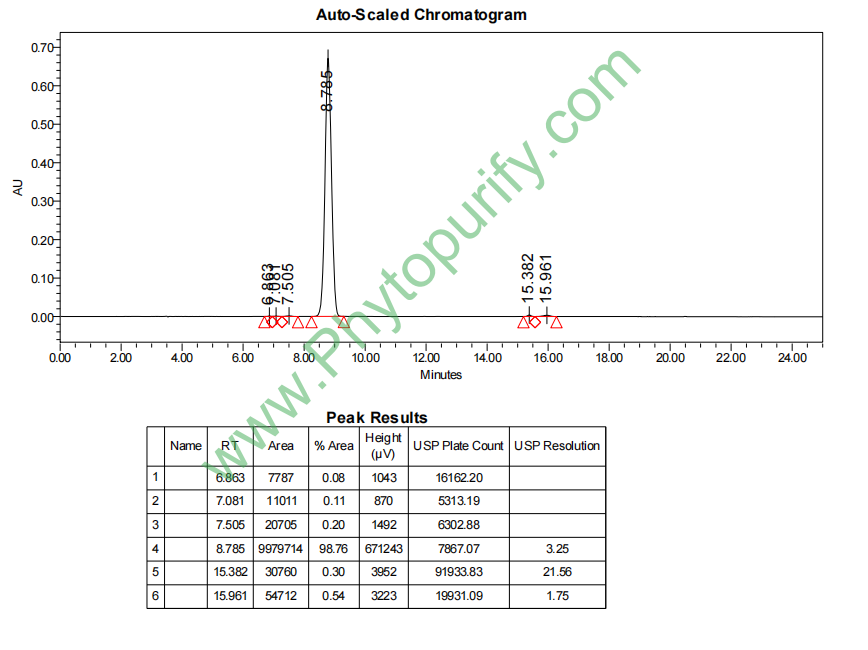
Purity: 95%~99%
Analysis Method: HPLC-DAD or/and HPLC-ELSD
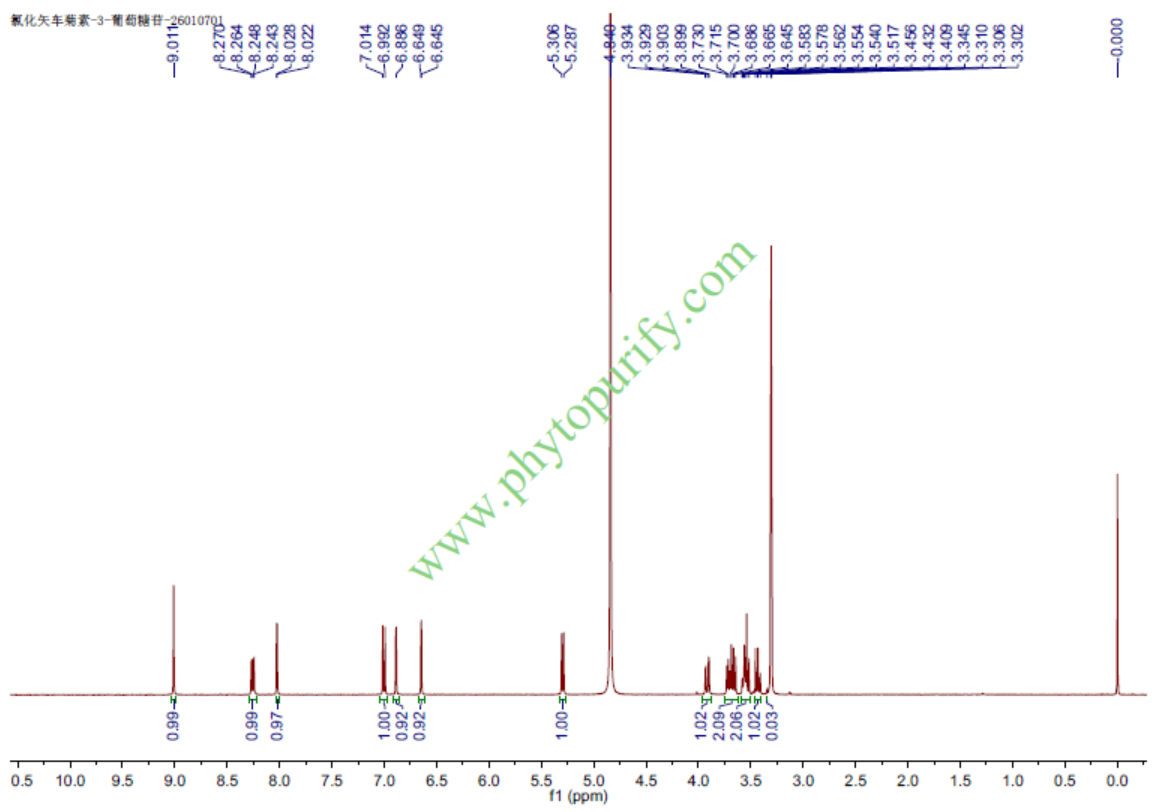
Identification Method: Mass, NMR
Packing: Brown vial or HDPE plastic bottle
Storage: Store in a well closed container, protected from air and light. Put into refrigerate or freeze for long term storage.
Whenever possible, you should prepare and use solutions on the same day. However, if you need to make up stock solutions in advance, we recommend that you store the solution as aliquots in tightly sealed vials at -20℃. Generally, these will be useable for up to two weeks.
The product could be supplied from milligrams to grams, up to kilograms
Inquire for bulk scale.
Descriptions:
Cyanidin-3- O -glucoside, is one of the main component of mulberry anthocyanins,has protective effects from blackberry extract against peroxynitrite-induced endothelial dysfunction and vascular failure.[1]
Cyanidin-3- O -glucoside exhibits strong antioxidant activities including DPPH radical scavenging activities, ABTS radical scavenging activities and ORAC values.[2]
Cyanidin-3-O-glucoside chloride decreases mutant p21 expression, and increases the ratio of Bax/Bcl-2 and the activation of caspase-3 to induce apoptosis.[3]
References:
[1] Serraino I, Dugo L, Dugo P, et al. Life Sci, 2003, 73(9):1097-114.
[2] Chen M, Meng H, Zhao Y, et al. Bmc Complem Altern M, 2015, 15(1):1-8.
[3] Chen M, Zhao Z, Yu S. Int J Mol Sci, 2016, 17(7).
[4] Liu Z Y, Liu X Q, Bai S F, et al. Food Sci, 2011, 32(18):256-9.
HPLC of Cyanidin-3-glucoside chloride
HNMR of Cyanidin-3-glucoside chloride
Storage conditions:Short-term storage at 2~8℃, long-term storage at -20 ~ -80℃
Cyanidin-3-glucoside chloride (C3G-Cl) is a natural anthocyanin compound widely found in various plants and is an important member of the flavonoid natural product family. As a water-soluble natural pigment, C3G Cl not only gives plants a bright red purple color, but also attracts attention due to its significant biological activity. In recent years, with the in-depth study of the pharmacological effects of natural products, C3G Cl has shown broad application potential in fields such as antioxidant damage, anti-inflammatory, anti-tumor, and neuroprotection. It plays a role in clearing free radicals and reducing oxidative stress by regulating various antioxidant enzymes and transcription factors within cells, making it a hot topic in the research of natural antioxidants.
This article aims to systematically review the chemical structure and physicochemical properties, plant sources and extraction methods, pharmacological activity and mechanism of action, pharmacological evaluation and pharmacokinetic characteristics of cyanidin-3-glucoside chloride. Combining the latest research progress, it explores its clinical application prospects and development directions, providing reference and inspiration for researchers in related fields.
The chemical structure of chlorinated cyanidin-3-glucoside is based on the core skeleton of cyanidin, with a molecular formula of C21H21ClO11 and a molecular weight of 484.84. Its structural feature is that the benzene rings A and B are connected by a three carbon bridge to form a flavonoid skeleton, and the hydroxyl group at position 3 is modified by a glucose group to form a 3-glucoside structure. Chloride ions combine with cationic parts in the form of ionic bonds, endowing them with good water solubility.
In terms of physical and chemical properties, C3G Cl exhibits low lipid solubility (LogP of about -2.5), indicating its strong hydrophilicity and easy solubility in water (solubility of about 100 mg/mL), which is beneficial for its absorption and distribution in vivo. Its extremely high polar surface area (TPSA of approximately 203.24 Å ²) and number of hydrogen bond receptors (11) suggest that it has certain limitations in cell membrane penetration, especially in terms of low blood-brain barrier penetration ability. In addition, the stability of C3G Cl is greatly affected by pH, and it is relatively stable in acidic environments. However, it is prone to structural transformation under alkaline conditions, which affects its biological activity.
Chlorinated cyanidin-3-glucoside is widely present in various red or purple fruits and vegetables, such as blueberries, blackberries, purple cabbage, red grapes, and cornflowers. Its content is significantly affected by factors such as plant variety, growth environment, maturity, and harvesting time.
The extraction methods mainly include solvent extraction, ultrasound assisted extraction, microwave-assisted extraction, and enzymatic extraction. Traditional solvent extraction often uses a mixed solvent of methanol, ethanol, or ethyl acetate with water, supplemented by acidic conditions (such as adding a small amount of hydrochloric acid) to stabilize the structure of anthocyanins. Ultrasound assisted extraction can improve extraction efficiency, shorten time, and reduce solvent usage. In recent years, the application of green extraction technologies such as supercritical CO2 extraction and natural deep eutectic solvents has gradually increased, aiming to improve the purity of extraction and the stability of bioactive components.
After extraction, high performance liquid chromatography (HPLC) combined with mass spectrometry (MS) technology is commonly used for qualitative and quantitative analysis to ensure that the purity and content of cyanidin-3-glucoside chloride meet the needs of pharmacological research and application.
C3G Cl, as a natural anthocyanin, has significant antioxidant capacity. Numerous in vitro and in vivo studies have shown that it can effectively eliminate free radicals (such as hydroxyl radicals, superoxide anions, etc.) and alleviate cell damage caused by oxidative stress. Its antioxidant effect not only relies on direct free radical scavenging, but also works by regulating the intracellular antioxidant enzyme system.
Oxidative stress is closely related to inflammatory response, and C3G Cl reduces inflammatory response by inhibiting the expression of pro-inflammatory factors such as TNF - α, IL-6, IL-1 β. It can inhibit the activation of the nuclear factor kappa B (NF - κ B) signaling pathway, reduce the release of inflammatory mediators, and exert multi-target anti-inflammatory effects.
Due to its antioxidant and anti-inflammatory properties, C3G Cl exhibits neuroprotective effects in neurodegenerative disease models. Research has shown that C3G Cl can alleviate oxidative stress-induced neuronal apoptosis, improve cognitive function, and has potential therapeutic value for neurological diseases such as Alzheimer's disease and Parkinson's disease.
C3G Cl shows cardiovascular protection through antioxidation and improving vascular endothelial function, reducing blood lipids and anti atherosclerosis. It can regulate the synthesis of vasodilator nitric oxide (NO), inhibit platelet aggregation, and reduce the risk of cardiovascular events.
Some studies have shown that C3G Cl exerts anti-tumor activity by inducing tumor cell apoptosis, inhibiting tumor cell proliferation and migration. Its mechanism involves regulating cell cycle related proteins, activating apoptotic signaling pathways, and inhibiting inflammatory responses in the tumor microenvironment.
The main mechanism of action of C3G Cl is focused on regulating the antioxidant signaling pathway, especially by activating the nuclear factor erythroid 2-related factor 2 (NFE2L2, abbreviated as NRF2) signaling pathway, enhancing the cell's antioxidant defense ability. NRF2, as a key transcription factor in cells, regulates the expression of various antioxidant enzyme genes, including superoxide dismutase 1 (SOD1), superoxide dismutase 2 (SOD2), catalase (CAT), glutathione peroxidase 1 (GPX1), and heme oxygenase 1 (HMOX1).
C3G Cl promotes the translocation of NRF2 from the cytoplasm to the nucleus, enhances its binding with antioxidant response elements (ARE), initiates the transcription of downstream antioxidant enzyme genes, significantly enhances the cell's ability to clear reactive oxygen species (ROS), and reduces oxidative stress-induced cell damage. In addition, C3G Cl can also inhibit pro-inflammatory signaling pathways such as NF - κ B, reduce the production of inflammatory factors, and synergistically exert cell protective effects.
At the molecular level, the multi hydroxyl structure of C3G Cl endows it with strong free radical capture ability, while its interaction with the active center of antioxidant enzymes enhances enzyme activity, forming a multi-level, multi-target protective network.
The molecular weight of C3G Cl is 484.84, which belongs to the category of medium molecular weight compounds. Its LogP value is -2.5, indicating its high hydrophilicity and excellent water solubility (about 100 mg/mL), which is beneficial for the preparation and in vivo absorption of oral formulations. However, the high polarity and number of hydrogen bond receptors (11) limit its cell membrane permeability, especially the low blood-brain barrier permeability, suggesting that its direct action in the central nervous system may be limited.
Toxicological evaluation shows that the LD50 of C3G Cl is about 2000 mg/kg, with low toxicity and no significant hepatotoxicity, cardiotoxicity, or hERG channel inhibition. The Ames mutagenicity test is negative, indicating good safety and potential for drug development.
At present, there is limited research on the pharmacokinetics of C3G Cl. Previous studies have shown that C3G Cl has poor stability in the gastrointestinal tract after oral administration, and is partially metabolized and converted by gastric acid and intestinal microbiota, resulting in low bioavailability. Its main metabolic pathways include gut microbiota mediated deglycosylation and liver phase I and phase II metabolism, producing various metabolites.
The short half-life of C3G Cl and its metabolites in plasma suggests the need for dosage form improvement or optimization of administration routes to increase in vivo exposure. Its excretion is mainly completed through urine and bile.
Based on its excellent multiple pharmacological activities such as antioxidant, anti-inflammatory, and neuroprotective properties, cyanidin-3-glucoside chloride has broad application prospects in the prevention and treatment of various diseases related to oxidative stress. Especially in neurodegenerative diseases, cardiovascular diseases, metabolic syndrome, and certain inflammatory diseases, the potential value is becoming increasingly prominent.
Future clinical development should focus on the following aspects:
Formulation optimization Given its strong water solubility but limited bioavailability, it is necessary to develop new drug delivery systems such as nanocarriers, liposomes, and inclusion complexes to enhance in vivo stability and targeting.
Combination therapy strategy Combining other antioxidants or anti-inflammatory drugs to exert synergistic effects and improve treatment efficacy.
Clinical trial design Conduct systematic pharmacokinetic, pharmacodynamic, and safety evaluations, clarify effective doses and treatment windows, and promote clinical translation.
Disease targeting research Thoroughly analyze its mechanism of action in specific disease models, especially in neurological and cardiovascular diseases, and explore potential therapeutic targets.
Metabolite research Given that metabolites may have unique biological activities, it is necessary to strengthen research on their metabolic pathways and biological functions.
Chlorinated cyanidin-3-glucoside, as a natural anthocyanin with significant antioxidant and multiple pharmacological activities, has demonstrated good safety and potential for medicinal use. It effectively alleviates oxidative stress and inflammatory damage by regulating NRF2 and related antioxidant enzyme systems, and has broad application value in disease prevention and treatment. Although its bioavailability and pharmacokinetic properties still need to be optimized, with the continuous deepening of extraction technology, formulation development, and molecular mechanism research, C3G Cl is expected to become an important candidate molecule in the development of natural product drugs. Future research should strengthen its clinical translation and application research, and promote its widespread application in antioxidant related diseases.
