


Product name: Arctigenin
Synonym name: (-)-Arctigenin
Catalogue No.: BP0186
Cas No.: 7770-78-7
Formula: C21H24O6
Mol Weight: 372.417
Botanical Source: Arctium lappa L.(Burdock)
Physical Description: Powder
Type of Compound: Lignans
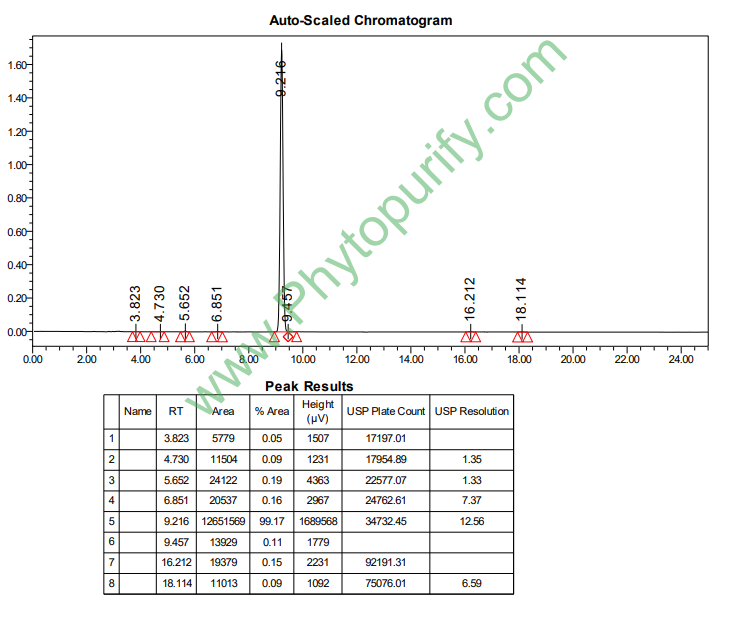
Purity: 95%~99%
Analysis Method: HPLC-DAD or/and HPLC-ELSD
Identification Method: Mass, NMR
Packing: Brown vial or HDPE plastic bottle
Storage: Store in a well closed container, protected from air and light. Put into refrigerate or freeze for long term storage.
Whenever possible, you should prepare and use solutions on the same day. However, if you need to make up stock solutions in advance, we recommend that you store the solution as aliquots in tightly sealed vials at -20℃. Generally, these will be useable for up to two weeks.
The product could be supplied from milligrams to grams, up to kilograms
Inquire for bulk scale.
Descriptions:
Arctigenin, naturally occurring in Bardanae fructus, Saussurea medusa, Arctium lappa L., Torreya nucifera and Ipomea cairica, is a phenylpropanoid dibenzylbutyrolactone lignan with antioxidant and anti-inflammatory activities, it can potently inhibit the activity of MKK1 in vitro with the IC(50) value of 1 nM, and inhibit activation of MAP kinases including ERK1/2, p38 kinase and JNK through the inhibition of MKK activities, leading to AP-1 inactivation, which might, at least in part, contribute to the inhibition of TNF-α production, inhibits expression via suppressing JAK-pathway in macrophages.[1,2]
Arctigenin blocks the activation of Akt induced by glucose starvation, which is a key process in the tolerance exhibits by cancer cells to glucose starvation, suggests arctigenin could be an antitumor agent having the ability to eliminate the tolerance of cancer cells to nutrient starvation.[3]
Arctigenin has a glucose-lowering effect, is a potent indirect activator of AMPK via inhibition of respiratory complex I, with beneficial effects on metabolic disorders in ob/ ob mice, suggests the potential value of arctigenin as a possible treatment of type 2 diabetes.[4]
References:
[1] Min K C, Jang Y P, Kim Y C, et al. Int Immunopharmacol, 2004, 4(10-11):1419-29.
[2] Kou X, Qi S, Dai W, et al. Int Immunopharmacol, 2011, 11(8):1095-102.
[3] Awale S, Lu J, Kalauni S K, et al. Cancer Res, 2006, 66(3):1751-7.
[4] Huang S L, Yu R T, Gong J, et al. Diabetologia, 2012, 55(5):1469-81.
[5] Rui-Tao Y U, Luo Z M, Zhang X W, et al. Chinese Journal of Pharmaceutical Analysis, 2010(02):294-6.
HPLC of Arctigenin
Storage conditions:Short-term storage at 2~8℃, long-term storage at -20 ~ -80℃
74.2200
3.1857
3.1842
.0494
6.6063
10.1957
High
91.8242
3.0476
No
No
No
No
No
No
0.0
No
No
No
No
Natural products, as an important source of drug discovery, play an irreplaceable role in the history of human disease prevention and treatment. Phenolic compounds, as a class of secondary metabolites widely present in the plant kingdom, have attracted much attention due to their diverse chemical structures and significant biological activities. Arctigenin, chemical name (3R, 4R) -4- [(3,4-dimethoxyphenyl) methyl] -3- [(3,4-dimethoxyphenyl) methyl] dihydrofuran-2 (3H) - one, CAS number 7770-78-7, is one of the representative lignans. It mainly comes from the seeds of traditional Chinese medicine Arctium lappa L. and is the main metabolite of its active ingredient Arctiin in the body. In recent years, with the deepening of modern pharmacological research, Arctigenin has demonstrated a variety of biological activities, including anti-tumor, anti-inflammatory, antioxidant, neuroprotective, antiviral and energy metabolism regulation. Its potential therapeutic value covers many major disease fields, such as tumor, metabolic diseases (such as type 2 diabetes), neurodegenerative diseases, viral infection and fatigue syndrome. Especially as an indirect activator of adenosine monophosphate activated protein kinase (AMPK), its role in improving metabolic disorders provides new ideas for the treatment of metabolic diseases. This article aims to systematically review the chemical properties, plant sources, pharmacological activities, mechanisms of action, pharmacological evaluation, and clinical application prospects of arctiin, in order to provide comprehensive scientific references for the in-depth research and development of this natural product.
Arctiin belongs to the aromatic naphthalene type lignans. Its molecular formula is C21H24O6 and its molecular weight is 372.4170. Its core structure consists of two C6-C3 units (i.e. two 3,4-dimethoxyphenylpropane units) connected by β - β 'and forming a lactone ring (dihydrofuran-2 (3H) - one structure). This rigid skeletal structure is an important foundation for its biological activity.
In terms of physicochemical properties, arctigenin exhibits typical lipophilic characteristics. The calculated lipid water partition coefficient (LogP) is 3.1857, indicating that it has good lipid solubility, which is beneficial for its penetration into cell membranes. Its topological polar surface area (TPSA) is 74.2200 Å ², which is relatively low, further confirming its good membrane permeability. The water solubility data shows that its solubility is relatively low, about 0.0494 mg/mL, which to some extent limits its bioavailability in aqueous media, but can be improved through formulation methods such as making nano formulations, cyclodextrin inclusion complexes, or prodrugs. It is worth noting that its blood-brain barrier (BBB) penetration is predicted to be "high", providing key pharmacokinetic advantages for its central nervous system protective effects, such as anti Alzheimer's disease. In addition, preliminary pharmacological risk assessment shows that it has no significant inhibitory effect on hERG potassium channels (hERG inhibition: no), indicating a low risk of cardiac toxicity; The Ames test result is 0.0, indicating that there is no mutagenicity in this testing system, providing preliminary support for its safety.
The main source of arctiin is the dried and mature fruit of the burdock (Arctium lappa L.) plant in the Asteraceae family, which is the traditional Chinese medicine arctiin. In addition, a small amount has also been found in plants such as Cang'er and Yunmu Xiang. In plants, arctiin is often present in the form of its glucoside, arctiin. After oral administration, arctiin is hydrolyzed by β - glucosidase in the gut microbiota or tissues, removing one molecule of glucose and generating a more biologically active glycoside form.
Solvent extraction method is commonly used to extract arctigenin and its glycosides from plant materials. Traditional methods include heating reflux or ultrasound assisted extraction using methanol, ethanol, or aqueous ethanol. In order to obtain higher purity of arctigenin, further hydrolysis steps are usually required: first, extract the crude extract of arctigenin, and then convert it into arctigenin through acid hydrolysis (such as using hydrochloric acid or sulfuric acid), enzymatic hydrolysis (such as β - glucosidase), or microbial transformation. Subsequently, by combining various modern separation and purification techniques such as macroporous adsorption resin chromatography, silica gel column chromatography, and preparative high-performance liquid chromatography (HPLC), high-purity arctiin monomers can be obtained. In recent years, some green extraction techniques such as supercritical fluid extraction and microwave-assisted extraction have also been explored to improve extraction efficiency and selectivity. Optimizing the extraction and transformation process is the key to achieving large-scale preparation of arctigenin.
Numerous in vitro and in vivo studies have confirmed that arctigenin has broad and significant pharmacological activities.
Antitumor activity: Arctigenin has the effect of inhibiting proliferation, inducing apoptosis and inhibiting metastasis in a variety of tumor cell lines, including breast cancer, lung cancer, liver cancer, colon cancer, prostate cancer and leukemia. Its function has multi-target characteristics, involving regulating the cell cycle, activating apoptotic signaling pathways, inhibiting angiogenesis and metastasis related protein expression, etc.
Anti inflammatory and antioxidant activity Arctiin is an effective antioxidant that can eliminate free radicals and enhance the activity of intracellular antioxidant enzymes such as superoxide dismutase (SOD) and glutathione peroxidase (GSH Px). Its anti-inflammatory effect is mainly achieved by inhibiting key inflammatory signaling pathways such as nuclear factor kappa B (NF - κ B) and mitogen activated protein kinases (MAPKs), and downregulating the production of inflammatory mediators such as tumor necrosis factor alpha (TNF - α), interleukin-6 (IL-6), nitric oxide (NO), and prostaglandin E2 (PGE2). This lays the foundation for its application in the treatment of inflammatory diseases such as arthritis and pneumonia, as well as inflammation related fatigue.
Neuroprotective effect Due to its excellent blood-brain barrier penetration ability and anti-inflammatory and antioxidant properties, arctigenin has shown protective effects in various neurodegenerative diseases and injury models. Research has reported that it has improved neurotoxicity induced by β - amyloid protein (A β), Parkinson's disease models, and cerebral ischemia-reperfusion injury, possibly through mechanisms such as inhibiting excessive activation of microglia, reducing oxidative stress, and mitochondrial dysfunction.
Antiviral activity Arctiin has inhibitory effects on influenza A virus, and its mechanism may be related to interfering with the virus replication cycle and regulating the host immune response.
Anti fatigue and enhanced endurance Research has shown that arctigenin can significantly prolong the exhaustion swimming time of rats and effectively alleviate exercise-induced fatigue. The mechanism is not to directly stimulate the central nervous system, but to enhance the antioxidant capacity of skeletal muscle tissue, reduce the damage of excessive reactive oxygen species (ROS) produced during exercise to muscle cells, protect mitochondrial function, and thus enhance the endurance performance of the body. This highlights its potential as a natural antioxidant for treating fatigue and related diseases.
Improve metabolic disorders This is the pharmacological activity of arctigenin that has received much attention in recent years. In the high-fat diet induced obesity or diabetes mouse model, arctigenin can significantly improve hyperglycemia, insulin resistance, dyslipidemia and liver steatosis. The core mechanism lies in the ability to indirectly and effectively activate the AMPK signaling pathway.
The multiple pharmacological effects of arctiin stem from its regulation of multiple molecular targets and signaling pathways.
The core role of AMPK signaling pathway The core mechanism by which arctigenin improves metabolic disorders is the activation of AMPK. It is worth noting that it is not a direct activator of AMPK. Research has shown that arctigenin can mildly inhibit the activity of mitochondrial respiratory chain complex I (NADH dehydrogenase), leading to an increase in intracellular AMP/ATP ratio and conformational activation of AMPK. As the main switch of cellular energy metabolism, AMPK activation can bring a series of beneficial effects: promoting glucose uptake and utilization in skeletal muscle and liver (by upregulating GLUT4), inhibiting hepatic gluconeogenesis, promoting fatty acid oxidation, inhibiting fat synthesis, thereby comprehensively improving insulin sensitivity and energy metabolism homeostasis. This provides a solid molecular basis for its treatment of type 2 diabetes and non-alcoholic fatty liver disease.
Target network associated with hyperglycemia In addition to AMPK, the action of arctigenin also involves a target network closely related to hyperglycemia. Research suggests that it may affect:
Anti tumor related mechanisms The anti-tumor effects of arctiin involve inducing cell cycle arrest (such as G1 or G2/M phase), activating endogenous (mitochondrial) and exogenous (death receptor) apoptosis pathways, inhibiting the expression of NF - κ B and its downstream anti apoptotic and pro metastatic genes, and inhibiting the vascular endothelial growth factor (VEGF) signaling pathway.
Anti inflammatory and antioxidant mechanisms Mainly by inhibiting the IKK/I κ B/NF - κ B pathway and MAPK (such as p38, JNK, ERK) pathway, the transcription and release of pro-inflammatory mediators are reduced. Its antioxidant effect is closely related to activating the Nrf2/ARE pathway, upregulating the expression of phase II detoxifying enzymes and antioxidant proteins.
Although arctigenin has a wide range of biological activities, its pharmacological properties still need to be comprehensively evaluated.
Absorption, Distribution, Metabolism, and Excretion (ADME):
Challenges and Strategies in Drug Development:
The multi-target and multi pathway action characteristics of arctiin make it have broad application prospects in the prevention and treatment of various complex diseases.
Metabolic diseases As an indirect activator of AMPK, arctigenin has great potential in the treatment of type 2 diabetes, obesity, non-alcoholic fatty liver disease and metabolic syndrome. Its mechanism of action is different from classical hypoglycemic drugs, which may provide a new treatment option, especially for patients with insulin resistance. It can be considered to be developed as a dietary supplement or prescription drug for oral anti diabetes/weight loss.
neoadjuvant therapy Its anti-tumor activity and sensitization to chemotherapy drugs make it a promising adjuvant drug for comprehensive cancer treatment, used to enhance efficacy, reduce side effects of radiotherapy and chemotherapy, or prevent recurrence. Further clarification is needed on its anti-tumor spectrum and optimal combination therapy regimen.
Neurodegenerative diseases Good brain entry ability and neuroprotective effect make it valuable in the prevention and early intervention of diseases such as Alzheimer's disease and Parkinson's disease. Can be explored as a functional food ingredient or drug for cognitive function maintenance.
Anti fatigue and exercise nutrition Based on its ability to enhance endurance through antioxidant mechanisms, sports nutritional supplements can be developed to alleviate chronic fatigue syndrome, promote post exercise recovery, or improve athlete performance.
Anti inflammatory and antiviral In viral infections such as influenza or chronic inflammatory diseases, it can be used as an adjuvant treatment.
Future research directions should focus on:
* In depth mechanism exploration Using omics techniques and chemical biology methods, comprehensively map its target genes and elucidate the networked mechanism of its pleiotropy.
* Structural optimization and formulation development Reasonably modify the structure to improve pharmacokinetic properties in response to its drug weakness; Develop new drug delivery systems to improve bioavailability and targeting.
* Clinical translational research Promote rigorously designed clinical trials, first verifying their human effectiveness and safety in areas such as metabolic diseases, and obtaining key clinical evidence.
* Source quality control Optimize the sustainable plant sources, biosynthesis or chemical synthesis pathways of arctiin to ensure the supply of raw materials.
As a natural lignan compound derived from traditional Chinese medicine, arctigenin has become a hot topic in modern natural product pharmacology research due to its unique chemical structure and diverse pharmacological activities. From anti-tumor and anti-inflammatory effects to emerging metabolic regulation and neuroprotective effects, its versatile nature reflects the advantages of natural products in multi-target intervention of complex diseases. Especially its mechanism of indirectly activating AMPK by inhibiting mitochondrial complex I to improve metabolic disorders has opened up a novel perspective for the treatment of metabolic diseases. Despite facing challenges such as water solubility and metabolic stability in drug development, these obstacles are expected to be overcome through the empowerment of modern pharmaceutical chemistry and formulation technologies. With the further analysis of its molecular mechanism and the advancement of high-quality clinical research, arctigenin is expected to move from the laboratory to clinical practice, contributing a candidate drug or functional product with Chinese original characteristics to human health, especially in the fields of metabolic diseases and neurodegenerative diseases, fully demonstrating the modern scientific value of traditional Chinese medicine treasure trove.
