


Product name: Amentoflavone
Synonym name:
Catalogue No.: BP0161
Cas No.: 1617-53-4
Formula: C30H18O10
Mol Weight: 538.464
Botanical Source: Metasequoia glyptostroboides, Viburnum prunifolium, Podocarpus gracilior, Garcinia livingstonei, Selaginella willdenowii, Rhus succedanea, Garcinia multiflora, Ginkgo biloba, Cupressocyparis leylandii, Cryptomeria japonica, Amentotaxus formos
Physical Description: Yellow powder
Type of Compound: Flavonoids
Purity: 95%~99%
Analysis Method: HPLC-DAD or/and HPLC-ELSD
Identification Method: Mass, NMR
Packing: Brown vial or HDPE plastic bottle
Storage: Store in a well closed container, protected from air and light. Put into refrigerate or freeze for long term storage.
Whenever possible, you should prepare and use solutions on the same day. However, if you need to make up stock solutions in advance, we recommend that you store the solution as aliquots in tightly sealed vials at -20℃. Generally, these will be useable for up to two weeks.
The product could be supplied from milligrams to grams, up to kilograms
Inquire for bulk scale.
Descriptions:
Amentoflavone, a biflavonoid with antiinflammatory activity, inhibits NF-κB/DNA binding activity potently along with inhibition of degradation of IκBα and NF-κB translocation into nucleus in TNFα-activated A549 cells.[1]
Amentoflavone has the inhibition of LPS-induced NO formation, is due to its inhibition of NF-kappaB by blocking degradation, which may be the mechanistic basis of the anti-inflammatory effects of amentoflavone.[2]
Amentoflavone has been shown to inhibit tumor metastasis in vivo, amentoflavone treatment reduces experimental tumor metastasis and suggest that such an action is associated with attenuation of tumor invasion, proliferation and angiogenesis.[3]
Amentoflavone has been shown to inhibit tumor metastasis in vivo, inhibits experimental tumor metastasis through a regulatory mechanism involving MMP-2, MMP-9, prolyl hydroxylase, lysyl oxidase, VEGF, ERK-1, ERK-2, STAT-1, NM23 and cytokines in lung tissues of C57BL/6 mice.[4]
Amentoflavone and its derivatives as novel natural inhibitors of human Cathepsin B(CatB), CatB is a member of the papain superfamily of cysteine proteases and has been implicated in the pathology of numerous diseases, including arthritis and cancer. [5]
Amentoflavone induces breast cancer apoptosis through blockade of fatty acid synthesis.[6]
Amentoflavone exhibits potent antifungal activity against several pathogenic fungal strains but has a very low hemolytic effect on human erythrocytes, it induces the accumulation of intracellular trehalose on C. albicans as a stress response to the drug, and disrupts the dimorphic transition that forms pseudo-hyphae during pathogenesis, it has great potential to be a lead compound for the development of antifungal agents.[7]
References:
[1] Banerjee T, Valacchi G, Ziboh V A, et al. Mol Cell Biochem, 2002, 238(1-2):105-10.
[2] Woo E R, Lee J Y, Cho I J, et al. Pharmacol Res, 2005, 51(6):539-46.
[3] Guruvayoorappan C, Kuttan G. Biochemistry, 2008, 73(2):209-18.
[4] Guruvayoorappan C, Kuttan G. Immunopharm Immunot, 2008, 30(4):711-27.
[5] Pan X, Tan N, Zeng G, et al. Bioorg Med Chem, 2005, 13(20):5819-25.
[6] Lee J, Lee M, Oh W, et al. Biol Pharm Bull, 2009, 32(8):1427-32.
[7] Jung H J, Sung W S, Yeo S H, et al. Arch Pharm Res, 2006, 29(9):746-51.
[8] Sun D M, Luo W H, Zhi-Yong L I. Journal of Chinese medicinal materials, 2006, 29(29):26-8.
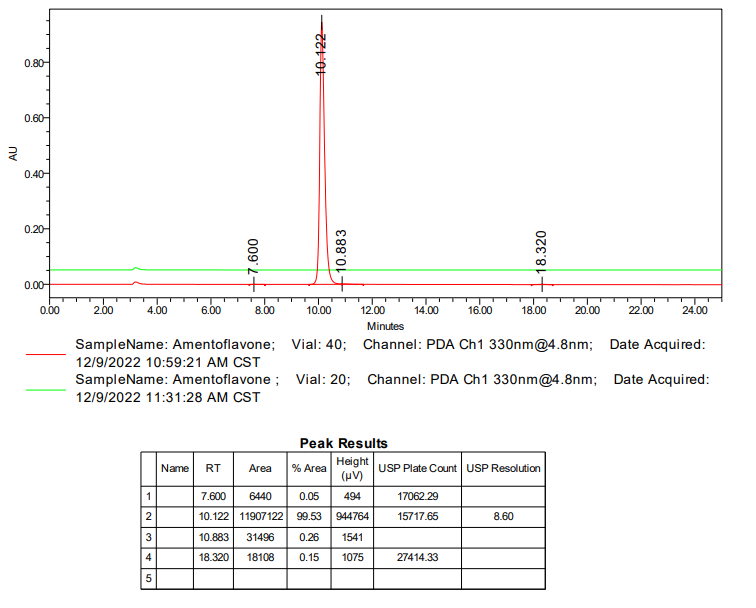
HPLC of Amentoflavone
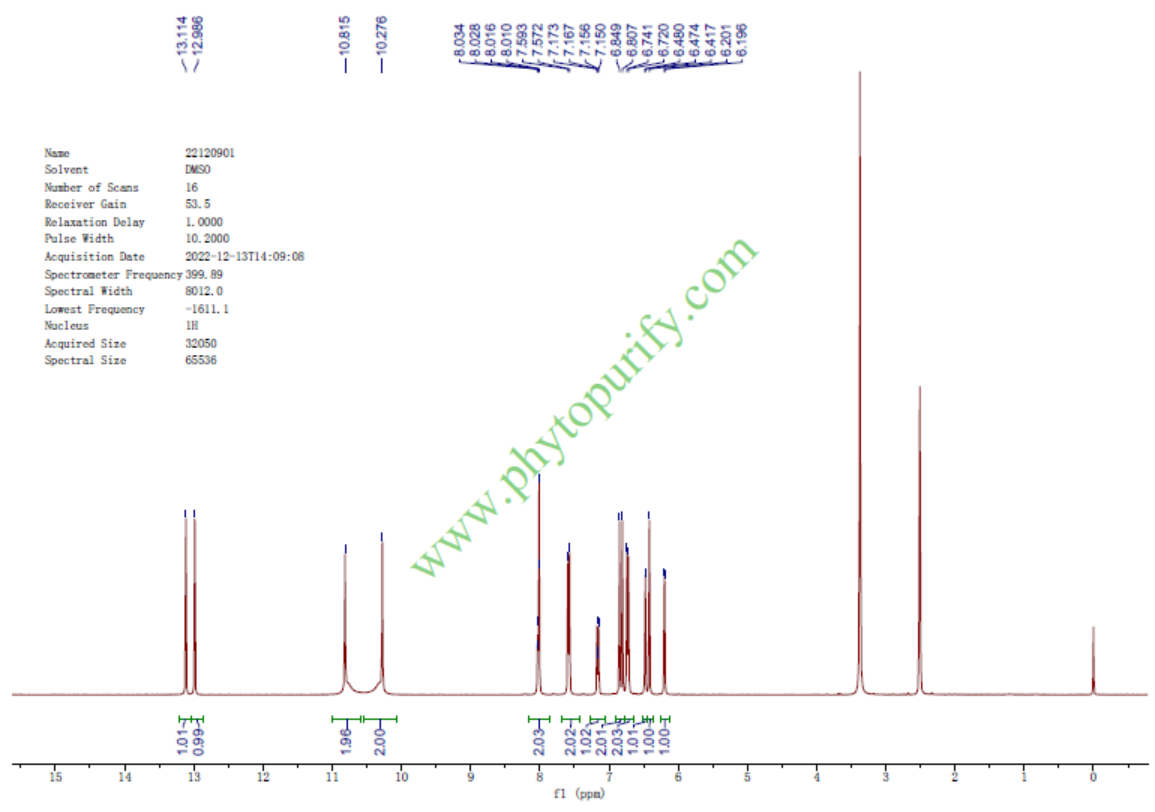
HNMR of Amentoflavone
Storage conditions:Short-term storage at 2~8℃, long-term storage at -20 ~ -80℃
181.8000
3.4288
2.4361
.0037
1.3774
7.2362
Low
92.7705
3.0376
Yes
No
No
No
Yes
No
0.6
Yes
Yes
Yes
No
Natural products, as an important source of drug discovery and development, play an irreplaceable role in the history of human disease prevention and treatment. Among them, flavonoids have attracted much attention due to their wide range of biological activities and low toxicity. Amentoflavone, as a unique flavonoid compound, is composed of two apigenin units connected by a C-3 '- C-8' 'diaryl ether bond. Since its discovery, its diverse and significant pharmacological activities have gradually become a hot topic in pharmacological research. This compound is widely present in Ginkgo biloba(Ginkgo biloba L.)、 Guanye Lianqiao(Hypericum perforatum L. ) and a variety of cypress and Arhat pine plants, which is one of the important material bases for these traditional medicinal plants to play their roles.
Modern pharmacological studies reveal that arachidonic biflavones exhibit remarkable characteristics of multi target and multi pathway actions, and their activities cover many fields such as anti-inflammatory, antioxidant, antiviral, anti-tumor, neuroprotective, anti diabetes and cardiovascular protection. More importantly, it has been identified as a new natural inhibitor of human cathepsin B (CatB) and plays a central role in regulating Wnt/β - catenin, NF - κ B, MAPK and other key signal pathways, which provides a solid scientific basis for its intervention in complex diseases such as tumors, neurodegenerative diseases, fibrosis diseases and infectious diseases. Despite challenges such as poor water solubility and low blood-brain barrier permeability, its high efficiency and low toxicity make it a highly promising lead compound for drug development. This article aims to provide a systematic review of the chemical properties, plant sources, pharmacological activities, mechanisms of action, and pharmacological research progress of Sophora japonica flavonoids, and to explore their clinical application prospects.
Suihuashan flavonoids (CAS number: 1617-53-4), chemical name 8- [5- (5,7-dihydroxy-4-oxo-4H-chromene-2-yl) -2-hydroxyphenyl] -5,7-dihydroxy-2- (4-hydroxyphenyl) -4Hchromene-4-one, molecular formula C30H18O10, molecular weight 538.4640. Its core structure is formed by oxidative coupling of two apigenin monomers, with the specific connection method being the formation of a carbon carbon bond (C-3 '- C-8' 'diaryl bond) between the B ring C-3' position of one apigenin unit and the A ring C-8 position of another apigenin unit. This unique connection method forms the basis of its dual flavonoid skeleton and significantly affects its spatial conformation and biological activity.
From the analysis of physical and chemical properties, Suihuashan flavonoids belong to typical hydrophobic polyphenolic compounds. The calculated lipid water partition coefficient (LogP) is about 3.43, indicating that it has good lipid solubility. However, its topological polar surface area (TPSA) is as high as 181.80 Å ², and its water solubility is extremely low (about 0.0037 mg/mL), which poses the primary challenge for its formulation development. This compound contains multiple phenolic hydroxyl groups, giving it strong hydrogen bond donor/acceptor ability, which is also the structural basis for its strong antioxidant activity and easy binding to various enzyme/acceptor active sites. The preliminary risk assessment of its medicinal properties shows that its Ames test result is 0.6 (usually considered to have potential mutagenic risk if it is greater than 1.5), indicating a low risk of genetic toxicity; Meanwhile, it does not inhibit hERG potassium channels, indicating a lower risk of potential arrhythmogenic cardiac toxicity. However, it should be noted that its blood-brain barrier permeability is predicted to be "low", which may limit its direct efficacy in central nervous system diseases and needs to be improved through structural modifications or drug delivery systems.
Suihuashan flavonoids are relatively widely distributed in nature, mainly found in gymnosperms and some dicotyledonous plants.
1. Main plant sources:
* Ginkgo family Ginkgo biloba leaves are one of the most abundant and well-known sources of isoflavones in Chinese fir. The various pharmacological effects of Ginkgo biloba extract (EGb 761) are believed to be related to the flavonoid components it contains, including genistein.
* Fujicaceae/Primulaceae Forsythia suspensa (St. John's wort) is another important source, partially attributed to its antidepressant and antiviral activity.
* Other sources: This compound is also found in Podocarpus mongolicus, Walmaishan, Selaginella Selaginella (Revival Grass) and some ferns, and is one of the characteristic components of the secondary metabolites of these plants.
2. Extraction and Separation Methods Due to the moderate to high polarity and relative stability to heat and light of the flavonoids in Taxodium sibiricum, organic solvent extraction is commonly used for their extraction.
* Conventional extraction Methanol, ethanol, acetone, or their aqueous solutions are commonly used for reflux extraction or ultrasound assisted extraction of dried plant materials.
* Purification and Separation: After the crude extract is extracted by solvent such as petroleum ether and ethyl acetate, the ethyl acetate part rich in arachis biflavone can be separated and purified by a variety of chromatographic technologies, such as silica gel column chromatography, polyamide column chromatography, Sephadex LH-20 column chromatography, high-performance liquid chromatography (HPLC), high-speed countercurrent chromatography (HSCCC) and other modern preparation chromatographic technologies. Its identification mainly relies on spectroscopic methods such as ultraviolet spectroscopy (UV), mass spectrometry (MS), and nuclear magnetic resonance spectroscopy (NMR).
A large number of in vitro and in vivo studies have confirmed that the dual flavonoids of Taxodium sibiricum have broad and powerful pharmacological activities, demonstrating their potential for application in multiple disease fields.
The multiple pharmacological activities of Sophora japonica flavonoids stem from their interactions with multiple key target proteins and signaling pathways within cells, reflecting the characteristics of multi-target therapy.
Although the pharmacological activity of Sophora japonica flavonoids is excellent, there are significant shortcomings in their drug like properties, which are obstacles that must be overcome during their conversion into drugs.
As a multi-target natural lead compound, the dual flavonoids of Taxodium sibiricum have broad development prospects in various disease fields.
As a plant derived natural product of flavonoids, Suihuashan flavonoids exhibit excellent biological activity in anti-inflammatory, antioxidant, anti-tumor, neuroprotective, metabolic regulation, and other aspects due to their unique chemical structure and multi-target, multi pathway pharmacological mechanisms. It is not only a key component for explaining the pharmacological substance basis of traditional medicinal herbs such as Ginkgo biloba and Forsythia suspensa, but also a modern drug lead compound with great development value. Despite facing challenges such as poor water solubility and low bioavailability, with the rapid development of modern medicinal chemistry, pharmacy, and nanotechnology, these obstacles are expected to be overcome one by one through rational structural modification and innovative formulation strategies. In the future, in-depth research on the dual flavonoids of Taxodium sibiricum will undoubtedly promote its steady progress from laboratory to clinical translation, providing new weapons and hope for humanity to address major health challenges such as tumors, neurodegenerative diseases, and metabolic syndrome.
