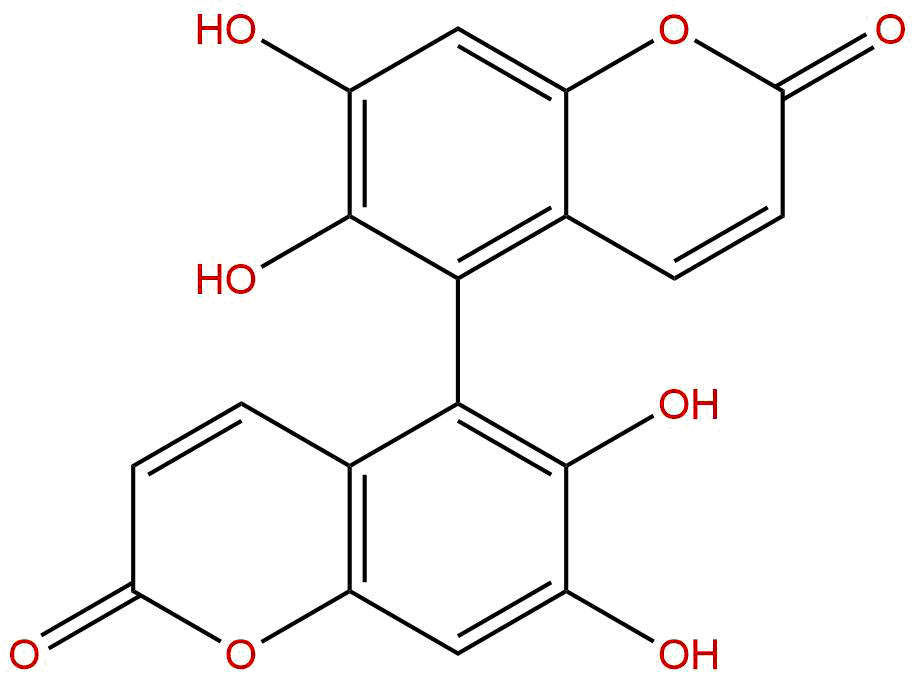


Product name: Euphorbetin
Synonym name: 5,5'-Bi(6,7-dihydroxycoumarin)
Catalogue No.: BP2128
Cas No.: 35897-99-5
Formula: C18H10O8
Mol Weight: 354.27
Botanical Source: Euphorbia lathyris L
Type of Compound: Coumarins
Purity: 95%~99%
Analysis Method: HPLC-DAD or/and HPLC-ELSD
Identification Method: Mass, NMR
Packing: Brown vial or HDPE plastic bottle
Storage: Store in a well closed container, protected from air and light. Put into refrigerate or freeze for long term storage.
Whenever possible, you should prepare and use solutions on the same day. However, if you need to make up stock solutions in advance, we recommend that you store the solution as aliquots in tightly sealed vials at -20℃. Generally, these will be useable for up to two weeks.
The product could be supplied from milligrams to grams
Inquire for bulk scale.
For Reference Standard and R&D, Not for Human Use Directly.
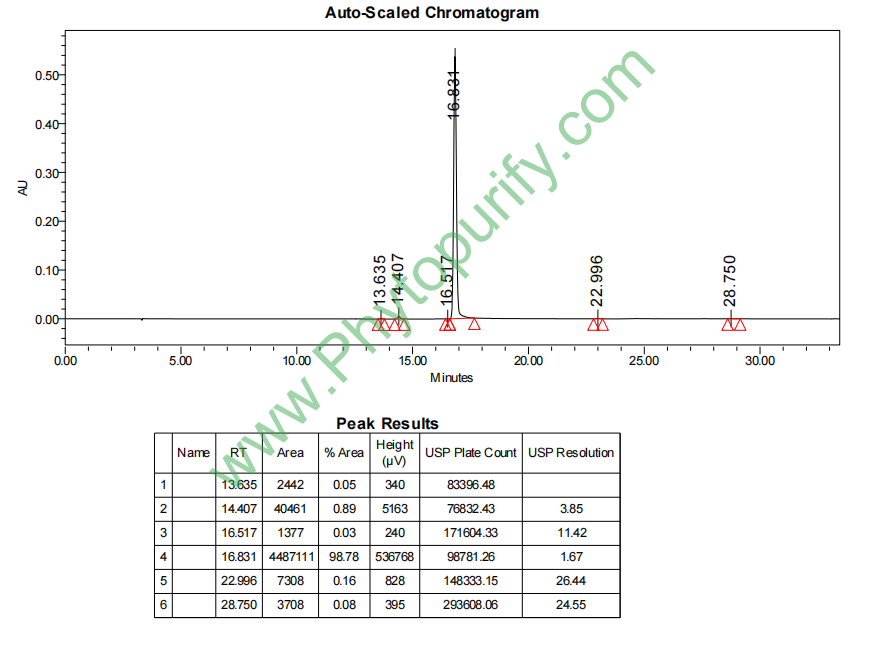
HPLC of Euphorbetin
Storage conditions:Short-term storage at 2~8℃, long-term storage at -20 ~ -80℃
141.3400
2.0673
.7456
.0044
2.7131
6.2687
Low
87.5989
2.7436
Yes
No
No
No
Yes
Yes
0.6
Yes
No
Yes
Yes
Euphorbein is a natural product derived from plants of the genus Euphorbia, which has received widespread attention in recent years due to its significant anticoagulant activity and potential anti-tumor effects. As a diterpenoid compound with a unique chemical structure, quercetin has a long history of application in traditional Chinese medicine, especially in the treatment of blood circulation disorders and tumor diseases, demonstrating unique pharmacological potential. With the development of modern pharmacology and molecular biology techniques, the biological activity mechanism and target of quercetin have gradually been revealed, especially in the treatment research of malignant tumors such as liver cancer, showing good application prospects.
As a malignant tumor with high incidence rate and mortality worldwide, liver cancer urgently needs to develop new effective therapeutic drugs. Current research indicates that quercetin exerts anti-tumor effects by regulating various molecular targets related to liver cancer, such as BCL2, STAT3, TOP1, etc., providing new ideas and directions for drug development of liver cancer. This article will provide a systematic review of the chemical structure, sources, pharmacological activity, mechanism of action, and pharmacological evaluation of quercetin, combined with its potential application in the treatment of liver cancer, aiming to provide theoretical basis and reference for natural product pharmacology research and new drug development.
The molecular formula of quercetin is C2H_30O6, with a molecular weight of 354.27 and a CAS number of 35897-99-5. Its chemical structure belongs to the diterpenoid class, with multiple hydroxyl and ester groups. The structure contains a typical cyclic skeleton and side chains, endowing it with unique biological activity. The LogP value of quercetin is 2.0673, indicating its moderate lipid solubility, which is beneficial for membrane penetration and bioavailability.
Its topological polar surface area (TPSA) is 141.34 Å ², indicating that the molecule has strong polarity and hydrogen bond donor/acceptor ability, which has a significant impact on its binding to biological targets. Low water solubility (0.0044 mg/mL) suggests limited solubility in vivo, which may affect oral absorption and bioavailability. Low blood-brain barrier permeability indicates limited distribution of quercetin in the central nervous system, which helps reduce neurological side effects. The hERG channel inhibition experiment showed a negative result, indicating a low risk of cardiac toxicity. The Ames test result is 0.6, indicating a low risk of genotoxicity and meeting safety requirements.
In summary, the physicochemical properties of quercetin are suitable as drug candidate molecules, especially in the fields of anti-tumor and anticoagulation, with good development potential.
Qianjingzi is mainly found in Euphorbia spp., especially in the seeds and rhizomes of Euphorbia lathyris L., where the content is relatively high. Thousand gold plants are widely distributed in temperate and subtropical regions, traditionally used to treat diseases such as tumors, thrombosis, and inflammation.
The commonly used methods for extracting quercetin include solvent extraction, ultrasound assisted extraction, and liquid chromatography separation. Generally, ethanol or methanol is used as the extraction solvent, and impurities are removed through multi-step solvent fractionation extraction, combined with silica gel column chromatography and reverse phase high performance liquid chromatography (RP-HPLC) for purification. In recent years, supercritical CO2 extraction technology and microwave-assisted extraction technology have also been applied to the efficient extraction of quercetin, significantly improving the extraction rate and purity.
During the extraction process, attention should be paid to temperature and pH control to prevent degradation and isomerization of quercetin. The purified quercetin can be structurally confirmed and purity detected by techniques such as mass spectrometry (MS), nuclear magnetic resonance (NMR), and infrared spectroscopy (IR).
Qianjingzi Su was first discovered for its significant anticoagulant effect. In vitro experiments have shown that quercetin can effectively inhibit platelet aggregation and thrombin activity, prolong clotting time (PT and aPTT), thereby reducing the risk of thrombosis. Its anticoagulant mechanism may involve inhibiting the activity of coagulation factors in plasma and regulating the function of endothelial cells, promoting blood flow.
Animal model studies further confirm that quercetin has good antithrombotic effects in rats and rabbits, with no obvious bleeding tendency, demonstrating good safety and therapeutic window. This activity makes it potentially valuable for the prevention and treatment of cardiovascular and cerebrovascular diseases, deep vein thrombosis, and other related conditions.
In recent years, the research on quercetin in the field of tumor treatment has gradually increased, especially showing significant inhibitory effects on liver cancer. In vitro cell experiments have shown that quercetin can inhibit the proliferation and migration of liver cancer cell lines (such as HepG2 and Huh7), induce cell apoptosis, and inhibit tumor invasion and metastasis.
In animal experiments, quercetin significantly slows down the growth of liver cancer xenografts, reduces tumor burden, and improves liver function indicators. Its anti-tumor activity is closely related to the regulation of multiple signaling pathways, demonstrating comprehensive therapeutic potential with multiple targets and mechanisms.
In addition, quercetin also exhibits multiple pharmacological effects such as anti-inflammatory, antioxidant, and immune regulation, providing a theoretical basis for its combined application in the treatment of complex diseases.
The pharmacological effects of quercetin are mainly achieved by regulating multiple key molecular targets, especially in the treatment of liver cancer, showing a multi-level and multi-channel regulatory network.
Qianjingzi Su inhibits the activity of platelet activating factor and thrombin, interferes with the coagulation cascade reaction, and delays the process of blood coagulation. Meanwhile, its protective effect on endothelial cells helps maintain vascular permeability and anti-inflammatory status, reducing the risk of thrombosis.
The pharmacological parameters of quercetin indicate that it has good potential for drug development. The moderate molecular weight (354.27 Da) conforms to Lipinski's rule, with a LogP of 2.0673, indicating its moderate lipid solubility, which is beneficial for cell membrane penetration and in vivo distribution. A high TPSA (141.34 Å ²) suggests strong polarity, which may affect oral absorption but helps to form stable binding with target molecules.
Low water solubility (0.0044 mg/mL) is a major challenge for its drug development, which may limit its oral bioavailability. Therefore, formulation improvements such as nanocarriers and solid dispersions are needed to enhance solubility and stability. Low blood-brain barrier permeability reduces the risk of central nervous system side effects. The hERG channel inhibition test is negative, indicating a low risk of cardiac toxicity. The Ames test results show that its genotoxicity risk is relatively low and its safety is good.
Pharmacokinetic studies have shown that quercetin is widely distributed in the body and mainly metabolized through the liver. The metabolites need further identification. Its half-life is moderate and suitable for daily administration. The first pass effect on the liver is significant, indicating that oral dosage forms need to be optimized to improve bioavailability. The excretion in the body is mainly through bile and urine, and no significant accumulation is observed.
As a natural product with dual anticoagulant and anti-tumor activities, quercetin has broad prospects in clinical applications. Its anticoagulant effect makes it potentially valuable in the prevention and treatment of cardiovascular and cerebrovascular diseases, deep vein thrombosis, pulmonary embolism, and other diseases. At the same time, the multi-target regulatory ability for liver cancer provides a theoretical basis for its use as an adjuvant or combination therapy drug.
Future research should focus on the following aspects:
In summary, as a multifunctional natural product, quercetin has the potential to become a new type of anti-tumor and anticoagulant drug, and is worth exploring and developing in the field of drug research and development.
As a natural product with unique chemical structure and multiple biological activities, quercetin exhibits significant anticoagulant and anti-tumor potential, especially in the field of liver cancer treatment, demonstrating comprehensive regulatory ability with multiple targets and mechanisms. Its physical and chemical properties and pharmacological parameters provide a good foundation for drug development, but poor water solubility and low bioavailability are still technical challenges that urgently need to be solved.
In the future, through innovative drug formulations, in-depth research on the mechanism of action, and systematic preclinical evaluation, quercetin is expected to become an important candidate molecule for natural product drug development, providing new treatment strategies and drug choices for liver cancer and related diseases. The continuous progress in pharmacology of natural products will lay a solid foundation for the clinical translation and application of quercetin, and promote its widespread application in modern medicine.
