


Synonym name: 3-O-Galloylepicatechin; ECG; Epicatechin 3-gallate; Teatannin
Catalogue No.: BP0539
Cas No.: 1257-08-5
Formula: C22H18O10
Mol Weight: 442.376
Botanical Source: tea and other plant spp., e.g. Detarium microcarpum and Pithecellobium lobatum
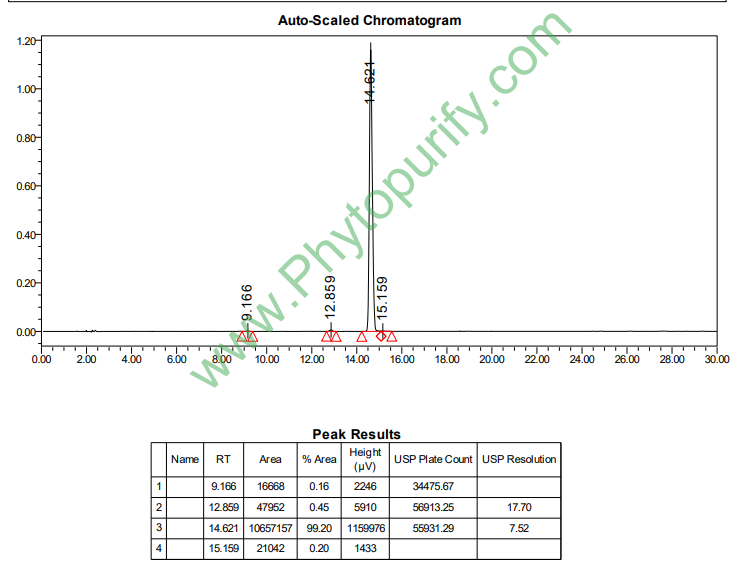
Purity: 95%~99%
Analysis Method: HPLC-DAD or/and HPLC-ELSD
Identification Method: Mass, NMR
Packing: Brown vial or HDPE plastic bottle
Can be supplied from milligrams to grams.
For Reference Standard and R&D, Not for Human Use Directly.
Inquire for bulk scale.
Storage conditions:Short-term storage at 2~8℃, long-term storage at -20 ~ -80℃
177.1400
2.2446
1.6106
.2796
1.9796
.0816
Low
88.1188
3.6081
No
No
No
No
Yes
No
0.6
Yes
No
Yes
No
Epicatechin gallate (ECG), CAS number 1257-08-5, is an important catechin polyphenol compound in tea and a derivative of flavan-3-ol. As one of the key active ingredients of tea polyphenols, ECG is not only widely present in daily consumption of green tea, black tea, etc., but also found in various medicinal plants such as Pangdai. Traditionally, tea rich in ECG is considered beneficial to health due to its antioxidant properties. Modern pharmacological research has gradually revealed that ECG is far from a simple antioxidant, and has shown great potential in regulating various key cellular signaling pathways and intervening in core pathological processes of diseases. Early studies have confirmed its activity as a xanthine oxidase inhibitor (IC50 of 982.14 μ M), indicating its potential value in the treatment of hyperuricemia and gout. However, what is more remarkable is its multi-target and multi pathway action characteristics in the field of anti-tumor. Research has shown that ECG can act on a series of molecular targets closely related to tumor occurrence, development, invasion, metastasis, and drug resistance, such as MCL1, BCL2, STAT3, MMP2, TOP1, HIF1A, TOP2A, MAPK1, ESR1, CYP19A1, making it a highly promising natural anti-tumor lead compound. This article aims to systematically review the chemical characteristics, plant sources, pharmacological activities of ECG, especially its anti-tumor mechanism and molecular target network, and to deeply explore and prospect its pharmacological properties and clinical application prospects.
The molecular formula of epicatechin gallate is C22H18O10, with a molecular weight of 442.3760. Its chemical structure consists of two core units: one is the Epicatechin nucleus, which belongs to the flavan-3-ol family and has a cis configuration at the 2nd and 3rd positions of the C ring (different from catechins); The second is the galloyl group, which is connected to the C-ring hydroxyl group of the epicatechin nucleus through ester bonds. This structure endows ECG with unique physicochemical and biological properties.
In terms of physicochemical properties, the lipid water partition coefficient (LogP) of ECG is 2.2446, indicating that it has a certain degree of lipophilicity, but not high lipid solubility. Its topological polar surface area (TPSA) is as high as 177.1400 Å ², mainly attributed to the presence of multiple phenolic hydroxyl and ester bond oxygen atoms in the molecule, which are strong donors and acceptors of hydrogen bonds, resulting in strong molecular polarity. This characteristic also affects its solubility. The calculated or measured water solubility value is about 0.2796 mg/mL, which belongs to the category of slightly soluble to poorly soluble, which to some extent limits its bioavailability. The catechol structure and galloyl group in ECG molecules make them potent electron donors, thus exhibiting significant antioxidant activity and the ability to scavenge free radicals and chelate metal ions. In addition, its phenolic hydroxyl group is unstable under alkaline conditions and is prone to oxidation, polymerization, and other reactions.
From the preliminary parameters of drug formation, the molecular weight of ECG is moderate, but higher TPSA and more hydrogen bond donors and acceptors may affect its cell membrane permeability. Its blood-brain barrier permeability is predicted to be "low", indicating that it may have difficulty entering the central nervous system to exert its effects. On early safety indicators, hERG inhibition is' no ', indicating a lower risk of causing QT interval prolongation in the heart; The Ames test result is 0.6 (usually negative if the mutation rate is less than 2), indicating that it has no significant genetic toxicity. These data provide a fundamental reference for the subsequent development of ECG.
ECG is a characteristic catechin component in tea, particularly abundant in green tea. Its content is significantly affected by tea tree variety, growth environment, picking season, and processing technology. In green tea (unfermented tea), catechins are well preserved, and the ECG content is usually higher than that of black tea (fully fermented tea), because during the fermentation process, some catechins are catalyzed by polyphenol oxidase to oxidize and polymerize into theaflavins, thearubigins, etc. In addition to tea (Camellia sinensis), ECG has also been found in other plants, such as the seeds of the traditional Chinese medicine Sterculia lychnophora, providing evidence for its source diversity.
The extraction of ECG from plant materials is mainly based on their polyphenol properties. The conventional methods include:
1. Solvent extraction method The most commonly used method is to use polar solvents such as water, methanol, ethanol, acetone, or their mixed solutions in different proportions for extraction, reflux, or ultrasound assisted extraction. Ethanol water systems are commonly used due to their safety and low cost.
2. Column chromatography separation and purification: After preliminary enrichment by macroporous adsorption resins (such as AB-8 and D101), the crude extract is often further separated by silica gel column chromatography and Sephadex gel (LH-20) column chromatography. Sephadex LH-20 can be used in both water and organic solvents such as methanol, ethanol, and acetone, and has specific adsorption and separation effects on polyphenolic compounds, making it a key technology for purifying ECG.
3. High performance liquid chromatography method Prepa HPLC is the ultimate effective method for obtaining high-purity ECG monomers, usually using a reverse phase C18 chromatography column and gradient elution with methanol water or acetonitrile water (often containing a small amount of formic acid or acetic acid to adjust pH) as the mobile phase.
Attention should be paid to avoiding light, low temperature, and inert gas protection during the extraction and separation process to prevent oxidative degradation of ECG.
The pharmacological activity research of ECG is extensive, covering multiple fields such as antioxidant, anti-inflammatory, cardiovascular protection, neuroprotection, antimicrobial, and anti-tumor. Among them, anti-tumor activity has been a research hotspot in recent years.
The anti-tumor effect of ECG involves a complex multi-target regulatory network, and its mechanism has been deeply studied at the molecular and pathway levels. Based on the provided target information, its main mechanism of action can be summarized as follows:
Inducing apoptosis of tumor cells This is one of the core mechanisms of ECG anti-tumor therapy.
Inhibition of tumor cell proliferation and cycle arrest:
Inhibit tumor invasion and metastasis:
Regulating hormone related pathways:
In summary, ECG forms a synergistic anti-tumor network by simultaneously acting on multiple key targets and pathways such as apoptosis, proliferation, invasion, and hormone signaling, which helps overcome the problem of resistance to single target drugs.
Although ECG exhibits excellent biological activity in vitro, its drug development faces challenges, mainly due to its poor pharmacokinetic properties.
To improve the pharmacological properties of ECG, researchers are exploring various strategies:
1. Structural modification Protecting phenolic hydroxyl groups, improving their lipid solubility and metabolic stability through methylation, acylation, and preparation of prodrugs.
2. New drug delivery system Using nanotechnology such as liposomes, nanoparticles, micelles, solid lipid nanoparticles, etc. to encapsulate ECG can improve its solubility, protect it from premature degradation, enhance target site accumulation (such as targeting tumors through EPR effect), and potentially improve its oral absorption.
3. Combined administration When used in combination with other bioactive ingredients or chemotherapy drugs, it may produce synergistic effects, reduce individual dosages, minimize side effects, and potentially overcome drug resistance through multi-target action.
ECG, as a multi-target and multifunctional natural product, has broad clinical application prospects but is also full of challenges.
prospect:
1. Tumor prevention and adjuvant therapy: As a dietary supplement or functional food ingredient, long-term intake of tea drinks rich in ECG may have a chemopreventive effect on some cancers (such as breast cancer, prostate cancer, gastrointestinal cancer). As a drug, ECG can be combined with conventional chemotherapy, radiotherapy, or targeted therapy to enhance sensitivity, reduce toxicity, and reverse drug resistance, thereby improving overall efficacy.
2. Management of chronic metabolic diseases Its role in anti hyperuricemia/gout, antioxidant stress, anti-inflammatory, and blood lipid regulation makes it potentially valuable in the prevention and treatment of chronic diseases such as metabolic syndrome, cardiovascular disease, and arthritis.
3. Developed as a multi-target anti-tumor drug Based on its clear multi-target mechanism of action, through rational formulation modification or structural optimization, it is expected to be developed into a new generation of multi-target anti-tumor candidate drugs with Chinese original characteristics.
Challenges and Prospects:
1. Bioavailability bottleneck This is the clinical application of ECG The biggest obstacle Future research must focus on utilizing advanced pharmaceutical technologies and prodrug strategies to systematically address the issues of poor absorption and rapid metabolism.
2. Deep exploration of the mechanism of action At present, the understanding of the ECG network is still incomplete, especially the interaction between various targets, the dominant mechanisms in different tumor types, and the impact on the tumor microenvironment (such as immune cells), which requires further systematic biology research.
3. Lack of clinical evidence The vast majority of research is still in the preclinical stage. It is urgent to design rigorous clinical trials to evaluate the safety, tolerability, pharmacokinetic characteristics, and preliminary efficacy of ECG or its optimized formulations in humans, especially in cancer patients.
4. Quality Control and Standardization If used for drug development, it is necessary to establish quality control standards for the entire process from raw materials to finished products to ensure the stability of active ingredients and the consistency of formulations.
Epicatechin gallate (ECG) is a precious pharmacological treasure bestowed upon us by nature. From traditional tea drinks to modern anti-tumor research, their value is constantly being re recognized and deepened. It constructs an anti-tumor network that acts on multiple key targets such as MCL1, STAT3, TOP1, MMP2, ESR1, etc. through a sophisticated molecular structure, demonstrating the unique advantages of multi pathway collaborative intervention in diseases. Although its poor pharmacokinetic properties are currently the main barrier to clinical translation, this is also the driving force behind cross innovation in pharmacy, medicinal chemistry, and pharmacology. With the continuous maturity of nano delivery technology, prodrug design and other strategies, as well as the more refined mapping of ECG mechanisms, we have reason to believe that ECG has the potential to transform from a well-known natural ingredient into a modern drug with clear molecular mechanisms and clinical value, providing new choices for the prevention and treatment of tumors and other chronic diseases. Future research should not only strengthen the scientific foundation, but also vigorously promote the transformation and application of this ancient compound, so as to bring new vitality to modern medicine.
