


Product name: Chlorogenic acid
Synonym name: Caffeylquinic acid; Caffetannic acid; Helianthic acid; Igasuric acid;
Catalogue No.: BP0345
Cas No.: 327-97-9
Formula: C16H18O9
Mol Weight: 354.311
Botanical Source:
Physical Description: Powder
Type of Compound: Phenylpropanoids
Purity: 95%~99%
Analysis Method: HPLC-DAD or/and HPLC-ELSD
Identification Method: Mass, NMR
Packing: Brown vial or HDPE plastic bottle
Storage: Store in a well closed container, protected from air and light. Put into refrigerate or freeze for long term storage.
Whenever possible, you should prepare and use solutions on the same day. However, if you need to make up stock solutions in advance, we recommend that you store the solution as aliquots in tightly sealed vials at -20℃. Generally, these will be useable for up to two weeks.
The product could be supplied from milligrams to grams, up to kilograms
Inquire for bulk scale.
Descriptions:
Chlorogenic acid, a phenolic compound found ubiquitously in plants, is an in vitro antioxidant and metal chelator, some derivatives of chlorogenic acid are hypoglycemic agents and may affect lipid metabolism;in vivo, chlorogenic acid can improve glucose tolerance, decrease some plasma and liver lipids, and improve mineral pool distribution.[1]
Chlorogenic acid and caffeic acid have antioxidant property, have effects on intestinal ischemia–reperfusion injury.[2]
Chlorogenic acid has antiviral activity, reduces serum DHBV level in DHBV-infected duckling model, shows inhibitory effect on HBV replication.[3]
References:
[1] Sotillo D V R D, Hadley M. J Nutr Biochem, 2002, 13(12):717-726.
[2] Sato Y, Itagaki S, Kurokawa T, et al.Int J Pharm, 2011, 403(1-2):136-138.
[3] Wang G F, Shi L P, Ren Y D, et al. Antivir Res, 2009, 83(2):186-90.
[4] Li X P, Yu J, Luo J Y, et al.Biomed Chromatogr, 2006, 20(2):206-10.
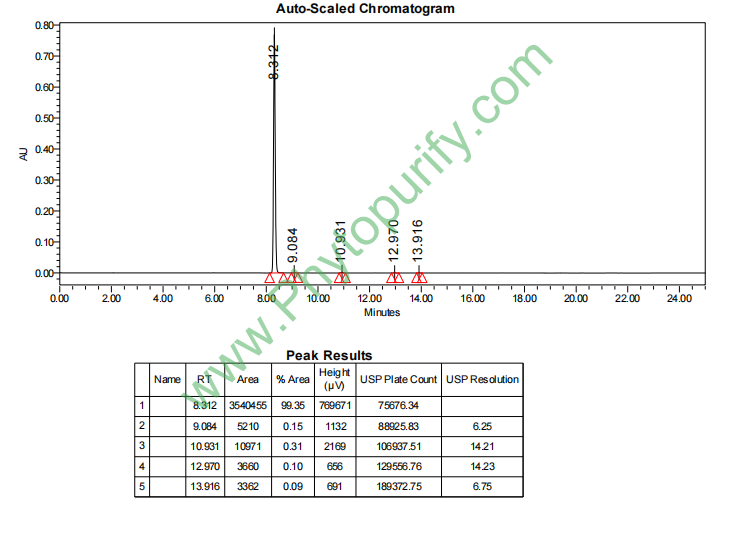
HPLC of Chlorogenic acid
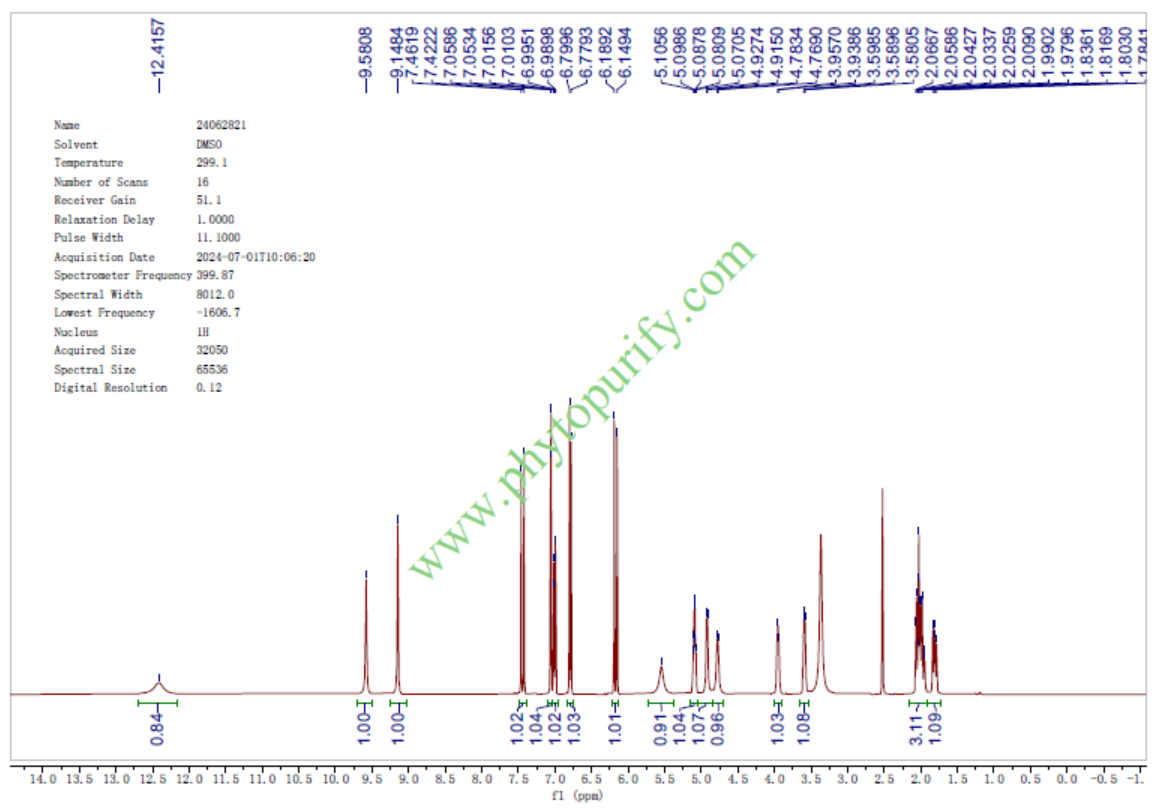
HNMR of Chlorogenic acid
Storage conditions:Short-term storage at 2~8℃, long-term storage at -20 ~ -80℃
164.7500
-.2843
-2.3134
5.9530
.6189
.2736
Low
67.5323
3.8711
Yes
No
No
No
Yes
No
0.0
Yes
Yes
Yes
Yes
Chlorogenic acid (CGA), also known as 3-O-caffeoylquinic acid, is a polyphenolic compound widely present in higher plants, with a CAS number of 327-97-9. As a secondary metabolite of plants, chlorogenic acid is not only an important substance for plants to cope with environmental stress, but also a hot topic in natural product pharmacology research due to its diverse biological activities. Especially in the traditional Chinese medicine Lonicera japonica Thunb., chlorogenic acid is recognized as its main active ingredient and key quality marker, closely related to its heat clearing and detoxifying effects, as well as its ability to disperse wind heat. Modern pharmacological research reveals that chlorogenic acid has shown a wide range of pharmacological activities, including antioxidant, anti-inflammatory, antibacterial, anti-virus, liver protection, heart protection, neuroprotection, anti obesity and anti hypertension, which makes it show great potential in the prevention and treatment of metabolic syndrome, cardiovascular disease, neurodegenerative disease and infectious diseases. This article aims to systematically review the chemical structure, plant origin, pharmacological activity, mechanism of action, medicinal properties, and clinical application prospects of chlorogenic acid, in order to provide comprehensive scientific references for the in-depth research and development of this natural product.
Chlorogenic acid is a phenolic acid formed by the ester bond between a molecule of quinic acid and a molecule of caffeic acid. Its chemical name is 3-O-caffeoylquinic acid, indicating that the caffeic acid is partially attached to the hydroxyl group at position 3 of the quinic acid parent nucleus. Its molecular formula is C16H18O9 and its molecular weight is 354.3110. Chlorogenic acid exists in various isomers (such as 4-O -, 5-O-caffeoylquinic acid, etc.), but the commonly referred chlorogenic acid is the 3-O-isomer.
In terms of physical and chemical properties, chlorogenic acid is a light yellow or white crystalline powder with a slightly bitter taste. Its LogP value is -0.2843, indicating strong hydrophilicity; The topologically polar surface area (TPSA) is as high as 164.75 Å ², further confirming the presence of multiple polar groups (such as hydroxyl, carboxyl, ester bonds) in its molecule. These structural features determine its good water solubility, with an experimentally measured water solubility of approximately 5.9530 mg/mL, which is beneficial for its extraction and formulation in aqueous media. However, its high polarity and molecular weight also pose challenges to its bioavailability, especially its ability to cross the blood-brain barrier is evaluated as "low", which to some extent limits its direct effect on central nervous system diseases. In the preliminary safety screening, chlorogenic acid did not show hERG potassium channel inhibitory activity (indicating low potential risk of cardiac toxicity), and the Ames test result was negative (0.0), indicating no obvious signs of genetic toxicity, laying a good safety foundation for its further development.
Chlorogenic acid is widely distributed in the plant kingdom and is a key active ingredient in many medicinal and edible plants. Its most famous source is the honeysuckle plant in the Lonicera family, in which the content of chlorogenic acid is often used as a core indicator to evaluate the quality of honeysuckle medicinal materials. In addition, coffee beans (especially unbaked), sunflower seeds, potatoes, apples, pears, thistle, chrysanthemum, Eucommia ulmoides leaves, etc. are also important sources of chlorogenic acid. The content of chlorogenic acid varies significantly among different plants and different parts and growth stages of the same plant.
Efficient extraction of chlorogenic acid from plant materials is the foundation of research and application. Traditional methods include water decoction and organic solvents (such as methanol, ethanol, acetone) reflux or impregnation. Among them, ethanol has become a commonly used solvent due to its low toxicity, moderate cost, and good selectivity for polyphenolic substances. Modern extraction techniques have significantly improved extraction efficiency and purity, mainly including:
1. Ultrasonic assisted extraction The use of ultrasonic cavitation effect to destroy cell walls, accelerate solvent permeation and solute release, has the advantages of short time, low temperature, and high yield.
2. Microwave assisted extraction By selectively heating the internal water of plant cells with microwaves, high pressure is generated to rupture the cells and rapidly release their contents, resulting in high efficiency and low solvent usage.
3. Supercritical fluid extraction Supercritical CO2 is commonly used to achieve selective extraction by adjusting temperature and pressure to change its solubility. This method has no solvent residue and mild conditions, but the equipment cost is high and often requires the addition of entrainers (such as ethanol) to improve the extraction rate of chlorogenic acid.
4. Enzymatic extraction Using cellulases, pectinases, and other enzymes to disrupt the structure of plant cell walls, gently releasing target components with strong specificity and mild conditions.
The crude extract after extraction usually needs to be further purified, and common methods include macroporous adsorption resin method (such as AB-8, D101 resin), polyamide column chromatography, preparative high-performance liquid chromatography, etc., to obtain high-purity chlorogenic acid monomer for further research.
Numerous in vitro and in vivo studies have confirmed that chlorogenic acid has broad and significant pharmacological activities, which form the basis for its multi-target therapeutic potential.
antioxidant activity This is one of the core biological activities of chlorogenic acid. The catechol structure (caffeic acid portion) in its molecule is a potent electron donor that can directly scavenge free radicals (such as superoxide anions, hydroxyl radicals, peroxynitrite) and interrupt the lipid peroxidation chain reaction. Research has shown that chlorogenic acid can significantly enhance the antioxidant capacity of cells or tissues, protecting biomolecules from oxidative damage.
anti-inflammatory effect Chlorogenic acid has shown good inhibitory effects on both acute and chronic inflammation models. It can significantly reduce the excessive production of key inflammatory mediators such as nitric oxide, prostaglandin E2, tumor necrosis factor - α, interleukin-1 β, and interleukin-6 in macrophages induced by lipopolysaccharides.
Antibacterial and antiviral activity Chlorogenic acid has inhibitory effects on various bacteria (such as Staphylococcus aureus, Escherichia coli, Streptococcus) and fungi, and its mechanism may be related to the destruction of microbial cell membrane integrity and interference with energy metabolism. In addition, studies have shown that chlorogenic acid has certain inhibitory activity against influenza virus, human immunodeficiency virus, herpes simplex virus, etc., and may exert its effect by interfering with virus adsorption, invasion, or replication processes.
Metabolic regulation and organ protection:
The multiple pharmacological activities of chlorogenic acid stem from its multi-target action characteristics, and its core mechanism revolves around anti-oxidative stress and Regulating related signaling pathways open.
1. Activate the Nrf2/ARE antioxidant defense pathway This is the key molecular mechanism by which chlorogenic acid exerts antioxidant and cell protective effects. Under oxidative stress, chlorogenic acid can promote the dissociation and translocation of transcription factor NFE2L2 (NRF2) from cytoplasmic chaperone protein Keap1 to the nucleus. In the nucleus, NRF2 binds to antioxidant response elements, initiating gene transcription and expression of a series of downstream phase II detoxifying enzymes and antioxidant proteins, including:
* Heme oxygenase-1 Catalyze the degradation of hemoglobin to produce biliverdin and carbon monoxide, which have antioxidant and anti-inflammatory effects.
* Superoxide Dismutase Catalytic dismutation of superoxide anions into hydrogen peroxide and oxygen.
* catalase Decompose hydrogen peroxide into water and oxygen.
* Glutathione peroxidase Using glutathione to reduce hydrogen peroxide and lipid peroxides.
Through this pathway, chlorogenic acid not only directly scavenges free radicals, but more importantly enhances the intracellular antioxidant defense ability, achieving long-term protection.
2. Regulating inflammatory signaling pathways Chlorogenic acid can inhibit the overactivation of the nuclear factor kappa B signaling pathway. It inhibits the activation of I κ B kinase, suppresses the phosphorylation and degradation of I κ B protein, thereby preventing the nuclear translocation of NF - κ B p65 subunit and downregulating the expression of various pro-inflammatory cytokines and inflammatory mediators. Meanwhile, chlorogenic acid can also regulate inflammation related pathways such as MAPK and JAK/STAT.
3. Regulating pathways related to metabolism and cell survival In terms of metabolism, chlorogenic acid can activate the AMP activated protein kinase pathway, promote glucose uptake and fatty acid oxidation, and inhibit lipid synthesis. In organ protection, it can upregulate survival promoting signaling pathways such as PI3K/Akt and inhibit mitochondrial dependent apoptosis pathways (such as regulating the Bcl-2/Bax ratio and inhibiting caspase-3 activation), thereby reducing cell apoptosis.
4. Other targets Chlorogenic acid can also serve as a mild metal ion chelating agent, inhibiting the Fenton reaction catalyzed by iron and copper ions and reducing the generation of hydroxyl radicals. In addition, its direct inhibitory effect on various enzymes such as alpha glucosidase, acetylcholinesterase, and angiotensin-converting enzyme is also an important way for it to exert specific pharmacological effects.
Although chlorogenic acid has a wide range of pharmacological activities, its medicinal properties, especially Oral bioavailability It is the main bottleneck that restricts its conversion into drugs.
To improve its bioavailability and efficacy, researchers are exploring various strategies:
1. Structural modification By preparing prodrugs of chlorogenic acid (such as esterification, making phospholipid complexes) or derivatives, their lipid solubility and metabolic stability can be improved.
2. New drug delivery system Develop delivery systems such as nanoparticles, liposomes, microemulsions, and solid dispersions that encapsulate chlorogenic acid to enhance its solubility, protect it from enzymatic hydrolysis, promote intestinal absorption, or achieve targeted delivery.
3. combination therapy Combined with esterase inhibitors (such as piperine) or other natural products with synergistic effects to enhance their bioavailability and therapeutic efficacy.
As a safe and multifunctional natural active molecule, chlorogenic acid has broad clinical application prospects, but currently it is mainly used as a dietary supplement, functional food additive, and cosmetic ingredient. The development towards therapeutic drugs faces both opportunities and challenges.
Potential application directions:
1. Adjuvant therapy for chronic metabolic diseases As an auxiliary drug or functional ingredient, it is used for the prevention and management of diabetes and its complications, non-alcoholic fatty liver, obesity, hypertension and atherosclerosis, and plays its advantages in comprehensively regulating glucose and lipid metabolism, anti-oxidation and anti-inflammatory.
2. Prevention of neurodegenerative diseases Develop health products or drugs for early intervention or adjuvant therapy of Alzheimer's disease and Parkinson's disease, based on their neuroprotective activity.
3. Adjuvant treatment of infectious diseases By utilizing its broad-spectrum antimicrobial activity in combination with antibiotics or antiviral drugs, it may enhance therapeutic efficacy or reduce drug resistance.
4. Liver protectants Develop drugs or liver protection products for auxiliary protection against chemical liver injury and alcoholic liver disease.
5. Cosmetics and skincare products Its strong antioxidant and anti-inflammatory properties make it an excellent cosmetic active ingredient for anti-aging, whitening, sun protection, and soothing sensitive skin.
Challenges and Future Prospects:
1. Improved bioavailability This is the core issue for maximizing its clinical efficacy. Future research needs to continue optimizing new drug delivery systems and exploring more effective oral absorption promotion strategies.
2. In depth study on the mechanism of action Although it is known to act on multiple targets, the interaction network between each pathway and the dominant mechanism in different disease models still need to be more accurately elucidated. Systems pharmacology and molecular docking techniques can help discover new targets.
3. High quality clinical evidence Currently, most research is still in the preclinical stage. It is urgent to design rigorous, large sample randomized controlled clinical trials to confirm their effective dosage, long-term safety, and definite efficacy in specific diseases.
4. Standardization and Quality Control Ensuring stable raw material sources, controllable extraction processes, and standardized content and isomer composition of chlorogenic acid in products are the basis for ensuring consistent therapeutic efficacy and safety.
5. Multi component collaborative research Chlorogenic acid often coexists with other phytochemicals. Studying its synergistic effects with coexisting components (such as other phenolic acids and flavonoids in honeysuckle) and developing multi-component compound formulations may have advantages over single components.
Chlorogenic acid, as a natural phenolic acid compound with abundant resources, high safety, and diverse biological activities, is a model molecule that connects traditional herbal wisdom with modern life sciences. This ingredient, discovered from traditional medicinal plants such as honeysuckle, has powerful antioxidant, anti-inflammatory, organ protective, and metabolic regulatory effects, providing a highly potential natural solution for addressing the high incidence of chronic diseases in today's society. Despite its limitations in oral bioavailability, with the continuous deepening of pharmaceutical, pharmacokinetic, and molecular pharmacology research, through structural optimization, development of novel delivery systems, and scientific clinical validation, chlorogenic acid is expected to gradually develop from an important dietary supplement and lead compound into an innovative drug or key functional ingredient for the prevention and treatment of various diseases. Continuous and in-depth research on it will not only promote the development of natural product pharmacology, but also inject new vitality into the development of original drugs and health products with Chinese characteristics.
