


Synonym name: 20-Deoxyingenol
Catalogue No.: BP0046
Cas No.: 54706-99-9
Formula: C20H28O4
Mol Weight: 332.44
Botanical Source: Occurs as esters in Euphorbia kansui and Euphorbia paralias
Purity: 95%~99%
Analysis Method: HPLC-DAD or/and HPLC-ELSD
Identification Method: Mass, NMR
Packing: Brown vial or HDPE plastic bottle
Can be supplied from milligrams to grams.
For Reference Standard and R&D, Not for Human Use Directly.
Inquire for bulk scale.
HPLC of 20-deoxyingenol
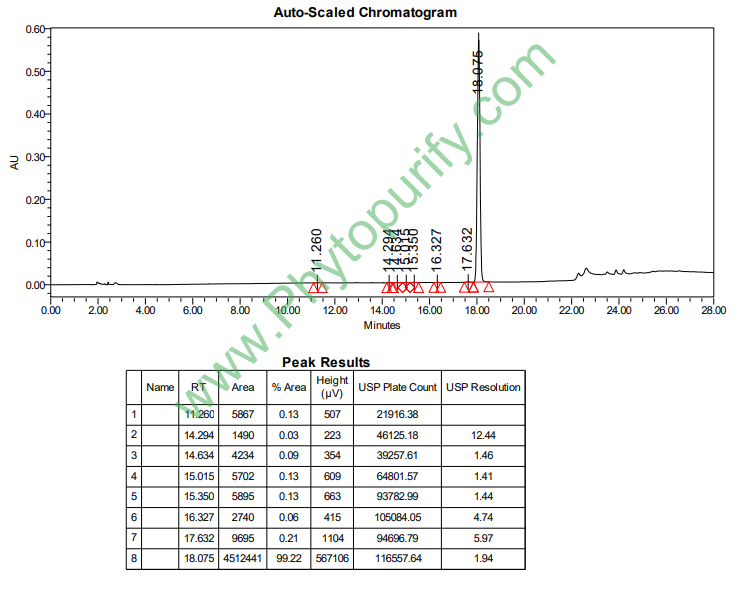
Storage conditions:Short-term storage at 2~8℃, long-term storage at -20 ~ -80℃
74.6000
2.5000
2.5000
Low
No
No
No
Unknown
No
Unknown
20 deoxyingenol (CAS number: 54706-99-9) is a natural diterpenoid derived from the roots of the traditional Chinese medicine Euphorbia kansui. As a derivative of macrolide compounds, 20 deoxymacrolide has attracted widespread attention in the field of natural product pharmacology in recent years due to its unique molecular structure and diverse biological activities. Especially in the study of chronic degenerative diseases such as osteoarthritis (OA), 20 deoxymacrolide has shown potential therapeutic value by regulating autophagy and lysosomal biogenesis. In addition, based on its regulatory ability on various disease-related molecular targets, 20 deoxymacrolide has also shown broad research prospects in neurodegenerative diseases (such as Alzheimer's disease and Parkinson's disease), metabolic diseases (such as non-alcoholic fatty liver disease and insulin resistance), and other fields.
This article will provide a systematic review of the chemical structure and physicochemical properties, plant sources, and extraction methods of 20 deoxyquercetin. The focus will be on analyzing its pharmacological activity and mechanism of action, exploring its pharmacokinetic characteristics through drug evaluation, and finally looking forward to its clinical application potential, providing a theoretical basis and research direction for the in-depth development and application of this natural product.
20 Deoxystrobin belongs to the diterpenoid class, with a molecular formula of C20H28O5 and a molecular weight of 332.43. Its chemical structure is based on a huge spear alcohol skeleton, and the significant feature of its structure is the absence of an oxygen group at position 20 (deoxygenation modification). This compound has four hydrogen bond acceptor sites, a polar surface area (TPSA) of 74.6 Å ², and a LogP value of approximately 2.5, indicating moderate lipid solubility and good membrane permeability.
Structural deoxygenation modification may affect its binding affinity and metabolic stability with biological targets. The molecular structure of 20 deoxyquercetin endows it with certain spatial conformational rigidity and stereoselectivity, which is of great significance for its biological activity. Its physical and chemical properties, such as moderate molecular weight and lipophilicity, are conducive to the penetration of cell membranes, but its blood-brain barrier permeability is relatively low, suggesting that its direct action in the central nervous system may be limited.
20 Deoxystrobin is mainly extracted from the roots of Euphorbia kansui. Gan Sui, a plant of the Euphorbiaceae family, is widely used in traditional Chinese medicine for the treatment of diuresis, anti-inflammatory, expectorant, and cough relief. Its roots are rich in diterpenoid compounds, especially magnolol and its derivatives.
Traditional extraction methods typically use organic solvents such as ethanol, methanol, and ethyl acetate for extraction, followed by separation and purification through liquid-liquid partitioning, column chromatography (silica gel, reverse phase C18), high-performance liquid chromatography (HPLC), and other techniques. In recent years, modern technologies such as ultrasound assisted extraction and microwave-assisted extraction have also been used to improve extraction efficiency and purity.
During the extraction process, attention should be paid to avoiding high temperature and strong acid-base conditions to prevent the degradation of the 20 deoxy macroalcohol structure. The purified compound was structurally confirmed by mass spectrometry (MS), nuclear magnetic resonance (NMR) and other methods.
The pharmacological activity of 20 deoxyquercetin is mainly reflected in its regulation of cellular autophagy and lysosomal function. Research has shown that 20 deoxymacrolide can promote nuclear translocation of transcription factor EB (TFEB), activate autophagy related gene expression, enhance lysosomal biogenesis, and improve the clearance efficiency of intracellular metabolic waste.
In the osteoarthritis (OA) model, 20 deoxymacrolide reduces the inflammatory response and matrix degradation of chondrocytes by regulating the expression of inflammatory factors (such as IL-1 β, IL-6, TNF - α), matrix metalloproteinases (MMP1, MMP3), and signaling pathway (NF - κ B), thus delaying the process of joint degeneration. In addition, its activation of the AMPK signaling pathway helps regulate energy metabolism and cell survival in chondrocytes.
In the field of neurodegenerative diseases, although the blood-brain barrier permeability of 20 deoxymacrolide is low, its regulatory potential on related targets such as BCL2, MCL1, APP, BACE1, etc. suggests its application value in peripheral or adjuvant therapy. Studies on non-alcoholic fatty liver disease and insulin resistance have shown that 20 deoxymacrolide may improve metabolic disorders and oxidative stress by regulating key molecules such as AMPK, NFE2L2, PTPN1, etc.
The biological effects of 20 deoxyquercetin are mainly achieved by regulating multiple signaling pathways and key molecular targets:
Promote autophagy and lysosomal biogenesis
20 Deoxystrobin promotes nuclear translocation of transcription factor EB (TFEB), activates transcription of autophagy related genes, enhances cellular autophagy activity and lysosomal function, promotes intracellular waste clearance and maintains metabolic homeostasis.
anti-inflammatory effect
This compound can inhibit the NF - κ B signaling pathway, reduce the expression of pro-inflammatory cytokines such as IL-1 β, IL-6, and TNF - α, alleviate inflammatory reactions, and especially play a protective role in the pathological process of osteoarthritis.
Regulating the expression of matrix metalloproteinases
By downregulating the activity of matrix degrading enzymes such as MMP1 and MMP3, 20 deoxymacrolide helps maintain the integrity of the articular cartilage matrix and slow down the progression of osteoarthritis.
Energy metabolism regulation
Activate the AMPK (PRKAA1) signaling pathway, promote energy metabolism balance, enhance cell survival ability, and inhibit the pathological process of metabolic diseases.
Multi target regulatory potential
Combining bioinformatics and molecular docking analysis, 20 deoxy macrolide may act on multiple disease-related targets, including BCL2, MCL1, APP, BACE1 in neurodegenerative diseases, PTPN1, NFE2L2 in metabolic diseases, etc., demonstrating its pharmacological characteristics of multi-target and multi pathway synergistic regulation.
From the perspective of pharmacological parameters, 20 deoxyquercetin has an ideal molecular weight (332.43), moderate lipid solubility (LogP about 2.5), and polar surface area (TPSA 74.6), which meet the basic requirements of Lipinski's rule, indicating its good oral bioavailability potential.
The number of hydrogen bond acceptors is 4, indicating that the molecule has a certain hydrophilicity, which is conducive to forming stable hydrogen bond interactions with the target protein. The low permeability of the blood-brain barrier may limit its direct application in central nervous system diseases, but it also reduces the risk of central nervous system side effects.
In terms of toxicity evaluation, 20 deoxyquercetin has no significant cardiac toxicity or hERG channel inhibition effect, and is relatively safe. The hepatotoxicity and genotoxicity (Ames test) are not yet clear, and further systematic toxicology research is needed.
At present, there is relatively little systematic research on its pharmacokinetics, and it is expected that it may be metabolized by the liver in vivo. The metabolites and their activities still need to be further explored. In the future, research on absorption, distribution, metabolism, excretion (ADME) and toxicology in the body should be strengthened to provide a basis for clinical development.
20 Deoxystrobin, as a natural diterpenoid compound with multiple pharmacological activities, has shown significant potential in the treatment of osteoarthritis. It can effectively delay cartilage degeneration and improve joint function by promoting autophagy and lysosomal biogenesis, regulating inflammatory response and matrix metabolism, and has the potential to become a new therapeutic drug for osteoarthritis.
In addition, the regulatory ability of 20 deoxymacrolide on various disease-related targets such as Alzheimer's disease, Parkinson's disease, non-alcoholic fatty liver disease, and insulin resistance suggests its potential application prospects in multi disease and multi mechanism synergistic therapy. Although its blood-brain barrier penetration ability is low, it is expected to expand its therapeutic potential for neurological diseases through structural modification or optimization of drug delivery systems.
Future research should focus on:
Through interdisciplinary collaboration, 20 deoxyquercetin is expected to become an important candidate molecule in the development of natural product drugs, promoting the application of natural medicines in modern medicine.
In summary, 20 deoxyquercetin, as an important diterpenoid active ingredient in Gansui, has shown broad application prospects in the study of osteoarthritis and various metabolic and neurodegenerative diseases due to its unique chemical structure and diverse biological activities. It exerts a multi-target synergistic effect by regulating autophagy, inflammation, and metabolic pathways, and has good pharmacological basis and safety potential.
However, current research on its pharmacokinetics, systemic toxicology, and clinical efficacy is still relatively limited, and there is an urgent need for further exploration and validation. In the future, it is necessary to strengthen the combination of basic and applied research, promote the clinical translation of 20 deoxyquercetin, and promote the innovative development of natural products in modern disease prevention and treatment.
