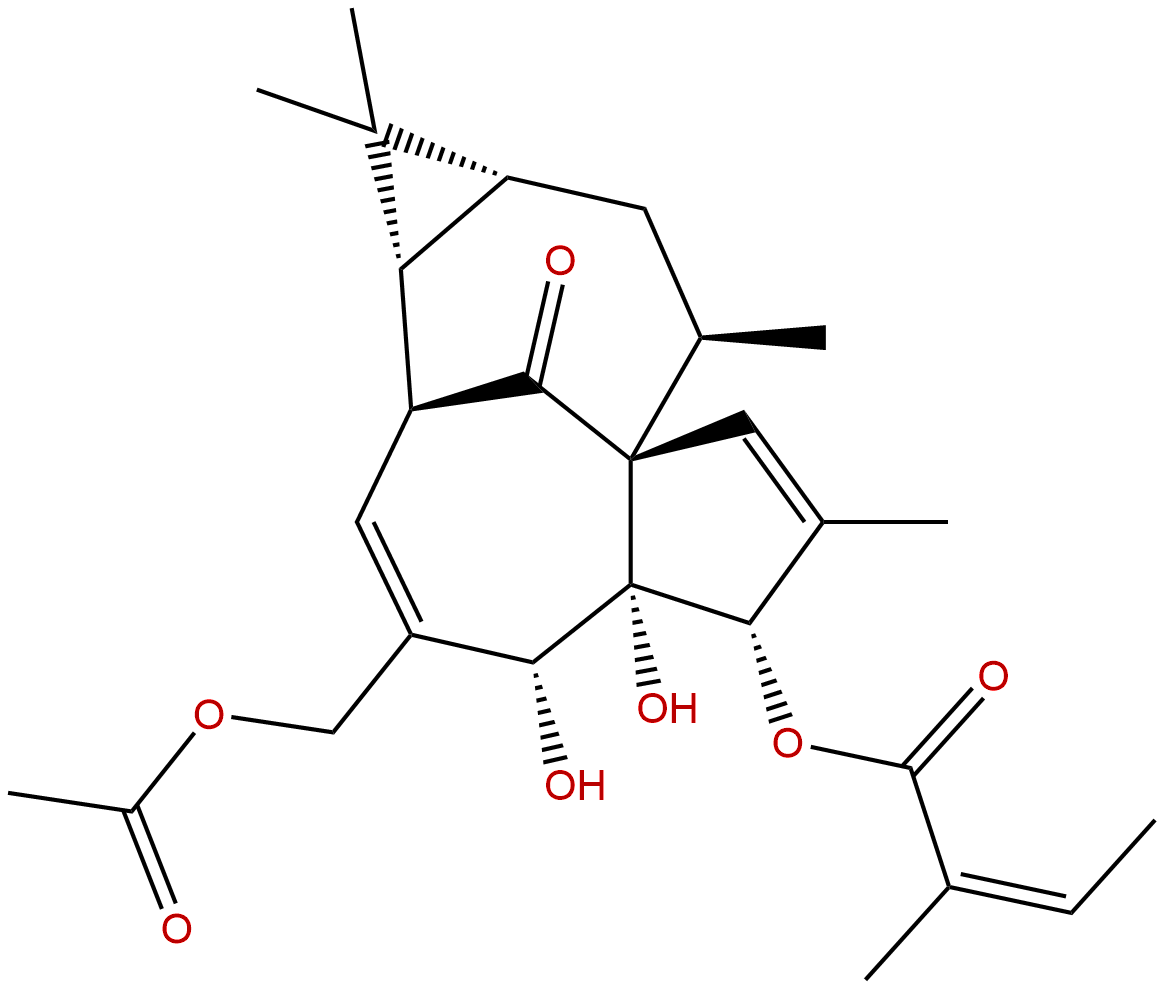
Giant Euphorbian-3-O-Angelica acid-20-acetate: a natural anti-inflammatory molecule derived from Scutellaria baicalensis and its potential in the treatment of psoriasis
1. Overview
20-O-Acetyline-3-angelate (CAS number: 82425-35-2) is a natural product with a complex diterpene skeleton, belonging to the Ingenane type of diterpenoid esters. The molecular formula of this compound is C27H36O7, with a molecular weight of 472.5780 g/mol, mainly derived from Euphorbiaceae plants Qianjin Gold It was isolated from the seeds of Croton tiglium L. Qianjinzi, as a traditional Chinese medicine, has a pungent, warm, and toxic nature. It has the effects of dispelling water, reducing swelling, breaking blood, and eliminating symptoms. It is commonly used to treat edema, phlegm retention, and stagnant swelling. However, its strong irritant toxicity also limits its direct application. Modern research is dedicated to isolating single compounds with clear activity and controllable toxicity from these traditional poisons, among which the great potential candidate molecule is the 3-O-Angelica acid-20-acetate.
In recent years, with the in-depth study of the pathogenesis of inflammatory skin diseases, especially psoriasis, this compound has become increasingly important due to its unique properties Multi target anti-inflammatory activity And receive attention. Bioinformatics analysis and preliminary pharmacological studies have revealed that it can act on multiple key targets closely related to the pathological process of psoriasis, including STAT3, TNF, IL17A, IL23, and DEFB4. This transforms it from a toxic component in traditional Chinese medicine to a modern drug lead compound with a clear molecular mechanism of action. This article will systematically expound the scientific value of this natural product from its chemical structure, plant origin, pharmacological mechanism, medicinal evaluation, and research prospects.
2. Chemical structure and physicochemical properties
The chemical structure of macrocephedrin-3-O-Angelica acid-20-acetate reflects the typical characteristics of macrocephedrane type diterpenes. The SMILES string is:C/C=C(/C)C(=O)O[C@H]1C(C)=C[C@]23C(=O)[C@@H](C=C(COC(C)=O)[C@@H](O)[C@]12O)[C@H]1[C@@H](C[C@H]3C)C1(C)CFrom this description, it can be seen that its core is a highly oxidized four ring giant trident skeleton (C20), which is connected by ester bonds at the C-3 position Angelica acid The Angelate group is connected at position C-20 Acetate esters Functional groups. This specific esterification modification has a decisive impact on its biological activity and physicochemical properties.
Analyze based on its pharmacological parameters:
- Molecular weight (MW):472.58 g/mol, Slightly higher than the standard for conventional small molecule drugs (usually<500 Da), but still within an acceptable range.
- Lipid water partition coefficient (LogP/LogD)Both are 2.94. This value indicates that the compound has moderate lipophilicity, which facilitates its penetration of cell membranes and binding to targets (often located inside or on the membrane), while also suggesting that it may have some potential for oral absorption.
- Topological Polarity Surface Area (TPSA): 110.13 Å ². This value reflects the area of polar atoms (O) in the molecule, and is relatively high, mainly due to multiple ester groups and hydroxyl groups in the molecule. Higher TPSA is usually unfavorable for passive transmembrane diffusion, but may be absorbed through other mechanisms such as active transport.
- Water solubility:0.0474 mg/mL, Belonging to micro solubility. This is consistent with higher LogP values and complex esterification structures, suggesting that solubilization strategies may need to be considered in formulation development.
- Permeability The permeability of Caco-2 cells is 8.8337 × 10 ⁻⁶ cm/s, and the effective permeability of the human body (Peff) is 1.5237 cm/s × 10 ⁻⁴. Combined with its BBB permeability, it is predicted to be "high", indicating that although the molecule has a certain polarity, its overall membrane permeability is good, and it may have a certain degree of Blood-brain barrier penetration ability This has special significance for targeting targets related to the central nervous system, but for the skin specific drugs it mainly studies, this characteristic needs to be taken into account in systemic toxicity assessment.
from Five principles of generic drugs From the perspective of Lipinski's Rule of Five, its molecular weight is slightly over 500 (472.58), the number of hydrogen bond donors (possibly 1-2 hydroxyl groups based on its structure) is less than 5, the number of hydrogen bond acceptors (7 oxygen atoms) is less than 10, and the LogP value (2.94) is less than 5. Among the four items, only the molecular weight slightly exceeded the standard. Overall, the compound has a good drug like basis.
3. Plant sources and traditional applications
The main plant source of macroethanol-3-O-Angelica acid-20-acetate is Qianjinzi, a plant belonging to the family Euphorbiaceae and the genus Croton(Croton tiglium L.)。 Qianjinzi, also known as "Xusuizi", has been recorded in traditional Chinese medicine books for its seeds used in medicine. The "Shu Bencao" states that it can "treat the accumulation of phlegm and drink without eating." The "Compendium of Materia Medica" records that it can "expel phlegm, clear water, break blood, and attack accumulation. Traditionally, Qianjin gold has been used to treat conditions such as edema, bloating, accumulation of phlegm and fluids, blood stasis, meridian closure, and scabies toxin. It is often made into pills or applied topically.
However, the toxic nature of Qianjin gold has long been a consensus among ancient medical practitioners. Its toxic components mainly come from the substances contained in the seeds Fatty oil(Croton oil) and various types Diterpenoid ester compounds These ingredients have strong irritant, pro-inflammatory, and tumor promoting effects, and ingestion or excessive use can cause severe burning pain, nausea, vomiting, diarrhea, and even dehydration and shock in the mouth, throat, and gastrointestinal tract. Therefore, traditional usage emphasizes the use of oil removing cream (Thousand Gold Cream) to reduce toxicity and strictly controls the dosage.
Modern plant chemistry research has isolated and identified dozens of diterpenoid compounds from Scutellaria baicalensis, and one of them is the 3-O-Angelica acid-20-acetate. Research has found that the toxicity and activity of these diterpene esters are closely related to their esterification groups. By structural modification, it is possible to "remove its toxicity and preserve its medicinal properties", transforming the originally highly irritating and pro-inflammatory "poison" components into ones with Specific anti-inflammatory or anti-tumor activity The lead compound of 'good medicine'. The discovery of the giant halberin-3-O-Angelica acid-20-acetate is a manifestation of this research approach. It retains the core of the giant quercetin skeleton, but through specific esterification (Angelica sinensis ester and acetate ester), its interaction mode with biomolecules in the body may be altered, thereby exhibiting more selective pharmacological activity than crude extracts or other diterpenoid esters.
4. Pharmacological activity and mechanism of action
The pharmacological activity research of giant halberin-3-O-Angelica acid-20-acetate is currently mainly focused on its anti-inflammatory effect Especially for psoriasis The therapeutic potential of this chronic, recurrent, and inflammatory skin disease. Its mechanism of action involves the regulation of multiple key inflammatory signaling pathways and cytokines, and the target information clearly points to the core links of the psoriasis immune pathogenesis network.
(1) Core target analysis and association with psoriasis
-
STAT3 (Signal Transduction and Transcription Activation Factor 3)STAT3 is involved in the pathogenesis of psoriasis Core hub transcription factors In psoriasis lesions, cytokines such as IL-6 and IL-23 continuously activate the JAK-STAT3 pathway in keratinocytes and immune cells (such as Th17 cells). After activation of STAT3 into the nucleus, it drives the expression of a series of pro-inflammatory factors (such as IL-17A, IL-23 receptor, DEFB4) and proliferation related genes, leading to excessive proliferation, abnormal differentiation, and inflammation amplification of keratinocytes. Inhibiting STAT3 signaling is an effective strategy for treating psoriasis. This compound is predicted to target STAT3, possibly by directly binding or interfering with its phosphorylation/dimerization process, thereby blocking this critical pathway.
-
TNF - α (tumor necrosis factor alpha)TNF - α is a cascade reaction of psoriasis inflammation Upstream key initiating factor It is produced by activated dendritic cells, macrophages, etc., which can activate endothelial cells, promote the release of other inflammatory factors, and directly act on keratinocytes. Anti TNF - α biologics such as etanercept and adalimumab are important weapons for treating moderate to severe psoriasis. The targeting effect of this compound on TNF suggests that it may intervene from the top of the inflammatory network.
-
IL-17A (interleukin-17A)IL-17A, mainly produced by Th17 cells, is pathological in psoriasis Effect Core It directly acts on keratinocytes, inducing their production of antimicrobial peptides (such as DEFB4), chemokines, and other inflammatory mediators, leading to epidermal proliferation, neutrophil infiltration, and inflammation maintenance. Anti-IIL-17A antibodies (such as Sikuximab) have excellent therapeutic effects. Targeting IL-17A means that the compound can directly neutralize this strongest effector cytokine.
-
IL-23 (interleukin-23)IL-23 is Key factors for Th17 cell differentiation and maintenance It is produced by antigen-presenting cells and promotes their proliferation and secretion of IL-17A, IL-22, etc. by acting on IL-23 receptors on Th17 cells. Inhibition of IL-23 can fundamentally reduce pathogenic Th17 cells. Anti IL-23p19 antibodies (such as gusetuximab) are a new generation of highly effective psoriasis treatment drugs. This compound targets IL-23 and targets the regulation of immune cells at the root of the disease.
-
DEFB4 (Defense Factor β 4, also known as Human β - Defense Factor 2), hBD-2)DEFB4 is a type of keratinocyte produced under stimulation from IL-17A and other factors Antimicrobial peptide In psoriasis, its expression level is significantly elevated, not only as a biomarker of inflammatory activity, but also as a chemotactic immune cell and amplifying inflammatory response. Inhibiting DEFB4 expression helps alleviate inflammation.
(2) Mechanism of action integration speculation
Based on the above target information, the potential mechanism network of action of the compound, Jujinol-3-O-Angelica acid-20-acetate, can be outlined: this compound may act directly or indirectly,Simultaneously inhibit upstream inflammatory signals such as TNF - α and IL-23, and block downstream activation of the STAT3 pathway Inhibition of the STAT3 pathway can reduce the inflammatory response and proliferation of keratinocytes themselves; On the other hand, it can also affect the differentiation and function of Th17 cells, leading to a decrease in IL-17A production. The decrease in IL-17A levels leads to a reduction in the production of effector molecules such as DEFB4 by keratinocytes. This Multi target, multi-level The intervention strategy can more comprehensively interrupt the "inflammatory vicious cycle" of psoriasis, which may produce synergistic therapeutic effects and potentially overcome the problem of resistance or insufficient efficacy of single target drugs.
It should be pointed out that currently, most of these target information comes from database predictions and preliminary molecular docking or cell experiment evidence. The exact direct target, binding mode, and detailed regulatory mechanism of in vivo signaling pathways still need to be further validated through biochemical, cellular, and animal experiments.
5. Evaluation of drug properties
Based on the provided detailed pharmacological parameters, we conducted a systematic evaluation of the development potential of macrolide-3-O-Angelica acid-20-acetate:
(1) Pharmacokinetic (PK) characteristics
- Absorption and penetration Moderate LogP (2.94) and good Caco-2/Peff data indicate that it has certain Oral absorption potential However, higher TPSA (110) and slightly soluble characteristics (0.0474 mg/mL) may become limiting factors for oral bioavailability. Considering that its primary indication is psoriasis,Topical administration locally It may be a more direct and secure development path. Its good membrane permeability facilitates its penetration through the stratum corneum of the skin, reaching target cells in the epidermis and even dermis.
- distribution A higher BBB permeability prediction suggests that it can enter the central nervous system. For topical medication on the skin, this is not a necessary characteristic, but rather requires attention to its potential in systemic safety evaluation Central nervous system side effects The plasma protein binding rate (PPB) is 78.3%, which is at a moderate level, indicating that approximately 21.7% of free drugs are available for distribution to tissues to exert their effects.
- Metabolism and excretion The parameters were not directly provided. However, the presence of multiple ester bonds in the structure suggests that it may be susceptible to Esterase hydrolysis metabolism Generate giant halberin, Angelica acid, and acetic acid. This is both a possible reason for its rapid metabolic clearance and a possibility that its metabolites still have activity or toxicity, which requires further research.
(2) Safety (toxicity) characteristics
- Genotoxicity The Ames test result is 0.0 (negative), and the chromosomal aberration test is "none". The negative results of these two key genetic toxicity tests are driving their development forward Important positive news It reduces the long-term risk of causing gene mutations or chromosomal damage.
- cardiotoxicity HERG inhibition is' no ', indicating a lower risk of inducing QT interval prolongation and apical torsion ventricular tachycardia in the heart.
- Organ toxicity The parameters indicate that it has an effect on serum alkaline phosphatase (ALK), gamma glutamyl transferase (GGT), aspartate aminotransferase (AST), and alanine aminotransferase (ALT) (marked as "Yes"). These are Sensitive biomarkers of liver injury This strongly suggests that the compound may have Hepatotoxicity potential This is a core safety issue that must be strictly monitored and evaluated during its development process, and is consistent with the known toxicity of many natural diterpenoid compounds.
- Other toxicities Skin sensitization (Skid_Sens), respiratory sensitization (Resp_Sens), and phototoxicity (Photo_tox) are all negative or "none", and the maximum recommended therapeutic dose (MRTD) has not yet been determined. These information provide some support for the safety of its topical dosage form.
(3) Comprehensive evaluation and re examination of Lipinski rules
As mentioned earlier, this compound basically conforms to the Lipinski five rules and has the structural basis of small molecule oral drugs. but its Hepatotoxicity warning, moderate solubility, and metabolic instability This is the main challenge. Therefore, the most feasible development path may be:
1. Topical preparations for local use Used for skin diseases such as psoriasis and dermatitis. Directly acting on the affected area can maximize the therapeutic effect while minimizing systemic exposure, avoiding liver toxicity and central permeability risks. Its anti-inflammatory multi-target properties are very suitable for local immune regulation of the skin.
2. lead optimization Using it as a template Structural modification For example, modifying or replacing ester bonds to enhance metabolic stability; Introducing polar groups to improve water solubility or reduce LogP to alleviate liver accumulation; Improve its properties through prodrug strategies. The goal is to obtain derivatives that retain or enhance activity but significantly reduce toxicity.
6. Research Status and Application Prospects
At present, research on the production of macroethanol-3-O-Angelica acid-20-acetate is still ongoing Early discovery and mechanism exploration stage Most studies focus on isolating and identifying the compound from its plant derived Qianjin gold, and predicting its target and pathway of action through techniques such as network pharmacology and molecular docking. Direct and systematic in vitro and in vivo pharmacological experimental evidence for its anti psoriasis activity is still relatively limited, but existing target predictions provide a solid theoretical basis for its strong therapeutic potential.
Future research directions may include:
1. Mechanism verification In psoriasis cell models (such as TNF - α/IL-17A stimulated keratinocytes and HaCaT cells) and animal models (such as the mouse psoriasis like model induced by imiquimod), confirm its ability to inhibit STAT3 phosphorylation, reduce the expression of factors such as TNF - α, IL-17A, IL-23, DEFB4, and observe its improvement effect on epidermal proliferation and inflammatory infiltration.
2. Study on Structure Activity Relationship Systematically study the effects of different positions and types of esterification groups on the activity (anti-inflammatory, anti proliferative) and toxicity (irritant, hepatotoxic) of Euphorbia macrocephala. This helps to understand its' pharmacophore 'and guide the design of safer derivatives.
3. Formulation development and local pharmacodynamics Focus on developing it Delivery system of external gel, cream or nano carrier Evaluate its transdermal permeability characteristics, distribution in various layers of the skin, local anti-inflammatory efficacy, and systemic absorption degree to ensure effectiveness and local/systemic safety.
4. Exploration of combination therapy Given its multi-target nature, explore whether its combination with existing psoriasis treatment drugs (such as vitamin D3 analogs, glucocorticoids, and even biologics) can produce synergistic or additive therapeutic effects while reducing their respective dosages and side effects.
Application prospects:
The giant halberin-3-O-Angelica acid-20-acetate represents a successful example of discovering modern therapeutic drugs from traditional toxic Chinese medicine. If subsequent research can confirm its excellent local anti psoriasis activity and effectively control its toxicity, it is expected to develop into a novel and unique mechanism of action Natural source small molecule drugs for topical treatment of psoriasis Its multi-target mechanism of action may be effective for patients who are resistant to traditional treatments and provide a treatment option different from hormones or vitamin D derivatives. In the long run, optimizing its structure may also give birth to oral or injectable candidate drugs that can be used for systemic therapy, although this path is longer due to toxicity challenges.
In summary, the macrolide-3-O-Angelica acid-20-acetate is a bridging molecule that connects traditional wisdom with modern pharmacology. It reminds us that the "poison" in nature often contains the "key" to precise treatment of diseases, and the key lies in the use of modern science and technology, guided by structure, targets, and mechanisms, to achieve the intelligent transformation from "poison" to "medicine".