


Synonym name: EGCG; 3-O-Galloylepigallocatechin; Teatannin II; Epigallocatechin 3-gallate
Catalogue No.: BP0542
Cas No.: 989-51-5
Formula: C22H18O11
Mol Weight: 458.375
Botanical Source: tea (Thea sinensis), Myrica esculenta, Mallotus japonicus and other plant spp.
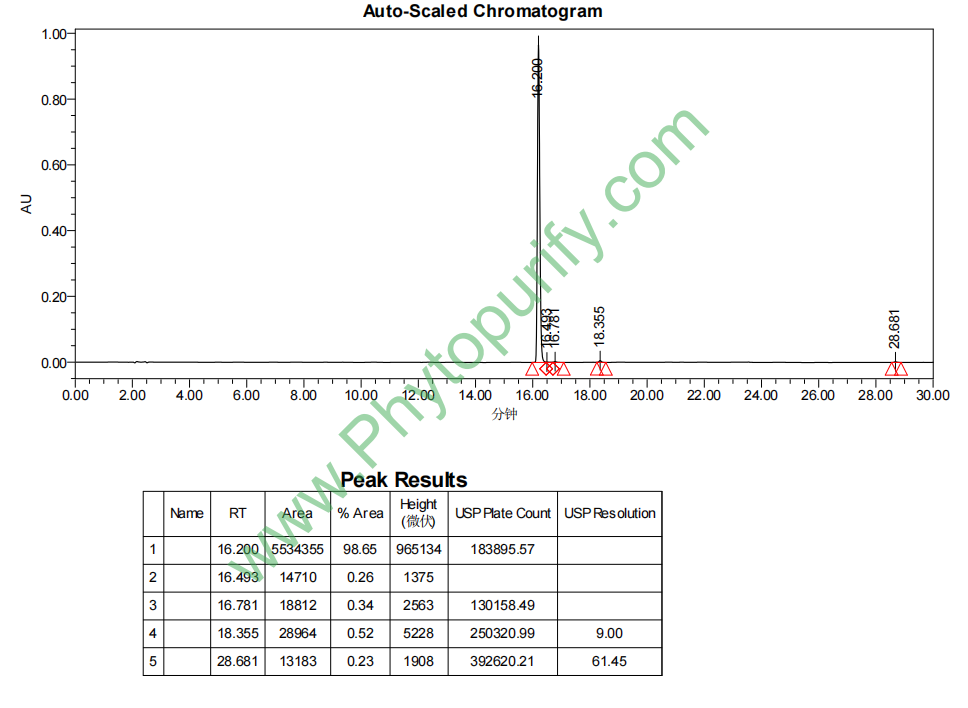
Purity: 95%~99%
Analysis Method: HPLC-DAD or/and HPLC-ELSD
Identification Method: Mass, NMR
Packing: Brown vial or HDPE plastic bottle
Can be supplied from milligrams to grams,up to Kgs, Ton.
Storage conditions:Short-term storage at 2~8℃, long-term storage at -20 ~ -80℃
197.3700
1.9824
1.1645
.3344
1.7725
.0818
Low
87.9588
3.7398
No
Yes
No
No
Yes
No
0.6
Yes
No
Yes
No
Epigallocatechin gallate (EGCG), CAS number 989-51-5, is the most abundant and biologically active catechin monomer in green tea, belonging to flavan-3-ol compounds. As an ester derivative formed by (-) - epigallocatechin gallate and gallic acid, EGCG is widely known for its excellent antioxidant capacity. However, in-depth research over the past two decades has revealed that its pharmacological activity extends far beyond this, involving multiple fields such as anti-tumor, anti-inflammatory, neuroprotective, metabolic regulation, and cardiovascular protection. Especially in the prevention and treatment of colon cancer, it exhibits multi-target and multi pathway characteristics. EGCG, as an outstanding representative of natural polyphenols, has become a bridge between traditional beverages and modern precision medicine due to its complex biological effects and relatively clear targets of action. It is also a star molecule for developing new preventive and therapeutic drugs. This article aims to systematically review the chemical properties, sources, pharmacological activities of EGCG, especially its mechanism of action and molecular targets for colon cancer, and objectively evaluate its pharmacological properties, looking forward to its clinical application prospects.
The chemical name of EGCG is (-) - epigallocatechin-3-gallate, with a molecular formula of C22H18O11 and a molecular weight of 458.3750. The core of its structure is the flavan-3-ol skeleton, which is in the cis configuration ("epigenetic" configuration) at positions 2 and 3 of the C ring, and is connected to a galloyl group through an ester bond on the hydroxyl group at position C3. This unique structure endows EGCG with special physicochemical properties and biological activity.
EGCG molecules contain eight phenolic hydroxyl groups, giving them a strong ability to provide protons and electrons, which is the structural basis for their strong antioxidant activity. Its calculated lipid water partition coefficient (LogP) is about 1.98, indicating that it has a certain degree of lipophilicity, but overall it is still a hydrophilic compound. Its topological polar surface area (TPSA) is as high as 197.37 Å ², indicating that its membrane permeability may be limited. Experimental data confirms that the solubility of EGCG in water is approximately 0.3344 mg/mL, which is slightly soluble. These physicochemical parameters collectively determine the pharmacokinetic behavior of EGCG in vivo: low oral bioavailability, rapid metabolism, and selective tissue distribution. For example, its blood-brain barrier permeability is predicted to be "low", which is consistent with its higher polarity and molecular weight, but also suggests that it may require structural modifications or special delivery systems in the treatment of central nervous system diseases. Fortunately, preliminary screening for drug efficacy showed that EGCG had no significant inhibitory effect on hERG potassium channels (hERG inhibition: no), and the Ames test result was 0.6, indicating a low risk of mutagenicity and providing early data support for its safety.
EGCG mainly comes from the tender leaves of Camellia sinensis (L.) O. Ktze. It has the highest content in green tea, usually accounting for 5% -10% of dry weight, much higher than black tea (due to oxidation during fermentation). In addition, trace amounts are also present in some fruits (such as cranberries, blackberries) and nuts.
The extraction of EGCG from tea mainly uses solvent extraction method. Traditional processes use water or ethanol/water mixed solvents for extraction, followed by liquid-liquid extraction and enrichment of catechins using organic solvents such as ethyl acetate. Modern separation and purification technologies have greatly improved efficiency and purity:
1. Column chromatography technology: Use macroporous adsorption resin (such as HP-20), dextran gel (Sephadex LH-20) or reversed silica gel column (C18) for separation, which can effectively remove caffeine, polysaccharide, protein and other impurities.
2. membrane separation technology Preliminary separation and concentration are carried out using ultrafiltration and nanofiltration membranes based on molecular weight.
3. High speed countercurrent chromatography technology As a solid-liquid distribution chromatography without solid carriers, it is particularly suitable for high-purity preparation of thermosensitive polyphenols, avoiding irreversible adsorption.
4. Crystallization method EGCG can form crystals in specific solvent systems (such as ethyl acetate n-hexane) to obtain high-purity products.
Industrial production often combines multiple technologies, such as the combination process of "water extraction membrane concentration resin adsorption solvent elution crystallization", to achieve efficient, green, and large-scale preparation of EGCG.
The pharmacological activity research of EGCG is extensive and in-depth, and its effects cover almost all major chronic disease fields.
The biological effects of EGCG are not only due to its antioxidant properties, but more importantly, as a polyphenol molecule, it can interact with various proteins, enzymes, receptors, and signaling molecules to regulate complex cellular signaling networks. Taking colon cancer as an example, its anti-tumor effect involves multiple targets and pathways:
Inducing cell cycle arrest and apoptosis:
Inhibition of proliferation, invasion and metastasis:
Reverse multidrug resistance:
Other direct effects:
In summary, the role of EGCG in colon cancer is like a carefully planned "multi-target attack", forming a three-dimensional anti-tumor network from inducing apoptosis, inhibiting proliferation, anti-inflammatory, reversing drug resistance to interfering with metabolism.
Although EGCG has excellent in vitro activity, its pharmacological properties, especially oral bioavailability, are the main bottleneck restricting its clinical translation.
To improve the pharmacological properties of EGCG, current research strategies include:
1. Structural modification Methylation, esterification, or prodrug preparation of phenolic hydroxyl groups to improve stability, lipid solubility, and membrane permeability.
2. New delivery system Develop nanoparticles (liposomes, polymer nanoparticles), microemulsions, phospholipid complexes, cyclodextrin inclusion complexes, etc. to protect EGCG from degradation, enhance its targeting, control its release, and improve its bioavailability.
3. combination therapy Combined with substances such as vitamin C and piperine, it can inhibit the metabolism of EGCG and increase its plasma concentration.
At present, EGCG mainly exists in the form of dietary supplements as a preventive health product. Its clinical application development is moving towards two main directions:
The future research focus should include: ① using systems biology and computational chemistry methods to more accurately elucidate its in vivo action network and direct targets; ② Conduct rigorously designed and sufficiently scaled Phase II/III clinical trials to confirm their efficacy and optimal dosage regimen in specific diseases such as colon adenomas and mild cognitive impairment; ③ Deeply explore its individualized application and study the impact of genetic polymorphism (such as differences in metabolic enzymes and transporter genes) on the efficacy and toxicity of EGCG; ④ Develop smarter and more efficient targeted delivery systems to achieve precise enrichment of disease sites.
Epigallocatechin gallate (EGCG), as a chemical masterpiece gifted by nature, has grown from a simple tea polyphenol to a focal molecule in modern pharmacological research, and its history is remarkable. Based on its multi hydroxyl chemical structure, it plays multiple biological roles such as antioxidant, signal regulation, and protein interaction, especially demonstrating the unique advantage of a "multi-target regulatory network" in combating complex diseases such as colon cancer. Despite its inherent pharmaceutical defects, such as low oral bioavailability and metabolic instability, which pose challenges to direct drug development, this has precisely sparked a research boom in dosage form innovation, structural modification, and combination strategies. The research paradigm of EGCG provides valuable references for the development of other natural products, from prevention to treatment, from adjuvant drugs to new drug lead compounds. With the deep integration of modern science and technology, especially delivery technology and precision medicine, EGCG is expected to break through bottlenecks and truly transform from a health guardian in daily drinking cups to a clinical treatment weapon, playing a more practical and important role in the human journey to fight chronic diseases. Continuous and in-depth research on it is not only about uncovering the value of individual compounds, but also about exploring the mysteries of the dialogue between complex life systems and natural chemicals.
