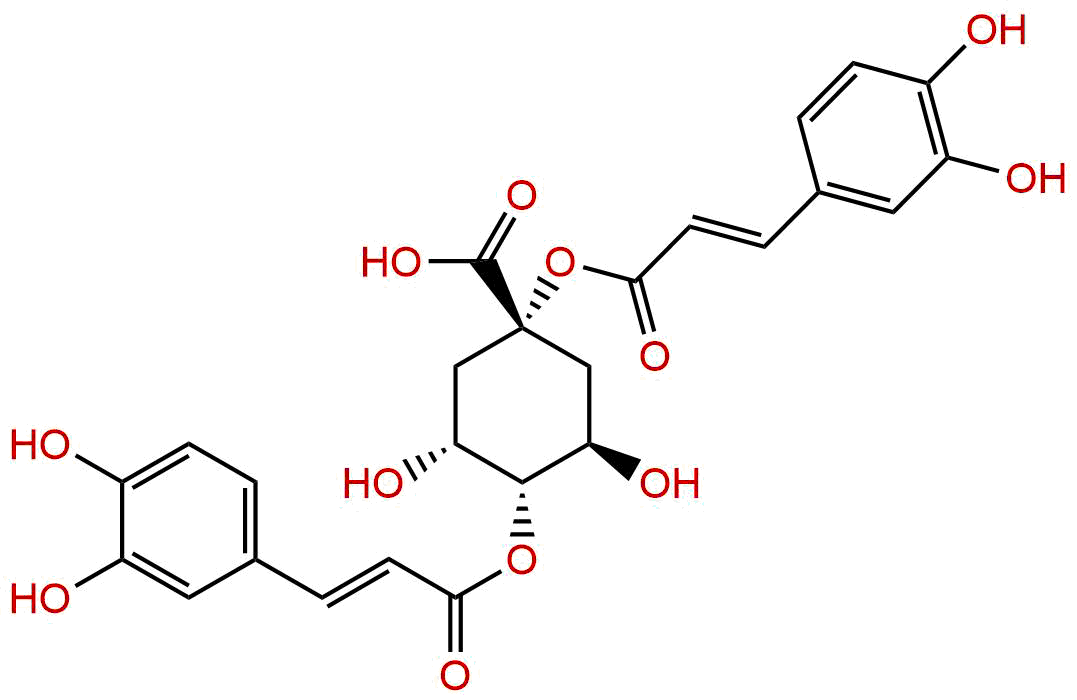


Product name: 1,4-Dicaffeoylquinic acid
Synonym name:
Catalogue No.: BP1860
Cas No.: 1182-34-9
Formula: C25H24O12
Mol Weight: 516.455
Botanical Source: Lonicera japonica Thunb.
Physical Description:
Type of Compound: Phenylpropanoids
Purity: 95%~99%
Analysis Method: HPLC-DAD or/and HPLC-ELSD
Identification Method: Mass, NMR
Packing: Brown vial or HDPE plastic bottle
Storage: Store in a well closed container, protected from air and light. Put into refrigerate or freeze for long term storage.
Whenever possible, you should prepare and use solutions on the same day. However, if you need to make up stock solutions in advance, we recommend that you store the solution as aliquots in tightly sealed vials at -20℃. Generally, these will be useable for up to two weeks.
The product could be supplied from milligrams to grams
Inquire for bulk scale.
For Reference Standard and R&D, Not for Human Use Directly.
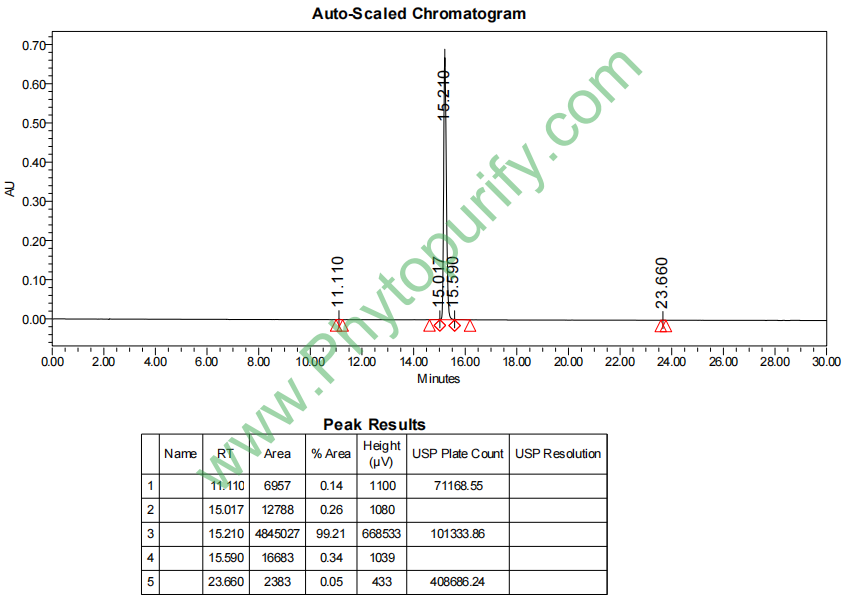
HPLC of 1,4-Dicaffeoylquinic acid
Storage conditions:Short-term storage at 2~8℃, long-term storage at -20 ~ -80℃
211.2800
1.1817
-1.0836
.5847
.8194
.3991
Low
87.7322
3.8776
Yes
No
No
No
Yes
No
0.0
Yes
Yes
Yes
Yes
Natural products, as the source of drug discovery, play an irreplaceable role in the long struggle between humans and diseases. Among numerous natural compounds with biological activity, Caffeoylquinic acids (CQAs) and their derivatives have attracted much attention due to their widespread presence in daily diets (such as coffee, fruits, vegetables) and various medicinal plants, and their diverse pharmacological activities. 1,4-dicaffeoylquinic acid (1,4-dicaffeoylquinic acid, 1,4-diCQA), as an important member of the dicaffeoylquinic acid family, has a unique chemical structure and significant biological activity, especially in the field of antiviral research, making it a hot spot in natural product pharmacology research.
1,4-Dicaffeoylquinic acid, also known as 1,4-di-O-caffeoylquinic acid, is a phenolic acid compound formed by the ester bond between one molecule of quinic acid and two molecules of caffeic acid. Its structural feature is that the caffeoyl group is connected to the hydroxyl groups at positions 1 and 4 of quinic acid, respectively. This specific acylation mode endows it with unique physicochemical properties and biological activity profiles that differ from monocaffeoylquinic acid (such as chlorogenic acid) or other positional isomers (such as 3,5-dicaffeoylquinic acid).
From a historical perspective, the research on caffeoylquinic acid compounds can be traced back to the discovery of chlorogenic acid in the 19th century. However, the in-depth exploration of dicaffeoylquinic acid, especially its antiviral activity, accelerated in the 1980s and 1990s with the global spread of the human immunodeficiency virus (HIV). Early research found that certain plant extracts, such as those from honeysuckle(Lonicera japonica)The components isolated from Asteraceae plants have the ability to inhibit HIV reverse transcriptase and integrase activity. Subsequent chemical and pharmacological studies have confirmed that 1,4-dicaffeoylquinic acid is one of the key contributors to these activities.
This review aims to comprehensively and systematically review the research progress of 1,4-dicaffeoylquinic acid. The article will explore its plant origin and extraction techniques based on its chemical structure and physicochemical properties, with a focus on its pharmacological activity in the field of anti HIV and other diseases. It will also delve into its molecular mechanisms of action with key targets such as CCR5, CXCR4, HIV integrase, Nef, and Tat proteins. At the same time, combining modern medicinal chemistry and pharmacokinetic theory, objectively evaluate its drug properties, and look forward to its potential applications and challenges in clinical translation. Through this article, we hope to provide a comprehensive and in-depth reference for researchers engaged in natural product chemistry, pharmacology, and antiviral drug development.
The chemical structure of 1,4-dicaffeoylquinic acid is the basis of all its biological activities. Its core skeleton is Quinic acid, a cyclohexane polyhydroxy acid containing four hydroxyl groups and one carboxyl group. In 1,4-dicaffeoylquinic acid molecules, the 1st and 4th hydroxyl groups of quinic acid are respectively connected to a molecule of caffeic acid through ester bonds. Caffeic acid is a hydroxycinnamic acid, which contains a catechol (catechol) group and an acrylic side chain in its structure. Therefore, 1,4-dicaffeoylquinic acid molecules are rich in phenolic hydroxyl groups and conjugated double bond systems, which are key structural units for their antioxidant properties, chelation of metal ions, and interactions with biomolecules.
From a stereochemical perspective, multiple chiral centers on the quinic acid ring endow the molecule with a specific three-dimensional conformation. There are spatial structural differences between 1,4-dicaffeoylquinic acid and its isomers, such as 3,4-3,5- and 4,5-dicaffeoylquinic acid. This difference directly affects their binding affinity and selectivity with different target proteins. For example, studies have shown that 3,5-dicaffeoylquinic acid has stronger inhibitory activity against HIV integrase, while 1,4-dicaffeoylquinic acid exhibits unique advantages in inhibiting HIV entry, attributed to its specific acyl spatial arrangement.
In terms of physicochemical properties, 1,4-dicaffeoylquinic acid exhibits typical phenolic acid compound characteristics. Its molecular weight is 516.4550 g/mol. According to computer-aided prediction, its lipid water partition coefficient (LogP) is 1.1817, indicating a certain degree of lipophilicity, but overall leaning towards hydrophilicity. The topologically polar surface area (TPSA) is as high as 211.2800 Å ², mainly attributed to the large number of hydroxyl and carboxyl groups in the molecule. A high TPSA value usually indicates that the molecule has good water solubility (predicted water solubility of 0.5847 mg/mL), but it also means that its transmembrane permeability is poor, especially difficult to penetrate the blood-brain barrier (predicted blood-brain barrier permeability is low). This characteristic determines its distribution and pharmacokinetic behavior in the body. In addition, the presence of phenolic hydroxyl groups makes it weakly acidic, easily dissociated under alkaline conditions, and relatively stable under acidic conditions. Its UV absorption spectral characteristics mainly come from the conjugated system of caffeoyl groups, usually with a strong absorption peak around 325 nm, which provides convenience for its detection and quantitative analysis.
1,4-Dicaffeoylquinic acid is widely distributed in nature, but it is not the main secondary metabolite, and its content is usually lower than the common chlorogenic acid (3-caffeoylquinic acid). It mainly exists in plants such as Asteraceae, Caprifoliaceae, Convolvulaceae, etc.
The main sources of plants include:
1. Honeysuckle flower(Lonicera japonica Thunb.)As a traditional Chinese medicine for clearing heat and detoxifying, honeysuckle is one of the most extensively studied sources of 1,4-dicaffeoylquinic acid. Its flower buds are rich in various caffeoylquinic acid compounds, among which 1,4-dicaffeoylquinic acid is one of the active ingredients.
2. Asteraceae plants Various Asteraceae plants, such as Artemisia argyi(Artemisia argyi)Artemisia scoparia, Artemisia scoparia(Artemisia capillaris)Stevia rebaudiana(Stevia rebaudiana)Purple cone chrysanthemum(Echinacea purpurea)All of them have been reported to contain 1,4-dicaffeoylquinic acid.
3. Coffee plants Although coffee beans mainly contain chlorogenic acid, trace amounts of dicaffeoylquinic acid, including 1,4-isomers, can also be detected in the leaves and fruits of coffee.
4. Other plants Like burdock(Arctium lappa)Dandelion(Taraxacum officinale)This compound also exists in common medicinal and edible plants.
The choice of extraction method is directly related to the yield, purity, and activity maintenance of the target compound. Given that 1,4-dicaffeoylquinic acid is sensitive to heat and light and easily oxidized, the extraction process typically requires mild conditions.
Traditional extraction methods:
- Solvent extraction method The most commonly used method. Usually, ethanol water or methanol water mixed solvents (such as 50% -80% ethanol) are used for heating reflux or cold soaking extraction. Acidizing solvents (such as adding a small amount of formic acid or acetic acid) can help improve the extraction efficiency of phenolic compounds and inhibit their dissociation. This method is simple to operate, but has poor selectivity, and the extract contains a large amount of impurities.
- Water extraction method Low cost, but the extraction efficiency is usually lower than that of alcohol extraction, and it is easy to introduce a large amount of water-soluble impurities such as polysaccharides and proteins.
Modern extraction and purification techniques:
- Ultrasound assisted extraction (UAE)Using the cavitation effect of ultrasound to destroy plant cell walls, accelerate solvent penetration and target component dissolution. This method has the advantages of short extraction time, low temperature, and high efficiency, and is particularly suitable for thermosensitive components.
- Microwave assisted extraction (MAE)By using microwave energy to selectively heat polar molecules (such as water), the interior of the cell rapidly heats up, increasing pressure and causing cell rupture, thereby releasing its contents. High efficiency, but attention should be paid to temperature control to prevent compound degradation.
- Enzyme Assisted Extraction (EAE)Using cellulases, pectinases, and other enzymes to hydrolyze plant cell walls, breaking down their structural barriers, thereby increasing the dissolution rate of target components. This method has mild conditions and is environmentally friendly, but the cost is relatively high.
Purification strategy:
The content of 1,4-dicaffeoylquinic acid in crude extract is usually low and requires further separation and purification.
- Liquid-liquid extraction Preliminary separation of target substances and impurities based on differences in solubility using different solvents such as ethyl acetate and n-butanol.
- Macroporous adsorption resin chromatography This is a classic method for separating and purifying phenolic acid compounds. By selecting appropriate types of resins (such as HPD-100, AB-8) and gradient elution conditions (ethanol water), the target components can be effectively enriched.
- Preparation type high performance liquid chromatography (Prep HPLC): is the most effective means to obtain high-purity (>98%) 1,4-dicaffeoylquinic acid. Usually, a reverse phase C18 chromatographic column is used, with acetonitrile water (containing a small amount of acid) as the mobile phase for isocratic or gradient elution.
The pharmacological activity research of 1,4-dicaffeoylquinic acid mainly focuses on its antiviral, antioxidant, anti-inflammatory and other aspects, among which the anti HIV activity is the most concerned core area.
This is the most representative pharmacological activity of 1,4-dicaffeoylquinic acid. Numerous in vitro studies have shown that this compound can act on multiple stages of the HIV lifecycle, exhibiting multi-target inhibition properties.
The pharmacological activity of 1,4-dicaffeoylquinic acid originates from its interactions with multiple molecular targets, exhibiting typical "multi-target drug" characteristics. Its core mechanism of action can be summarized as follows:
This is the area where its research is most in-depth and its mechanism is most clear.
meaning Targeting two main HIV co receptors simultaneously theoretically can cover a wider range of viral preferences (R5 and X4 viruses), overcoming the problem of viral preference switching that may be caused by single co receptor antagonists.
Target: HIV-1 gp120 envelope glycoprotein
mechanism 1,4-Dicaffeoylquinic acid can directly bind to the conserved region of gp120, especially near the CD4 binding site or co receptor binding site. This binding stabilizes the closed conformation of gp120, preventing it from undergoing necessary conformational rearrangements after binding to CD4, thereby failing to expose the co receptor binding site and ultimately inhibiting membrane fusion. The surface plasmon resonance (SPR) experiment confirmed its direct binding with gp120.
Target: HIV-1 integrase (IN)
mechanism The mechanism by which it inhibits integrase activity is believed to be a dual effect of "metal ion chelation" and "protein binding". The catechol group in the molecule is an efficient metal chelating agent that can competitively capture the Mg ² ⁺ cofactor of the integrase active site (near the LEDGF/p75 binding pocket), thereby inhibiting the catalytic activity of the enzyme. In addition, it may also directly form hydrogen bonds or π - π stacking with amino acid residues of integrases (such as Lys, Arg), interfering with their binding to viral DNA substrates.
Target: Nef and Tat regulatory proteins
To promote 1,4-dicaffeoylquinic acid from a natural active ingredient to clinical use, it is necessary to rigorously evaluate its drug like and pharmacokinetic (ADME) properties.
According to Lipinski's "Rule of Five" and other classic pharmacological criteria, the behavior of 1,4-dicaffeoylquinic acid is as follows:
- molecular weight:516.4550 Da, Slightly above the threshold of 500 Da.
- LogP 1.1817, far less than 5, moderate lipophilicity.
- hydrogen bond donor The molecule contains multiple phenolic hydroxyl and carboxyl groups, and the number of hydrogen bond donors (>5) exceeds the rule limit.
- Hydrogen bond acceptor The same quantity (>10) exceeds the rule limit.
Therefore, 1,4-dicaffeoylquinic acid violates the Lipinski rule, especially in terms of high molecular weight and excessive hydrogen bond donors/acceptors. This usually indicates that its oral bioavailability may be low. However, there are many successful drugs outside of these "rules" in natural products. Other important pharmacological parameters include:
- TPSA 211.28 Å ², much higher than the threshold of 140 Å ², indicates poor transmembrane permeability, especially difficulty in penetrating the blood-brain barrier.
- Water solubility:0.5847 mg/mL, Belongs to moderate to low water solubility.
- HERG inhibition A prediction of 'no' indicates a low risk of cardiac toxicity.
- Ames test The predicted value is 0.0, indicating a low risk of mutagenicity.
Overall, 1,4-dicaffeoylquinic acid has a certain pharmacological basis (low toxicity, no hERG inhibition), but it faces significant challenges in oral absorption and bioavailability.
At present, direct research on the pharmacokinetics of 1,4-dicaffeoylquinic acid in vivo is relatively limited, but based on the study of its structural analogues (such as chlorogenic acid and 3,5-dicaffeoylquinic acid), its general characteristics can be inferred:
key challenges The extremely low oral bioavailability is the biggest bottleneck limiting the clinical application of 1,4-dicaffeoylquinic acid. Its pharmacological activity may depend more on its local effects in the intestine (such as regulating gut microbiota, antioxidant) or mediated by its active metabolites produced in the body.
Despite facing severe challenges in pharmacokinetics, the unique pharmacological activity spectrum of 1,4-dicaffeoylquinic acid, especially its multi-target anti HIV mechanism, still opens up promising prospects for its clinical application.
1,4-Dicaffeoylquinic acid, a phenolic acid compound originating from nature, demonstrates the eternal value of natural products in drug discovery with its unique chemical structure and multi-target biological activity, especially its enormous potential in the field of anti HIV. It provides new ideas for addressing the global challenge of HIV infection by simultaneously acting on multiple links such as virus entry, integration, and regulation, as well as its impact on host immune regulation.
However, the journey from "natural active ingredients" to "clinical drugs" is still long and challenging. The inherent physical and chemical property defects, especially low oral bioavailability, are the core bottleneck restricting its development. Future research must closely integrate modern medicinal chemistry, pharmacy, and in-depth molecular pharmacology research. On the one hand, innovative structural modification and delivery technologies should be used to "leverage strengths and avoid weaknesses", and on the other hand, comprehensive in vivo action networks and active metabolites should be revealed through systems biology methods.
The study of 1,4-dicaffeoylquinic acid is not only an exploration of a specific compound, but also a practice of the paradigm of natural product drug development. It reminds us that in addition to pursuing the modern drug design concept of "single target, high affinity", natural products that originate from natural evolution and have the characteristics of "multi-target, weak interaction" still contain enormous wisdom for treating complex diseases. We have reason to believe that, with the continuous deepening of research and the progress of technical means, 1,4-dicaffeoylquinic acid and its derivatives will eventually find their own place in the fight against diseases, especially AIDS.
