


Product name: Cryptochlorogenic acid
Synonym name: 4-O-caffeoylquinic acid; 4-caffeoylquinic acid
Catalogue No.: BP0411
Cas No.: 905-99-7
Formula: C16H18O9
Mol Weight: 354.311
Botanical Source: Coffea sp. (coffee), Cynara scolymus (artichoke) heads, Cydonia oblonga (quince fruit), Helianthus sp. (sunflowers), Ipomoea batatas (sweet potato) tubers and Prunus domestica (prune)
Physical Description: White powder
Type of Compound: Phenylpropanoids
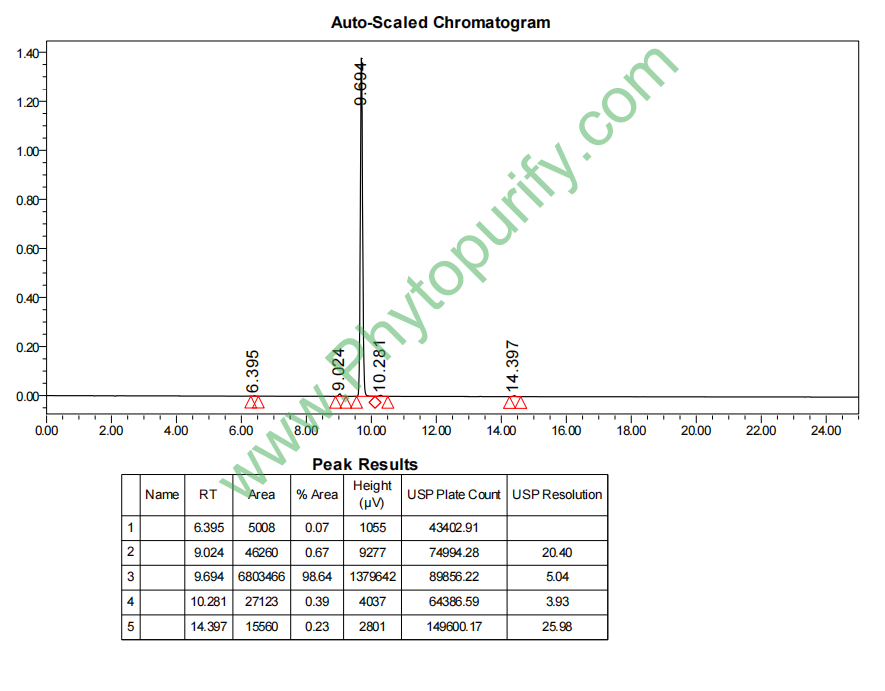
Purity: 95%~99%
Analysis Method: HPLC-DAD or/and HPLC-ELSD
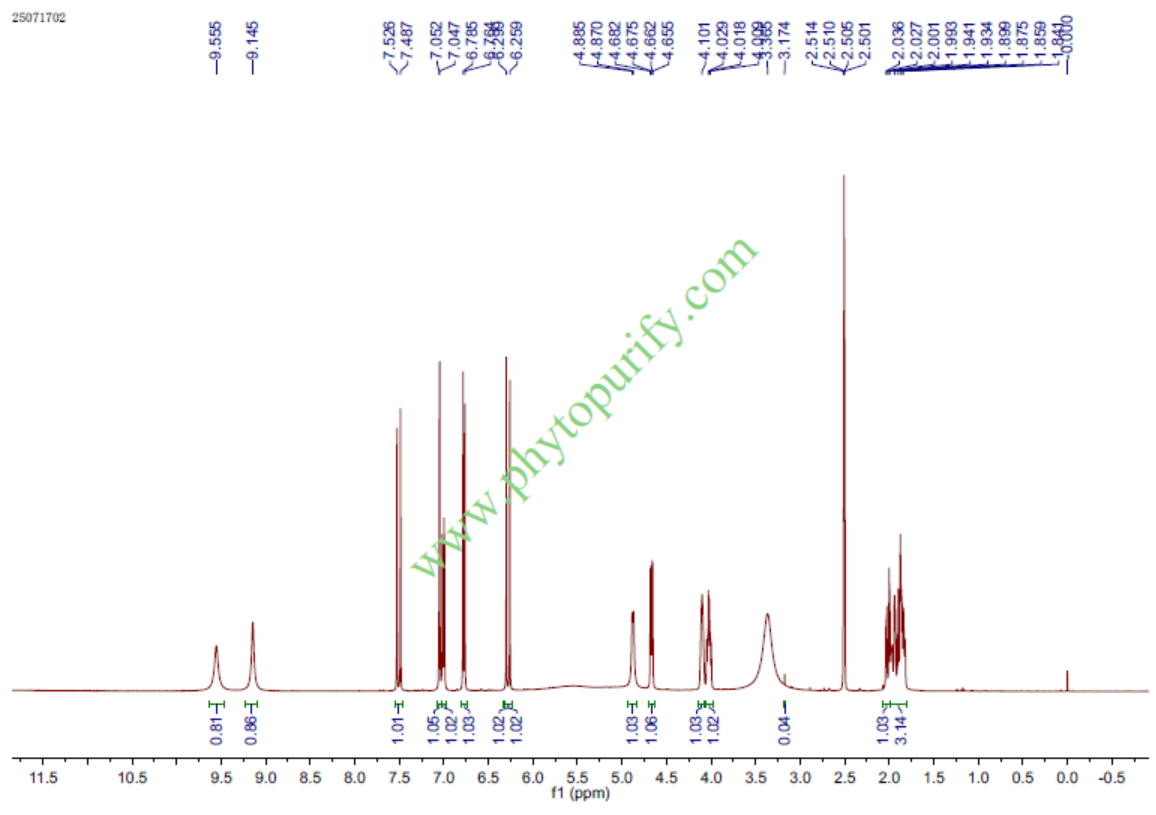
Identification Method: Mass, NMR
Packing: Brown vial or HDPE plastic bottle
Storage: Store in a well closed container, protected from air and light. Put into refrigerate or freeze for long term storage.
Whenever possible, you should prepare and use solutions on the same day. However, if you need to make up stock solutions in advance, we recommend that you store the solution as aliquots in tightly sealed vials at -20℃. Generally, these will be useable for up to two weeks.
The product could be supplied from milligrams to grams, up to kilograms
Inquire for bulk scale.
Descriptions:
Chlorogenic acid has antioxidative activity, superoxide anion radicals, and radical scavenging activity.[1]
References:
[1] Nakatani N, Kayano S, Kikuzaki H, et al. J Agr Food Chem, 2000, 48(11):5512-6.
[2] Wang J, Zhang X, Xiaoyan W U, et al. China J Chinese Mat Med, 2010, 35(13):1702-5.
HPLC of Cryptochlorogenic acid
HNMR of Cryptochlorogenic acid
Storage conditions:Short-term storage at 2~8℃, long-term storage at -20 ~ -80℃
164.7500
-.2567
-2.2806
5.6331
.6181
.4451
Low
64.5067
3.5845
Yes
No
No
No
Yes
No
0.0
Yes
Yes
Yes
Yes
In the field of natural product chemistry and pharmacology research, phenolic acid compounds have attracted much attention due to their extensive biological activity and low toxicity. Caffeoylquinic acid compounds are one of the important members, widely present in various medicinal plants and daily fruits and vegetables. Cryptochlorogenic acid, also known as 4-caffeoylquinic acid, is an isomer of chlorogenic acid that has been relatively poorly studied for a long time and is often considered a minor component in chlorogenic acid mixtures. However, with the advancement of separation and purification technology and the deepening of pharmacological research, the unique biological activity of chlorogenic acid has gradually been revealed, demonstrating its significant potential in anti-inflammatory, antioxidant, and cardiovascular protection. Modern pharmacological studies have shown that chlorogenic acid can intervene in pathological processes such as inflammation, oxidative stress, and pathological myocardial hypertrophy by regulating key signaling pathways such as nuclear factor kappa B, nuclear factor E2 related factor 2, phosphatidylinositol 3-kinase/protein kinase B/mammalian rapamycin target protein/hypoxia inducible factor-1 alpha. This article aims to systematically review the chemical properties, plant sources, pharmacological activities, molecular mechanisms of action, and medicinal properties of chlorogenic acid, in order to provide scientific basis for the deep development and clinical application of this natural product.
Cryptochlorogenic acid (4-Caffeoylquinic acid), CAS number 905-99-7, is a monocaffeoylquinic acid. Its molecular formula is C ₁₆ H ₁₈ O ₉, and its molecular weight is 354.3110. Structurally, it is composed of quinic acid (a cyclic polyol acid) and caffeic acid connected by ester bonds. Its structural feature is that the caffeoyl group is attached to the 4th hydroxyl group of the quinic acid parent nucleus, which forms isomers with common chlorogenic acid (5-caffeoylquinic acid) and neochlorogenic acid (3-caffeoylquinic acid). The difference in connection positions directly affects its spatial conformation, physicochemical properties, and biological activity.
In terms of physicochemical properties, chlorogenic acid is a white to off white powder and belongs to the category of moderately polar compounds. The calculated lipid water partition coefficient (LogP) is approximately -0.2567, indicating its strong hydrophilicity. The topologically polar surface area (TPSA) is as high as 164.75 Å ², which is closely related to the presence of multiple polar groups such as hydroxyl and carboxyl groups in its molecules. The higher polarity also determines its good water solubility, with a predicted water solubility value of approximately 5.6331 mg/mL, which is beneficial for its dissolution and absorption in living organisms. However, its higher polarity and TPSA also indicate a lower ability to penetrate the blood-brain barrier, which is consistent with the description of "low blood-brain barrier permeability" in its pharmacokinetic properties. This compound is relatively stable in acidic to neutral environments, but its ester bonds may undergo hydrolysis under strong alkaline or high-temperature conditions.
Chlorogenic acid is widely distributed in various plants in nature, especially in the Asteraceae, Rosaceae, and Lonicera families, where its content is relatively abundant. Common sources include honeysuckle (Lonicera japonica), coffee beans (Coffea arabica), chrysanthemums (Chrysanthemum morifolium), echinacea purpurea, as well as many fruits and vegetables such as apples, peaches, eggplants, and potatoes. In these plants, cryptochlorogenic acid usually coexists with various isomers such as chlorogenic acid and neochlorogenic acid, forming a complex mixture of phenolic acids.
Solvent extraction method is commonly used to extract chlorogenic acid from plant materials. Methanol, ethanol, acetone, and their mixed solutions with water are commonly used extraction solvents, among which the ethanol water system is highly favored for its safety, environmental friendliness, and high extraction efficiency. In order to improve extraction efficiency, modern extraction techniques such as ultrasound assisted extraction, microwave-assisted extraction, and pressurized liquid extraction have been widely used. These techniques destroy plant cell walls through physical means, accelerate solvent penetration and dissolution of target components, thereby shortening extraction time and improving yield.
The crude extract after extraction has complex components and requires further separation and purification to obtain high-purity chlorogenic acid. The conventional purification steps include: first, using macroporous adsorption resins (such as AB-8, D101 type) for preliminary enrichment, and removing impurities such as sugars and proteins according to the adsorption desorption principle; Subsequently, intermediate separation was performed using silica gel column chromatography, polyamide column chromatography, or preparative thin-layer chromatography; The final production of high-purity products usually relies on high-performance liquid chromatography technology, especially reverse phase preparative HPLC, using C18 chromatography columns and gradient elution with methanol water or acetonitrile water (often with small amounts of formic acid or acetic acid added to improve peak shape) as the mobile phase. In recent years, high-speed countercurrent chromatography technology has shown unique advantages in separating isomers due to its irreversible adsorption and high recovery rate. The isolated compounds need to be structurally confirmed through techniques such as nuclear magnetic resonance and mass spectrometry.
A large number of pharmacological experiments both in vitro and in vivo have confirmed that cryptochlorogenic acid has multiple biological activities, with its core effects concentrated in the fields of anti-inflammatory, antioxidant, and cardiovascular protection.
1. Anti inflammatory activity
Chlorogenic acid exhibits significant anti-inflammatory effects. In the lipopolysaccharide induced macrophage (such as RAW264.7) inflammation model, chlorogenic acid can dose dependently inhibit the production of inflammatory mediators such as nitric oxide and prostaglandin E2, while downregulating the protein expression of inducible nitric oxide synthase and cyclooxygenase-2. In animal models, chlorogenic acid can effectively alleviate paw swelling and acute lung injury induced by carrageenan or LPS in mice, and reduce the levels of pro-inflammatory cytokines such as tumor necrosis factor - α, interleukin-1 β, and interleukin-6 in inflammatory sites or serum.
2. Antioxidant activity
Chlorogenic acid is an effective free radical scavenger and metal ion chelating agent. In vitro chemical experiments have shown that it has strong scavenging ability against 1,1-diphenyl-2-trinitrophenylhydrazine free radicals, 2,2 '- diazo-bis-3-ethylbenzothiazoline-6-sulfonic acid cationic free radicals, and superoxide anion free radicals. Its antioxidant mechanism is not limited to directly clearing reactive oxygen species, but also lies in its ability to activate the cell's own antioxidant defense system. In cell oxidative damage models induced by hydrogen peroxide or tert butyl hydroperoxide (such as H9c2 cardiomyocytes and HL-7702 hepatocytes), pretreatment with chlorogenic acid can significantly improve cell survival rate, reduce intracellular reactive oxygen species levels and malondialdehyde content, and enhance the activity of antioxidant enzymes such as superoxide dismutase, catalase, and glutathione peroxidase.
3. Cardiovascular protective effect
Chlorogenic acid has a clear protective effect on the cardiovascular system. One of its core activities is anti myocardial hypertrophy. In the animal model of pathological myocardial hypertrophy induced by isoproterenol, administration of chlorogenic acid can significantly reduce cardiac weight index, improve cardiac function indicators, and inhibit the increase in cross-sectional area of myocardial cells. In addition, the study also suggests that cryptochlorogenic acid may have the potential of anti atherosclerosis, improving endothelial function and resisting myocardial ischemia reperfusion injury. These effects are closely related to their anti-inflammatory and antioxidant properties, and together form the basis of their cardiovascular protection.
4. Other potential activities
Preliminary studies also found that cryptochlorogenic acid may also play a role in regulating glucose and lipid metabolism (potential anti diabetes activity), protecting nerves (resisting neuron damage induced by oxidative stress) and anti-tumor (inhibiting the proliferation of some cancer cells), but these activities still need further systematic research to confirm.
The multiple pharmacological activities of chlorogenic acid stem from its precise regulation of multiple key signaling pathways within cells, and its mechanism of action mainly focuses on the following three aspects:
1. Inhibit the NF - κ B inflammatory pathway
Nuclear factor kappa B is a core transcription factor that regulates inflammatory responses. In the resting state, NF - κ B binds to its inhibitory protein I κ B and exists in the cytoplasm. When stimulated by LPS and other factors, I κ B is phosphorylated and degraded, and NF - κ B (usually p65/p50 dimer) is released and transferred into the nucleus, initiating the transcription of numerous pro-inflammatory cytokine genes. Research has shown that chlorogenic acid can inhibit the phosphorylation and degradation of I κ B α, thereby preventing the nuclear translocation of NF - κ B p65 subunit. At the same time, it can also reduce the DNA binding activity of p65 in the nucleus, ultimately leading to downregulation of gene expression such as TNF - α, IL-6, IL-1 β, iNOS, and COX-2, which is the main molecular basis for its anti-inflammatory effect.
2. Activate the Nrf2/ARE antioxidant pathway
Nuclear factor E2 related factor 2 is the central regulator of cellular antioxidant stress response. Under oxidative stress, Nrf2 dissociates from the chaperone protein Keap1 in the cytoplasm, transfers to the nucleus, binds to antioxidant response elements, and initiates the transcription of a series of phase II detoxifying enzymes and antioxidant proteins. Chlorogenic acid has been shown to promote nuclear transfer of Nrf2 and enhance its binding ability with ARE. The downstream target genes regulated by it include heme oxygenase-1, quinone oxidoreductase 1, superoxide dismutase, catalase, and glutathione peroxidase. By activating the Nrf2 pathway, chlorogenic acid not only enhances the direct antioxidant enzyme defense ability of cells, but also exerts anti-inflammatory and cell protective effects through the production of enzymes such as HO-1.
3. Adjust the PI3K/Akt/mTOR/HIF-1 α signal axis
The phosphatidylinositol 3-kinase/protein kinase B/mammalian rapamycin target protein pathway is a core pathway that regulates cell growth, proliferation, metabolism, and survival, and is closely related to hypoxia inducible factor-1 α. During pathological myocardial hypertrophy and other processes, this pathway is often abnormally activated. Research has found that chlorogenic acid can regulate PI3K α/Akt/mTOR signaling. Specifically, it may affect downstream effector molecules such as HIF-1 α by moderately inhibiting the excessive phosphorylation of Akt and mTOR. HIF-1 α is a key factor in cellular adaptation to hypoxia, but its sustained high expression promotes transcription of genes related to myocardial hypertrophy. Cryptochlorogenic acid inhibits the pathological growth and remodeling of myocardial cells by intervening in this pathway, which may be an important mechanism of its anti myocardial hypertrophy effect.
4. Effects on specific target proteins
In addition to the aforementioned pathways, chlorogenic acid may also directly or indirectly affect the activity and expression of specific antioxidant enzyme targets such as SOD1, SOD2, CAT, and GPX1, thereby consolidating the cellular antioxidant defense network at multiple levels.
The pharmacological evaluation based on calculations and preliminary experimental data shows that chlorogenic acid, as a natural small molecule, has certain development potential, but there are also some challenges.
Analysis of pharmacological parameters:
Its molecular weight (354.3) meets the requirement of less than 500 in the "Five Rules" for generic drugs. The lower LogP value (-0.26) and higher TPSA (164.8) indicate its strong hydrophilicity and high polarity, which explains its good water solubility, but also suggests that its cell membrane permeability may be average, especially its ability to cross the blood-brain barrier is low, which limits its therapeutic potential for central nervous system diseases. In the safety early warning indicators, the predicted risk of hERG inhibition is "no", indicating a low potential risk of causing QT interval prolongation in the heart. The Ames test predicted a result of 0.0, indicating that it may not be mutagenic and preliminarily demonstrating good genetic toxicity safety characteristics.
Pharmacokinetic studies:
At present, pharmacokinetic studies on the cryptochlorogenic acid system are relatively limited. The existing pharmacokinetic data mostly come from the study of its homolog chlorogenic acid or the study of plant extracts containing chlorogenic acid. It is known that after oral administration, caffeoylquinic acid compounds are rapidly but incompletely absorbed in the gastrointestinal tract, and their absolute bioavailability is influenced by various factors. They may undergo extensive first pass metabolism in intestinal epithelial cells and liver, including hydrolysis (ester bond cleavage to produce caffeic acid and quinic acid), methylation, sulfonation, and glucuronidation. Caffeic acid and its metabolites may be further metabolized by gut microbiota. The prototype drug and its metabolites are mainly excreted through the kidneys and urine. The specific absorption, distribution, metabolism, and excretion characteristics of chlorogenic acid, especially its differences in pharmacokinetic behavior with common isomers such as chlorogenic acid, need to be further studied through more accurate detection methods (such as using dedicated LC-MS/MS methods). The oral bioavailability, tissue distribution characteristics, and potential drug drug interaction risks will be the focus of future preclinical pharmacokinetic evaluations.
As a multi-target and multifunctional natural active molecule, chlorogenic acid has shown broad application prospects in the prevention and treatment of various chronic diseases.
Potential clinical application directions:
1. Adjuvant treatment and prevention of cardiovascular diseases: Based on its properties of anti cardiac hypertrophy, anti oxidative stress and anti inflammation, cryptochlorogenic acid is expected to be developed as a drug or functional food ingredient for the auxiliary treatment of hypertensive heart disease, cardiac hypertrophy, heart failure and atherosclerosis.
2. Management of metabolic diseases: Its anti-inflammatory and antioxidant effects can help improve insulin resistance and vascular endothelial function, which may be of value in the prevention and treatment of type 2 diabetes and its complications (such as diabetes cardiomyopathy).
3. Inflammatory related diseases: It can be used to alleviate chronic low-grade inflammation or as an adjuvant for inflammatory diseases of specific organs, such as hepatitis, pneumonia, colitis, etc.
4. Health products and functional foods: Due to its natural source and high safety, chlorogenic acid can be used as an antioxidant and anti-inflammatory additive, and is widely used in health foods, beverages, and cosmetics.
Challenges and Future Prospects:
Despite the promising prospects, the development of chlorogenic acid still faces many challenges:
1. Source and Cost: The content of chlorogenic acid in natural products is usually lower than its isomer chlorogenic acid, and the cost of obtaining high-purity monomers on a large scale is relatively high. In the future, efficient biosynthetic or chemical synthesis routes need to be developed.
2. Pharmacological mechanism depth: The existing mechanism research is still mostly focused on a few classic pathways, and their direct effects on more specific targets, epigenetic regulation, and other aspects need to be elucidated.
3. Systemic pharmacokinetics and toxicology: The lack of complete and standardized preclinical pharmacokinetic and long-term toxicological research data is a key bottleneck for its drug conversion.
4. Formulation and delivery: Its strong hydrophilicity and possible first pass effect may affect oral bioavailability, and suitable drug delivery systems such as nanoparticles, liposomes, or prodrug strategies need to be studied to improve its stability and targeting.
Future research should focus on utilizing synthetic biology techniques to achieve efficient and green biomanufacturing; Combining chemical and biological methods (such as molecular probes) to deeply reveal its target network of action; Conduct preclinical safety and efficacy evaluations that comply with international standards; Explore structural optimization and modification based on the core structure of chlorogenic acid, in order to obtain derivatives with stronger activity and better pharmacokinetic properties.
Hidden chlorogenic acid, a natural phenolic acid compound once hidden under the halo of chlorogenic acid, is increasingly becoming a hot topic in natural product pharmacology research due to its unique chemical structure and excellent multiple pharmacological activities. Its role in anti-inflammatory, antioxidant, and cardiovascular protection is achieved by regulating key signaling pathways such as NF - κ B, Nrf2, PI3K/Akt/mTOR/HIF-1 α, reflecting the advantages of multi-target and multi pathway synergistic effects of natural products. The preliminary evaluation of its pharmacological properties shows its good development potential, but breakthroughs in systematic pharmacokinetics, toxicology research, and efficient preparation techniques are the key to whether it can move from laboratory to clinical application. With the continuous deepening of research and the continuous advancement of technology, chlorogenic acid is expected to open up new horizons in drug development, functional foods, and the big health industry, providing a new natural choice for the prevention and treatment of chronic diseases in humans. Continuous and in-depth research on it will not only help to uncover the value of this specific molecule, but also provide important references for the development of similar natural products.
