


Product name: Isochlorogenic acid C
Synonym name: 4,5-Dicaffeoylquinic acid;Isochlorogenic acid C, Deleted Cas No.: 32451-88-0
Catalogue No.: BP0074
Cas No.: 57378-72-0
Formula: C25H24O12
Mol Weight: 516.455
Botanical Source:
Physical Description: White powder
Type of Compound: Phenylpropanoids
Purity: 95%~99%
Analysis Method: HPLC-DAD or/and HPLC-ELSD
Identification Method: Mass, NMR
Packing: Brown vial or HDPE plastic bottle
Storage: Store in a well closed container, protected from air and light. Put into refrigerate or freeze for long term storage.
Whenever possible, you should prepare and use solutions on the same day. However, if you need to make up stock solutions in advance, we recommend that you store the solution as aliquots in tightly sealed vials at -20℃. Generally, these will be useable for up to two weeks.
The product could be supplied from milligrams to grams, up to kilograms
Inquire for bulk scale.
Descriptions:
Isochlorogenic acid C possesses potent hepatoprotective and anti-HBV effects; the anti-apoptotic and anti-injury effects could be achieved by its anti-oxidative properties and interfering the caspase-3 and TGF-beta expressions.;the anti-HBV target may mainly be at the downstream links of HBV replication process and is probably associated with blocking translation step.[1]
Isochlorogenic acid C has antioxidant activity.[2]
References:
[1] Hu S Q, Wu Y H, Hao B J, et al. J Med Plants Res, 2012,6(16):3199-206.
[2] Chang Y X, Liu J, Bai Y, et al.Plos One, 2014, 9(9):e106254-e106254.
[3] Xiao-Kun X U, Chen Z Y, Liao L P, et al. China Journal of Chinese Materia Medica, 2015, 40(6):1119-22.
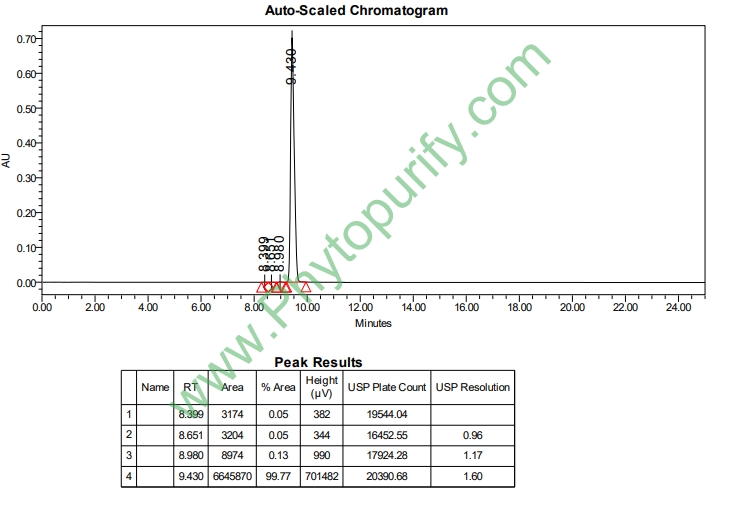
HPLC of Isochlorogenic acid C
Storage conditions:Short-term storage at 2~8℃, long-term storage at -20 ~ -80℃
Isochlorogenic acid C (CAS number: 57378-72-0) is a naturally occurring derivative of quinic acid phenolic acid, widely distributed in various Chinese medicinal herbs and plants. As one of the isomers of chlorogenic acid, isochlorogenic acid C has attracted widespread attention in the field of natural product pharmacology in recent years due to its unique chemical structure and significant biological activity. Numerous studies have shown that isochlorogenic acid C has significant hepatoprotective effects and anti hepatitis B virus (HBV) activity. Its ability to resist apoptosis and cell damage is mainly attributed to its strong antioxidant properties and regulation of key molecular targets such as caspase-3 and TGF - β 1 expression. In addition, the therapeutic potential of isochlorogenic acid C in cardiovascular diseases such as heart failure is gradually being revealed. Its targets include multiple key proteins such as AMPK, EHMT2, APP, PTPN1, etc., demonstrating complex multi-target regulatory characteristics.
This article aims to systematically review the chemical structure and physicochemical properties, plant sources and extraction processes, pharmacological activity and mechanism of action, pharmacological evaluation and pharmacokinetic characteristics of isochlorogenic acid C, and explore its potential prospects in clinical applications, providing theoretical basis and research direction for subsequent drug development and clinical translation.
Isochlorogenic acid C belongs to quinic acid phenolic acid derivatives and is one of the isomers of chlorogenic acid. Its molecular formula is C25H24O12 and its molecular weight is 516.4550. Its structural feature is that the quinic acid core is connected to multiple caffeic acid units through ester bonds, forming a triester structure. The LogP value of isochlorogenic acid C is 1.1249, indicating that it has moderate lipid solubility and is beneficial for membrane penetration. The polar surface area (TPSA) is 211.2800, reflecting its strong polarity and hydrogen bond donor/acceptor ability, which is consistent with its good water solubility (0.8153). The compound has low blood-brain barrier permeability, indicating its limited distribution in the central nervous system. The negative result of hERG channel inhibition experiment indicates a low risk of cardiac toxicity. The Ames mutagenicity test showed 0.0, indicating no significant mutagenicity of isochlorogenic acid C and high safety.
From the perspective of chemical stability, isochlorogenic acid C is relatively stable under neutral and weakly acidic conditions, but is prone to hydrolysis reactions under strongly alkaline conditions. Its phenolic hydroxyl structure endows it with excellent antioxidant activity, which is an important foundation for its biological activity.
Isochlorogenic acid C is widely present in various traditional Chinese medicinal materials and edible plants, especially in plants of the Asteraceae family, Rutaceae family, and certain tea plants with higher content. For example, the presence of isochlorogenic acid C has been detected in Ginkgo biloba leaves, chrysanthemums, green tea, and certain medicinal plants such as Scutellaria baicalensis and Salvia miltiorrhiza. Its content is greatly affected by plant species, growth environment, harvesting period, and processing methods.
The traditional methods for extracting isochlorogenic acid C mainly include water extraction, alcohol extraction, and their combined processes. Modern extraction techniques such as ultrasound assisted extraction, microwave-assisted extraction, and supercritical fluid extraction have also been applied to improve extraction efficiency and purity. The general process flow is: after drying and crushing the plants, 70% ethanol or methanol is used for extraction, combined with ultrasonic assisted extraction to promote the dissolution of effective ingredients. After filtration and concentration, the extract was separated and purified using liquid chromatography (HPLC) to obtain high-purity isochlorogenic acid C.
During the purification process, reverse phase high performance liquid chromatography (RP-HPLC) is a commonly used separation method, combined with mass spectrometry (MS) and nuclear magnetic resonance (NMR) techniques to confirm the structure of isochlorogenic acid C. The optimization of extraction process not only improves the yield, but also provides sufficient material basis for subsequent pharmacological research.
The pharmacological activity research of isochlorogenic acid C mainly focuses on liver protection, antiviral, antioxidant, and cardiovascular protection.
Numerous in vitro and in vivo experiments have shown that isochlorogenic acid C has significant hepatoprotective effects. It clears free radicals, reduces oxidative stress, inhibits liver cell apoptosis, and protects the structural integrity of liver tissue. In animal models, isochlorogenic acid C can reduce serum transaminase (ALT, AST) levels, alleviate liver tissue fibrosis, and promote liver cell regeneration. Its anti fibrotic effect is closely related to the inhibition of the TGF - β 1 signaling pathway, which in turn blocks the activation of hepatic stellate cells and excessive deposition of collagen.
Isochlorogenic acid C has a significant inhibitory effect on HBV. Cell experiments have shown that it can effectively reduce the expression of HBV surface antigen (HBsAg) and e antigen (HBeAg), and inhibit virus replication. Mechanistically, isochlorogenic acid C inhibits the expression and activity of virus related proteins by regulating the intracellular redox state, thereby blocking key steps in the virus lifecycle.
Isochlorogenic acid C is rich in phenolic hydroxyl structures and exhibits strong free radical scavenging ability. It can significantly reduce intracellular reactive oxygen species (ROS) levels, protect mitochondrial function, and reduce apoptosis caused by oxidative damage. Research has found that isochlorogenic acid C downregulates the expression of Caspase-3, blocks the apoptotic signaling pathway, and protects cell survival.
In recent years, the research on isochlorogenic acid C in the field of cardiovascular disease has gradually increased, especially in the application of heart failure models. It activates the AMPK signaling pathway, regulates energy metabolism, and improves myocardial cell function. In addition, isochlorogenic acid C can inhibit key targets such as EHMT2 and PTPN1, alleviate myocarditis and fibrosis, and improve cardiac structure and function.
The multi-target mechanism of action of isochlorogenic acid C is the basis for its pharmacological activity. It mainly involves the following key targets and signaling pathways:
As an executing enzyme of cell apoptosis, Caspase-3 plays a central role in various liver injuries and myocardial cell apoptosis processes. Isochlorogenic acid C inhibits the activation of Caspase-3, blocks the cascade of apoptosis, and protects cells from programmed cell death.
TGF - β 1 is a key regulatory factor in the fibrosis process, promoting collagen deposition and fibrosis tissue formation. Isochlorogenic acid C inhibits the development of liver fibrosis and myocardial fibrosis by downregulating the expression of TGF - β 1.
AMPK, as a central regulatory factor of cellular energy metabolism, regulates lipid metabolism, glucose metabolism, and cellular autophagy. Isochlorogenic acid C activates the AMPK signaling pathway, improves myocardial energy metabolism, and enhances the tolerance of myocardial cells to ischemia and hypoxia.
EHMT2 participates in histone methylation to regulate gene expression, affecting inflammatory response and cell apoptosis. The inhibitory effect of isochlorogenic acid C on EHMT2 helps regulate the inflammatory state and survival of myocardial cells.
APP plays an important role in both cardiovascular and neurodegenerative diseases. Isochlorogenic acid C regulates APP expression and may be involved in maintaining and protecting myocardial cell function.
In addition, isochlorogenic acid C also affects various proteins such as PTPN1, MAOA, ESR2, ABCB1, ALOX15, ABCG2, FEN1, involving multiple biological processes such as signal transduction, drug transport, and redox balance, reflecting its comprehensive regulatory characteristics of multi-target and multi pathway.
The pharmacological parameters of isochlorogenic acid C show that it has good potential for drug development. The molecular weight of 516.4550 is moderate, and the LogP value of 1.1249 suggests moderate lipid solubility, which is beneficial for in vivo distribution. A high TPSA indicates strong polarity and good water solubility (0.8153), which is beneficial for oral absorption. Low blood-brain barrier permeability reduces the risk of central nervous system side effects.
In toxicological evaluation, isochlorogenic acid C has no hERG channel inhibitory effect and has high cardiac safety. A negative Ames test indicates no risk of mutagenicity. In addition, pharmacokinetic studies in vivo have shown that the bioavailability of isochlorogenic acid C is moderate after oral administration, with a suitable plasma half-life. It is mainly metabolized by the liver and excreted through the kidneys. Its metabolites are mostly hydroxylated and glucuronic acid conjugates, with good metabolic stability.
Based on the above data, isochlorogenic acid C has good pharmacokinetic and safety characteristics, making it suitable for further drug development and clinical research.
As a natural quinic acid derivative, isochlorogenic acid C has shown broad clinical application prospects due to its significant hepatoprotective, anti HBV, and cardiovascular protective effects. In the future, it has potential value in the adjuvant treatment of chronic liver disease, viral hepatitis, heart failure and other diseases.
In the field of liver disease, isochlorogenic acid C can be used as a new natural medicine for the prevention and treatment of liver fibrosis and hepatitis, especially suitable for combination with existing antiviral drugs to improve efficacy and reduce side effects. In terms of cardiovascular disease, it is expected to become a protective agent for heart failure and myocardial injury by regulating myocardial metabolism and inflammatory response through multiple targets.
However, the clinical research on isochlorogenic acid C is still in its infancy and there is an urgent need to conduct systematic clinical trials to verify its safety and efficacy. Meanwhile, optimizing the administration route and dosage form development based on its pharmacokinetic characteristics is also a future research focus. In addition, in-depth analysis of its molecular mechanisms, especially multi-target synergistic effects, will provide theoretical support for precision therapy.
In the future, with the interdisciplinary combination of modern medicinal chemistry, pharmacology, and clinical medicine, isochlorogenic acid C is expected to become an important candidate molecule in the development of natural product drugs, promoting the application and transformation of natural products in modern medicine.
As a natural quinic acid compound with rich biological activity, isochlorogenic acid C has become a hot topic in natural product pharmacology research due to its excellent hepatoprotective, antiviral, and cardiovascular protective effects. Its unique chemical structure endows it with good physicochemical properties and safety, and its extensive pharmacological effects and multi-target mechanism provide a solid foundation for its clinical application. Although further exploration is needed in pharmacokinetics and clinical research, the potential of isochlorogenic acid C in the field of natural medicine development cannot be ignored. In the future, through systematic mechanism research and clinical verification, isochlorogenic acid C is expected to become an important drug for the treatment of liver and cardiovascular diseases, bringing new treatment options for related patients.
