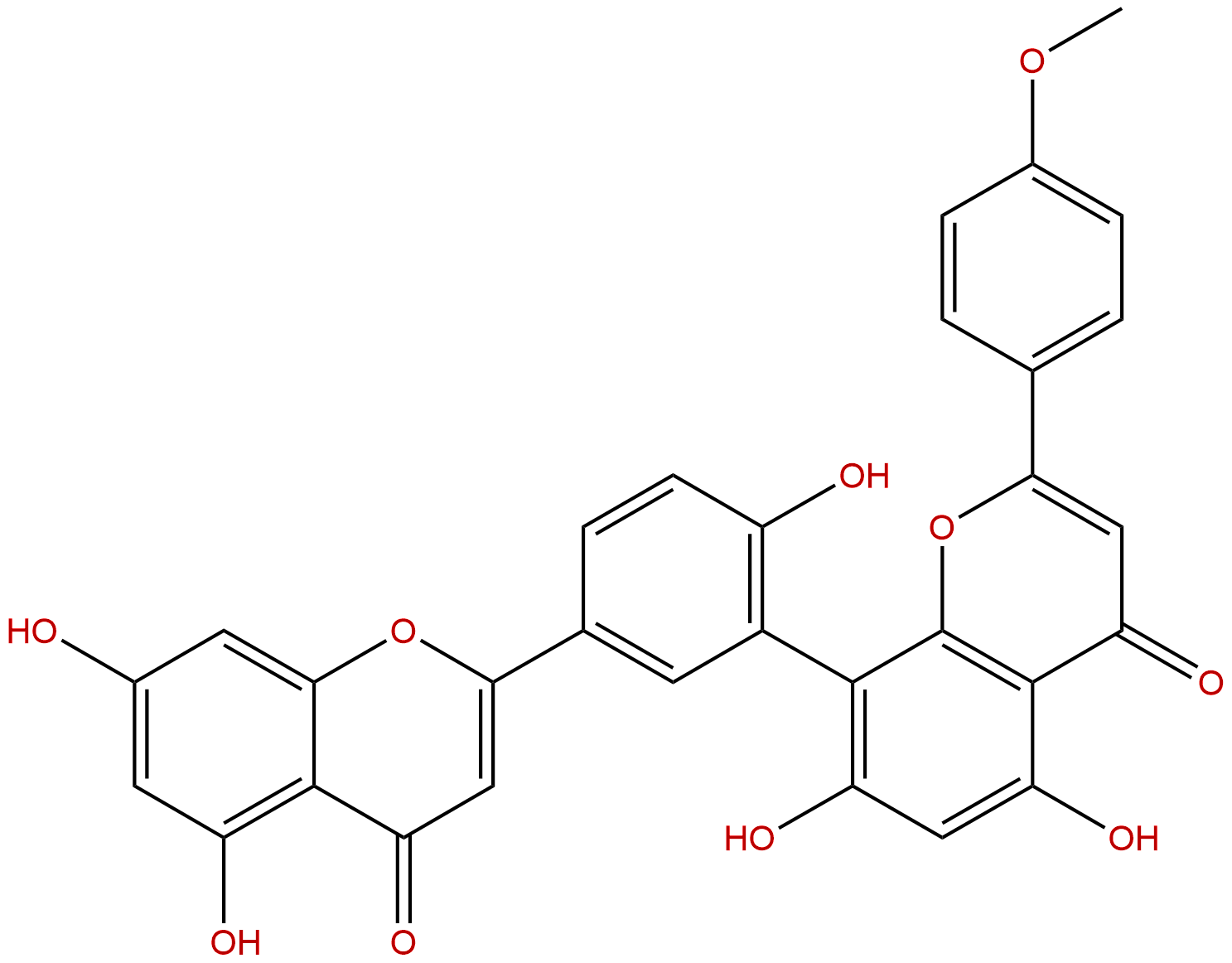


Product name: Podocarpusflavone A
Synonym name:
Catalogue No.: BP1816
Cas No.: 22136-74-9
Formula: C31H20O10
Mol Weight: 552.491
Botanical Source: Garcinia dulcis
Physical Description: Yellow powder
Type of Compound: Flavonoids
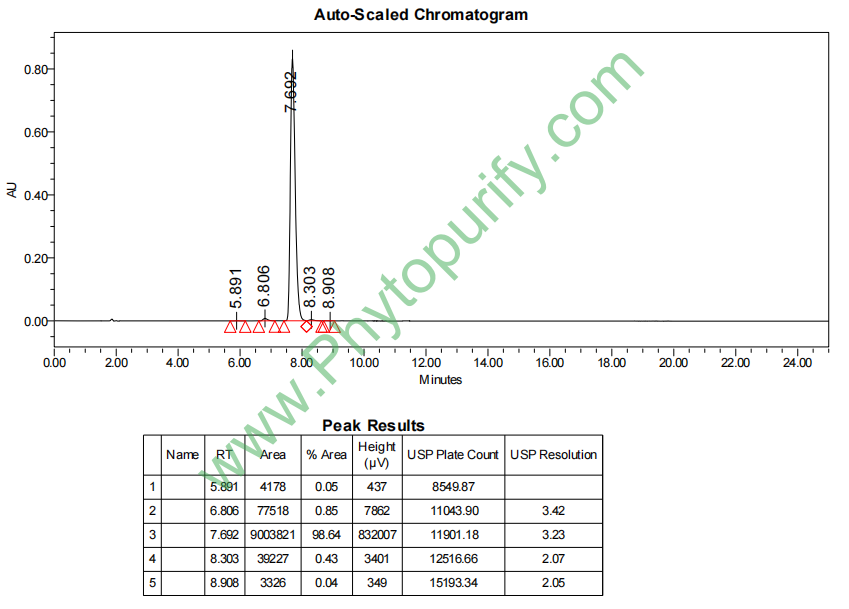
Purity: 95%~99%
Analysis Method: HPLC-DAD or/and HPLC-ELSD
Identification Method: Mass, NMR
Packing: Brown vial or HDPE plastic bottle
The product could be supplied from milligrams to grams. Inquire for bulk scale.
We provide solution to improve the water-solubility of compounds, thereby facilitating the variety of activity tests and clinic uses.
For Reference Standard and R&D, Not for Human Use Directly.
HPLC of Podocarpusflavone A
Storage conditions:Short-term storage at 2~8℃, long-term storage at -20 ~ -80℃
170.8000
3.9616
3.0742
.0023
1.5621
12.5812
Low
92.9038
2.9893
Yes
No
No
No
Yes
No
0.6
Yes
Yes
Yes
No
Malignant tumors are a global public health issue that poses a serious threat to human health. Despite the continuous progress of surgery, radiotherapy, and traditional chemotherapy methods, the serious toxic side effects, drug resistance issues, and limited efficacy they bring have prompted the scientific community to continuously explore lead compounds with novel structures and unique mechanisms of action from nature. Natural products, especially compounds derived from plants, have always been a valuable source for the development of anti-tumor drugs due to their structural diversity and rich biological activity. Among them, flavonoids, as a special type of flavonoid composed of two flavonoid units connected by C-C or C-O-C bonds, have attracted much attention due to their complex chemical structure and extensive pharmacological activities, such as anti-inflammatory, antioxidant, antiviral, and anti-tumor effects.
Podocarpus flavonoids A, as a representative natural product of flavonoids, has gradually become a research hotspot for its potential anti-tumor activity since its discovery. Studies have shown that this compound can effectively inhibit the activity of DNA topoisomerase I, and show significant anti proliferation ability in a variety of tumor cell lines, especially in human breast cancer MCF-7 cells, which can induce apoptosis. These preliminary pharmacological features indicate the potential of Zhubai flavonoids A to develop into a novel anti-tumor candidate drug. This article aims to systematically review the chemical structure, plant sources, pharmacological activity, mechanism of action, pharmacological evaluation, and clinical application prospects of bamboo and cypress flavonoids A, in order to provide comprehensive academic references for the in-depth research and development of this compound.
The chemical system name of bamboo and cypress flavonoids A is relatively complex, and its CAS accession number is 22136-74-9. Structurally, it is a typical dual flavonoid, composed of two flavonoid basic skeletons (specifically apigenin type) coupled through C-C bonds (most likely C3 '- C8' 'connections). This connection method gives its molecules greater planarity and rigidity, which is crucial for their interaction with DNA or enzyme active centers. Its molecular formula is C ∝₀ H ₁₈ O ₁₀, and its molecular weight is 552.4910.
In terms of physicochemical properties, bamboo and cypress flavonoids A exhibit typical hydrophobic characteristics. The calculated lipid water partition coefficient (LogP) is 3.9616, indicating that the compound has strong lipophilicity, which is beneficial for its penetration of cell membranes, but may also affect its water solubility and in vivo distribution. Its topological polar surface area (TPSA) is as high as 170.8000 Å ², mainly attributed to the presence of multiple phenolic hydroxyl and carbonyl groups in the molecule. The combination of high TPSA and moderate LogP values determines its poor apparent water solubility, with experimental or predicted data of approximately 0.0023 mg/mL, which will be one of the key issues to be addressed in its formulation development. In addition, the abundant phenolic hydroxyl groups in the molecule also endow it with strong antioxidant capacity and potential metal chelating ability.
Bamboo cypress biflavone A mainly comes from Arhat pine plants, especially the representative source of bamboo cypress plants. This compound was originally derived from Podocarpus Belonging to plants (such as Podocarpus macrophyllus Separation and identification in (etc.). In addition, its presence has also been found in some members of the Cupressaceae family. These plants are often used in traditional medicine to treat diseases such as inflammation and infections, providing clues for their modern pharmacological research.
Extracting bamboo and cypress flavonoids A from plant materials usually follows the conventional process of natural product chemistry. Firstly, the dried plant leaves or stem bark are crushed and subjected to leaching or reflux extraction using organic solvents such as methanol, ethanol, or acetone. Due to the relatively low polarity of flavonoids, using solvents with moderate polarity or mixed solvents (such as 70-80% ethanol) can often achieve better extraction efficiency. After vacuum concentration, the crude extract was subjected to preliminary separation using solvent partitioning methods (such as extraction with petroleum ether, ethyl acetate, and n-butanol in sequence), and bamboo and cypress flavonoids A were mostly enriched in the ethyl acetate fraction.
Further purification relies on various chromatographic techniques. Silica gel column chromatography is commonly used for crude separation, with chloroform methanol or petroleum ether ethyl acetate gradient elution. Then, in combination with modern separation methods such as reverse phase silica gel column chromatography (such as ODS, eluted by methanol water system), dextran gel column chromatography and high performance liquid chromatography, the high-purity Bambusa biflavone A monomer was finally obtained. Structural identification is accomplished through spectroscopic techniques such as nuclear magnetic resonance, mass spectrometry, ultraviolet and infrared spectroscopy.
The pharmacological activity research of bamboo and cypress flavonoids A mainly focuses on the field of anti-tumor and exhibits various effects.
1. Anti proliferative activity: In vitro cytotoxicity tests have shown that bamboo and cypress flavonoids A have significant growth inhibitory activity on various human tumor cell lines. Among them, it has strong cytotoxicity to breast cancer MCF-7 cells, lung cancer A549 cells, liver cancer HepG2 cells, etc., and its IC ₀ value is usually in the micromolar level. It is worth noting that its toxicity to certain normal cells is relatively low, suggesting that it may have some selectivity, but this characteristic still needs to be validated in a wider range of normal cell lines.
2. Inducing cell apoptosis: In depth studies in MCF-7 cells have confirmed that bamboo and cypress flavonoids A can effectively induce cell apoptosis. Flow cytometry analysis showed that after treatment with this compound, the cells exhibited a distinct sub-G1 phase peak (apoptosis peak). Further molecular biology testing revealed that the mitochondrial apoptosis pathway was activated, including a decrease in mitochondrial membrane potential, release of cytochrome c, and cascade activation of caspase-9 and caspase-3. At the same time, the expression balance of Bcl-2 family proteins is disrupted, with upregulation of pro apoptotic protein Bax expression and downregulation of anti apoptotic protein Bcl-2 expression.
3. Cell cycle arrest: In addition to inducing apoptosis, bamboo and cypress flavonoids A can also interfere with the normal cycle progression of tumor cells. Research has shown that it can block cells in the G2/M phase, which may be related to its interference with microtubule function or its impact on the expression and activity of cell cycle regulatory proteins such as Cyclin B1 and Cdc2. Cycle arrest prevents cells from completing mitosis and ultimately leads to death.
4. Other activities: In addition to its core anti-tumor activity, some studies also suggest that bamboo and cypress flavonoids A may have anti-inflammatory and antioxidant effects, which are related to the structural characteristics of its flavonoid parent nucleus. These auxiliary activities may play a synergistic role in their anti-tumor effects, such as by reducing inflammatory responses in the tumor microenvironment.
The core molecular mechanism of the anti-tumor effect of bamboo and cypress flavonoids A lies in its DNA Topoisomerase I Effective inhibition.
DNA topoisomerase I is a key helicase in the nucleus of the cell, which alleviates the topological tension generated during DNA replication and transcription by creating reversible breaks on DNA single strands. This enzyme is a clear target for clinically important anti-tumor drugs, such as camptothecin. Research has shown that bamboo and cypress flavonoids A can bind to DNA topoisomerase I complex in a non embedded manner, stabilizing the "cleavable complex" and preventing the reconnection of broken DNA single strands. This' toxic 'effect leads to the continuous accumulation of DNA single strand breaks. When the replication fork encounters these irreparable breaks, it triggers fatal DNA double strand breaks, activating the DNA damage response pathway and ultimately leading to cell cycle arrest and apoptosis.
In addition to this main target, the study also suggests that bamboo and cypress flavonoids A may exert synergistic anti-tumor effects through multiple targets and pathways:
* Affects microtubule protein polymerization: Its rigid planar structure may interfere with the dynamic balance of microtubules, leading to abnormal spindle function during mitosis, which is consistent with the observed G2/M phase arrest phenomenon.
* Regulating signaling pathways: There is evidence to suggest that it may inhibit signaling pathways closely related to cell survival and proliferation, such as PI3K/Akt and MAPK, and may affect the transcriptional activity of NF - κ B, thereby downregulating the expression of a series of pro survival and anti apoptotic genes.
* Inducing the generation of reactive oxygen species: Some flavonoids can induce an increase in reactive oxygen species levels through the mitochondrial pathway, causing oxidative stress, which in turn damages cellular macromolecules and promotes apoptosis. It is worth further exploring whether bamboo and cypress flavonoids A have this effect.
Based on its physicochemical parameters and preliminary biological data, a preliminary evaluation of the pharmacological properties of bamboo and cypress flavonoids A can be conducted.
Advantage:
1. Clear targets and activities: As a Topoasomerase I inhibitor, its mechanism of action is relatively clear and its in vitro anti-tumor activity is significant.
2. Potential security: The preliminary toxicity prediction shows that the Ames test result is 0.6 (usually considered to have mutagenic risk if>1.0), indicating a low genetic toxicity risk. Meanwhile, it does not significantly inhibit hERG potassium channels, indicating a lower risk of causing prolonged QT interval in the heart.
3. Low central nervous system permeability: Predicting low blood-brain barrier permeability may reduce central nervous system toxicity for systemic anti-tumor drugs.
Challenges and shortcomings:
1. Contradiction between solubility and permeability: This is the biggest challenge it faces. A high LogP value indicates that its membrane permeability is still acceptable, but its extremely low water solubility and high TPSA severely limit its dissolution and absorption in gastrointestinal fluids, which may lead to extremely low oral bioavailability.
2. Pharmacokinetic properties unknown: At present, there is a severe lack of publicly available data on the in vivo pharmacokinetics of bamboo and cypress flavonoids A, including absorption, distribution, metabolism, and excretion. The key information such as metabolic stability, major metabolites, half-life, and tissue distribution characteristics in its body is still blank.
3. Compliance with the Five Rules for Classified Drugs: Its molecular weight (552.5) is slightly over 500, and the number of hydrogen bond donors (phenolic hydroxyl groups) may be relatively high, which may not fully meet the classic criteria of the "Five Rules for Drug Analogy". However, this is not an absolute obstacle, and many successful drugs also exceed this range.
Improvement strategy:
In order to improve its medicinal properties, future research can focus on:
* Pre drug design: Modify its phenolic hydroxyl group through esterification, phosphorylation, or amino acid conjugation to prepare water-soluble prodrugs, improve solubility and absorption, and hydrolyze them into active active active ingredients in vivo.
* Formulation technology: Develop new drug delivery systems such as nanocrystals, liposomes, micelles, or solid dispersions to improve their apparent solubility and bioavailability.
* Simplification and Modification of Structure: Simplify or modify the molecule while retaining the pharmacophore, and optimize parameters such as LogP and TPSA while improving activity.
As a natural anti-tumor lead compound with a clear mechanism of action, the clinical application prospects of bamboo and cypress flavonoids A depend on further systematic research.
Potential application directions:
1. New Topo I inhibitor drug development: It is expected to be developed into a new generation of non camptothecin topoisomerase I inhibitors for the treatment of tumors that are resistant or ineffective against existing Topo I inhibitors such as irinotecan.
2. Combination therapy: It is possible to explore the combination of chemotherapy drugs with other mechanisms of action (such as platinum and taxanes) or targeted drugs to produce synergistic effects, reduce their respective dosages and toxic side effects.
3. Mechanism based derivatization: By using it as the parent nucleus for systematic structural modification and structure-activity relationship research, it is expected to obtain a series of derivatives with stronger activity, lower toxicity, and better drug properties.
Future research focus and challenges:
1. In depth in vivo pharmacological evaluation: It is urgent to validate the in vivo anti-tumor effect and dose-response relationship of various human tumor xenograft mouse models, which is the cornerstone for promoting their translation into preclinical research.
2. Comprehensive preclinical safety evaluation: Toxicological studies on GLP standards such as acute toxicity, long-term toxicity, and reproductive toxicity need to be conducted to clarify their safety window.
3. Pharmacokinetic and metabolic studies: Elucidate the ADME process in its body, determine the main metabolic enzymes and excretion pathways, and provide a basis for dosage form design and clinical administration plans.
4. Overcoming solubility and delivery challenges: As mentioned earlier, solving the problem of poor water solubility through chemical or pharmaceutical means is the key to successful development.
Bamboo and cypress flavonoids A is a natural product of flavonoids with significant anti-tumor activity isolated from traditional medicinal plants. It exhibits good anti proliferative effects in vitro by inhibiting DNA topoisomerase I, inducing DNA damage, cell cycle arrest, and mitochondrial pathway apoptosis. Although its clear molecular targets and promising biological activities have laid the foundation for its drug development, poor solubility, unknown pharmacokinetic properties in vivo, and incomplete toxicological data constitute the main obstacles to its clinical application.
In the future, through interdisciplinary collaboration, combined with systematic research in medicinal chemistry, pharmacy, pharmacology, and toxicology, targeted optimization and modification of its pharmacological shortcomings will be carried out. Zhubai flavonoids A is expected to gradually develop from a potential lead compound into a new anti-tumor candidate drug with clinical application value, providing new options for the treatment of malignant tumors. The continuous exploration of bamboo and cypress flavonoids A once again confirms the irreplaceable value of natural products in innovative drug development.
