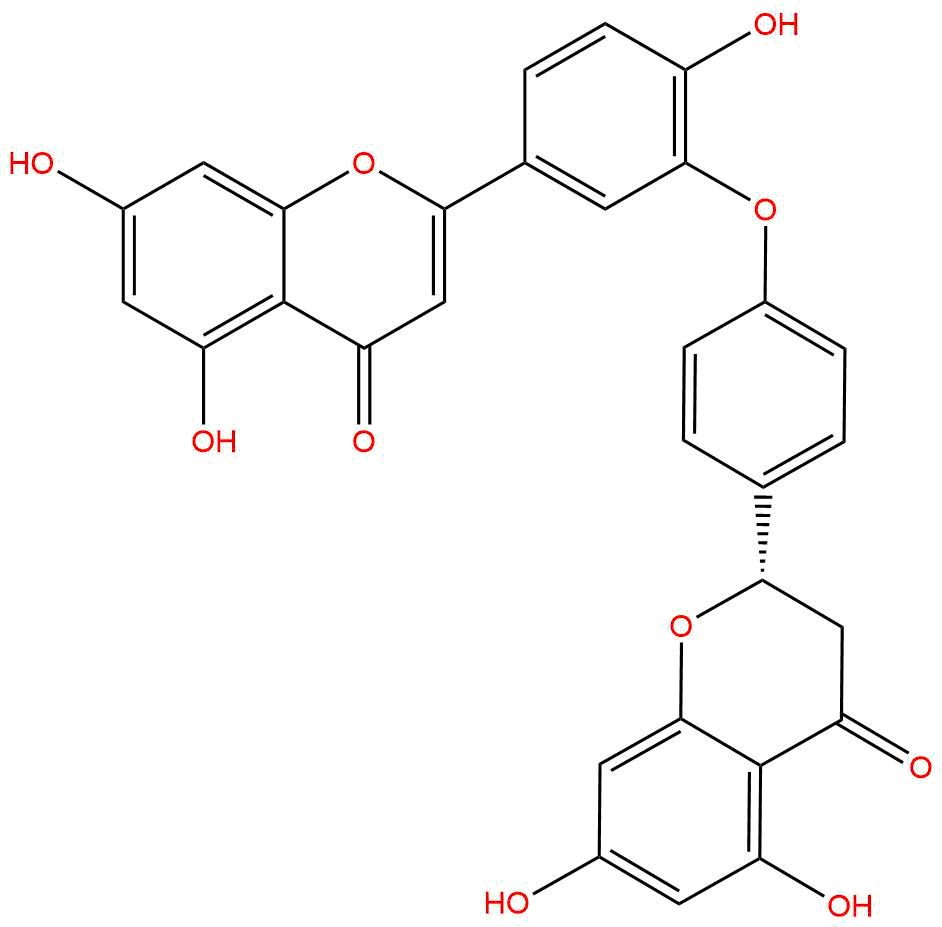


Product name: 2'',3''-Dihydroochnaflavone
Synonym name:
Catalogue No.: BP2411
Cas No.: 340997-02-6
Formula: C30H20O10
Mol Weight: 540.48
Botanical Source: Selaginellae herba
Type of Compound: "Flavonoids,Biflavones"
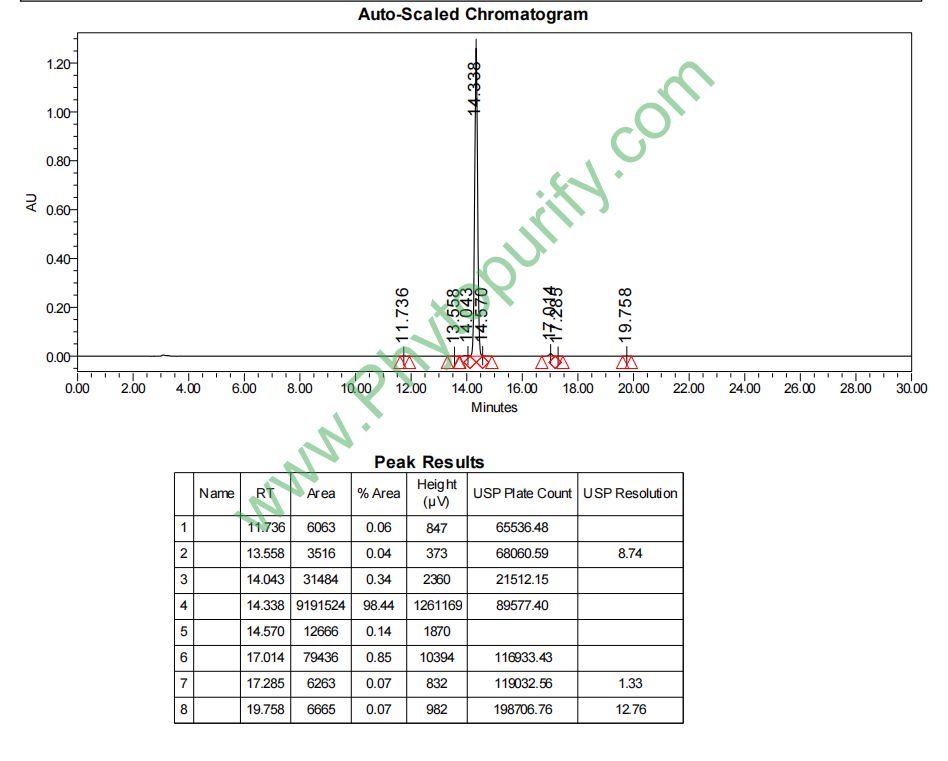
Purity: 95%~99%
Analysis Method: HPLC-DAD or/and HPLC-ELSD
Identification Method: Mass, NMR
Packing: Brown vial or HDPE plastic bottle
Storage: Store in a well closed container, protected from air and light. Put into refrigerate or freeze for long term storage.
Whenever possible, you should prepare and use solutions on the same day. However, if you need to make up stock solutions in advance, we recommend that you store the solution as aliquots in tightly sealed vials at -20℃. Generally, these will be useable for up to two weeks.
The product could be supplied from milligrams to grams
Inquire for bulk scale.
For Reference Standard and R&D, Not for Human Use Directly.
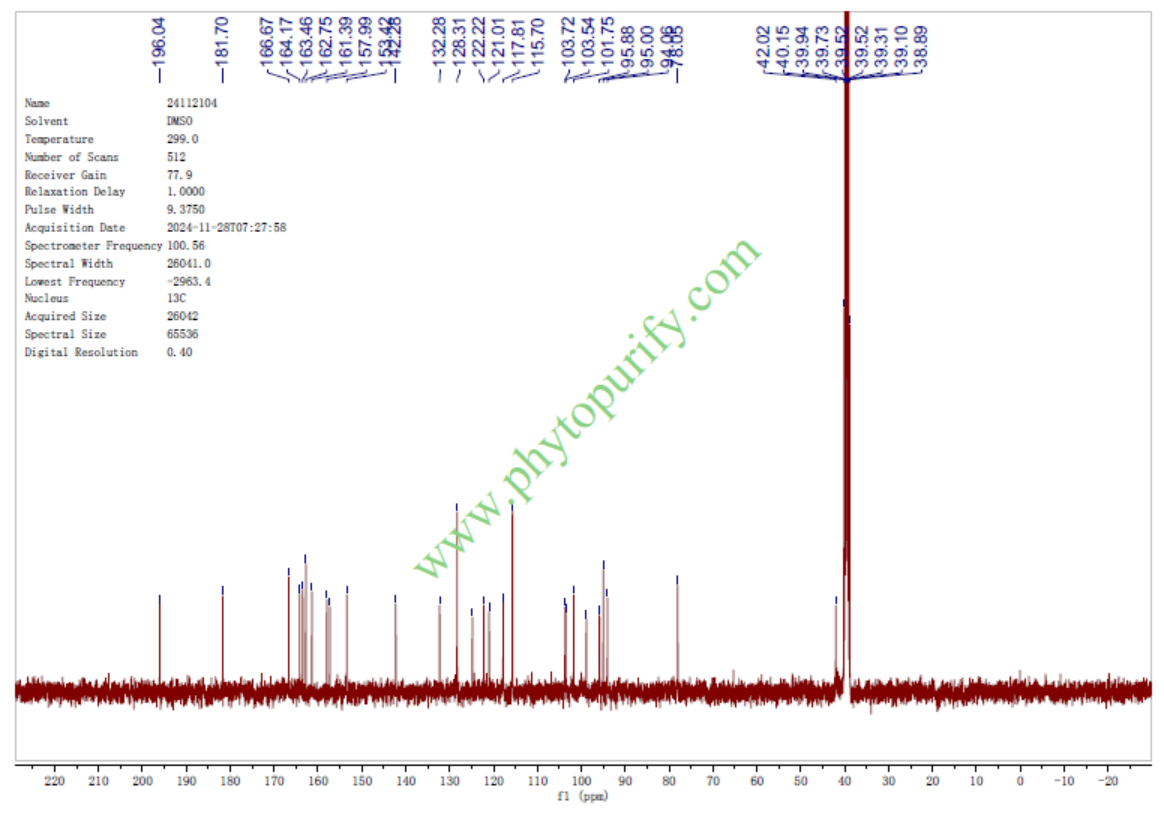
NMR of 2'',3''-Dihydroochnaflavone
HPLC of 2'',3''-Dihydroochnaflavone
Storage conditions:Short-term storage at 2~8℃, long-term storage at -20 ~ -80℃
166.8900
3.9195
3.2353
.0027
2.6201
7.3876
Low
93.3170
3.4088
No
No
Yes
No
Yes
No
0.6
Yes
No
Yes
No
Natural products, as an important source of drug discovery, play an irreplaceable role in the long history of human fight against diseases. Among them, biflavonoids are a unique secondary metabolite composed of two flavonoid units connected by C-C or C-O-C bonds, which have attracted much attention due to their structural diversity and wide range of biological activities. Ochnaflavone and its derivatives are important members of the flavonoid family in honeysuckle. They were initially isolated and identified from plants in the Ochnaceae family, and later found in other families and genera. In recent years, with the advancement of separation technology and activity screening methods, a series of structurally novel flavonoids have been reported. Among them, 2 '', 3 '' - Dihydro Honeysuckle Flavonoids (2 '', 3 '' - Dihydro Honeysuckle Flavonoids) have gradually become one of the hotspots in natural product pharmacology research due to their unique pharmacological potential and relatively clear molecular targets.
2 '', 3 '' - Dihydrohoneysuckle flavonoids (CAS number: 340997-02-6) are a naturally occurring flavonoid compound characterized by the reduction of the C2 '' - C3 '' double bond of a flavonoid unit in the flavonoid skeleton to a single bond, thereby forming a dihydroflavonoid fragment. This subtle chemical modification, compared to its parent compound honeysuckle flavonoids, may endow it with unique conformational flexibility and different biological activity spectra. Existing studies have shown that this compound exhibits potential pharmacological activities in anti-inflammatory, antioxidant, neuroprotective, and anti-tumor aspects, and its mechanism of action involves the regulation of specific signaling pathways and enzyme activities. However, compared to some more in-depth studies on flavonoids such as ginkgo flavonoids and fir flavonoids, systematic research on 2 '', 3 '' - dihydrohoneysuckle flavonoids is still relatively limited, and their pharmacokinetic properties, in vivo efficacy, and toxicological evaluation need to be improved.
This article aims to provide a systematic review of the current research status of 2 '', 3 '' - dihydrohoneysuckle flavonoids, covering their chemical structure and physicochemical properties, plant sources and extraction methods, pharmacological activity, mechanism of action and molecular targets, pharmacological evaluation and pharmacokinetics, and prospects for their clinical application, in order to provide reference for the further development and utilization of this natural product.
The chemical essence of 2 '', 3 '' - dihydrohoneysuckle flavonoids belongs to the class of flavonoids, and its core structure is composed of two flavonoid mother nuclei connected by C-O-C bonds. Specifically, the compound is linked by an ether bond between an apigenin unit and a dihydroapigenin (i.e. 5,7,4 '- trihydroxydihydroflavone) unit. The systematic naming reflects this structural feature, where "2 '', 3 '' - dihydro" specifically refers to the reduction of the double bond attached to the C-6 flavonoid unit's C ring. The molecular formula of this compound is C ∝₀ H ₂₀ O ₁₀, with a molecular weight of 540.4800 Da.
From the perspective of structural analysis, the UV spectra of 2 '', 3 '' - dihydrohoneysuckle flavonoids typically exhibit characteristic absorption in the 240-280 nm (band II) and 300-400 nm (band I) regions. However, due to the presence of dihydroflavonoid fragments, the absorption intensity in band I may be weakened or blue shifted compared to typical flavonoid compounds. Infrared spectroscopy (IR) can observe characteristic peaks of hydroxyl (~3400 cm ⁻¹), carbonyl (~1650 cm ⁻¹), and aromatic ring skeleton vibrations (~1600, 1500 cm ⁻¹). Nuclear magnetic resonance spectroscopy (NMR) is a key means of identifying the structure of this compound, especially in the ¹ H-NMR and ¹ ³ C-NMR spectra. The characteristic chemical shifts of H-2 '' and H-3 '' on the C ring of dihydroflavonoids (H-2 '' is about δ 5.2-5.5 ppm, H-3 '' is about δ 2.7-3.1 ppm, showing typical ABX system coupling splitting), as well as the carbon signals of C-2 '' (about δ 78-80 ppm) and C-3 '' (about δ 42-44 ppm), are key evidence that distinguishes it from its unsaturated parent compound, honeysuckle flavonoids. High resolution mass spectrometry (HRMS) can provide precise molecular weight information, further confirming its molecular formula.
In terms of physicochemical properties, according to the calculated pharmacological parameters, the lipid water partition coefficient (LogP) of 2 '', 3 '' - dihydrohoneysuckle flavonoids is 3.9195, indicating that they have a certain lipophilicity and are beneficial for crossing biofilms. Its topological polar surface area (TPSA) is as high as 166.8900 Å ², far exceeding the recommended upper limit of 140 Å ² for oral drugs, mainly due to the numerous phenolic hydroxyl and carbonyl oxygen atoms in the molecule. High TPSA values typically indicate poor membrane permeability and oral absorption. Its water solubility is extremely low, only 0.0027 mg/mL, which is consistent with its polyphenol structure and large molecular weight, and is one of the key factors limiting its bioavailability. In addition, the calculation predicts that its blood-brain barrier (BBB) penetration ability is low, suggesting that its application in central nervous system diseases may be limited, but it may also imply lower central neurotoxicity. The predicted result of hERG inhibition is' no ', indicating a relatively low risk of cardiac toxicity. The Ames test predicted a value of 0.6, indicating a potential genetic toxicity risk that needs to be addressed in future research.
2 '', 3 '' - Dihydrohoneysuckle flavonoids were initially isolated from plants in the Caryophyllaceae family. Ochna plants, such as Ochna squarrosa and Ochna obtusata, are important sources of flavonoids. In addition, with the deepening of research, this compound has also been found in other families and genera of plants, such as some species in the Guttiferae family and certain ferns. It is worth noting that although its name includes "honeysuckle", this compound is not the main active ingredient of traditional Chinese medicine Lonicera japonica. Its name may be derived from its structural similarity with certain flavonoids in honeysuckle, or confusion with early isolated source plants, which needs to be identified when citing literature. Clarifying its exact plant source is crucial for the sustainable utilization of resources and subsequent research in chemical synthesis biology.
For the extraction of 2 '', 3 '' - dihydrohoneysuckle flavonoids, classical natural product chemical methods are usually used. Due to its moderate polarity and frequent coexistence with various structurally similar flavonoids, flavonoids, and polyphenols, the extraction and purification process of this compound requires precise design. The typical extraction process is as follows:
Raw material pretreatment and extraction Crush dry plant materials (such as branches, leaves, bark, or roots) and extract them using organic solvents. Common solvents include methanol, ethanol, or their aqueous solutions. To improve extraction efficiency, techniques such as heating reflux, ultrasound assisted extraction, or microwave-assisted extraction can be used. Usually, a 70% -95% ethanol or methanol aqueous solution is the preferred solvent system for extracting flavonoids.
Preliminary separation After the extraction solution is concentrated under reduced pressure, crude extract is obtained. The crude extract is usually suspended in water and then subjected to liquid-liquid extraction using solvents of different polarities such as petroleum ether, ethyl acetate, n-butanol, etc. Due to the LogP of 2 '', 3 '' - dihydrohoneysuckle flavonoids being approximately 3.9, they tend to be distributed in solvent phases of moderate polarity. Therefore, the ethyl acetate extraction site is usually the main component enriched in this compound.
Chromatographic Separation and Purification Systematic chromatographic separation of the ethyl acetate extraction site. Common methods include:
The entire separation process requires real-time monitoring through thin layer chromatography (TLC) and HPLC analysis, and structural confirmation of the separated compounds through spectroscopic techniques such as NMR and MS. Due to the low content of this compound in plants and the difficulty of isolation, developing efficient and green extraction and purification processes, as well as exploring chemical synthesis or biosynthetic pathways, are key directions to ensure the supply of subsequent research samples.
Existing research has shown that 2 '', 3 '' - dihydrohoneysuckle flavonoids exhibit various pharmacological activities, particularly in the fields of anti-inflammatory, antioxidant, neuroprotective, and anti-tumor effects.
1. Anti inflammatory activity
Inflammation is a defensive response of the body to injury and infection, but excessive or persistent inflammation is the pathological basis of various chronic diseases such as arthritis, cardiovascular disease, and neurodegenerative diseases. Research has shown that 2 '', 3 '' - dihydrohoneysuckle flavonoids can significantly inhibit the production of nitric oxide (NO) and prostaglandin E ₂ (PGE ₂) in macrophages stimulated by lipopolysaccharide (LPS), which are key mediators of inflammatory response. Its mechanism of action is closely related to the inhibition of inducible nitric oxide synthase (iNOS) and cyclooxygenase-2 (COX-2) expression. In addition, the compound can downregulate the mRNA and protein levels of pro-inflammatory cytokines such as tumor necrosis factor - α (TNF - α), interleukin-1 β (IL-1 β), and interleukin-6 (IL-6). In animal models, local or systemic administration can alleviate carrageenan induced toe swelling in rats and xylene induced ear swelling in mice, demonstrating clear in vivo anti-inflammatory effects.
2. Antioxidant activity
Oxidative stress is caused by the excessive production of reactive oxygen species (ROS) and reactive nitrogen species (RNS) and the imbalance of the body's antioxidant defense system, which is closely related to various pathological processes such as aging, cancer, and cardiovascular disease. The molecular structure of 2 '', 3 '' - dihydrohoneysuckle flavonoids contains multiple phenolic hydroxyl groups, which endow them with excellent free radical scavenging ability. In vitro chemical experiments (such as DPPH, ABTS, FRAP methods) have confirmed that the compound can effectively scavenge various free radicals and exhibit strong reducing ability. In cell models, it can reduce intracellular ROS levels induced by hydrogen peroxide (H ₂ O ₂) or tert butyl hydroperoxide (t-BHP), and alleviate apoptosis caused by oxidative damage. Its antioxidant mechanism may include direct clearance of free radicals, chelation of transition metal ions (such as Fe ² ⁺, Cu ² ⁺), and activation of endogenous antioxidant enzyme systems (such as superoxide dismutase SOD, glutathione peroxidase GPx, catalase CAT).
3. Neuroprotective activity
Given that oxidative stress and neuroinflammation are the core pathological features of neurodegenerative diseases such as Alzheimer's disease (AD) and Parkinson's disease (PD), the anti-inflammatory and antioxidant properties of 2 '', 3 '' - dihydrohoneysuckle flavonoids provide a theoretical basis for their neuroprotective potential. Research has found that this compound can protect primary cultured neurons or neural cell lines (such as PC12 cells, SH-SY5Y cells) from A β - amyloid toxicity, glutamate excitotoxicity, or hypoxia reoxygenation damage. Its protective effect may involve inhibiting mitochondrial dysfunction, reducing cytochrome c release, downregulating caspase-3 activity, and thus inhibiting cell apoptosis. In addition, it can inhibit the excessive activation of microglia, reduce the release of neuroinflammatory factors, and improve synaptic plasticity. Although its blood-brain barrier penetration prediction is low, some studies suggest that under pathological conditions (such as blood-brain barrier damage), there may still be a certain amount of drugs entering the brain parenchyma to exert local effects, or indirectly affecting the central nervous system by regulating peripheral inflammation.
4. Antitumor activity
Preliminary studies have shown that 2 '', 3 '' - dihydrohoneysuckle biflavones have inhibitory effects on the proliferation of various tumor cell lines (such as human hepatoma cell HepG2, human breast cancer cell MCF-7, human colon cancer cell HT-29). Its mechanism of action may involve multiple aspects: inhibiting tumor growth by inducing cell cycle arrest (such as blocking cells in G0/G1 or G2/M phases) and promoting cell apoptosis (through endogenous mitochondrial pathways or exogenous death receptor pathways). In addition, the compound may exert anti angiogenic effects by inhibiting the expression of vascular endothelial growth factor (VEGF), thereby cutting off the nutritional supply to tumors. However, current research on its anti-tumor activity mostly remains at the cellular level in vitro, and in vivo anti-tumor activity and specific molecular mechanisms still need to be further explored.
The pharmacological activity of 2 '', 3 '' - dihydrohoneysuckle flavonoids is the result of multi-target and multi pathway synergistic effects. Based on existing research, its key molecular targets and signaling pathways mainly include the following aspects:
1. Inhibit the NF - κ B signaling pathway
Nuclear factor kappa B (NF - κ B) is the core transcription factor in inflammatory response. In the resting state, NF - κ B binds to its inhibitory protein I κ B and exists in an inactive form in the cytoplasm. When stimulated by LPS, TNF - α, etc., I κ B kinase (IKK) is activated, leading to phosphorylation and degradation of I κ B, and the released NF - κ B enters the nucleus, initiating the transcription of downstream inflammation related genes (such as iNOS, COX-2, TNF - α, IL-6). Research has shown that 2 '', 3 '' - dihydrohoneysuckle flavonoids can inhibit the activity of IKK, prevent the phosphorylation and degradation of I κ B α, thereby blocking the nuclear translocation and transcriptional activity of NF - κ B, and ultimately downregulating the expression of inflammatory mediators. This is one of the core mechanisms by which it exerts anti-inflammatory effects.
2. Regulating the MAPK signaling pathway
The mitogen activated protein kinase (MAPK) family, including ERK, JNK, and p38 MAPK, plays a critical role in mediating cell proliferation, differentiation, stress response, and inflammation. This compound has been found to inhibit LPS or oxidative stress-induced phosphorylation of JNK and p38 MAPK, with varying effects on ERK phosphorylation. By inhibiting the activation of these stress kinases, the activity of downstream transcription factors (such as AP-1) can be blocked, thereby synergistically inhibiting the NF - κ B pathway and jointly suppressing inflammation and cell apoptosis.
3. Activate the Nrf2/ARE antioxidant pathway
Nuclear factor E2 related factor 2 (Nrf2) is the main regulator of cellular response to oxidative stress. Under normal conditions, Nrf2 binds to Keap1 and is degraded by ubiquitination. When stimulated by oxidants or electrophilic agents, Nrf2 dissociates from Keap1, translocates into the nucleus, binds to antioxidant response elements (ARE), and initiates the transcription of a series of antioxidant enzymes and phase II detoxifying enzymes (such as HO-1, NQO1, GST, SOD). 2 '', 3 '' - Dihydrohoneysuckle flavonoids have been shown to promote nuclear translocation of Nrf2, upregulate the expression of antioxidant enzymes such as HO-1, and enhance the antioxidant defense ability of cells. This mechanism is an important foundation for its neuroprotective and cellular protective effects.
4. Directly target enzyme activity
In addition to regulating signaling pathways, this compound may also directly bind to certain key enzymes, affecting their activity. For example, its anti-inflammatory effect partially stems from direct inhibition of COX-2 and iNOS enzyme activity. In addition, studies suggest that certain flavonoids can act as inhibitors of phosphodiesterases (PDEs), exerting anti-inflammatory and vasodilatory effects by increasing intracellular cAMP or cGMP levels. It is worth further exploring whether 2 '', 3 '' - dihydrohoneysuckle flavonoids also have similar PDE inhibitory activity.
5. Interaction with proteins
Flavonoids often bind to various proteins through hydrogen bonding, π - π stacking, and hydrophobic interactions. For example, they can bind to amyloid A β, inhibiting its aggregation and fiber formation, which has potential significance in the treatment of Alzheimer's disease. In addition, they can also bind to ATP binding sites of certain kinases (such as PI3K/Akt, tyrosine kinases), regulate their activity, and thus affect cell proliferation and survival signals. The specific binding modes and binding sites of 2 '', 3 '' - dihydrohoneysuckle flavonoids with these target proteins need to be further studied through molecular docking, surface plasmon resonance (SPR), and X-ray crystallography.
Translating natural products into clinical drugs and evaluating their pharmacological properties is a crucial step. The pharmacological properties of 2 '', 3 '' - dihydrohoneysuckle flavonoids face significant challenges, mainly reflected in their physicochemical properties and pharmacokinetic characteristics.
1. Physical and chemical properties and drug like properties
According to the Lipinski Five Rules, the molecular weight (540.48 Da) of 2 '', 3 '' - dihydrohoneysuckle flavonoids exceeds 500, and the LogP (3.92) is within an acceptable range. However, the large number of hydrogen bond donors (phenolic hydroxyl) and hydrogen bond acceptors (carbonyl and ether oxygen) results in extremely high TPSA (166.89 Å ²) and poor water solubility (0.0027 mg/mL). These properties seriously violate the principle of drug likeness, indicating poor oral absorption and low bioavailability. High TPSA also means that it is difficult for it to passively diffuse through the cell membrane, limiting its ability to reach intracellular targets.
2. Pharmacokinetic characteristics
At present, there is a lack of experimental data on the pharmacokinetics of 2 '', 3 '' - dihydrohoneysuckle flavonoids in vivo. Based on its physical and chemical properties, it can be reasonably inferred that:
* absorb After oral administration, its absorption will be very limited, mainly due to water solubility and membrane permeability. It may be mainly absorbed through passive diffusion or transporter mediated pathways in the intestine, but the efficiency is extremely low. Its absorption may be highly dependent on formulation technology.
* distribution Once it enters the bloodstream, due to its high lipophilicity, it may bind highly to plasma proteins such as albumin. Its distribution volume may be large, but its ability to penetrate the blood-brain barrier is expected to be low.
* Metabolism As a polyphenolic compound, its metabolism may be very extensive. The main metabolic pathways include phase II metabolic reactions in the liver and intestines, such as glucuronidation, sulfation, and methylation. These metabolites may lose or alter their original activity. In addition, its dual flavonoid skeleton may also be metabolized by gut microbiota.
* excretion Metabolites and small amounts of prototype drugs may be mainly excreted through bile and urine.
3. Toxicity prediction and safety
The calculation prediction shows that the compound has no hERG inhibitory activity, reducing the risk of cardiac toxicity. However, the Ames test predicted a value of 0.6, which is a highly alert signal indicating potential mutagenicity. This may be due to the formation of quinone intermediates by multiple phenolic hydroxyl groups in its molecule during in vivo metabolism, which can then react with DNA. Therefore, strict genetic toxicity evaluation must be conducted in subsequent development.
4. Strategies for improving drug properties
Given the above challenges, it is extremely difficult to directly develop 2 '', 3 '' - dihydrohoneysuckle flavonoids as oral drugs. Future strategies for improving drug efficacy should focus on:
* Structural modification Selective protection of phenolic hydroxyl groups in molecules through medicinal chemical methods (such as prodrug strategies, making phosphate esters, amino acid esters, etc.) to improve water solubility and membrane permeability. Alternatively, through skeletal transitions, search for structurally simplified and more active analogues.
* Formulation technology The use of modern formulation techniques such as liposomes, nanoemulsions, solid lipid nanoparticles, cyclodextrin inclusion, phospholipid complexes, etc. can significantly improve their solubility and oral bioavailability.
* route of administration Given the poor oral absorption, it may be considered to develop non oral routes of administration, such as intravenous injection, transdermal administration, or nasal administration (for central nervous system diseases), to bypass the absorption barrier.
Although there are many challenges in the pharmacological development of 2 '', 3 '' - dihydrohoneysuckle flavonoids, their unique pharmacological activity spectrum and relatively clear molecular targets still provide attractive prospects for their application in specific fields.
1. As a lead compound
The greatest value of this compound lies in its potential as a lead compound. Its novel dual flavonoid skeleton and clear anti-inflammatory and antioxidant activities provide a good structural template for medicinal chemists. By conducting systematic structure-activity relationship (SAR) studies on this molecule, its activity, selectivity, and pharmacokinetic properties can be optimized, ultimately leading to the development of candidate drugs with clinical application value. For example, in terms of its anti-inflammatory activity, efforts can be made to simplify the structure, retain key pharmacophores, while reducing molecular weight and TPSA, and improving drug like properties.
2. Local medication or targeted delivery
Given its low oral bioavailability but clear local anti-inflammatory activity, it may be considered to develop it as an external preparation for the treatment of skin inflammatory diseases such as dermatitis and psoriasis. In addition, by loading it into targeted delivery systems (such as nanoparticles targeting macrophages), precise drug delivery to inflammatory lesions can be achieved, local drug concentrations can be increased, and systemic exposure and toxic side effects can be reduced.
3. As a dietary supplement or functional food ingredient
Despite the difficulties in drug development, its excellent antioxidant activity makes it potential as a dietary supplement or additive in functional foods. After improving its bioavailability through rational formulation techniques (such as compounding with phospholipids and cyclodextrins), it can be used to assist in improving sub-health states related to oxidative stress. Of course, this requires strict toxicological evaluation and human clinical trial data support.
4. Future research directions
In order to promote the research and application of this compound, future work should focus on the following directions:
* In depth study on the mechanism of action Using systems biology and network pharmacology methods, comprehensively reveal its multi-target action network, clarify its key target proteins and signaling pathways. Verify its direct target through CRISPR-Cas9 gene editing, proteomics, and other technologies.
* Pharmacokinetic study of the system Establish sensitive and specific biological sample analysis methods (such as LC-MS/MS), conduct absorption, distribution, metabolism, and excretion (ADME) studies in animals, and clarify their metabolic pathways and metabolite activities. This is the basis for evaluating its in vivo efficacy and toxicity.
* Comprehensive toxicological evaluation Conduct acute toxicity, long-term toxicity, reproductive toxicity, and genetic toxicity evaluations, especially to validate the risk of positive Ames test predictions. This is the key to determining whether it can enter preclinical development.
* Research on Resources and Synthesis Establish sustainable utilization strategies for its plant resources, or develop efficient chemical total synthesis, semi synthesis, and biosynthetic pathways to address sample sourcing issues.
* Study on Structure Activity Relationship Systematically synthesize a series of structurally similar compounds, combine activity evaluation, clarify the structure-activity relationship of their anti-inflammatory, antioxidant, neuroprotective and other activities, and provide guidance for structural optimization.
2 '', 3 '' - Dihydrohoneysuckle flavonoids, as a structurally unique natural flavonoid compound, have demonstrated potential value as drug leads due to their pharmacological activities in anti-inflammatory, antioxidant, neuroprotective, and anti-tumor aspects, as well as their ability to regulate key signaling pathways such as NF - κ B, MAPK, and Nrf2. However, its high molecular weight, poor water solubility, low oral bioavailability, and potential genetic toxicity risks constitute the main bottlenecks for its drug development. At present, research on this compound is still in its early stages, and there is a huge gap between basic pharmacology and clinical translation.
Future research should not be limited to a simple description of its activity, but should shift towards in-depth exploration guided by solving the problem of drug formation. Through drug chemical modification, advanced formulation technology, and optimization of administration routes, it is expected to overcome its inherent shortcomings. At the same time, with the help of modern molecular pharmacology and toxicology methods, elucidating its targets, metabolic pathways, and toxicity mechanisms will provide scientific basis for rational design of better derivatives. Despite the numerous challenges ahead, the research value of 2 '', 3 '' - dihydrohoneysuckle flavonoids, as a unique chemical entity endowed by nature, cannot be ignored. Continuous and in-depth exploration may not only lead to the emergence of new therapeutic drugs, but also enrich our understanding of the relationship between the structure and function of flavonoids, contributing unique wisdom to the discovery and development of natural product drugs.
