


Product name: Rosmarinic acid
Synonym name: Labiatenic acid
Catalogue No.: BP1224
Cas No.: 20283-92-5
Formula: C18H16O8
Mol Weight: 360.318
Botanical Source: Rosmarinus officinalis, Melissa officinalis, Momordica balsamina, Mentha piperita, Salvia officinalis, Teucrium scorodonia, Sanicula europaea, Coleus blumei, Thymus spp., Hyptis verticillata, Lithospermum erythrorhizon and other plant spp.
Physical Description: Powder
Type of Compound: Phenylpropanoids
Purity: 95%~99%
Analysis Method: HPLC-DAD or/and HPLC-ELSD
Identification Method: Mass, NMR
Packing: Brown vial or HDPE plastic bottle
Storage: Store in a well closed container, protected from air and light. Put into refrigerate or freeze for long term storage.
Whenever possible, you should prepare and use solutions on the same day. However, if you need to make up stock solutions in advance, we recommend that you store the solution as aliquots in tightly sealed vials at -20℃. Generally, these will be useable for up to two weeks.
The product could be supplied from milligrams to grams, up to kilograms
Inquire for bulk scale.
Descriptions:
Rosmarinic acid is a naturally occurring hydroxylated compound, it is present in many plants, such as Artemisia capillaris , Calendulla officinalis; it shows antiviral, antibacterial, antiinflammatory and antioxidant activity, can produce anxiolytic-like effect without exerting locomotor alterations or DNA damage in brain tissue.[1]
Rosmarinic acid can inhibit complement activation in vivo as well as in vitro, the inhibition of complement activation by rosmarinic acid is due to the reaction of rosmarinic acid with the activated thioester of metastable C3b, resulting in covalent attachment of the inhibitor to the protein.[2]
Rosmarinic acid induces melanogenesis through protein kinase A activation signaling, which occurs downstream of cAMP production.[3
Rosmarinic acid has antioxidative and anti-inflammatory activities, can inhibit diesel exhaust particles (DEP)-induced lung injury by the reduction of proinflammatory molecule expression, and the antioxidative activities may also contribute to its protective effects.[4]
Rosmarinic acid inhibits the expression of CCL11 and CCR3 by suppressing the IKK- β activity in NF- κ B activation signaling, suggests that rosmarinic acid might inhibit the expression of NF- κ B promoter-related genes. [5]
Rosmarinic acid has potent anticancer, anti-lipid peroxidative and apoptotic effect in 7,12-dimethylbenz(a)anthracene-induced skin carcinogenesis.[6]
Rosmarinic acid mediates neuroprotective effects against H2O2-induced neuronal cell damage in N2A cells, suggests that it may potentially serve as an agent for prevention of several human neurodegenerative diseases caused by oxidative stress.[7]
References:
[1] Pereira P, Tysca D P, Da S B L, et al. Pharmacol Res, 2005, 52(3):199-203.
[2] Sahu A, Rawal N, Pangburn M K. Biochem Pharmacol, 1999, 57(57):1439-46.
[3] Lee J, Kim Y S, Park D. Biochem Pharmacol, 2007, 74(7):960-8.
[4] Sanbongi C, Takano H, Osakabe N, et al.Free Radical Biol Med, 2003, 34(8):1060-9.
[5] Jongsung Lee, Eunsun Jung, Youngji Kim,et al. Brit J Pharmacol, 2006, 148(3):366-75.
[6] Sharmila R, Manoharan S. Indian J Exp Biol 2012, 50(3):187-94.
[7] Ghaffari H, Venkataramana M, Ghassam B J, et al. Life Sci, 2014, 113(1–2):7-13.
[8] Wang Z, Xu Y, Jiao R, et al. China Pharmacist, 2014(09):1473-5.
HPLC of Rosmarinic acid
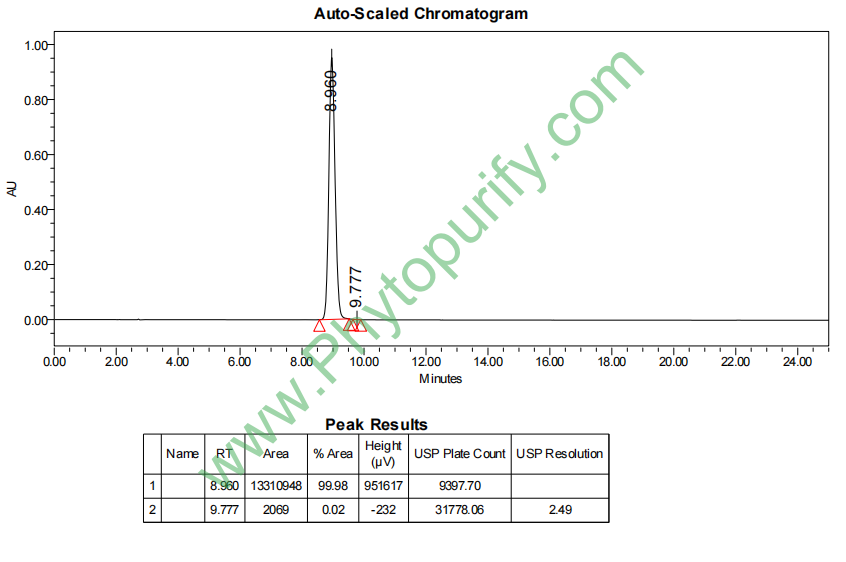
Storage conditions:Short-term storage at 2~8℃, long-term storage at -20 ~ -80℃
144.5200
1.7707
-.7543
.6085
1.6195
.1675
Low
89.9048
2.9030
Yes
Yes
No
No
Yes
No
0.0
Yes
Yes
Yes
Yes
Rosmarinic acid (RA), CAS number 20283-92-5, is a natural phenolic ester compound widely found in various medicinal and aquatic plants. Since its first isolation and identification from Rosmarinus officinalis L. in 1958, its unique chemical structure and wide range of biological activities have attracted sustained attention in the fields of pharmacology, food science, and natural product chemistry. As an ester derivative connecting caffeic acid and 3,4-dihydroxyphenyllactic acid, rosmarinic acid is not only an important secondary metabolite for plants to cope with environmental stress, but has also been proven to have excellent multiple pharmacological activities such as antioxidant, anti-inflammatory, neuroprotective, antibacterial, and antiviral. Modern pharmacological research has revealed that its mechanism of action involves inhibition of key neurotransmitter metabolism enzymes such as monoamine oxidase (MAO-A/B) and catechol-O-methyltransferase (COMT), as well as deep regulation of the antioxidant defense pathway centered around nuclear factor E2 related factor 2 (NRF2/NFE2L2). Given its significant protective effects in models of neurodegenerative diseases, cardiovascular diseases, metabolic syndrome, and inflammation related diseases, rosmarinic acid has become a leading compound for the development of novel preventive and therapeutic drugs. This article aims to systematically review the chemical properties, plant sources, pharmacological activities, molecular mechanisms of action, pharmacological characteristics, and clinical application prospects of rosmarinic acid, in order to provide comprehensive scientific references for the in-depth research and development of this compound.
The chemical name of rosmarinic acid is (R) - O - (3,4-dihydroxycinnamoyl) -3- (3,4-dihydroxyphenyl) lactic acid, with a molecular formula of C18H16O8 and a molecular weight of 360.3180. Its structural core is composed of a caffeic acid residue and a 3,4-dihydroxyphenyllactic acid residue connected by an ester bond. This structure endows the molecule with multiple phenolic hydroxyl groups (a total of four), which are the chemical basis for its strong antioxidant activity. The chiral center in the molecule allows it to exist in two enantiomers, (R) and (S), with the naturally occurring form mainly being the (R) - configuration.
In terms of physical and chemical properties, rosmarinic acid is a light yellow to white crystalline powder. Its calculated lipid water partition coefficient (LogP) is about 1.77, indicating that it has a certain lipophilicity, but not high lipid solubility. The topologically polar surface area (TPSA) is as high as 144.52 Å ², mainly attributed to the abundant polar groups such as hydroxyl and carboxyl in the molecule, indicating strong interactions with water molecules. The experimental data supports that its water solubility is about 0.6085 mg/mL, which belongs to the category of slightly soluble to poorly soluble, which to some extent limits its bioavailability. Rosmarinic acid is relatively stable under acidic conditions, but in neutral and alkaline environments, especially in the presence of light and oxidants, its phenolic hydroxyl groups are easily oxidized, leading to a decrease in activity. Therefore, attention should be paid to avoiding light, low temperature, and inert gas protection during extraction, storage, and formulation processes.
Rosmarinic acid is widely distributed in the plant kingdom, especially abundant in Lamiaceae and Boraginaceae plants. Its name comes from the leaves of the plant Rosmarinus officinalis L. (now classified as Salvia rosmarinus), which is one of its main sources. In addition, common medicinal plants rich in rosmarinic acid include Salvia miltiorrhiza, Mentha spp., Perilla frutescens, Thymus vulgaris, Melissa officinalis, and Ocimum basilicum. There are also high levels in some ferns and aquatic plants such as Houttuynia cordata.
The extraction method of rosmarinic acid has been continuously optimized with technological advancements. Traditional methods include:
1. Solvent extraction method The most commonly used methods are extraction, reflux, or ultrasound assisted extraction using methanol, ethanol, acetone, or their mixed solvents with water. Ethanol has become the preferred choice due to its safety, environmental friendliness, and high extraction efficiency.
2. Water extraction method Considering food safety, hot or sour water extraction is also used in the food industry, but the extraction rate is usually lower than that of organic solvent methods.
3. Modern extraction techniques To improve extraction efficiency and protect thermosensitive components, technologies such as supercritical CO2 extraction, microwave-assisted extraction, and high-voltage pulsed electric field extraction have been successfully applied. These methods can shorten extraction time, reduce solvent usage, and potentially obtain higher purity extracts.
The crude extract after extraction usually requires further purification. The conventional purification steps include: utilizing the acidity of rosmarinic acid and conducting preliminary enrichment through alkali soluble acid precipitation; Subsequently, macroporous adsorption resins (such as AB-8, D101, HP-20) were used for column chromatography, utilizing their hydrophobic interactions to adsorb phenolic substances; Finally, high-purity monomer compounds were obtained through techniques such as silica gel column chromatography, preparative high-performance liquid chromatography (HPLC), or high-speed countercurrent chromatography (HSCCC). The optimization of extraction and purification processes is a key link in ensuring the yield and quality of rosmarinic acid and promoting its industrial application.
Numerous in vitro and in vivo studies have confirmed that rosmarinic acid has diverse and significant pharmacological activities.
Powerful antioxidant activity This is the core biological activity of rosmarinic acid. It can directly remove various reactive oxygen species/nitrogen species such as superoxide anions (O2 •−), hydroxyl radicals (• OH), and peroxynitrite (ONOO −), and its ability is superior to common antioxidants such as vitamin C and E. In addition, it can chelate transition metal ions (such as Fe2+, Cu2+) to prevent their catalytic Fenton reaction from generating free radicals, thereby protecting biomolecules (such as DNA, proteins, lipids) from oxidative damage.
anti-inflammatory effect In lipopolysaccharide (LPS) - induced macrophages, microglia, and various animal inflammation models, rosmarinic acid can significantly inhibit the production of pro-inflammatory mediators such as nitric oxide (NO), prostaglandin E2 (PGE2), tumor necrosis factor - α (TNF - α), interleukin-6 (IL-6), and IL-1 β. Its anti-inflammatory effect is closely related to the inhibition of the activation of nuclear factor kappa B (NF - κ B) and mitogen activated protein kinase (MAPK) signaling pathways.
Neuroprotective effect Rosmarinic acid exhibits multi-target protective effects on the nervous system. It can inhibit monoamine oxidase A (MAO-A, IC50=50.1 μ M) and MAO-B (IC50=184.6 μ M), reducing the degradation of neurotransmitters such as serotonin and dopamine; Simultaneously inhibiting catechol-O-methyltransferase (COMT, IC50=26.7 μ M) and prolonging the activity of catecholamine neurotransmitters. Rosmarinic acid can improve cognitive impairment, reduce neuronal apoptosis, and alleviate behavioral deficits in animal models of Alzheimer's disease, Parkinson's disease, cerebral ischemia-reperfusion injury, and depression.
Cardiovascular protective effect Research shows that rosmarinic acid has the effects of anti atherosclerosis, anti thrombosis, vasodilation and protection of myocardial cells from ischemia-reperfusion injury. Its mechanism involves inhibiting the proliferation of vascular smooth muscle cells, anti platelet aggregation, upregulating endothelial nitric oxide synthase (eNOS) activity, and strong antioxidant stress resistance.
Antibacterial and antiviral activity Rosmarinic acid has inhibitory effects on various Gram positive and Gram negative bacteria (such as Staphylococcus aureus and Escherichia coli) as well as fungi (such as Candida albicans). In addition, it also has a certain inhibitory effect on herpes simplex virus, human immunodeficiency virus (HIV), influenza A virus, etc., which may be achieved by interfering with virus adsorption, invasion, or replication processes.
Other activities It also includes anti-tumor activities (by inducing apoptosis, inhibiting proliferation and metastasis), anti liver fibrosis, anti diabetes and its complications, and protecting skin from UV damage.
The multiple pharmacological activities of rosmarinic acid stem from its multi-target action characteristics, and its core molecular mechanism revolves around antioxidant defense and anti-inflammatory signaling pathways.
Activate NRF2/ARE antioxidant pathway This is the core mechanism of rosmarinic acid in combating oxidative damage. In the resting state, the transcription factor NRF2 (encoded by the NFE2L2 gene) binds to its inhibitory protein Keap1 in the cytoplasm and is degraded by ubiquitination. The electrophilic groups (such as catechol structures) in rosmarinic acid or its metabolites can directly modify the key cysteine residues of Keap1, or induce mild oxidative stress to promote the dissociation of NRF2 from Keap1. Free NRF2 translocates into the nucleus and binds to antioxidant response elements (ARE), initiating the transcriptional expression of a series of downstream phase II detoxifying enzymes and antioxidant proteins. These proteins include:
Inhibition of monoamine oxidase (MAO) and COMT As shown in the compound information, rosmarinic acid has inhibitory activity on MAO-A, MAO-B, and COMT. MAO is a key enzyme located on the outer membrane of mitochondria, responsible for catalyzing the oxidative deamination degradation of monoamine neurotransmitters such as serotonin, dopamine, and norepinephrine. COMT mainly catalyzes the methylation and inactivation of catecholamine neurotransmitters in the cytoplasm. Inhibition of these two enzyme systems can effectively increase the concentration and retention time of monoamine neurotransmitters in the synaptic cleft, providing a direct pharmacological basis for their activity in combating depression, Parkinson's disease, and other neurological and psychiatric disorders.
Regulating the inflammatory signaling pathway Rosmarinic acid can effectively inhibit the activation of the NF - κ B pathway. It inhibits the phosphorylation and degradation of I κ B protein by blocking the activation of I κ B kinase (IKK), thereby preventing the transfer of NF - κ B p65/p50 dimer to the nucleus and downregulating the gene expression of inflammatory mediators such as TNF - α, IL-6, IL-1 β, inducible nitric oxide synthase (iNOS), and cyclooxygenase-2 (COX-2). At the same time, it also has an inhibitory effect on the activation of MAPK pathways such as ERK, JNK, p38.
Other targets Rosmarinic acid can also regulate signaling pathways related to cell survival, metabolism, and autophagy, such as PI3K/Akt, AMPK, Nrf2/HO-1, and may directly interact with certain receptors or enzyme active centers.
Despite the excellent pharmacological activity of rosmarinic acid, its drug likeness still faces challenges, mainly due to its pharmacokinetic properties.
According to the provided pharmacological parameters: molecular weight 360.3 (<500), LogP 1.77 (ideal range 1-3), TPSA 144.5 (<140 Å ² is generally considered to have good membrane permeability, slightly higher), which preliminarily meets the three criteria of Lipinski's five rules (molecular weight, LogP, hydrogen bond donor number), but high TPSA and hydrogen bond acceptor number (8) may affect its membrane permeability. Predict it Low blood-brain barrier permeability This is partially consistent with the experimental research results (although there is neural activity, the prototype drug has limited brain uptake).HERG inhibition negative This means that its risk of cardiac toxicity is relatively low.The Ames test result is 0.0 Under this testing system, there is no mutagenicity, indicating a low risk of genetic toxicity.
Pharmacokinetic study indicate:
* absorb After oral administration, it can be absorbed in the gastrointestinal tract, but the absorption rate and degree are affected by factors such as dosage form and food. Its high polarity and molecular weight result in limited passive transmembrane diffusion ability.
* distribution After absorption, it is widely distributed in various tissues, but its concentration is higher in the liver and kidneys. Due to its low blood-brain barrier permeability, the direct effects within the central nervous system may partially depend on its metabolites or protective effects on the integrity of the blood-brain barrier.
* Metabolism Rosmarinic acid undergoes extensive metabolism in the body. The main metabolic pathways include: ① hydrolysis of ester bonds to produce caffeic acid and 3,4-dihydroxyphenyllactic acid; ② Methylation: Catechin-O-methyltransferase (COMT) catalyzes the hydroxymethylation of phenols, generating various methylated derivatives; ③ Sulfation and glucuronidation combined reaction. Most of these metabolites still retain some biological activity.
* excretion Mainly excreted in the form of metabolites through urine and bile, with less excretion of the prototype drug.
* bioavailability Oral absolute bioavailability is generally reported to be low (usually<5%), mainly due to first pass effects (metabolism in the intestine and liver) and possibly poor intestinal absorption.
To improve its drug efficacy, current research strategies include developing prodrugs (such as esterification modification to enhance lipid solubility and stability), preparing nano formulations (such as liposomes, nanoparticles, micelles), using phospholipid complexes or cyclodextrin inclusion complexes, and exploring novel delivery routes (such as nasal and transdermal delivery) to bypass first pass effects and improve targeting and bioavailability.
The broad clinical application prospects of rosmarinic acid are based on its multi-target and multifunctional pharmacological properties, especially in the prevention and adjuvant treatment of chronic and degenerative diseases.
Neurological disorders:
Metabolic and cardiovascular diseases:
Inflammation and immune related diseases Can be used as an adjuvant therapy for chronic inflammatory diseases such as rheumatoid arthritis, inflammatory bowel disease, and allergic dermatitis.
Food, cosmetics and health products field As a safe and efficient natural antioxidant and preservative, it has been widely used in food preservation, functional beverages, and dietary supplements. Used in cosmetics for anti-aging, sun protection, whitening, and soothing skin products.
Future prospects and challenges:
* Deep exploration of mechanisms It is necessary to use omics techniques, molecular docking, gene knockout/knock in models, etc. to more accurately elucidate its direct target and regulatory role in complex disease networks.
* Structural modification and formulation innovation To address the bottleneck of low bioavailability, systematically optimize the structure and design derivatives with higher activity, more stable metabolism, and stronger targeting; At the same time, we will vigorously develop new drug delivery systems.
* Clinical translational research Currently, most research is still in the preclinical stage. It is urgent to design rigorous randomized controlled clinical trials to evaluate their safety, efficacy, and optimal dosing regimen in humans, providing conclusive evidence for their true conversion into drugs.
* Multi component collaborative research Rosmarinic acid often coexists with other phytochemicals. Studying its synergistic effects with other active ingredients, such as coexisting with oxalic acid and ursolic acid in rosemary extract, may provide ideas for developing more effective compound formulations.
Rosmarinic acid, as a natural phenolic ester compound with abundant resources and wide range of activities, has a research value that has evolved from initial plant chemical identification to systematic pharmacological mechanism exploration and potential application development. It forms a multidimensional and networked pharmacological system by directly clearing free radicals, activating the endogenous NRF2 defense system, inhibiting MAO/COMT, and regulating key inflammatory pathways such as NF - κ B, demonstrating unique advantages in various chronic diseases with oxidative damage as the core pathological link. Although its low bioavailability and complex in vivo metabolism pose challenges for its direct drug development, it also provides opportunities for innovation in the fields of medicinal chemistry and pharmacy. With the continuous deepening of the mechanism of action of rosmarinic acid, the continuous development of new derivatives and delivery systems, and the advancement of high-quality clinical research in the future, rosmarinic acid is expected to gradually move from a highly anticipated natural active molecule to clinical applications, contributing its unique value to human health, especially in the fields of neuroprotection, anti-aging, and chronic disease management.
