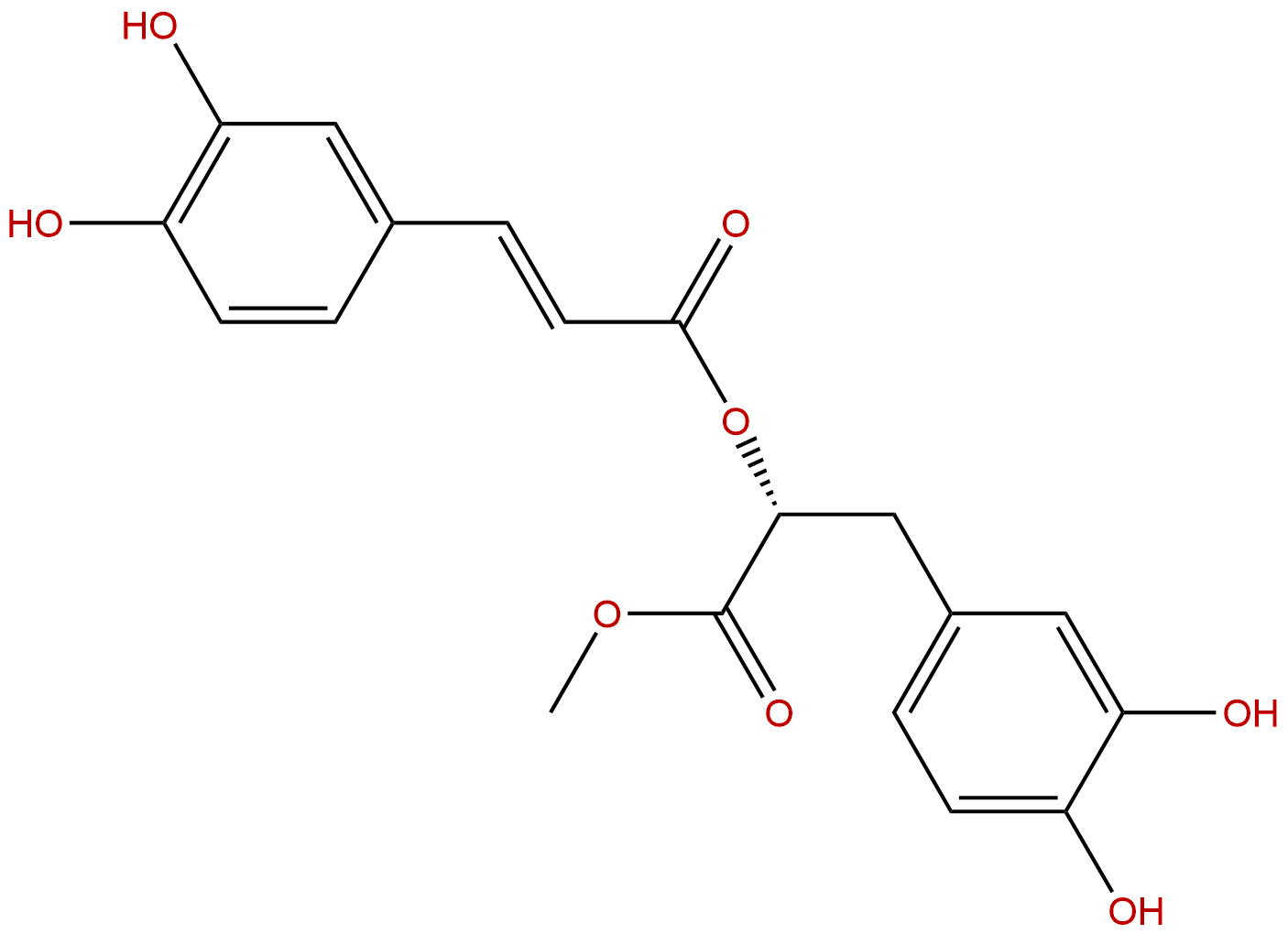


Product name: Methyl rosmarinate
Synonym name:
Catalogue No.: BP3256
Cas No.: 99353-00-1
Formula: C19H18O8
Mol Weight: 374.345
Botanical Source:
Physical Description: Powder
Type of Compound: Phenylpropanoids
Purity: 95%~99%
Analysis Method: HPLC-DAD or/and HPLC-ELSD
Identification Method: Mass, NMR
Packing: Brown vial or HDPE plastic bottle
The product could be supplied from milligrams to grams. Inquire for bulk scale.
We provide solution to improve the water-solubility of compounds, thereby facilitating the variety of activity tests and clinic uses.
For Reference Standard and R&D, Not for Human Use Directly.
Description:
Methyl rosmarinate shows antioxidative, and antifungal activities. It has inhibitory activities against tyrosinase, α-glucosidase, and matrix metalloproteinase-1 (MMP-1).
References:
J Food Prot. 2013 Sep;76(9):1539-48.Impact of fatty acid chain length of rosmarinate esters on their antimicrobial activity against Staphylococcus carnosus LTH1502 and Escherichia coli K-12 LTH4263.
The effect of the addition of a newly synthesized series of rosmarinic acid (RA) estes (REs) and alcohols with chain lengths of 1, 4, 8, 10, 12, 16, and 18 carbons (RE1 to 18) on the growth behavior of Staphylococcus carnosus LTH1502 and Escherichia coli K-12 LTH4263 was investigated.
METHODS AND RESULTS:
An initial microtiter dilution assay indicated activity of compounds against S. carnosus LTH1502, whereas esters with chain lengths, RA, n-Methyl rosmarinate (RE1), n-dodecyl rosmarinate (RE12), and n-octadecyl rosmarinate (RE18) were used in a time-kill assay S. carnosus LTH1502. Compounds were added at 0.75 mM in the log phase, 5 mM in the exponential phase, 10 mM in the stationary phase. RA had no effect in the lag and exponential phase but decreased cell counts during the stationary phase. In contrast, RE1 and RE12 decreased cell number in all three phase, will RE12 reducing counts most rapidly. Addition of RE18 did not affect regardless of the growth phase.
CONCLUSIONS:
Appearance and physiological state of S. carnosus LTH1502 cells indicated difference in the way the compounds interacted with and damaged cells. Results were attributed to the different physicochemical properties of RA and its esters.Zhongguo Zhong Yao Za Zhi. 2014 Jun;39(12):2284-8.[Chemical constituents of Hyptis rhomboidea and their antifungal activity].
The present work is to investigate the chemical constitutions of Hyptis rhomboidea and their antifungal activities.
METHODS AND RESULTS:
The compounds were isolated by Toyopearl HW-40, Sephadex LH-20, MCI-Gel CHP-20, RP-18, PTLC and silica column chromatographic methods and subjected to evaluate some monomers antifungal activity of eight kinds of plant pathogenic bacteria. Eleven compounds were isolated and identified as ethyl caffeate (1), ursolic acid (2), oleanolic acid (3), vanillactic acid (4), Methyl rosmarinate (5), kaempferol 3-O-alpha-L-rhamnopyranosyl-(1 --> 6) -beta-D-glucopyranoside (6), kaempferol 3-O-alpha-L-rhamnopyranosyl-(1 --> 6)-beta-D-glucopyranoside (7), ilexgenin A (8), beta-amyrin (9), kaempferol 3-O-beta-D-glucopyranoside (astrgalin, 10) and cholest-5-ene-3beta, 4beta-diol (11). Compound 1 showed the strongest inhibitory effect on Sclerotinia sclerotiorum with the MIC 16.2 mg x L(-1), and compound 5 showed the strongest inhibitory effect on S. minor and Exserohilum turcicum with MIC 16.2, 8.1 mg x L(-1), respectively.
CONCLUSIONS:
All compounds were isolated from the H. rhomboidea for the first time, and compounds 1 and 5 showed antifungal activity.
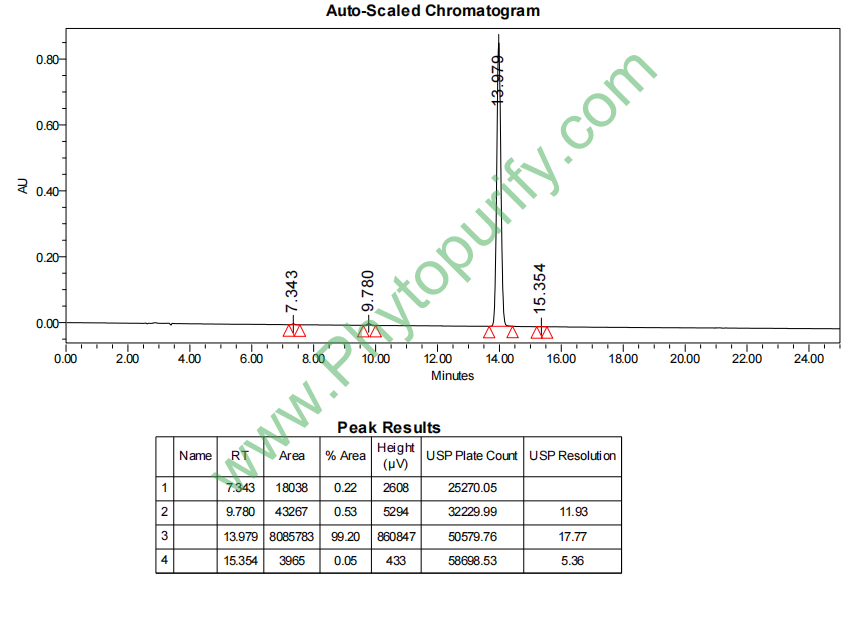
HPLC of Methyl rosmarinate
Storage conditions:Short-term storage at 2~8℃, long-term storage at -20 ~ -80℃
133.5200
2.3317
2.3025
.3570
2.7038
.3779
Low
88.5186
2.9428
Yes
Yes
No
No
Yes
No
0.0
Yes
Yes
Yes
Yes
Methyl rosmarinate is a naturally occurring phenolic acid compound with a CAS number of 99353-00-1, a molecular formula of C19H18O8, and a molecular weight of 374.3450 g/mol. As a methylated derivative of Rosmarinic acid, it inherits the strong biological activity spectrum of the parent compound and exhibits superior properties in certain aspects. This compound was originally derived from plants in the family Lamiaceae rosemary(Salvia rosmarinus, formerly known as Rosmarinus officinalis)Separation and identification, which is also the origin of its name. In addition, research has also found that it exists in various other plants, as mentioned in the literature Xihuang Herb(Rabdosia serra)。
Modern pharmacological research has revealed the extensive and remarkable biological activity of rosmarinic acid methyl ester. It has been identified as a type Non competitive tyrosinase inhibitors The half maximal inhibitory concentration (IC50) of mushroom tyrosinase is 0.28 mM, indicating its potential value in skin whitening and treatment of pigmentation diseases. At the same time, it can also inhibit Alpha glucosidase, which provides clues for the development of new diabetes management drugs. More importantly, its powerful antioxidant Activity is the cornerstone of its numerous pharmacological effects and has been validated through multiple antioxidant related targets. In addition, the study also reported its antifungal and matrix metalloproteinase-1 (MMP-1) inhibitory activities. These findings have elevated rosmarinic acid methyl ester from a traditional plant component to a hot molecule in modern natural product pharmacology, medicinal chemistry, and pharmacology research, particularly in the fight against Oxidative stress damage The field of related diseases shows broad prospects.
The chemical structure of rosmarinic acid methyl ester can be regarded as the connection of caffeic acid and 3,4-dihydroxyphenyllactic acid through ester bonds, and methylation occurs on the carboxyl group of the latter. The SMILES string is:COC(=O)[C@@H](Cc1ccc(O)c(O)c1)OC(=O)/C=C/c1ccc(O)c(O)c1It clearly demonstrates its core skeleton: a caffeoyl group (connected by a trans double bond) esterified with a methylated 3,4-dihydroxyphenyllactic acid unit. There are two catechol structures in the molecule, which are the key chemical basis for its strong antioxidant activity. Chiral center (composed of[C@@H]The existence of (indicating) implies its stereoisomerism, and its biological activity may be related to specific stereoconfigurations.
According to the analysis of drug parameters, its molecular weight (MW) is 374.35 g/mol, slightly higher but basically in line with the Lipinski Five Rules requirement of "less than 500". The topologically polar surface area (TPSA) is 133.52 Å ², which is relatively high and mainly attributed to the numerous hydroxyl and ester bonded oxygen atoms in the molecule. This usually indicates good water solubility but may affect membrane permeability. The calculated lipid water partition coefficient (LogP) is 2.33, and the LogD (distribution coefficient at a specific pH) is 2.30, indicating that the compound has moderate lipophilicity, balancing the need for cell membrane penetration with the need for water solubility. Its theoretical water solubility is about 0.357 mg/mL, which belongs to the category of slight solubility. In actual formulation development, it may need to be improved through methods such as salt formation or the use of solubilizers.
These physicochemical properties collectively determine the initial fate of rosmarinic acid methyl ester in organisms: moderate lipophilicity helps it pass through biological membranes, while a higher polar surface area and multiple hydrogen bond donors/acceptors (in accordance with Lipinski's rule, with 5 hydrogen bond donors and 8 hydrogen bond acceptors) make it more inclined to stay in a hydrophilic environment and may affect its oral bioavailability.
The main natural source of rosmarinic acid methyl ester is rosemary(Salvia rosmarinus). Rosemary is an evergreen aromatic shrub of the Salvia genus in the family Lamiaceae, native to the Mediterranean region and widely cultivated around the world. In the long river of human history, rosemary is not only a cooking spice, but also a highly respected medicinal plant, enjoying the reputation of "the dew of the ocean" and "the grass of memory".
There are records of using rosemary in ancient Roman, Greek, and Egyptian civilizations. In the traditional medical system, rosemary is used to treat various diseases: its decoction or infusion is often used to relieve symptoms Indigestion, bloating, and abdominal pain This is consistent with modern research finding that its components have anti-inflammatory and antispasmodic effects; For external use, it is used for processing Muscle pain, arthritis, and wounds It may be related to its anti-inflammatory, antioxidant, and mild antibacterial activity; In terms of the nervous system, it is used for Refreshing mind, enhancing memory, relieving headaches Modern research has confirmed that its volatile oil and phenolic acid components can penetrate the blood-brain barrier and have neuroprotective effects; In addition, it is also used as Preservatives and antioxidants To preserve food. In the Middle Ages, people burned rosemary branches to purify the air and resist epidemics.
Rosmarinic acid methyl ester, as one of the important water-soluble phenolic acid components in rosemary, although implied in the overall plant effect in its traditional application, undoubtedly contributes to it Antioxidant, anti-inflammatory, and neuroprotective properties One of the key material foundations for core efficacy. From traditional wisdom to modern science, the tracing of the efficacy of rosemary ultimately focuses on specific molecules like rosmarinic acid methyl ester, revealing its profound scientific implications.
The pharmacological activities of methyl rosmarinate are diverse, and its core mechanism closely revolves around antioxidant and Regulating key enzyme activity open. The target information provided by the database clearly points to its core pathway for combating oxidative stress damage.
4.1 Core antioxidant mechanisms and related targets
Oxidative stress is a process of tissue damage caused by imbalance in the production and elimination of reactive oxygen species (ROS) in the body, and is the common pathological basis of aging, neurodegenerative diseases, cardiovascular diseases, diabetes complications and other diseases. The chemical structure of methyl rosmarinate contains two components Catechol Functional groups are ideal electron donors that can directly neutralize free radicals (such as · OH, O ₂·⁻) and exert direct antioxidant effects.
More importantly, it can achieve indirect and more lasting protection by activating the cell's own antioxidant defense system. This is mainly achieved through regulation Nuclear factor E2 related factor 2 (Nrf2) Signal pathway implementation. Nrf2 is the "main switch" for cellular antioxidant response. Under oxidative stress, Nrf2 translocates from the cytoplasm to the nucleus, binds to antioxidant response elements (ARE), and initiates gene transcription of downstream antioxidant enzymes and phase II detoxifying enzymes. The targets in the database are the key executors of this pathway:
- SOD1 (Superoxide Dismutase 1)Convert harmful superoxide anions (O ₂·⁻) into hydrogen peroxide (H ₂ O ₂).
- CAT (catalase)Decompose H ₂ O ₂ into harmless water and oxygen.
- GPX1 (Glutathione Peroxidase 1)The use of reduced glutathione (GSH) to reduce H ₂ O ₂ and lipid peroxides is one of the most important H ₂ O ₂ clearance systems in cells.
- HMOX1 (Heme Oxygenase 1)Degradation of hemoglobin produces biliverdin (a strong antioxidant), carbon monoxide, and ferritin, which have powerful anti-inflammatory and antioxidant effects.
Rosmarinic acid methyl ester is activated through NFE2L2 (i.e. Nrf2)Upregulate the expression of SOD1, CAT, GPX1, and HMOX1, thereby systematically enhancing the cell's ability to clear ROS and resist Oxidative stress damage This is the fundamental molecular mechanism underlying its treatment of related diseases.
4.2 Enzyme inhibitory activity
- Tyrosinase inhibition Tyrosinase is the rate limiting enzyme in melanin biosynthesis. Rosmarinic acid methyl ester Non competitive inhibitors(IC50=0.28 mM), The catechol structure of the enzyme may chelate with copper ions in the active center of the enzyme, or bind to non substrate binding sites of the enzyme, changing the conformation of the enzyme and thereby inhibiting its activity. This provides a basis for its application in cosmetics (whitening) and the treatment of hyperpigmentation disorders such as melasma.
- α - glucosidase inhibition This enzyme is located at the brush border of the small intestine and is responsible for breaking down oligosaccharides into monosaccharides (glucose) for absorption into the bloodstream. Inhibiting its activity can delay carbohydrate digestion and absorption, and lower postprandial blood glucose peak. The activity of rosmarinic acid methyl ester, combined with its antioxidant and anti-inflammatory effects, makes it suitable for prevention or management Type 2 diabetes And its complications (such as diabetes nephropathy and neuropathy, which are related to oxidative stress).
- Inhibition of Matrix Metalloprotease-1 (MMP-1)MMP-1 is a key enzyme that degrades collagen (mainly type I and III) in the dermis of the skin, and its overexpression is an important cause of skin photoaging and wrinkle formation. The antioxidant effect of rosmarinic acid methyl ester can inhibit the upregulation of MMP-1 expression induced by ultraviolet radiation, thereby protecting collagen and having the potential to resist skin photoaging.
4.3 Other Activities
Research also indicates that it has antifungal Activity may be achieved by disrupting fungal cell membranes or interfering with their metabolism. its anti-inflammatory The effect is related to inhibiting inflammatory signaling pathways such as NF - κ B and reducing the production of pro-inflammatory factors, which complement their antioxidant activity, as ROS itself is an important inflammatory mediator.
In summary, rosmarinic acid methyl ester Directly eliminate free radicals and Activate Nrf2/ARE endogenous antioxidant pathway Dual pronged approach to combat oxidative stress, the core pathological process. At the same time, by inhibiting specific targets such as tyrosinase, alpha glucosidase, MMP-1, etc., it exerts therapeutic effects in specific application scenarios such as skin health, metabolic diseases, anti-aging, etc., forming a multi-target and networked pharmacological action mode.
Evaluating the physicochemical and biological parameters of methyl rosmarinate under drug development standards can objectively examine its potential as an oral or topical drug. We mainly make preliminary judgments based on the Lipinski Rule of Five (Ro5) and related extended rules.
5.1 Analysis based on Lipinski's Five Rules
1. Molecular weight (MW):374.35 < 500, Comply with。
2. Lipid water partition coefficient (LogP):2.33 < 5, Comply with。
3. Hydrogen bond donor (HBD)There are 5 phenolic hydroxyl groups in the molecule, slightly higher than The "≤ 5" standard for Ro5 (actually 5, at the critical level).
4. Hydrogen bond acceptor (HBA)There are a total of 8 oxygen atoms in the ester group and phenolic hydroxyl group, Comply with Ro5's "≤ 10" standard.
5. Number of rotatable keys About 8, slightly more than the commonly accepted loose standard of "≤ 10", but still within an acceptable range.
Conclusion Rosmarinic acid methyl ester basically conforms to Lipinski's five rules, only at the critical value in terms of the number of hydrogen bond donors. This indicates that it has the potential to become an orally active drug Basic chemical spatial characteristics But it is not optimal.
5.2 Deep interpretation of key pharmacological parameters
- Permeability and absorption The permeability of Caco-2 cells is 0.3779, which is a low value, indicating that their intestinal absorption may be poor. The effective permeability (Peff) is 2.7038, indicating that the oral absorption efficiency may not be high. This is related to its higher TPSA (133.52) and more hydrogen bond donors/acceptors, which are unfavorable for passive transmembrane diffusion.The blood-brain barrier (BBB) penetration is' low 'This is a challenge for indications that require central nervous system action, such as Alzheimer's disease, but it may also reduce the risk of central side effects.
- Distribution and protein binding The plasma protein binding rate (PPB) is as high as 88.52%, which means that most of the drugs are bound to proteins in the blood. The concentration of free drugs is low, which may affect their distribution to target tissues and their efficacy, but may also prolong their circulation time in the body.
- Metabolism and toxicity:
- Ames test The result is 0.0 (usually negative), indicating no mutagenicity,Good safety。
- chromosome aberration Warning: There is a risk, which requires high vigilance Potential genotoxic signals Strict confirmation and evaluation must be conducted in subsequent development.
- HERG inhibition The result is' no ', indicating a low likelihood of inducing QT interval prolongation (a serious risk of arrhythmia) in the heart,Good cardiovascular safety。
- Effects on liver and kidney function The data shows that it has an effect on serum alkaline phosphatase (Ser_LK), gamma glutamyltransferase (Ser_GGT), aspartate aminotransferase (Ser_ST), and alanine aminotransferase (Ser_LT) ("Yes"), indicating Potential risk of liver injury It needs to be given special attention in toxicology research.
- allergenicity Skin sensitization (Skid_Sens) is "Yes", respiratory sensitization (Resp_Sens) is "No", indicating the need to pay attention to allergic reactions in the development of topical preparations. Photo_tox has no phototoxicity, which is beneficial for its use as an external ingredient.
5.3 Comprehensive evaluation
Rosmarinic acid methyl ester, as a lead compound Clear pharmacological activity and multi-target targeting Outstanding advantages. But there are obvious shortcomings in terms of drug properties:Oral absorption may be poor and there is a potential risk of chromosomal abnormalities and liver damage These defects limit its direct development as a drug.
Future strategies may include:
1. Structural modification By using prodrug strategies (such as esterifying phenolic hydroxyl groups to improve lipid solubility and membrane penetration, and hydrolyzing them into the original drug in vivo) or synthesizing analogues, optimizing their LogP and TPSA, reducing hydrogen bond donors, and improving pharmacokinetic properties while maintaining activity.
2. Formulation technology Using techniques such as nano formulations, liposomes, and cyclodextrin inclusion to improve its solubility and bioavailability.
3. In depth toxicology research Strict and standardized preclinical validation must be conducted on chromosomal aberrations and liver toxicity to clarify their risk level and mechanism of action.
4. Focus on external development Given its tyrosinase inhibition, antioxidant, anti-MMP-1 activity, and controllable skin sensitization properties, it has been developed as External skincare products or skin disease treatment drugs(such as for whitening and anti-aging purposes) may be a faster and lower risk conversion pathway.
At present, research on methyl rosmarinate is mostly focused on Preclinical stage Focusing on activity screening, mechanism exploration, and preliminary optimization of extraction and separation processes. Its multi-target action characteristics, especially its strong Nrf2 activation ability, have attracted attention in multiple disease fields.
Research status:
- Active in basic research Cell and animal model studies in antioxidant, anti-inflammatory, neuroprotective, hypoglycemic, and skin protective fields continue to emerge, deepening our understanding of their functional networks.
- In depth mechanism research Research has gone beyond simple activity validation and delved into the regulation of signaling pathways such as Nrf2, NF - κ B, MAPK, as well as interactions with other pathways such as autophagy.
- Start of Structure Activity Relationship (SAR) Research Previous studies have begun to explore the synthesis and activity comparison of its analogues, providing clues for subsequent optimization.
- Weak research on medicinal properties The relative lack of research on pharmacokinetics, toxicology, and formulation of the system is the main bottleneck for its conversion into drugs.
Application Prospects:
1. Neurological disorders As a potent activator of Nrf2, it has great potential in oxidative stress and neuroinflammatory core diseases such as Alzheimer's disease, Parkinson's disease, stroke, and traumatic brain injury. Need to address BBB penetration issue.
2. Metabolic diseases: Combined with α - glucosidase inhibition, anti-oxidation and anti-inflammatory, it is used for the prevention and treatment of diabetes and its complications (nephropathy, retinopathy, neuropathy).
3. Skin Health and Disease This is the most promising field for direct conversion. As a tyrosinase inhibitor and antioxidant/anti-MMP-1 component, it can be developed for Whitening and spot lightening, anti wrinkle and anti photoaging Cosmetics or topical medications. Its antifungal activity can also be used for skin fungal infections.
4. Food and Health Products As a natural antioxidant and preservative, it is used in functional foods and dietary supplements to delay food oxidation and promote human health.
5. lead compound Its chemical structure is an excellent template, and medicinal chemists can systematically modify it to develop a series of new compounds with better activity, selectivity, and drug properties.
Challenges and Future Directions:
Future research should focus on: ① carrying out systematic standardization Preclinical pharmacokinetic and toxicological evaluation Clearly define its safety window; ② Strengthen structural optimization Improve absorption, metabolism, and toxicity issues while retaining the core pharmacophore (catechol structure); ③ Explore advanced delivery system Targeting nanomaterials to enhance their bioavailability and targeting ability; ④ Carry out high-quality Animal model efficacy verification To lay the foundation for clinical trials.
In summary, rosmarinic acid methyl ester is a multi-target "treasure molecule" gifted by nature, and its clear activity and mechanism provide a clear blueprint for its drug development. Although it still faces challenges such as absorption and toxicity on the path of becoming a traditional Chinese medicine, with the empowerment of modern pharmaceutical chemistry and formulation technology, it is highly likely to derive new drugs or functional products with important clinical application value, playing an important role in the battlefield against oxidative stress-related diseases.
