


Product name: Carnosol
Synonym name: Picrosalvin
Catalogue No.: BP0317
Cas No.: 5957-80-2
Formula: C20H26O4
Mol Weight: 330.424
Botanical Source: Rosmarinus officinalis
Physical Description:
Type of Compound: Diterpenoids
Purity: 95%~99%
Analysis Method: HPLC-DAD or/and HPLC-ELSD
Identification Method: Mass, NMR
Packing: Brown vial or HDPE plastic bottle
Storage: Store in a well closed container, protected from air and light. Put into refrigerate or freeze for long term storage.
Whenever possible, you should prepare and use solutions on the same day. However, if you need to make up stock solutions in advance, we recommend that you store the solution as aliquots in tightly sealed vials at -20℃. Generally, these will be useable for up to two weeks.
The product could be supplied from milligrams to grams
Inquire for bulk scale.
Description:
Carnosol, a novel agonist of TRPA1 with an EC50 value of 12.46 uM, which exhibits anti-inflammatory, anti-nociceptive, hepatoprotective, antioxidant, anticarcinogen, anti-angiogenic, anti- invasive and antimetastatic properties. Carnosol can cause a significant decrease in both bacterial and yeast growth whilst, it may prove useful as a food antioxidant which could also contribute to the retardation of the microbial spoilage of foods; it also can inhibit adipocyte differentiation in mouse 3T3-L1 cells through induction of phase2 enzymes and activation of glutathione metabolism, it may be a potential drug against obesity-related diseases.
References:
Eur J Nutr. 2013 Feb;52(1):85-95.
Anti-angiogenic properties of carnosol and carnosic acid, two major dietary compounds from rosemary.
The use of rosemary (Rosmarinus officinalis) leaves and their constituents as a source of dietary antioxidants and flavoring agents is continuously growing. Carnosol and carnosic acid, two major components of rosemary extracts, have shown activity for cancer prevention and therapy. In this study, we investigate the cytotoxic and anti-angiogenic activities of Carnosol and carnosic acid, in order to get further insight into their mechanism of action.
METHODS AND RESULTS:
Our results demonstrate that the mentioned diterpenes inhibit certain functions of endothelial cells, namely, differentiation, proliferation, migration and proteolytic capability. Our data indicate that their growth inhibitory effect, exerted on proliferative endothelial and tumor cells, could be due to, at least in part, an induction of apoptosis. Inhibition of the mentioned essential steps of in vitro angiogenesis agrees with the observed inhibition of the in vivo angiogenesis, substantiated by using the chick chorioallantoic membrane assay.
CONCLUSIONS:
The anti-angiogenic activity of Carnosol and carnosic acid could contribute to the chemopreventive, antitumoral and antimetastatic activities of rosemary extracts and suggests their potential in the treatment of other angiogenesis-related malignancies.
Food Microbiol., 1987, 4(4):311-5.
Antimicrobial activity of carnosol and ursolic acid: two anti-oxidant constituents of Rosmarinus officinalis L.
METHODS AND RESULTS:
Inhibition of the growth of 6 strains of food associated bacteria and yeasts by Carnosol and Ursolic acid, two antioxidant compounds extracted from rosemary, was investigated and compared to inhibitory effects exhibited by the commonly used food antioxidants Butylated Hydroxyanisole (BHA) and Butylated Hydroxytoluene (BHT). At the highest concentration used (150 μg ml−1) Carnosol inhibited all the test microbes to the greatest extent. BHA proved a superior inhibitor to Ursolic acid which itself was more effective overall than BHT. Even at 50 μg ml−1, Carnosolcaused a significant decrease in both bacterial and yeast growth whilst BHA proved more effective against the yeasts than bacteria.
CONCLUSIONS:
Thus Carnosol might prove useful as a food antioxidant which could also contribute to the retardation of the microbial spoilage of foods.
Eur J Gastroenterol Hepatol. 2002 Sep;14(9):1001-6.
Protective effect of carnosol on CCl(4)-induced acute liver damage in rats.
We recently reported that (Lamiaceae) may alleviate CCl(4)-induced acute hepatotoxicity in rats, possibly blocking the formation of free radicals generated during CCl(4) metabolism. Carnosol, one of the main constituents of Rosmarinus, has been shown to have antioxidant and scavenging activities. Therefore, it is plausible to expect that Carnosol may mediate some of the effects of Rosmarinus on oxidative stress consequences induced by CCl(4) in the liver. We evaluated the effectiveness of Carnosol to normalize biochemical and histological parameters of CCl(4)-induced acute liver injury.
METHODS AND RESULTS:
Male Sprague Dawley rats (n = 5) injured by CCl(4) (oral dose 4 g/kg of body weight) were treated with a single intraperitoneal dose (5 mg/kg) of Carnosol. Twenty-four hours later, the rats were anaesthetized deeply to obtain the liver and blood, and biochemical and histological parameters of liver injury were evaluated. Carnosol normalized bilirubin plasma levels, reduced malondialdehyde (MDA) content in the liver by 69%, reduced alanine aminotransferase (ALT) activity in plasma by 50%, and partially prevented the fall of liver glycogen content and distortion of the liver parenchyma.
CONCLUSIONS:
Carnosol prevents acute liver damage, possibly by improving the structural integrity of the hepatocytes. To achieve this, Carnosol could scavenge free radicals induced by CCl(4), consequently avoiding the propagation of lipid peroxides. It is suggested that at least some of the beneficial properties of Rosmarinus officinalis are due to Carnosol.
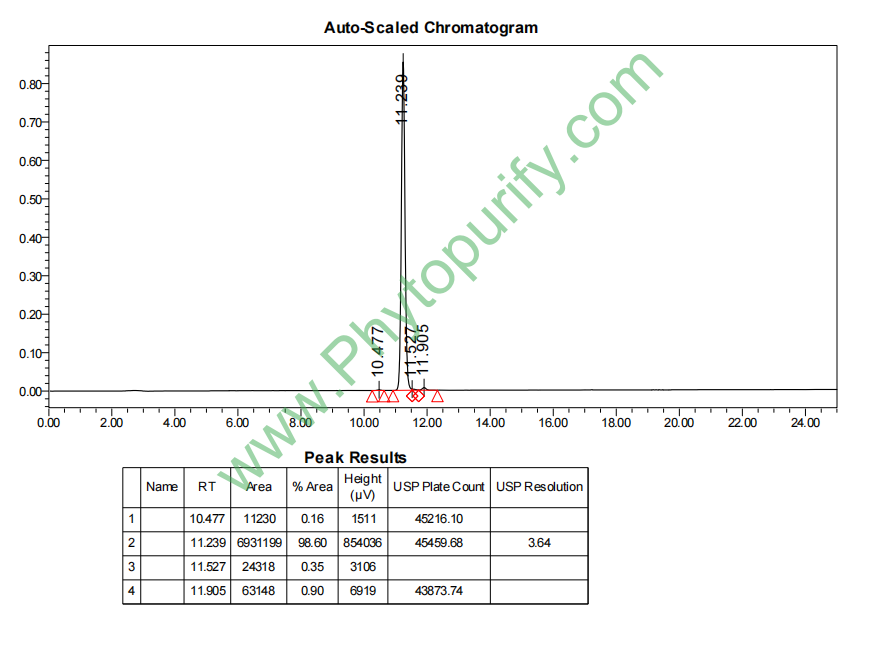
HPLC of Carnosol
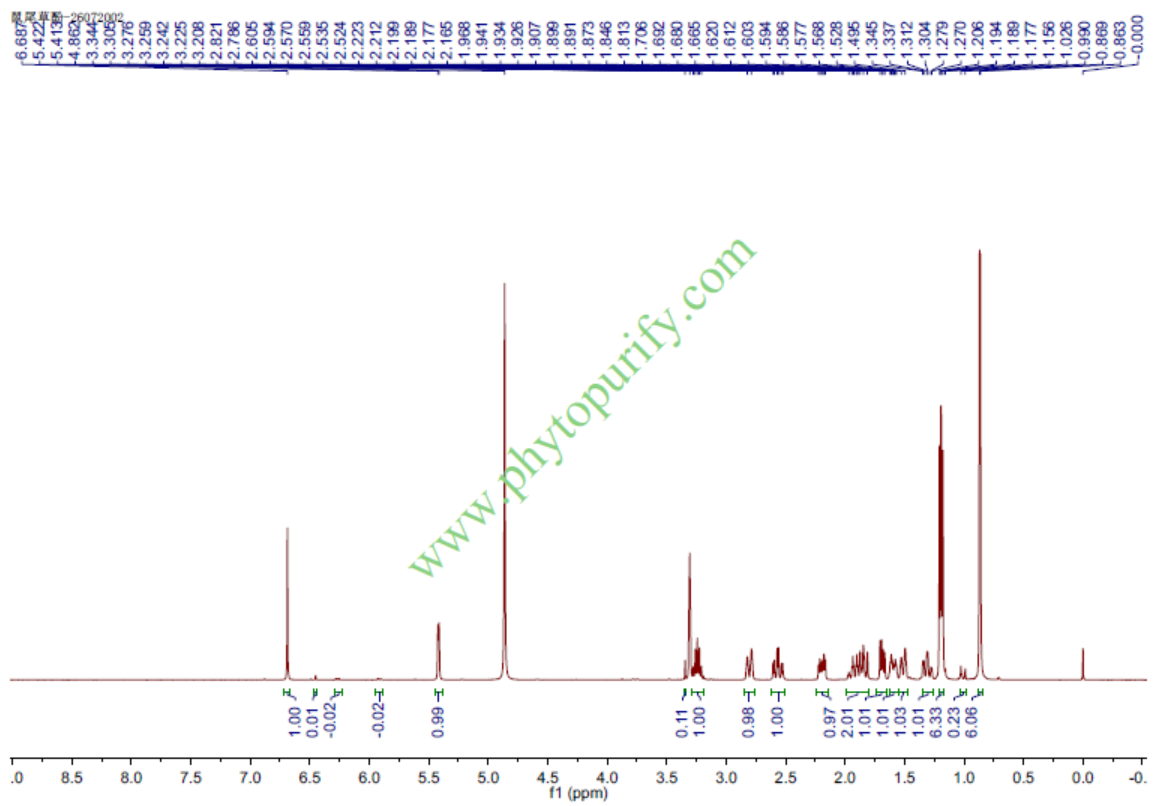
HNMR of Carnosol
Storage conditions:Short-term storage at 2~8℃, long-term storage at -20 ~ -80℃
Carnosol (CAS number: 5957-80-2) is a natural diterpenoid compound mainly found in Chinese herbal medicines such as Salvia spp. and Rosmarinus officinalis in the family Lamiaceae. As a biologically active natural product, salvianolic acid has gradually received attention in pharmacological research in recent years, especially due to its multi-target properties and low toxicity, it is considered a potential candidate molecule for anti-tumor, anti-inflammatory, and antibacterial drugs. This article will systematically review the chemical structure and physicochemical properties of salvianolic acid, plant sources and extraction methods, pharmacological activity and mechanism of action, drug evaluation and pharmacokinetic characteristics, and explore its potential prospects in clinical applications.
The molecular formula of salvianolic acid is C20H26O4, with a molecular weight of 330.42, belonging to the aromatic terpenes in the diterpenoid class. Its chemical structure contains a terpene skeleton with multiple hydroxyl and phenolic hydroxyl groups, endowing it with strong antioxidant activity. In terms of physical and chemical properties, the LogP value of salvianolic acid is about 4.2, indicating its good lipid solubility, which is beneficial for cell membrane penetration, but also suggests its limited water solubility. Its topological polar surface area (TPSA) is 77.93 Å ², and the number of hydrogen bond acceptors is 4, indicating that it has certain polarity characteristics in intermolecular forces. The low blood-brain barrier permeability of salvianolic acid suggests its limited distribution in the central nervous system.
Sage phenols are mainly found in Salvia spp. and Rosmarinus officinalis. Research on traditional Chinese medicine and modern medicinal botany has shown that the leaves and stems of these plants contain abundant diterpenoid compounds, among which salvianolic acid is one of the main active ingredients. The extraction method often uses organic solvent extraction combined with column chromatography separation technology, and commonly used solvents include ethanol, methanol, and ethyl acetate. In recent years, ultrasound assisted extraction and supercritical CO2 extraction technologies have gradually been applied to the extraction of salvianolic acid due to their high efficiency and environmental friendliness, improving the extraction rate and purity. During the purification process, high-performance liquid chromatography (HPLC) and mass spectrometry techniques are commonly used for qualitative and quantitative analysis of salvianolic acid.
The pharmacological activities of salvianolic acid include anti-tumor, anti-inflammatory, antioxidant, and antibacterial effects.
Salvianolol, as an effective inhibitor of ribosomal S6 kinase 2 (RSK2), exhibits significant inhibitory effects in gastric cancer cells with an IC50 of approximately 5.5 μ M. As a key regulatory factor for cell proliferation and survival, RSK2 inhibition can block the signaling pathway of cancer cells, induce cell cycle arrest and apoptosis. In addition, salvianolic acid enhances the antioxidant defense ability of cells by activating the Nrf2 signaling pathway, reduces DNA damage caused by oxidative stress, and further exerts anti-tumor effects.
Sage phenol is an activator of Nrf2, which can promote nuclear translocation of Nrf2 and the expression of downstream antioxidant enzyme heme oxygenase-1 (HMOX1), enhance the body's antioxidant capacity, and alleviate inflammatory reactions. In various inflammatory models, salvianolic acid significantly reduces the expression of pro-inflammatory factors such as TNF - α and IL-6, inhibits the activation of inflammatory cells, and demonstrates good anti-inflammatory effects.
Salvianolol exhibits inhibitory effects on multiple drug-resistant strains, with related targets including DNA gyrase subunit GYRA, erythrocyte membrane protein GYPB, dihydrofolate reductase DHFR, bacterial membrane protein MECA, and penicillin binding protein PENA. Through multi-target synergistic effects, salvianolic acid can disrupt bacterial DNA replication, cell wall synthesis, and metabolic functions, inhibit the growth of drug-resistant bacteria, and provide new ideas for combating drug-resistant bacterial infections.
The mechanism of action of salvianolic acid is diverse, involving multiple signaling pathways and molecular targets.
RSK2 is an important kinase downstream of the MAPK signaling pathway, involved in cell proliferation, differentiation, and survival. Sage phenol inhibits the activity of RSK2 by directly binding to its kinase domain, blocking the proliferation signal of cancer cells, promoting cell cycle arrest and apoptosis, especially in gastric cancer cells.
Nrf2, as the main intracellular antioxidant transcription factor, regulates the expression of various antioxidant enzymes. Sage phenol promotes nuclear translocation of Nrf2, enhances the expression of antioxidant enzymes such as HMOX1, enhances cellular antioxidant defense ability, reduces oxidative stress and inflammatory response, and protects cells from damage.
The inhibition of salvianolic acid on drug-resistant bacteria involves multiple targets. Its inhibitory effect on DNA gyrase GYRA blocks the replication and transcription of bacterial DNA; By acting on DHFR, it interferes with bacterial folate metabolism; Affects PENA and other penicillin binding proteins, disrupting the synthesis of bacterial cell walls. In addition, salvianolic acid can interfere with the functions of bacterial membrane proteins MECA and GYPB, comprehensively inhibiting the physiological activity of bacteria.
The pharmacological parameters of salvianolic acid show that it has certain potential for drug development. The molecular weight of 330.42 conforms to Lipinski's rule, and the LogP value of 4.2 shows that it has good lipid solubility, which is beneficial for cell membrane penetration, but poor water solubility, which may affect oral absorption. The TPSA is 77.93 Å ², indicating moderate polarity that facilitates binding to the target. The number of hydrogen bond receptors is 4, which is within the reasonable range of drug molecule design. Low blood-brain barrier permeability indicates limited distribution in the central nervous system, reducing the risk of central neurotoxicity.
Pharmacokinetic studies have shown that salvianolic acid is absorbed rapidly after oral administration, but its bioavailability is limited by its low water solubility and first pass effect. Metabolism is mainly carried out through the liver cytochrome P450 enzyme system, and the metabolites are mostly hydroxylation and glucuronic acid conjugates. Its half-life is moderate and suitable for daily administration. In the future, improvements in drug formulations such as nanocarriers and liposome encapsulation are expected to enhance their bioavailability and targeting.
Salvianolol has shown broad clinical application prospects due to its multi-target and multi mechanism pharmacological activities. It has potential adjuvant therapeutic value as an RSK2 inhibitor in the treatment of digestive system tumors such as gastric cancer. By activating the Nrf2 signaling pathway, salvianolic acid can also be used for the prevention and treatment of chronic inflammatory diseases and oxidative stress-related diseases. In addition, its inhibitory effect on drug-resistant bacterial infections provides new ideas for the development of antibacterial drugs, especially in the context of increasingly severe global antibiotic resistance. The development of salvianolic acid related derivatives is of great significance.
However, clinical research on salvianolic acid is still in its early stages and lacks systematic clinical trial data. In the future, it is necessary to strengthen its pharmacokinetics, toxicology, and clinical safety evaluation, combined with modern drug delivery technology, to optimize its efficacy and safety. Multidisciplinary joint research will promote the clinical translation of salvianolic acid and make it an important component of new natural medicines.
As a natural diterpenoid compound with significant biological activity, salvianolic acid exhibits multiple pharmacological effects in the fields of anti-tumor, anti-inflammatory, antioxidant, and antibacterial effects. It exhibits a complex and effective mode of action by inhibiting RSK2 kinase, activating Nrf2 signaling pathway, and multi-target antibacterial mechanism. The pharmacokinetic parameters indicate that it has good potential for drug development, but challenges such as water solubility and bioavailability still need to be overcome. In the future, with the advancement of drug formulation technology and the deepening of clinical research, salvianolic acid is expected to become an important research object and a new star in the field of natural product pharmacology.
