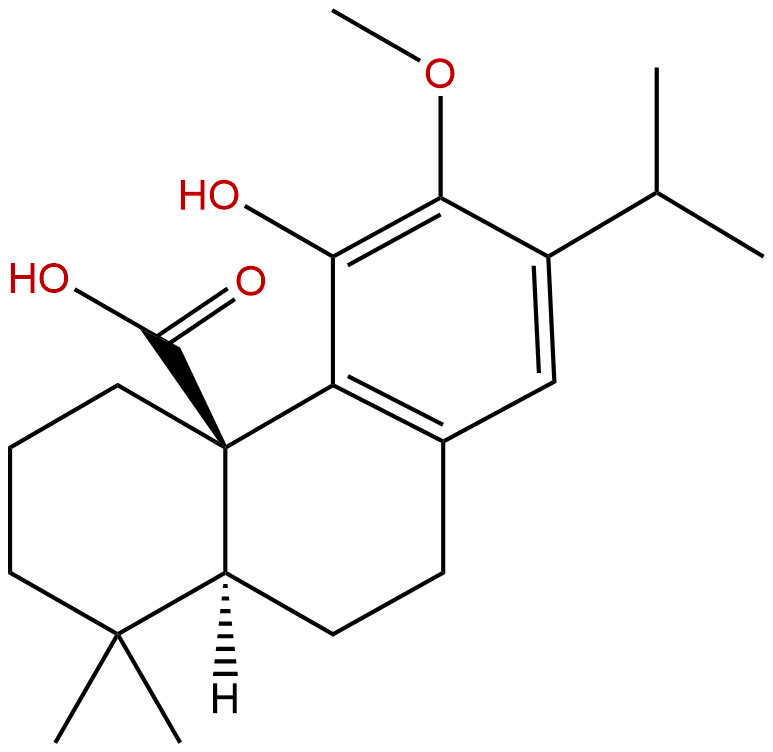


Product name: 12-O-Methylcarnosic acid
Synonym name:
Catalogue No.: SBP03616
Cas No.: 62201-71-2
Formula: C21H30O4
Mol Weight: 346.467
Botanical Source: Rosmarinus officinalis
Type of Compound: Diterpenoids
Purity: 95%~99%
Analysis Method: HPLC-DAD or/and HPLC-ELSD
Identification Method: Mass, NMR
Packing: Brown vial or HDPE plastic bottle
Storage: Store in a well closed container, protected from air and light. Put into refrigerate or freeze for long term storage.
Whenever possible, you should prepare and use solutions on the same day. However, if you need to make up stock solutions in advance, we recommend that you store the solution as aliquots in tightly sealed vials at -20℃. Generally, these will be useable for up to two weeks.
The product could be supplied from milligrams to grams
Inquire for bulk scale.
For Reference Standard and R&D, Not for Human Use Directly.
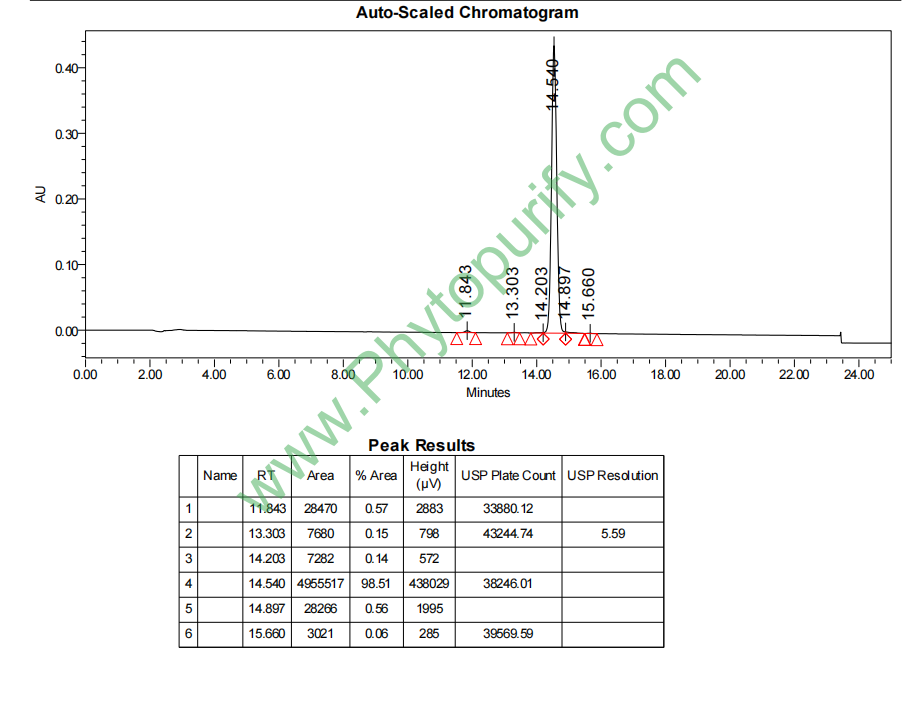
HPLC of 12-O-Methylcarnosic acid
Storage conditions:Short-term storage at 2~8℃, long-term storage at -20 ~ -80℃
66.7600
4.7646
2.6520
.0221
6.0244
6.4200
Low
92.1707
3.7514
No
No
No
No
No
No
0.0
Yes
No
No
No
12-O-Methylcarnosic acid, also known as 12-methoxycarnosic acid, is a diterpenoid compound with significant biological activity. Its CAS number is 62201-71-2. The compound was initially isolated and identified from the acetone extract of Salvia miltiorrhiza, but subsequent studies have confirmed that its primary natural source is the well-known medicinal and edible plant, rosemary(Salvia rosmarinus Lipstick family). As a methoxylated derivative of Carnosic acid, 12-O-methylCarnosic acid inherits the core active skeleton of the parent compound and the introduction of methoxy groups (- OCH ∝) at specific positions may have profound effects on its biological activity, stability, and metabolic characteristics.
Modern pharmacological research has revealed that 12-O-methylcarnitine is a typical multi-target, multifunctional natural product. Its biological activity spectrum is extensive, covering Antioxidant, anti-inflammatory, anti-cancer, antimicrobial, anti diabetes and inhibition of 5 α - reductase Waiting for multiple aspects. Of particular note is that it has been identified as an active ingredient that inhibits 5 α - reductase (IC ₅₀=61.7 μ M) and can effectively inhibit the proliferation of prostate cancer cells (such as LNCaP cells). In addition, it can inhibit melanin production by down regulating tyrosinase expression, and show potential anti diabetes activity by activating peroxisome proliferator activated receptor γ (PPAR γ). These diverse biological effects make it a bridge connecting traditional herbal applications with modern precision pharmacology research, attracting sustained attention in the fields of natural product chemistry, pharmacology, and new drug development. This article will systematically interpret this promising natural molecule from its chemical nature, origin, mechanism of action, medicinal properties, and prospects.
The molecular formula of 12-O-methylcarnitine is C ₂₁ H ∝₀ O ₄, with a molecular weight of 346.4670 g/mol. Structurally, it belongs to Rosin type diterpenes(abietane diterpenoid), Its core skeleton is a highly functionalized tricyclic phenanthrene structure, with a methoxy group (- OCH ∝) attached at the C-12 position, a key phenolic hydroxyl group at the C-11 position, and a carboxyl group at the C-20 position. Its SMILES string (COc1c (C (C) C) cc2c (c1O) [C @ @] 1 (C (=O) O) CCCC (C) (C) [C @ @ H] 1CC2) accurately describes its atomic connection order and chiral center (two chiral carbon atoms, usually in a specific stereoconfiguration), indicating that it is a compound with a clear three-dimensional spatial structure.
Analyzing its physicochemical properties from the parameters of drug properties:
- fat-soluble The calculated LogP value is 4.7646 and the LogD value is 2.6520. This indicates that the compound has Moderate to high lipophilicity A higher LogP value is usually beneficial for transmembrane passive diffusion, but excessive lipid solubility (LogP>5) may lead to poor water solubility and rapid metabolism. Its LogD (distribution coefficient at a specific pH) is lower than LogP, indicating that its carboxylic acid groups may be partially ionized at physiological pH, thereby increasing its hydrophilicity.
- Water solubility The predicted water solubility is 0.0221 mg/mL, belonging to slightly soluble Level. This is consistent with high LogP values and is a common characteristic of many diterpenoid compounds, which may affect their oral bioavailability and formulation development.
- Polar Surface Area The topological polar surface area (TPSA) is 66.76 Å ². This value is moderate, and compounds with TPSA<140 Å ² are generally considered to have good membrane permeability.
- Permeability The predicted permeability of Caco-2 cells is 6.42 × 10 ⁻⁶ cm/s, and the Peff value is 6.0244, both indicating that the compound has Good intestinal permeability potential This is a positive signal for its oral absorption.
In summary, 12-O-methylcarnitine is a medium-sized molecule with certain lipophilicity but retaining some polar groups (carboxyl and phenolic hydroxyl). Its physicochemical properties lay the foundation for its biological activity, but also pose challenges to its pharmacological properties.
The main natural source of 12-O-methylcarnitine is rosemary(Salvia rosmarinus, formerly known as Rosmarinus officinalis)It belongs to the Lamiaceae family and the Salvia genus. Rosemary is an evergreen aromatic shrub native to the Mediterranean region, and its leaves have been widely used for their unique aroma and various health benefits, with a long history.
In traditional medicine and folk applications, rosemary has been endowed with various benefits:
- Antioxidant and anti-corrosion Its strong antioxidant properties are used to preserve food, especially high-fat foods, to prevent spoilage. This is closely related to its high content of phenolic diterpenes such as carnitine, salvianolic acid, rosmarinic acid, and 12-O-methyl carnitine.
- Brain health and alertness Traditionally used to improve memory, enhance attention, and alleviate nerve fatigue. Modern research supports its potential to improve cognitive function, which may be related to antioxidant, anti-inflammatory, and effects on the neurotransmitter system.
- Digestive aid Used to relieve indigestion, bloating, and abdominal pain.
- Anti inflammatory and analgesic effects Used topically or orally to relieve muscle pain, arthritis, and headache.
- Antibacterial Used for treating minor wound infections and respiratory problems.
12-O-methylcarnitine, as an important member of the active ingredient group in rosemary, is one of the scientific material foundations for these traditional applications. Extracting and isolating such diterpenes from rosemary is a key step in elevating it from traditional experience to modern pharmaceutical research. Rosemary, as a medicinal and edible plant, has a long history of safe use, which also provides important safety references for the development of drugs or health products based on its active ingredients.
12-O-methylcarnitine exhibits a wide range of pharmacological activities, and its mechanism of action is complex, involving Multi target regulation Current research suggests that its core biological effects may revolve around Antioxidant, anti-inflammatory, and hormone regulation The three main lines are unfolded and achieved by influencing key signaling pathways.
Based on the provided pharmacological parameters, combined with classic Lipinski's Five Rules The development potential of 12-O-methylcarnitine can be preliminarily evaluated based on the Rule of Five (Ro5) and modern drug design concepts
Lipinski Five Rule Compliance:
Analysis of Absorption, Distribution, Metabolism, and Excretion (ADME) Characteristics:
Main challenges and optimization directions:
Overall evaluation 12-O-Methylcarnitine is a lead compound that conforms to the basic rules of drug likeness, with clear multi-target pharmacological activity and good preliminary safety prediction. Its main optimization direction lies in Improve solubility and bioavailability And further optimization of its activity, selectivity, and pharmacokinetic properties may be achieved through structural modifications (such as preparation of prodrugs or analogues).
At present, research on 12-O-methylcarnitine is still ongoing Preclinical stage Mainly focused on activity screening, preliminary exploration of mechanism of action, and preliminary isolation and preparation. Its research data mostly comes from cell models and a few animal experiments, lacking systematic pharmacokinetic, toxicological, and clinical efficacy evaluation.
Future research and application directions:
1. Deepening the mechanism of action Using chemical biology techniques such as molecular docking, surface plasmon resonance, proteomics, to accurately elucidate its direct interaction mode and affinity with predicted targets (TNF, PTGS2, NFKBIA, etc.), and explore whether it affects other unknown targets or signaling pathways (such as the Nrf2/ARE antioxidant pathway).
2. Structural optimization and derivative development Using it as the mother nucleus for systematic analysis Structure Activity Relationship (SAR) Study For example, modifying carboxyl, phenolic hydroxyl, or methoxy groups aims to improve water solubility, metabolic stability, target selectivity (such as enhancing selectivity for PPAR γ or 5 α - reductase), or BBB penetration (if needed for central nervous system diseases).
3. Pharmacokinetic and Formulation Research Conduct comprehensive ADME research to clarify its in vivo processes. Focus on tackling the problem of low solubility formulations and developing efficient delivery systems suitable for oral or topical use.
4. Disease model validation: Verify its efficacy and safety in animal models closer to human diseases (such as prostate cancer models, diabetes models, chronic inflammation models), and provide solid evidence for its possible clinical application.
5. Application scenario expansion:
- drug development: As anti prostatic hyperplasia/prostate cancer, anti type 2 diabetes or anti chronic inflammation New lead compounds。
- Functional food/health products As one of the standardized marker components of rosemary extract, it is used to develop health products with antioxidant, anti-inflammatory, liver protective, and sugar control functions.
- cosmetic ingredient Develop anti-aging and brightening cosmetic additives by utilizing their antioxidant and whitening (inhibiting melanin) activities.
Conclusion 12-O-methylcarnitine is a treasure molecule discovered from the traditional medicinal plant rosemary. It has demonstrated remarkable potential in various modern disease fields, such as anti-inflammatory, anticancer, and metabolic disease intervention, due to its unique multi-target mechanism of action. Although it still faces scientific challenges such as solubility and systemic efficacy verification before becoming a mature drug, its clear biological activity, good drug like basis, and abundant plant resources make it a highly valuable candidate for innovative natural product drug development and health product development. With the deepening of systematic research, this "green molecule" originating from the Mediterranean is expected to bring new choices for human health in the future.
