Introduction/Overview
Natural products, as an important source of drug discovery, play an irreplaceable role in the long history of human struggle against diseases. The isolation, identification, and elucidation of active ingredients from traditional herbs is an important paradigm in modern medicinal chemistry and pharmacology research. Rosemary(Rosmarinus officinalis L.), As a widely used plant in the family Lamiaceae for cooking, flavoring, and traditional medicine, its pharmacological activity has attracted much attention. Rosemary extract and its various phenolic acids, flavonoids, and terpenoids have been proven to have multiple biological functions such as antioxidant, anti-inflammatory, antibacterial, anti-tumor, and neuroprotective effects. In the complex chemical composition of rosemary, a class of structurally unique rosin type diterpenoid compounds, such as oxalic acid, salvianolic acid, rosmarinol, and their isomers, are considered the main material basis for many of its core pharmacological activities.
Isorosmarinol, as a rosin type diterpene isolated from rosemary leaves, has gradually entered the field of researchers in recent years. Compared to the more well-known rosmarinol, isorosmarinol is its C-7 stereoisomer. Although there are only slight structural differences, this stereochemical difference endows isorosmarinol with a unique biological activity spectrum. Existing studies have shown that isorosmarinol not only inherits the powerful antioxidant capacity of rosemary diterpenoids, but also exhibits significant neuroprotective and neurotrophic effects, can inhibit acetylcholinesterase (AChE) activity, and has potential in regulating melanin synthesis. These findings suggest that rosmarinol may become a lead compound for treating neurodegenerative diseases such as Alzheimer's disease and pigmentation related skin diseases. This article aims to systematically review the chemical structure, plant origin, pharmacological activity, mechanism of action, pharmacological characteristics, and clinical application prospects of isorosmarinol, in order to provide comprehensive scientific basis for the in-depth research and development of this natural product.
Chemical structure and physicochemical properties
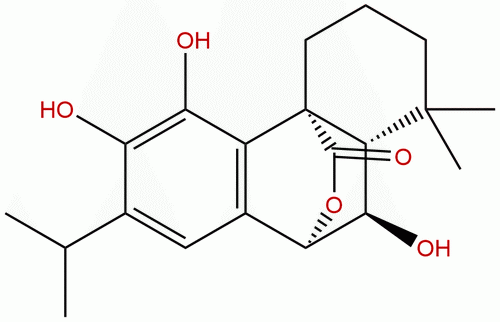
The chemical name of isorosmarinol is (4aR, 10aS) -5,6,10b-trihydroxy-8,8-dimethyl-3- (1-methylethyl) -8,10a-dihydro-4aH-phenanthrene-9-one, which belongs to the class of terpenoid compounds of the rosin type. Its core skeleton consists of four rings (A, B, C, D), with the D ring being a gamma lactone ring. This molecule contains multiple phenolic hydroxyl groups and one ketone group, which are the key structural basis for its antioxidant activity. Compared with Rosmanol, the difference between isorosmarinol and rosmarinol lies in the different stereoisomers of the C-7 hydroxyl group. In rosmarinol, the C-7 hydroxyl group is in the β configuration, while in isorosmarinol it is in the α configuration. This differential isomerization does not change the atomic composition of the molecule, but significantly affects its three-dimensional spatial structure, molecular polarity, and interaction mode with biological targets.
The molecular formula of isorosmarinol is C ₂₀ H ₂₆ O ₅, with a molecular weight of 346.4230 g/mol. Its lipid water partition coefficient (LogP) is 3.4681, indicating that the compound has moderate lipophilicity, which is beneficial for its penetration into biofilms, but may also affect its solubility in aqueous environments. Its topological polar surface area (TPSA) is 86.9900 Å ², which is lower than the commonly believed passive membrane permeability threshold (about 140 Å ²), indicating that it has a certain degree of cell membrane permeability. However, its low water solubility (0.0614 mg/mL) may limit its bioavailability in vivo. In addition, the predicted blood-brain barrier (BBB) permeability is "low", which means that rosmarinol may be difficult to enter the central nervous system in large quantities through passive diffusion, but whether it enters the brain through active transport mechanisms still needs further research. In terms of safety prediction, hERG inhibition was evaluated as' no ', indicating a lower risk of inducing QT interval prolongation in the heart; The Ames test result is 0.0, indicating that it is negative in the standard genetic toxicity test and preliminarily shows no mutagenicity. These physicochemical properties and preliminary safety data provide a favorable starting point for the subsequent drug development of rosmarinol.
Plant sources and extraction methods
Isorosmarinol is mainly derived from the plant rosemary in the family Lamiaceae(Rosmarinus officinalis L. The leaves and stems of. Rosemary is native to the Mediterranean region and is now widely cultivated in temperate and subtropical regions worldwide. In addition to rosemary, this compound may also be present in other plants of the family Lamiaceae, such as Salvia(Salvia Spp. and thyme genus(Thymus Plant species, but rosemary is currently the most extensively studied and widely recognized primary source.
In plants, isorosmarinol usually coexists with other rosin type diterpenes such as oxalic acid, salvianolic acid, and rosmarinol. Its content is influenced by various factors, including plant variety, growth environment, harvest season, tissue location, and processing method. Generally speaking, the content of diterpenes in rosemary leaves is relatively high, and it usually increases during the vigorous growth period of the plant or under specific stress conditions such as drought and high temperature.
The classic method for extracting isorosmarinol is mainly based on organic solvent extraction. Common solvents include methanol, ethanol, acetone, or their mixtures with water. Due to the lipophilicity of isorosmarinol, using high concentration ethanol or acetone for cold soaking or hot reflux extraction yields higher efficiency. In recent years, in order to improve extraction efficiency and environmental friendliness, some new extraction techniques have also been applied to the extraction of diterpenes from rosemary, such as ultrasound assisted extraction, microwave-assisted extraction, and supercritical fluid extraction (especially supercritical CO ₂ extraction). Supercritical CO ₂ extraction is particularly suitable for extracting thermosensitive phenolic diterpenes due to its advantages of no solvent residue, good selectivity, and low-temperature operation.
Obtaining high-purity rosmarinol from crude extract requires a series of complex separation and purification steps. Due to the complex composition of rosemary extract and the high similarity in structure between isorosmarinol and its isomer rosmarinol, separation is difficult. Common separation methods include liquid-liquid extraction (such as defatting with n-hexane and extracting target components with ethyl acetate), silica gel column chromatography (using polarity differences for preliminary separation), reverse phase silica gel column chromatography (such as C18 column, using methanol water or acetonitrile water gradient elution), and preparative high-performance liquid chromatography (Prep HPLC). Among them, Prep HPLC is a key step in achieving baseline separation of isorosmarinol and rosmarinol and other structurally similar compounds, and obtaining high-purity monomers. By optimizing chromatographic conditions, such as using chiral chromatography columns or specific mobile phase systems, this pair of enantiomers can be effectively separated.
Pharmacological activity research
antioxidant activity
Antioxidant activity is the most fundamental and core pharmacological activity of isorosmarinol. The multiple phenolic hydroxyl groups (especially ortho dihydroxy groups) in its molecular structure are efficient hydrogen atom donors, capable of effectively scavenging various free radicals, including hydroxyl radicals (• OH), superoxide anion radicals (O ₂⁻•), peroxynitrite (ONOO ⁻), and stable DPPH radicals. In vitro chemical experiments have shown that the DPPH free radical scavenging ability of isorosmarinol is comparable to classical antioxidants vitamin C and BHT, and even stronger in certain systems. Its antioxidant mechanism is not limited to directly scavenging free radicals, but also includes chelating transition metal ions (such as Fe ² ⁺, Cu ² ⁺), thereby inhibiting Fenton reaction mediated generation of reactive oxygen species (ROS). In cell models, rosmarinol can significantly reduce the increase in intracellular ROS levels caused by oxidative stress inducers such as H ₂ O ₂ and tert butyl hydroperoxide, protecting cells from oxidative damage. This protective effect has been validated in various cell lines, including neuronal cells, liver cells, and skin fibroblasts.
Neuroprotection and Neurotrophic Effects
Isorosmarinol has shown remarkable protective effects in neurological disease models. Research has shown that rosmarinol can protect primary cultured cortical neurons from glutamate excitotoxicity or neurotoxicity induced by β - amyloid protein (A β). Its neuroprotective mechanism is multifaceted: firstly, through its strong antioxidant activity, it inhibits the oxidative stress cascade triggered by A β or glutamate; Secondly, it can inhibit the activity of acetylcholinesterase (AChE). AChE is a key enzyme that degrades the neurotransmitter acetylcholine. In the brains of Alzheimer's disease (AD) patients, AChE activity is abnormally elevated, leading to functional decline of cholinergic neurons. The inhibitory effect of rosmarinol on AChE is similar to that of cholinesterase inhibitors used clinically, such as donepezil, and is expected to improve cognitive function by increasing synaptic acetylcholine levels. In addition, isorosmarinol has been found to have neurotrophic effects, promoting the growth and branching of neural processes, enhancing neuronal survival signals, which provides the possibility for repairing damaged neural networks.
Inhibit melanin synthesis
Isorosmarinol has also shown potential applications in the field of skin biology. Melanin is the main pigment that determines skin color, and its excessive synthesis and abnormal deposition can lead to pigmentation diseases such as melasma and freckles. Tyrosinase (TYR) is a key rate limiting enzyme in the melanin synthesis pathway. Research has found that rosmarinol can effectively inhibit the activity of tyrosinase, thereby reducing the production of melanin. In the B16F10 mouse melanoma cell model, rosmarinol reduced intracellular tyrosinase activity and melanin content in a concentration dependent manner, without showing significant cytotoxicity. Its mechanism of action may involve direct inhibition of tyrosinase activity and downregulation of protein expression levels of tyrosinase and related transcription factors (such as MITF). This discovery suggests that rosmarinol has the potential to serve as a safe and effective natural skin whitening agent or active ingredient for treating pigmentation disorders.
Other pharmacological activities
In addition to the main activities mentioned above, preliminary studies also suggest that isorosmarinol may have anti-inflammatory, antibacterial, and anti-tumor activities. For example, in a macrophage model stimulated by lipopolysaccharide (LPS), rosmarinol can inhibit the production of pro-inflammatory factors (such as TNF - α, IL-6) and nitric oxide (NO). It also exhibits certain inhibitory effects on certain Gram positive bacteria, such as Staphylococcus aureus. In terms of anti-tumor effects, it has been reported that rosmarinol can inhibit the proliferation of certain cancer cells, but its specific mechanism and selectivity still need to be further studied.
Mechanism of action and molecular targets
The pharmacological activity of rosmarinol is the result of its interaction with multiple molecular targets, and its mechanism of action is complex and interrelated.
1. Activation of antioxidant signaling pathways: The antioxidant effect of rosmarinol is not limited to directly scavenging free radicals, but more importantly, it activates the endogenous antioxidant defense system. Nuclear factor E2 related factor 2 (NFE2L2/NRF2) is a core transcription factor that cells use to respond to oxidative stress. Isorosmarinol can promote the dissociation of NRF2 from cytoplasmic inhibitory protein Keap1, causing it to translocate into the nucleus and bind to antioxidant response elements (ARE), thereby initiating the transcription of a series of downstream protective genes. These genes include:Heme oxygenase-1 (HMOX1)、Superoxide dismutase (SOD1, SOD2)、Catalase (CAT)、Glutathione peroxidase 1 (GPX1) Wait. By upregulating the expression of these antioxidant enzymes, isorosmarinol can enhance the overall antioxidant capacity of cells, thereby resisting oxidative damage more persistently and effectively.
2. Regulation of Matrix Metalloproteinases (MMPs): During the process of skin aging and tissue remodeling, matrix metalloproteinases (such as...)MMP1 and MMP3)Overexpression of can lead to degradation of collagen and extracellular matrix. The antioxidant activity of rosmarinol can inhibit the upregulation of MMP1 and MMP3 expression induced by ultraviolet radiation or oxidative stress, thereby protecting skin structure and delaying photoaging. The mechanism may involve inhibiting the activation of MAPK (such as JNK, p38) and AP-1 signaling pathways.
3. Inhibition of Tyrosinase (TYR): The core target of rosmarinol in inhibiting melanin synthesis is tyrosinase (TYR). It may function in two ways: as a competitive or non competitive inhibitor, it directly binds to the active site of tyrosinase, blocking its catalytic function; The second is achieved by downregulating the protein expression level of TYR. The latter may involve the regulation of upstream transcription factor MITF (microphthalmia related transcription factor) or the activation of signaling pathways such as PI3K/Akt to affect the process of melanin production.
4. Inhibition of acetylcholinesterase (AChE): The inhibitory effect of rosmarinol on AChE is an important component of its neuroprotective activity. Molecular docking studies suggest that isorosmarinol can interact with the active centers of AChE (mainly catalyzing the trimeric Ser His Glu) and peripheral anionic sites (PAS), thereby hindering the hydrolysis of acetylcholine. This dual binding mode may make it more effective than single site inhibitors.
In summary, isorosmarinol exerts its biological effects through a "multi-target, multi pathway" mode. Its core mechanism revolves around NRF2/ARE antioxidant pathway Expand while regulating MMPs、TYR and AChE By utilizing key enzymes, comprehensive interventions can be achieved for oxidative stress, neurodegenerative diseases, and skin pigmentation.
Evaluation of drug properties and pharmacokinetics
Based on the provided pharmacological parameters, isorosmarinol shows certain potential for drug development, but also faces some challenges.
Pharmaceutical advantages:
* Moderate molecular weight (346.4 Da): Meets the requirement of Lipinski's Rule of Five for molecular weight less than 500.
* Moderate lipid solubility (LogP 3.47): Beneficial for transmembrane transport and binding to hydrophobic pockets of target proteins.
* Good security prediction: No hERG inhibition risk, no Ames mutagenicity, reduced the risk of cardiac toxicity and genetic toxicity in early development.
* Clear active targets: Its antioxidant, neuroprotective, and whitening activities are supported by clear molecular targets, facilitating structure based drug design and optimization.
Challenges in drug development and pharmacokinetic characteristics:
* Poor water solubility (0.0614 mg/mL): This is its main pharmaceutical barrier. Low water solubility can lead to poor oral absorption and low bioavailability, affecting the efficacy of the drug in vivo. Formulation techniques such as nanoparticles, liposomes, cyclodextrin inclusion complexes, and solid dispersions are needed to improve their solubility and dissolution rate.
* Low blood-brain barrier (BBB) permeability: This is a key limitation for the clinical application of its neuroprotective effect, such as in the treatment of AD. Although its LogP and TPSA values suggest that it has certain membrane permeability potential, the predicted result is "low", indicating its limited passive diffusion ability. Future research needs to explore whether it enters the brain through carrier mediated transport (such as glucose transporters, amino acid transporters), or whether structural modifications (such as prodrug design) are needed to enhance its BBB penetration.
* Metabolic stability: As a polyphenolic compound, rosmarinol may undergo extensive phase II metabolism (such as glucuronidation and sulfation) in the body, leading to its rapid clearance. In addition, its phenolic hydroxyl group is also easily oxidized. Therefore, its oral bioavailability may be low and its half-life may be short. At present, there is very limited research data on the pharmacokinetic parameters (such as Cmax, Tmax, AUC, t1/2) of rosmarinol in animals, which is an urgent gap that needs to be filled in future research.
* Metabolites and Activity: It is currently unclear whether the metabolites of rosmarinol have biological activity or whether their activity is mediated by metabolites. Clarifying its metabolic pathways and metabolite activities in the body is crucial for understanding its true pharmacological substance basis.
Clinical application prospects and prospects
Based on existing pharmacological activity research, isorosmarinol has shown promising clinical application prospects in the following fields:
1. Neurodegenerative diseases: Given its multiple neuroprotective mechanisms including antioxidant, AChE inhibition, neurotrophic, and anti A β toxicity, rosmarinol is an ideal lead compound for developing candidate drugs for the treatment of neurodegenerative diseases such as Alzheimer's disease (AD) and Parkinson's disease (PD). Especially its inhibition of AChE activity directly corresponds to the mainstream strategy of AD treatment. However, its low BBB permeability is the biggest bottleneck. Future research directions should focus on: a) designing isorosmarinol derivatives or prodrugs that can penetrate the BBB; b) Develop targeted delivery systems (such as nanocarriers) to efficiently deliver them into the brain; c) Explore non oral routes such as nasal administration to bypass the BBB.
2. Skin care and whitening: Isorosmarinol inhibits tyrosinase activity and melanin synthesis, while also possessing antioxidant and MMP inhibitory properties, making it an ideal ingredient for developing multifunctional skincare products. It can be used for: a) whitening and spot removing products, treating melasma, freckles, and post inflammatory pigmentation; b) Anti aging products delay skin photoaging and natural aging by anti-oxidation and inhibiting collagen degradation. Its natural sources and preliminary safety data give it a competitive advantage in the "green" and "natural" cosmetics market. The development focus is on improving its stability and transdermal absorption rate in water-based formulations.
3. Functional foods and dietary supplements: Rosemary extract has been widely used as a food antioxidant. Isorosmarinol, as one of the highly effective antioxidant ingredients, can be developed into functional foods or dietary supplements with specific health claims, used to support cognitive health, delay aging, or maintain skin health. But it needs to overcome the problem of low oral bioavailability and verify its health benefits through rigorous clinical trials.
Future research direction outlook:
* In depth pharmacokinetic studies: Systematically evaluate the absorption, distribution, metabolism, and excretion (ADME) process of rosmarinol in vivo, and clarify its metabolites and bioavailability.
* Structure Activity Relationship (SAR) Study: Systematically synthesize a series of derivatives of isorosmarinol, explore the relationship between structural characteristics such as C-7 configuration, number and position of phenolic hydroxyl groups, and antioxidant, AChE inhibition, TYR inhibition, etc., and search for candidate molecules with stronger activity, higher selectivity, and better pharmacokinetic properties.
* In vivo efficacy verification: Validate the efficacy and safety of rosmarinol and its derivatives in various animal disease models, such as AD transgenic mice, skin photoaging models, and melanin deposition models.
* Formulation development: Develop advanced drug delivery systems, such as liposomes, polymer nanoparticles, phospholipid complexes, etc., to address the issues of poor water solubility and low BBB permeability.
* Toxicity evaluation: Conduct more comprehensive toxicological studies, including long-term toxicity, reproductive toxicity, and immunotoxicity, to lay a safe foundation for its entry into clinical trials.
Conclusion
Isorosmarinol, as an important rosin type diterpenoid in rosemary, has become a highlight in the field of natural product research due to its unique chemical structure and multiple pharmacological activities. It exhibits significant potential in antioxidant, neuroprotective, and inhibition of melanin synthesis by activating the NRF2 antioxidant pathway and inhibiting key enzymes such as AChE and TYR. Its good preliminary safety characteristics and physical and chemical properties that comply with the "Five Rules for Similar Drugs" provide favorable conditions for its drug development. However, pharmacokinetic defects such as poor water solubility and low blood-brain barrier permeability are the main obstacles to its clinical application. Future research requires the integration of multidisciplinary forces such as medicinal chemistry, pharmacology, pharmacy, and toxicology to deeply elucidate their mechanisms of action, optimize their pharmacokinetic properties, and validate their efficacy in more complex in vivo models. It can be foreseen that with the continuous deepening of research, isorosmarinol and its derivatives are expected to play an important role in the prevention and treatment of neurodegenerative diseases and skin health care, contributing the wisdom from natural products to the human health cause.