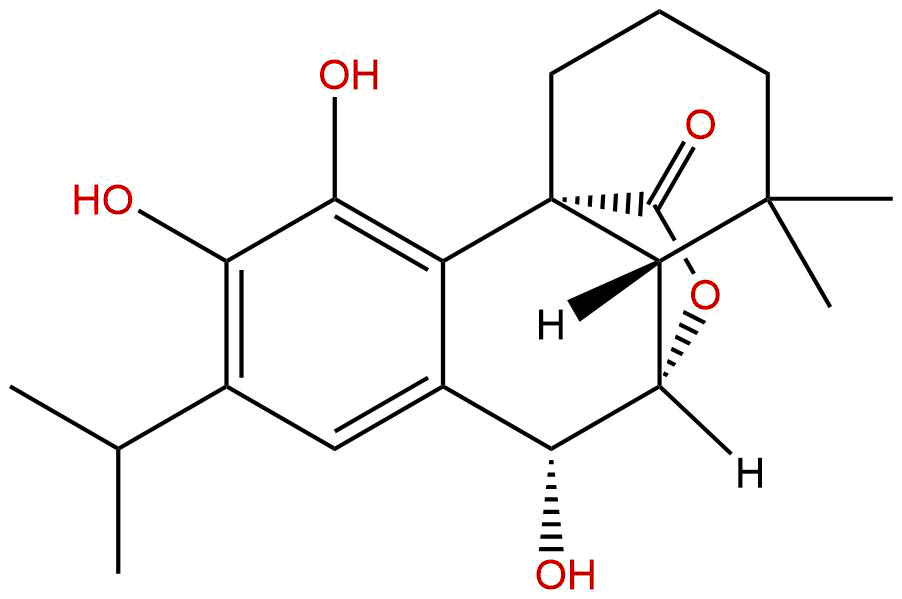
Rosmanol: a multi-target neuroprotective and anti-inflammatory star molecule in rosemary
1. Overview
Rosmanol is a compound derived from the plant Rosmarin in the family Lamiaceae(Salvia rosmarinus, formerly known as Rosmarinus officinalis)Natural diterpenoid phenolic compounds isolated from the middle. Its CAS number is 80225-53-2, molecular formula is C20H26O5, and molecular weight is 346.42 g/mol. Since its discovery, rosmarinol has been found to be Excellent antioxidant, anti-inflammatory, neuroprotective, and potential anti-tumor activity It quickly became one of the hot molecules in the field of natural product pharmacology research. Current studies have revealed that it can not only effectively inhibit the oxidation of low-density lipoprotein (LDL), which is a key initial step in atherosclerosis, but also significantly inhibit the expression of inducible nitric oxide synthase (iNOS) and cyclooxygenase-2 (COX-2) induced by bacterial lipopolysaccharide (LPS), showing a strong anti-inflammatory potential. More notably, rosmarinol exhibits complex regulatory effects in the central nervous system (CNS), including bidirectional regulation of GABAA receptors, and demonstrates analgesic, antidepressant, and anti anxiety activities in mouse models. In addition, its cytotoxicity and induction of apoptosis on neuroblastoma and colon adenocarcinoma cells provide clues for its application in the field of tumor therapy. This article will systematically review the chemical properties, pharmacological mechanisms, pharmacological evaluation, and future prospects of rosmarinol, providing a comprehensive professional science popularization material for relevant researchers.
2. Chemical structure and physicochemical properties
The chemical structure of rosmarinol belongs to highly oxidized rosin type diterpenes. The SMILES string is:CC(C)c1cc2c(c(O)c1O)[C@@]13CCCC(C)(C)[C@@H]1[C@H](OC3=O)[C@@H]2O, indicating that it is a possessing Multiple chiral centers The biological activity of complex molecules is likely closely related to their specific stereoconfigurations. The molecule contains one Catechol The structural unit (two adjacent phenolic hydroxyl groups) is the main chemical basis for its strong antioxidant activity; At the same time, the molecule also contains a lactone ring, which increases its structural rigidity.
According to the analysis of drug parameters, its molecular weight (MW) is 346.42, which meets the requirement of "less than 500" in Lipinski's five rules. The logarithm of the calculated lipid water partition coefficient (LogP) is 3.54, indicating that the compound Has good lipophilicity This is beneficial for its penetration through the cell membrane, but it may also affect its water solubility. Its water solubility parameter is 0.0686 (usually measured in mg/mL or mol/L, depending on the database definition), which is relatively low and confirms its lipophilic properties. The topological polar surface area (TPSA) is 86.99 Å ², which is lower than the threshold commonly considered to be "poor permeability" (about 140 Å ²), indicating that it has Better membrane permeability potential Combining LogP and TPSA, rosmarinol exhibits the basic characteristics of a "drug like" molecule.
3. Plant sources and traditional applications
The natural source of rosmarinol is very clear, that is rosemary Rosemary is an evergreen aromatic shrub of the Salvia genus in the family Lamiaceae, native to the Mediterranean region and widely cultivated around the world. In the long river of human history, rosemary is not only a famous cooking spice, but also a medicinal plant with a long history.
In traditional medicine, rosemary is used for Improve memory, relieve headaches, treat indigestion and rheumatic pain Its decoction or essential oil is often used as a refreshing, antibacterial, and antispasmodic medication. These traditional applications coincide with the antioxidant, anti-inflammatory, and neuroprotective activities of rosmarinol discovered by modern science. For example, the efficacy of "improving memory" may be related to the neuroprotective and antioxidant effects of its active ingredients, while "relieving rheumatic pain" corresponds to its strong anti-inflammatory activity. Rosmarinol, as one of the key bioactive components in rosemary, is an important material basis for its traditional medicinal value. The extraction, separation, and in-depth study of rosmarinol from rosemary is a model of interpreting ancient wisdom in modern scientific language.
4. Pharmacological activity and mechanism of action
The pharmacological activity of rosmarinol is extensive and profound, and its mechanism of action involves multiple signaling pathways and molecular targets, forming a multi-target, networked mode of action.
(1) Core antioxidant and Nrf2 pathway activation
The most fundamental and core activity of rosmarinol is Powerful antioxidant capacity Its function is far from being a simple free radical scavenger. Research has shown that rosmarinol can Activate antioxidant response element (ARE)The activation of ARE is regulated by the transcription factor NFE2L2 (commonly known as Nrf2). Nrf2 is the 'master switch' of the cellular antioxidant defense system. Under oxidative stress, rosmarinol may modify key cysteine residues on Keap1 protein (the negative regulator of Nrf2), promoting Nrf2 translocation from cytoplasm to nucleus and binding to ARE, thereby initiating a series of processes Phase II detoxification enzyme and antioxidant enzyme Gene transcription.
The target information provided by the database perfectly confirms this mechanism: the targets of rosmarinol action include NFE2L2(Nrf2)Both itself and downstream key antioxidant enzymes——Superoxide dismutase 1 (SOD1), catalase (CAT), glutathione peroxidase 1 (GPX1), and heme oxygenase-1 (HMOX1)SOD1 is responsible for converting superoxide anions into hydrogen peroxide, while CAT and GPX1 further remove hydrogen peroxide to prevent its conversion into more destructive hydroxyl radicals. HMOX1 degrades hemoglobin to produce biliverdin and carbon monoxide, which have antioxidant and anti-inflammatory effects. By activating the Nrf2 pathway, rosmarinol Systematically enhanced the overall antioxidant defense ability of cells This is the fundamental mechanism by which it combats oxidative stress-related diseases such as neurodegenerative diseases.
(2) Anti inflammatory effect and its complex signal network
The anti-inflammatory activity of rosmarinol is also significant. It can strongly inhibit LPS induced expression of iNOS and COX-2. INOS produces excessive nitric oxide (NO), while COX-2 catalyzes the production of inflammatory mediators such as prostaglandins, both of which are key pro-inflammatory factors in the inflammatory response. The anti-inflammatory mechanism of rosmarinol involves its effects on Synergistic inhibition of multiple inflammatory signaling pathways:
- Downregulation of MAPK pathway Inhibit the phosphorylation of p38, JNK, and ERK, and reduce the production of inflammatory factors.
- Inhibition of NF - κ B pathway Preventing the degradation of I κ B and nuclear translocation of NF - κ B, and blocking the expression of numerous inflammatory genes at the transcriptional level.
- Inhibition of STAT3 pathway STAT3 is an important bridge connecting inflammation and tumors, and its inhibition helps to simultaneously exert anti-inflammatory and anti-tumor effects.
- Inhibit the C/EBP pathway The C/EBP family transcription factors are also involved in regulating the expression of inflammatory genes.
The characteristic of this multi-path inhibition enables rosmarinol to more comprehensively and effectively suppress excessive inflammatory reactions.
(3) Neuroprotection and central nervous system activity
Based on its powerful antioxidant and anti-inflammatory properties, rosmarinol Neurodegenerative diseases The field shows enormous potential. Oxidative stress and chronic inflammation are the common pathological basis of neurodegenerative diseases such as Alzheimer's disease and Parkinson's disease. By activating pathways such as Nrf2/HO-1, rosmarinol can protect neurons from oxidative damage and inflammatory cytokine attacks.
In addition, its unique central activity is also reflected in its ability to Bidirectional regulation of GABAA receptors Up there. GABAA receptors are the main inhibitory receptors in the brain, closely related to anxiety, depression, epilepsy, and analgesia. The biphasic regulatory effect of rosmarinol (low concentration enhances, high concentration inhibits GABA current) suggests that it may be a potential regulator Allosteric regulator The ability to finely regulate the excitation inhibition balance of neural networks provides a direct electrophysiological explanation for its anti anxiety, anti depression, and analgesic effects in mouse models.
(4) Anti-tumor activity
Rosmarinol has cytotoxicity against various cancer cells, such as neuroblastoma and colon adenocarcinoma COLO 205 cells, and can effectively induce cell apoptosis. The mechanism of promoting apoptosis is Dual activation of mitochondrial pathway and death receptor pathway In the mitochondrial pathway, it may cause a decrease in mitochondrial membrane potential and release cytochrome c; in the death receptor pathway, it may upregulate Fas or TRAIL receptors, etc. This ability to induce apoptosis through multiple pathways makes it less likely to develop drug resistance and has good development prospects.
5. Evaluation of drug properties
Based on the provided pharmacological parameters, we can conduct a preliminary evaluation of the potential of rosmarinol as a drug:
(1) Lipinski's Five Rules Compliance Analysis(Rules apply to oral medications):
-Molecular weight (MW): 346.42<500,Comply with。
- LogP:3.54 < 5,Comply with。
-Number of hydrogen bond donors (HBD): From a structural perspective, the estimated number of phenolic hydroxyl groups and possible alcohol hydroxyl groups is 3-4,Comply with(<5)。
-Hydrogen bond acceptor number (HBA): There are 5 oxygen atoms in the molecule that can serve as HBAs,Comply with(<10)。
-Number of rotatable bonds: The molecular structure has strong rigidity, and the expected number of rotatable bonds is relatively small,Comply with(<10)。
In summary, rosmarinol Fully comply with Lipinski's five rules It has a good chemical foundation to become an orally active drug.
(2) Absorption, distribution, metabolism, excretion (ADME) characteristics:
- absorb The Caco-2 cell permeability value is 8.22 (usually measured in 10 ⁻⁶ cm/s), which is relatively high and suggests its Good intestinal absorption potential The effective permeability (Peff) is 3.43, which also supports its good permeability.
- distribution The plasma protein binding rate (PPB) is as high as 88.15%, which means that most drugs in the blood bind to proteins and may affect their free concentration and tissue distribution, but this is also a common characteristic of many drugs.The blood-brain barrier (BBB) penetration is marked as "low"This is a key limitation. Although its LogP and TPSA values appear favorable for BBB penetration, factors such as high plasma protein binding rate, possible active efflux (such as being pumped out by P-glycoprotein), or molecular size may result in low efficiency of its entry into the brain. This is a challenge for its treatment of central nervous system diseases such as neurodegeneration, which may require improvement through structural modifications or drug delivery systems such as nanoparticles.
- Metabolism and toxicity Ames test is negative (0.0), indicating No mutagenicity Low risk of genetic toxicity. If hERG inhibition is' no ', it means that the risk of inducing QT interval prolongation in the heart is low, which is an important indicator of drug cardiac safety. However, the database suggests a risk of "chromosomal aberration", which requires further in vitro and in vivo experiments to confirm its clinical relevance. In serum biochemical indicators, only serum alkaline phosphatase (Ser_LK) shows a "yes", which may indicate a certain impact on the liver, but more direct liver injury indicators such as AST and ALT are all "no", indicating a weak overall hepatotoxicity signal. No skin or respiratory sensitization, no phototoxicity.
6. Research Status and Application Prospects
At present, research on rosmarinol is mostly focused on Preclinical stage Including in vitro cell experiments and animal model studies. These studies have fully demonstrated its strong biological activity and multi-target mechanism in multiple aspects such as antioxidant, anti-inflammatory, neuroprotective, and anti-tumor effects. Its potential application in neurodegenerative diseases, inflammatory diseases, metabolic syndrome related diseases (such as atherosclerosis) and cancer prevention and treatment has been preliminarily verified.
However, there are still some challenges and future research directions to push rosmarinol into clinical applications:
1. Optimization of bioavailability and BBB penetration Its low BBB penetration is the main obstacle to treating brain diseases. Future research can focus on Prodrug design(such as esterifying phenolic hydroxyl groups to improve lipid solubility, or designing carriers for specific release of active drugs in the brain), or developing New drug delivery system(such as liposomes and polymer nanoparticles) to enhance their brain targeted delivery ability.
2. In depth study on the mechanism of action Although it is known to act on multiple targets, further molecular docking, point mutation, and structural biology research are needed to determine the precise binding sites for its interaction with GABAA receptors and its specific molecular switches as Nrf2 activators.
3. Preclinical development of the system More comprehensive pharmacokinetic, safety pharmacology, and long-term toxicity studies are needed, particularly focusing on the potential risk of chromosomal abnormalities, to evaluate the safety of its clinical development.
4. Collaborative effect research Rosmarinol, as a natural product, often coexists with other ingredients such as rosmarinic acid and oxalic acid. Studying its synergistic effects with other ingredients and developing standardized extracts or compound formulations may have advantages over single ingredients.
In summary, rosmarinol is a natural lead compound with a unique structure, novel mechanism, and multi-target effects. It is like a 'multi key' that can simultaneously unlock multiple 'locks' such as cellular defense, anti-inflammatory, and neuroprotection. Although challenges such as BBB penetration still need to be overcome on the path of drug development, its profound pharmacological activity and good drug like basis make it suitable for use in development Neurodegenerative diseases, chronic inflammatory diseases, and anticancer drugs used as chemotherapy adjuncts or prophylactic agents In terms of application prospects, it has bright prospects. With the advancement of medicinal chemistry and formulation technology, this versatile practitioner from rosemary is expected to make significant contributions to human health in the future.