


Product name: Cyanidin chloride
Synonym name: Cyanidine; Cyanidol chloride
Catalogue No.: BP0429
Cas No.: 528-58-5
Formula: C15H11ClO6
Mol Weight: 322.697
Botanical Source: Black Rice
Physical Description:
Type of Compound: Anthocyanins
Purity: 95%~99%
Analysis Method: HPLC-DAD or/and HPLC-ELSD
Identification Method: Mass, NMR
Packing: Brown vial or HDPE plastic bottle
Storage: Store in a well closed container, protected from air and light. Put into refrigerate or freeze for long term storage.
Whenever possible, you should prepare and use solutions on the same day. However, if you need to make up stock solutions in advance, we recommend that you store the solution as aliquots in tightly sealed vials at -20℃. Generally, these will be useable for up to two weeks.
The product could be supplied from milligrams to grams
Inquire for bulk scale.
Description:
Cyanidin Chloride, the main phenolic antioxidant in the grape (Vitis vinifera), in particular in the liposomal forms, could be used for treatment of diabetes mellitus complications. It has a dual effect on RANKL-induced osteoclastogenesis, exhibits therapeutic potential in prevention of osteoclasts related bone disorders.
References:
Biochem Pharmacol. 1996 Oct 11;52(7):1033-9.
Inhibition of lipid peroxidation and the active oxygen radical scavenging effect of anthocyanin pigments isolated from Phaseolus vulgaris L.
METHODS AND RESULTS:
No attention has been paid to anthocyanin pigments from the viewpoint of inhibitors of lipid peroxidation and scavengers of active oxygen radicals; therefore, we investigated the antioxidative, radical scavenging, and inhibitory effects on lipid peroxidation by UV light irradiation of three anthocyanin pigments, pelargonidin 3-O-beta-D-glucoside (P3G), cyanidin 3-O-beta-D-glucoside (C3G), and delphinidin 3-O-beta-D-glucoside (D3G), isolated from the Phaseolus vulgaris L. seed coat, and their aglycons, pelargonidin chloride (Pel), Cyanidin Chloride (Cy), and delphinidin chloride (Del).
CONCLUSIONS:
All pigments had strong antioxidative activity in a liposomal system and reduced the formation of malondialdehyde by UVB irradiation. On the other hand, the extent of antioxidative activity in a rat liver microsomal system and the scavenging effect of hydroxyl radicals (-OH) and superoxide anion radicals (O2-) were influenced by their own structures.
Planta Med. 2013 Nov;79(17):1599-604.
Treatment of diabetes in the mouse model by delphinidin and cyanidin hydrochloride in free and liposomal forms.
Cyanidin Chloride and delphinidin are the main phenolic antioxidants in the grape (Vitis vinifera). The aim of this study was to investigate the in vitro and in vivo inhibitory effects of delphinidin and Cyanidin Chloride in the free and liposomal forms on the albumin glycation reaction.
METHODS AND RESULTS:
Delphinidin and Cyanidin Chlorides were encapsulated in the liposomes using an extrusion method. The rate of albumin glycation was evaluated using the ELISA method. Finally, in vivo anti-glycation of delphinidin and Cyanidin Chloride in the free and liposomal forms in diabetic mice was investigated. The encapsulation efficacies of delphinidin and Cyanidin Chloride in the liposomes were 89.05 % ± 0.18 and 85.00 % ± 0.15, respectively. In vitro treatment with 100 mg/mL delphinidin and Cyanidin Chloride in free forms could reduce the rate of albumin glycation to 30.50 ± 3.46 and 46.00 ± 2.50 %, respectively. Under identical conditions, the delphinidin and Cyanidin Chloride-loaded liposomes could reduce the rate of albumin glycation to 8.50 ± 2.10 and 14.60 ± 3.60 %, respectively. In vivo testing showed that anti-glycation activity of delphinidin and cyanidin in loaded forms was higher than in free forms. The daily administration of 100 mg/kg delphinidin chloride-loaded liposomes to diabetic mice at eight weeks could decrease the rate of albumin and HbA1c glycation to 46.35 ± 1.20 and 3.60 ± 0.25 %, respectively. Moreover, under identical conditions, the loaded liposomes with Cyanidin Chloride could decrease the rate of albumin and HbA1c glycation to 55.56 ± 1.32 and 4.95 ± 0.20 %, respectively.
CONCLUSIONS:
The findings showed that delphinidin and Cyanidin Chloride, in particular in the liposomal forms, could be used for treatment of diabetes mellitus complications.
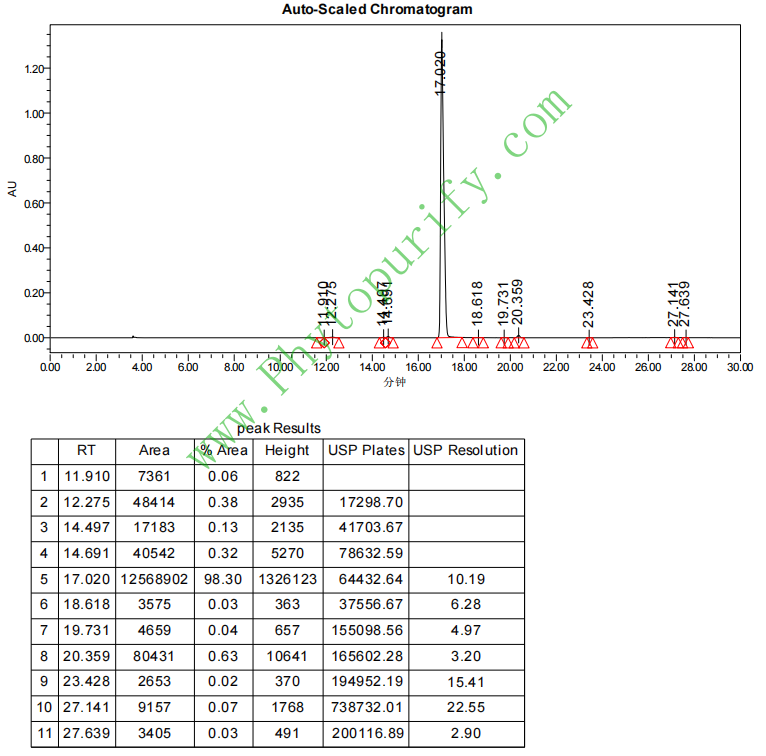
HPLC of Cyanidin chloride
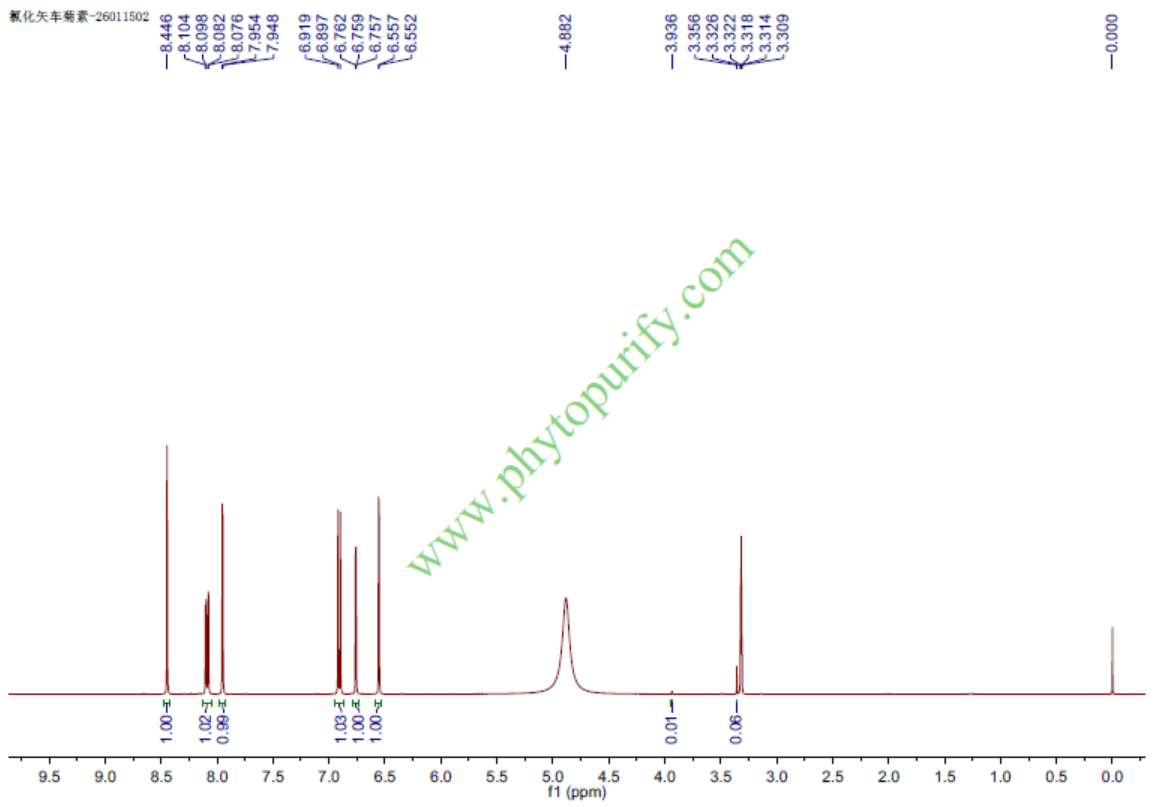
HNMR of Cyanidin chloride
Storage conditions:Short-term storage at 2~8℃, long-term storage at -20 ~ -80℃
Cyanidin chloride (CAS number: 528-58-5), as an important derivative of anthocyanins, has attracted much attention in recent years due to its significant biological activity. Anthocyanins are water-soluble polyphenolic pigments naturally present in various plants, widely found in various foods such as berries, cherries, and purple cabbage. They have good antioxidant, anti-inflammatory, anti-cancer, and cardiovascular protection effects. Chlorinated cyanidins, as a subclass of anthocyanins, have shown potential applications in antioxidant damage, bone metabolism regulation, and tumor suppression due to their unique chemical structure and biological activity.
This review aims to systematically summarize the chemical structure and physicochemical properties, plant sources, and extraction methods of cyanidin chloride, with a focus on its pharmacological activity and mechanism of action. Combined with drug evaluation, it explores its clinical application prospects, providing a theoretical basis and reference for subsequent natural product pharmacology research and new drug development.
The molecular formula of cyanidin chloride is C15H11ClO6, with a molecular weight of 302.69. The core of its structure is a typical anthocyanin skeleton, which is a tricyclic structure formed by the connection of phenylpropane structure and benzene ring through C3 carbon. The molecule of cyanidin chloride contains multiple hydroxyl groups (- OH) and one chlorine atom, giving it strong polarity and hydrophilicity. Its topological polar surface area (TPSA) is 136.26, indicating that it has a large number of hydrogen bond acceptors (9), which has an important impact on its binding ability with biomolecules and its biological activity.
The LogP value is 0.19, indicating low lipid solubility and good water solubility, which is consistent with the typical physicochemical characteristics of anthocyanin compounds. This compound is not easily able to pass through the blood-brain barrier, indicating that its main target of action may be limited to peripheral tissues. In addition, cyanidin chloride exhibits low risk of hepatotoxicity and cardiotoxicity in vivo, and does not inhibit hERG channels, indicating its good safety.
Cyanidin chloride is widely present in various plants rich in anthocyanins, especially in the Centaurea spp., berries (such as blueberries, blackberries, raspberries), and purple vegetables (such as purple cabbage). Its natural form is mostly glycosidic binding, and cyanidin chloride exists as a salt form in plant cell sap, with high stability.
The method of extracting cyanidin chloride mainly relies on aqueous organic solvents, such as ethanol water or methanol water mixed solvent systems, supplemented by acidic conditions (such as adding a small amount of hydrochloric acid or citric acid) to stabilize the anthocyanin structure. Common extraction techniques include ultrasound assisted extraction, microwave-assisted extraction, and high-performance liquid chromatography (HPLC) purification technology. During the extraction process, attention should be paid to temperature and pH control to prevent the degradation and structural transformation of anthocyanins.
Cyanine chloride, as a natural antioxidant, can effectively eliminate free radicals and alleviate cell damage caused by oxidative stress. In vitro studies have shown that it has the ability to scavenge hydroxyl radicals, superoxide anions, and hydrogen peroxide, significantly increasing the activity of intracellular antioxidant enzymes such as superoxide dismutase (SOD), catalase (CAT), and glutathione peroxidase (GPX). In animal models, cyanidin chloride can activate the NFE2L2/NRF2 signaling pathway, induce the expression of downstream antioxidant genes (such as HMOX1 and SOD2), enhance the body's antioxidant defense system, and alleviate the pathological progression of oxidative damage related diseases.
Multiple studies have confirmed that cyanidin chloride has anti-tumor activity, manifested by inhibiting tumor cell proliferation, inducing apoptosis, and inhibiting tumor metastasis. Its mechanism of action involves regulating cell cycle related proteins, activating mitochondrial mediated apoptosis pathways, inhibiting the NF - κ B signaling pathway, and reducing the expression of pro-inflammatory and tumor promoting factors. In addition, cyanidin chloride can enhance the sensitivity of chemotherapy drugs, demonstrating its potential as an adjuvant anticancer drug.
The role of cyanidin chloride in bone metabolism is receiving increasing attention. It inhibits the formation and activity of osteoclasts, reduces the absorption of hydroxyapatite, and regulates the process of bone reconstruction. The specific mechanism includes inhibiting the expression of osteoclast marker genes induced by RANKL, blocking the NF - κ B signaling pathway, reducing bone resorption, and having the potential to prevent and treat osteoporosis.
The multi-target mechanism of action of cyanidin chloride is the basis for its diverse pharmacological activities. Its main targets include:
In addition, cyanidin chloride may also participate in cell proliferation, apoptosis, and metabolic regulation by regulating signaling pathways such as MAPK and PI3K/Akt.
The pharmacological parameters of cyanidin chloride show that it has good safety and biocompatibility. The molecular weight is moderate (302.69) and the LogP value is low (0.19), indicating good water solubility and favorable oral absorption. A high TPSA value (136.26) and a high number of hydrogen bond receptors (9) suggest limited cell membrane permeability and difficulty in crossing the blood-brain barrier, making it suitable for targeting peripheral tissues.
Toxicological evaluation shows that cyanidin chloride has no significant hepatotoxicity, cardiotoxicity, or hERG channel inhibition effects, and is relatively safe. The data of Ames mutagenicity test is still unclear, and further experiments are needed to verify its genetic toxicity risk.
In terms of pharmacokinetics, anthocyanin compounds generally suffer from low bioavailability and fast metabolism. Cyanidin chloride is mainly metabolized by the liver in the body, forming various metabolites, and is easily degraded by intestinal microorganisms. In the future, it is necessary to improve its stability and bioavailability through formulation optimization, such as nanocarriers and liposome encapsulation.
Cyanine chloride, with its multiple biological activities, has shown extensive clinical application potential. Its application prospects in antioxidant damage related diseases (such as cardiovascular diseases, neurodegenerative diseases), osteoporosis, and tumor treatment are particularly prominent.
Future research should focus on the following aspects:
Chlorinated cyanidin, as a natural anthocyanin compound with significant antioxidant and anticancer activities, has demonstrated good potential as a drug and clinical application prospect due to its multi-target and multi mechanism pharmacological properties. Although there are still certain limitations in its pharmacokinetic properties and clinical research, with the continuous advancement of extraction and purification technologies and drug delivery systems, cyanidin chloride is expected to become an important research object in the field of natural product pharmacology and a strong candidate for new drug development. Future systematic research will further promote its transition from laboratory to clinical applications, benefiting human health.
