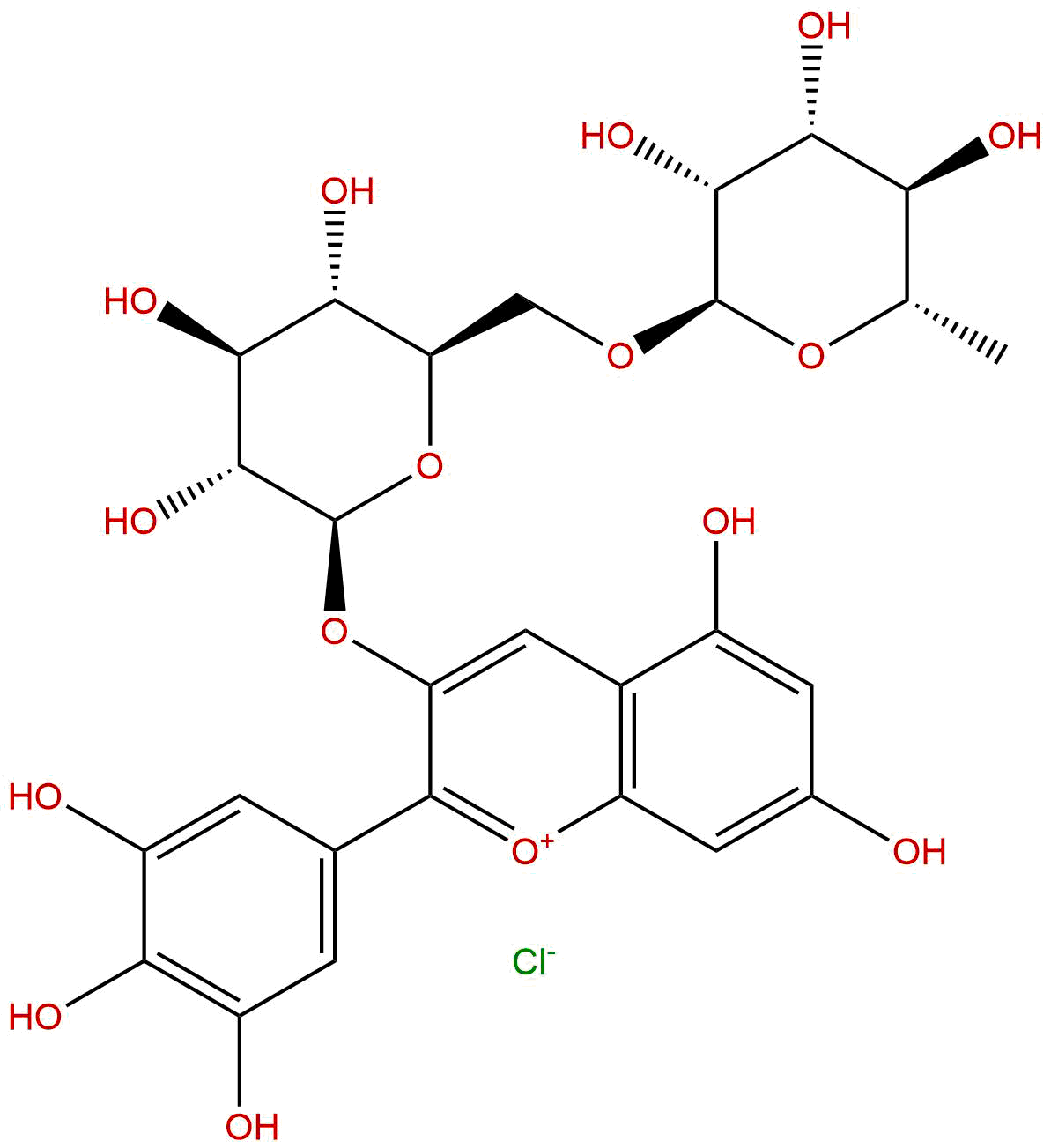


Product name: Delphinidin 3-O-rutinoside chloride
Synonym name: 3-O-Rutinosyldelphinidin;Delphinidin 3-O-rutinoside; Delphinidin 3-rutinoside
Catalogue No.: BP5300
Cas No.: 15674-58-5
Formula: C27H31ClO16
Mol Weight: 646.979
Botanical Source:
Type of Compound: "Flavonoids,Anthocyanins"
Purity: 95%~99%
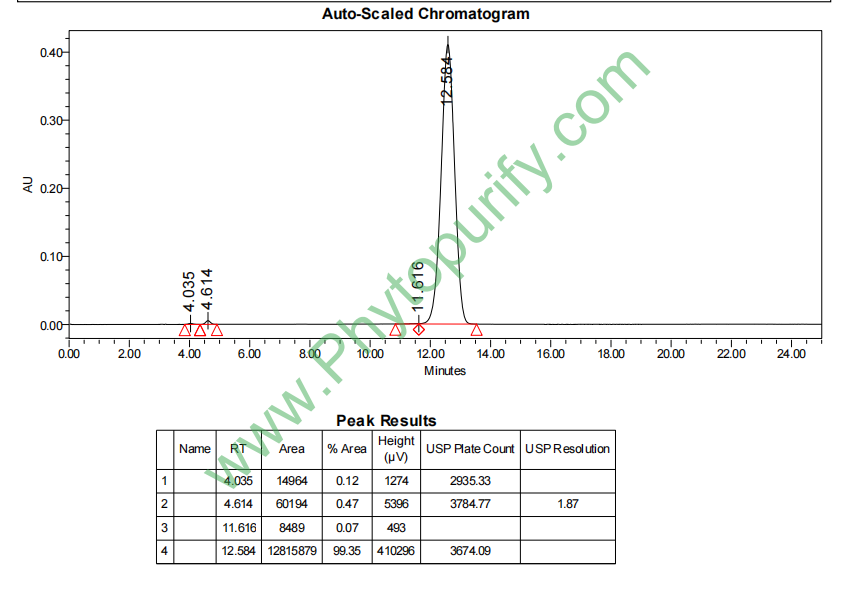
Analysis Method: HPLC-DAD or/and HPLC-ELSD
Identification Method: Mass, NMR
Packing: Brown vial or HDPE plastic bottle
Storage: Store in a well closed container, protected from air and light. Put into refrigerate or freeze for long term storage.
Whenever possible, you should prepare and use solutions on the same day. However, if you need to make up stock solutions in advance, we recommend that you store the solution as aliquots in tightly sealed vials at -20℃. Generally, these will be useable for up to two weeks.
The product could be supplied from milligrams to grams
Inquire for bulk scale.
For Reference Standard and R&D, Not for Human Use Directly.
HPLC of Delphinidin 3-O-rutinoside chloride
Storage conditions:Short-term storage at 2~8℃, long-term storage at -20 ~ -80℃
270.7500
-2.0009
-2.7007
1.8252
.5041
.1341
Low
61.6743
5.1529
Yes
No
Yes
No
Yes
No
1.2
Yes
No
Yes
No
Natural products, as an important source of drug discovery, play an irreplaceable role in human health maintenance and disease treatment. Among a wide variety of natural products, anthocyanins, as a water-soluble pigment widely present in the plant kingdom, not only endow fruits, vegetables, and flowers with brilliant colors, but also attract attention due to their rich biological activity. Anthocyanins belong to flavonoid compounds, and their basic structure is 2-phenylbenzopyran cation (i.e. Huangyan salt), which binds to one or more sugar groups through glycosidic bonds. Among them, Delphinidin stands out among numerous anthocyanins due to its unique chemical structure and significant biological activity.
Delphinidin-3-O-rutinoside chloride, as an important glycoside derivative of delphinidin, is characterized by a rutinose (α - L-rhamnose - (1 → 6) - β - D-glucose) group attached to the 3rd hydroxyl group of the core of the delphinidin. This specific glycosylation modification not only enhances the water solubility and stability of the compound, but also profoundly affects its absorption, distribution, metabolism, and excretion (ADME) processes in vivo, thereby determining its unique pharmacological activity spectrum. In recent years, with the deepening of research on the relationship between dietary components and chronic diseases, the potential of chlorinated delphinidin-3-O-rutinoside in anti-inflammatory, antioxidant, anti-tumor, especially anti prostate cancer has attracted widespread attention from the scientific community.
Prostate cancer is the world's second highest male incidence rate malignant tumor. Its occurrence and development are closely related to a variety of molecular events such as abnormal activation of androgen receptor (AR) signaling pathway, loss of tumor suppressor gene PTEN, overexpression of proto oncogene MYC, and increased activity of 5 α - reductase (SRD5A2). The commonly used prostate specific antigen (PSA) in clinical practice is both a diagnostic marker and a therapeutic monitoring indicator. Although existing endocrine therapy, chemotherapy, and radiotherapy have achieved certain results, the problems of drug resistance and side effects remain severe. Therefore, the search for efficient and low toxicity natural compounds as adjuvant therapy or prevention strategies has become a current research hotspot. Chlorfenapyr 3-O-rutinoside has shown great potential as a candidate drug for anti prostate cancer due to its potential regulatory effects on the aforementioned key targets. This article will provide a systematic and in-depth review of the compound from the aspects of chemical structure, plant origin, pharmacological activity, mechanism of action, medicinal properties, and clinical application prospects.
The chemical structure of chlorinated delphinidin-3-O-rutinoside is the basis of its biological activity. Its core skeleton is Delphinidin, a type of anthocyanin, and its mother core structure is 3,5,7-trihydroxy-2- (3,4,5-trihydroxyphenyl) benzopyran cation. Compared with other anthocyanins such as cyanidins and geraniums, delphinidin has three hydroxyl groups (3 ', 4', 5 '- trihydroxy) on its B ring, which endows it with strong antioxidant and metal ion chelating abilities due to its catechol structure. A disaccharide, rutin, is connected to the 3rd hydroxyl group of delphinidin through a glycosidic bond. Rutin is composed of one molecule of β - D-glucose and one molecule of α - L-rhamnose connected by an α (1 → 6) glycosidic bond. The compound exists in the form of chloride salt (Chloride), which helps to improve its solubility and stability in polar solvents.
From the perspective of physical and chemical properties, this compound exhibits typical strong polarity characteristics. Its molecular weight is 611.53 Da, which is a medium-sized molecule. The calculated LogP value is -2.0009, which is a very low value indicating that the compound has strong hydrophilicity and extremely poor lipid solubility. This characteristic determines that it is difficult for it to passively diffuse through the lipid bilayer of the cell membrane, and its transmembrane transport may depend on specific transporters such as glucose transporters GLUTs or organic anion transporters OATPs. Its topological polar surface area (TPSA) is as high as 270.75 Å ², far exceeding the recommended upper limit of 140 Å ² for oral medications, further confirming its high polarity and low membrane permeability. The water solubility parameter is 1.8252, indicating that it has good solubility in water, which provides convenience for its transportation and distribution in biological fluids. However, high water solubility also brings challenges, such as low oral bioavailability due to its difficulty in penetrating intestinal epithelial cells. In addition, the blood-brain barrier (BBB) penetration has been evaluated as "low", mainly due to its high polarity and large molecular weight, which means that the concentration of the compound in the central nervous system may be very low, which to some extent limits its application in brain diseases, but may also mean that its peripheral effects are more prominent, reducing the risk of side effects in the central nervous system. In the early safety assessment, the hERG inhibition test result was' no ', indicating a low risk of causing QT interval prolongation and arrhythmia in the heart; The Ames test result is 1.2, usually considered negative or weakly positive, indicating a low risk of genetic toxicity. These preliminary pharmacological parameters provide important references for subsequent drug development.
Chlorinated delphinidin-3-O-rutinoside is not a rare compound, it is widely distributed in nature, especially abundant in plant tissues that appear blue, purple, or deep red. Its main plant sources include berries, Solanaceae vegetables, and certain medicinal plants.
Berry category Blueberries(Vaccinium spp.)、 Blueberry(Vaccinium vitis-idaea)Blackberry(Rubus fruticosus)Raspberry(Rubus idaeus)And mulberries(Morus Dark colored berries such as spp are abundant sources of anthocyanins. In these berries, delphinidin-3-O-rutinoside often coexists with other anthocyanin glycosides such as delphinidin-3-O-glucoside, cyanidin-3-O-rutinoside, etc. For example, in the extracts of blueberries and kumquats, this compound is one of the main active ingredients, and its content is influenced by factors such as variety, maturity, growth environment, and harvest time.
solanaceous vegetables Eggplant(Solanum melongena)The purple skin is another important source of delphinidin-3-O-rutinoside. In fact, the main pigment component in eggplant skin is delphinidin-3-O-rutinoside (also known as eggplant pigment, Nasunin). In addition, purple sweet potatoes(Ipomoea batatas)And purple cabbage(Brassica oleracea The compound is also present in var. capitata f. rubra.
medicinal plants Some traditional medicinal plants are also rich in this ingredient. For example, elderberry, which has antioxidant and anti-inflammatory effects(Sambucus Spp. fruit and cranberry extract used for treating eye fatigue, including delphinidin-3-O-rutinoside, are important quality markers.
The extraction method for this compound usually follows the general extraction strategy for anthocyanins, with the core principle of protecting its unstable cationic structure and avoiding oxidation and degradation.
Solvent extraction method This is the most commonly used method. Due to the high polarity of anthocyanins, acidic alcohol solvents (such as methanol, ethanol, or water alcohol mixtures containing 0.1% -1% hydrochloric acid or formic acid) are usually used for extraction. An acidic environment helps maintain the cationic form of anthocyanins, making them stable and improving extraction efficiency. The extraction process is usually carried out under low temperature (4-25 ° C) and light avoidance conditions to reduce thermal degradation and photo oxidation. Common extraction techniques include impregnation, percolation, and reflux extraction. To improve efficiency and purity, modern extraction techniques such as ultrasound assisted extraction (UAE), microwave-assisted extraction (MAE), and pressurized liquid extraction (PLE) are also widely used. These methods can shorten extraction time, increase yield, and reduce solvent usage.
Purification Method The crude extract contains a large amount of sugars, organic acids, proteins, and other phenolic compounds, which require purification. The most commonly used purification technique is column chromatography. Macroporous adsorption resins such as Diaion HP-20 and Amberlite XAD-7 are widely used for preliminary purification due to their excellent adsorption and desorption properties for anthocyanins, which can remove most sugars and polar impurities. Then, fine separation can be carried out by gel filtration chromatography (such as Sephadex LH-20) or preparative high-performance liquid chromatography (Prep HPLC) to obtain high-purity target compounds. High speed counter current chromatography (HSCCC), as a liquid-liquid distribution chromatography technique, has been successfully applied in the separation and preparation of anthocyanin monomers in recent years due to its advantages of irreversible adsorption and high sample recovery rate.
The pharmacological activity research of chlorinated delphinidin-3-O-rutinoside mainly focuses on antioxidant, anti-inflammatory, and anti-tumor aspects, among which its research in the field of anti prostate cancer is the most in-depth and systematic.
antioxidant activity As a derivative of delphinidin, this compound inherits its strong free radical scavenging ability. The pyrogallol structure on its B ring is an efficient electron donor that can directly neutralize reactive oxygen species (ROS) and reactive nitrogen species (RNS), such as hydroxyl radicals (• OH), superoxide anions (O ₂⁻•), and peroxynitrite (ONOO ⁻). In addition, it can chelate transition metal ions (such as Fe ² ⁺, Cu ² ⁺), inhibit the Fenton reaction, and thus block the production of ROS. This multiple antioxidant mechanism makes it excellent in protecting cells from oxidative stress damage, which is considered one of the foundations for its anti-inflammatory and anticancer activities.
anti-inflammatory activity Chronic inflammation is an important driving factor for the occurrence and development of various cancers, including prostate cancer. Research has shown that chlorinated delphinidin-3-O-rutinoside can significantly inhibit the production of pro-inflammatory cytokines (such as TNF - α, IL-6, IL-1 β) and nitric oxide (NO) in macrophages induced by lipopolysaccharide (LPS). The mechanism involves inhibiting the activation of nuclear factor kappa B (NF - κ B) and mitogen activated protein kinase (MAPK) signaling pathways. By blocking these key inflammatory signaling pathways, this compound can effectively alleviate inflammatory responses, potentially inhibiting pro cancerous inflammation in the tumor microenvironment.
Anti prostate cancer activity This is the pharmacological activity of the compound that has received the most attention. Numerous in vitro and in vivo studies have confirmed its inhibitory effect on prostate cancer cells.
The anti prostate cancer effect of chlorinated delphinidin-3-O-rutinoside is not achieved through a single mechanism, but through a network regulation mode of multiple targets and pathways. Its core mechanism of action is closely related to key molecular targets involved in the occurrence and development of prostate cancer, including AR, PTEN, MYC, SRD5A2, and PSA.
Regulating the androgen receptor (AR) signaling pathway AR is the core driving factor for the occurrence and development of prostate cancer. Even in castration resistant prostate cancer (CRPC), AR signals continue to be activated. Research has found that chlorinated delphinidin-3-O-rutinoside can:
Restoring PTEN function and inhibiting PI3K/AKT pathway PTEN is an important tumor suppressor gene, and its encoded protein phosphatase can negatively regulate the PI3K/AKT signaling pathway. In prostate cancer, PTEN deficiency or mutation is very common, leading to sustained activation of AKT, promoting cell survival, proliferation, and metabolism. Research has shown that chlorinated delphinidin-3-O-rutinoside can:
Inhibition of MYC oncogene expression MYC is a powerful transcription factor that regulates various cellular processes such as cell cycle, proliferation, metabolism, and apoptosis. Overexpression of MYC is another common feature of prostate cancer, associated with disease progression and poor prognosis. Chlorinated delphinidin-3-O-rutinoside has been shown to be able to:
Inhibition of 5 α - reductase (SRD5A2) activity SRD5A2 is a key enzyme that catalyzes the conversion of testosterone to the more active dihydrotestosterone (DHT). The affinity between DHT and AR is much higher than that of testosterone, and it is the main driving force of androgen signaling in the prostate. Inhibiting SRD5A2 activity is an important strategy for treating benign prostatic hyperplasia and prostate cancer. Preliminary studies have shown that chlorinated delphinidin-3-O-rutinoside can directly inhibit the enzymatic activity of SRD5A2, thereby reducing the generation of DHT and decreasing the intensity of AR signals. This provides new evidence for its application in the treatment of androgen dependent prostate cancer.
Reduce prostate-specific antigen (PSA) levels PSA (encoded by KLK3 gene) is a direct target gene of AR, and its serum level is a classic biomarker for prostate cancer diagnosis, efficacy monitoring, and prognosis judgment. Due to its ability to inhibit the AR signaling pathway, chlorinated delphinidin-3-O-rutinoside can effectively reduce the expression and secretion of PSA. In both cellular and animal models, treatment with this compound resulted in a significant decrease in PSA levels, consistent with its mechanism of inhibiting AR activity.
In summary, chlorinated delphinidin-3-O-rutinoside forms a synergistic anti prostate cancer network by simultaneously acting on multiple key nodes such as AR, PTEN/AKT, MYC, and SRD5A2. The advantage of this multi-target mode of action is that it can simultaneously attack multiple fragile links of tumor cells, reduce the risk of drug resistance caused by single target mutations, and may produce more comprehensive therapeutic effects.
Although chlorinated delphinidin-3-O-rutinoside has shown strong anti prostate cancer activity in vitro and in vivo studies, its drug like and pharmacokinetic (PK) properties are key factors determining whether it can ultimately become a clinical drug.
Drugability assessment Based on the Lipinski Rule of Five, this compound presents significant challenges. Its molecular weight (611.53 Da) exceeds 500, LogP value (-2.0) is much lower than 5, and TPSA (270.75 Å ²) is much higher than 140 Å ². These parameters suggest that its oral bioavailability may be poor and it belongs to a typical "non drug like" molecule. However, the five rules mainly target orally administered small molecule drugs with passive diffusion. For natural products such as anthocyanins, their absorption may rely on active transport mechanisms. In addition, the low risk of hERG inhibition and negative Ames test results of this compound are positive aspects of its drug development, indicating its good cardiac safety and low risk of genetic toxicity. Therefore, its pharmacological evaluation needs to be comprehensively considered in conjunction with its unique absorption mechanism and administration route.
Pharmacokinetic characteristics:
Strategies for improving bioavailability Given its low oral bioavailability, it is necessary to develop non oral administration routes or adopt new formulation technologies. For example:
Chlorfenapyr 3-O-rutinoside, as a natural compound with multi-target anti prostate cancer activity, has broad clinical application prospects, but also faces many challenges.
As a dietary supplement or functional food ingredient Given that it originates from common berries and vegetables, its safety is relatively high, and its most direct application prospect is as a dietary supplement or functional food ingredient for chemical prevention of prostate cancer. For high-risk individuals (such as those with a family history or elevated PSA levels), long-term intake of extracts rich in this compound may help delay or reduce the risk of prostate cancer. Its antioxidant and anti-inflammatory activities also make it valuable in maintaining overall health.
As an adjuvant therapy drug On the basis of standard chemotherapy, radiation therapy, or endocrine therapy, the combined use of chlorinated delphinidin-3-O-rutinoside may produce synergistic effects and alleviate the toxic side effects of traditional treatments. For example, its inhibition of AR signaling and PI3K/AKT pathway may enhance the efficacy of castration therapy or novel endocrine drugs such as abiraterone and enzalutamide, and delay the development of drug resistance. Its ability to induce apoptosis and inhibit proliferation may also enhance sensitivity to chemotherapy drugs such as docetaxel.
Developed as a novel targeted therapy drug By solving its pharmacokinetic bottleneck and developing it into an injection or targeted nanoformulation, it is expected to be developed into a novel drug directly used for the treatment of prostate cancer. Its unique "multi-target" mode of action makes it particularly suitable for treating advanced or metastatic prostate cancer with complex genetic mutation backgrounds. For example, for patients with PTEN deficiency or MYC overexpression, this compound may have unique therapeutic advantages.
Future research directions:
Chlorinated delphinidin-3-O-rutinoside, a naturally occurring delphinidin glycoside, exhibits outstanding biological activity beyond its "pigment" identity due to its unique chemical structure. Especially in the field of anti prostate cancer, it has formed a multidimensional and networked anti-tumor mechanism by simultaneously regulating multiple key molecular targets such as AR, PTEN/AKT, MYC, SRD5A2, and PSA. This multi-target characteristic endows it with the potential to overcome traditional single target drug resistance and may bring more comprehensive therapeutic effects.
However, from laboratory discovery to clinical application, this compound faces the typical dilemma of "high activity, low drug resistance". The extremely poor oral bioavailability and complex in vivo metabolic processes are the main bottlenecks hindering its development. Future research should focus on developing innovative drug delivery systems (such as nanotechnology) or conducting rational prodrug design to overcome their pharmacokinetic deficiencies and fully unleash their therapeutic potential. Meanwhile, rigorous preclinical and clinical studies are necessary to verify its safety and efficacy.
Despite the numerous challenges, given the urgent global demand for safe, effective, and economical anti-tumor drugs, as well as the unique value of natural products in drug discovery, chlorinated delphinidin-3-O-rutinoside is undoubtedly a lead compound worthy of further research and development. It is not only a bridge to understand the relationship between dietary composition and health, but also has the potential to become a powerful tool in the fight against prostate cancer and other chronic diseases in the future. The in-depth study of it is not only an exploration of a compound, but also a profound excavation of the wisdom that nature endows human health.
