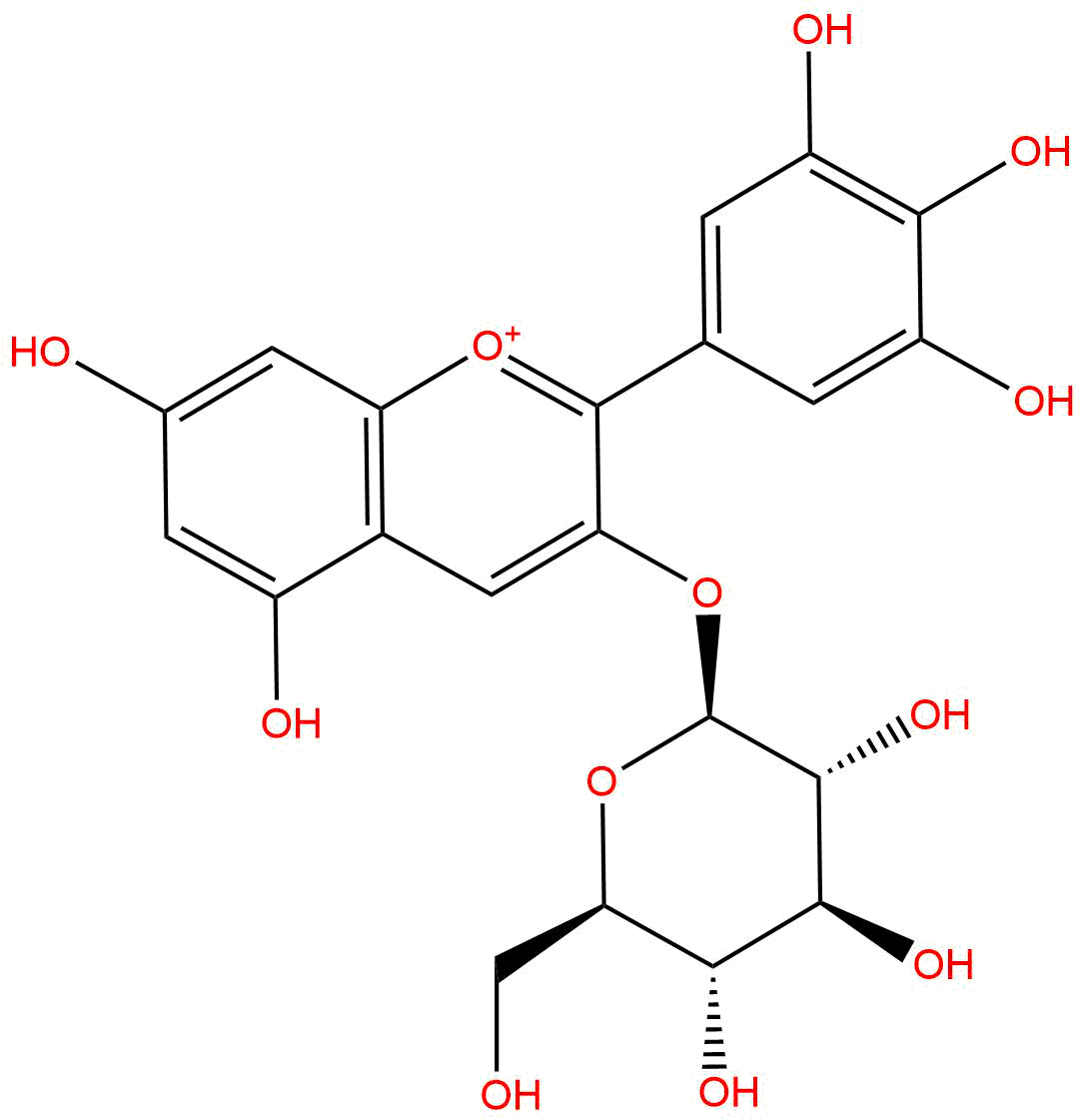


Synonym name: Myrtillin; Myrtillin A
Catalogue No.: BP0469
Cas No.: 50986-17-9
Formula: C21H21O12+
Mol Weight: 465.386
Botanical Source: grapes and many other plant spp.
Purity: 95%~99%
Analysis Method: HPLC-DAD or/and HPLC-ELSD
Identification Method: Mass, NMR
Packing: Brown vial or HDPE plastic bottle
Can be supplied from milligrams to grams.
For Reference Standard and R&D, Not for Human Use Directly.
Inquire for bulk scale.
Storage conditions:Short-term storage at 2~8℃, long-term storage at -20 ~ -80℃
211.8300
-1.8944
-2.4890
.9217
.5381
.1163
Low
58.7686
4.3669
Yes
No
Yes
No
Yes
No
1.2
Yes
No
Yes
No
Delphinidin 3-Glucoside (D3G) is a natural anthocyanin compound widely present in the plant kingdom, belonging to the cationic family of anthocyanins. As a 3-O - β - D-glucoside derivative of Delphinidin, D3G plays an important role in plant pigment synthesis and antioxidant defense. In recent years, with the development of natural product pharmacology and functional food research, D3G has attracted extensive attention due to its excellent biological activity, especially its potential therapeutic value in metabolic diseases such as type 2 diabetes (T2DM). This article will provide a systematic review of the chemical structure, plant sources, extraction methods, pharmacological activities, mechanisms of action, pharmacological evaluation, and clinical application prospects of delphinidin glucoside, aiming to provide a theoretical basis and research direction for the drug development and functional utilization of this natural product.
The chemical structure of delphinidin glucoside is composed of the core of delphinidin (3,4 ′, 5,5 ′, 7-pentahydroxyanthocyanin cation) and the β - D-glucose residue connected by a 3-OH glycosidic bond. Its molecular formula is C21H21O12, with a molecular weight of 465.3870 Da. The structure contains multiple hydroxyl groups, endowing it with high hydrophilicity and strong antioxidant capacity.
In terms of physical and chemical properties, the LogP value of D3G is -1.8944, indicating its strong hydrophilicity and water solubility of 0.9217, indicating its good solubility in aqueous media. Its topological polar surface area (TPSA) is 211.8300 Å ², reflecting the larger polar surface area of the molecule, which has a significant impact on the binding of the molecule to biological targets and cell membrane permeability. The low blood-brain barrier penetration ability of D3G suggests that it mainly acts on peripheral tissues rather than the central nervous system. The negative result of hERG channel inhibition experiment indicates a low risk of cardiac toxicity. The Ames test result is 1.2, indicating a low risk of genetic toxicity and high safety.
Feiyancao glucoside is widely present in various fruits, vegetables, and flowers, especially in blueberries, blackberries, purple cabbage, pomegranates, and purple grape skins. It mainly serves as a pigment component in the plant body, participating in the formation of petal color and attracting pollinating insects.
Common methods for extracting D3G include solvent extraction, ultrasound assisted extraction, microwave-assisted extraction, and solid-phase extraction. Usually, aqueous ethanol or methanol is used as the extraction solvent to ensure the stability and extraction efficiency of anthocyanins. During the extraction process, pH regulation is crucial, and acidic conditions (pH 1-3) help maintain the stable structure of anthocyanin cations and reduce degradation. After concentration and purification, the extract is often analyzed qualitatively and quantitatively using high-performance liquid chromatography (HPLC) combined with mass spectrometry (MS).
In recent years, green extraction technologies such as supercritical CO ₂ extraction and enzyme assisted extraction have gradually been applied to the extraction of D3G, aiming to improve extraction efficiency, reduce solvent residue and environmental pollution, and promote its industrial production.
Delphinidin glucoside, as a natural anthocyanin, shows a variety of biological activities, including antioxidant, anti-inflammatory, anti diabetes, cardiovascular protection and neuroprotection.
D3G has significant free radical scavenging ability, which can effectively neutralize reactive oxygen species (ROS) and nitrogen free radicals, and alleviate oxidative stress damage to cells. Its hydroxyl structure enables it to capture free radicals through electron transfer and hydrogen atom donor mechanisms, protecting cell membrane lipids and DNA from oxidative damage.
A large number of in vitro and in vivo studies have shown that D3G has a potential therapeutic effect on type 2 diabetes. Its main manifestations are improving insulin sensitivity, promoting glucose metabolism, and regulating lipid metabolism. Animal model studies have shown that D3G can reduce blood glucose levels, improve islet beta cell function, and alleviate diabetes related inflammatory reaction and oxidative stress.
D3G exerts anti-inflammatory effects by inhibiting the nuclear factor kappa B (NF - κ B) signaling pathway, reducing the expression of pro-inflammatory factors such as tumor necrosis factor alpha (TNF - α) and interleukin-6 (IL-6). This effect is of great significance for the prevention and treatment of diabetes and its complications.
D3G can improve vascular endothelial function, inhibit low-density lipoprotein oxidation, and reduce the risk of atherosclerosis. In addition, its antioxidant and anti-inflammatory properties help alleviate myocardial damage and improve heart function.
Although D3G has low blood-brain barrier permeability, its antioxidant and anti-inflammatory effects may still indirectly protect the nervous system through peripheral mechanisms, slowing down the progression of neurodegenerative diseases.
The mechanism of delphinidin glucoside in metabolic diseases such as type 2 diabetes involves multiple signaling pathways and key molecular targets.
AMP activated protein kinase (AMPK) is a core regulatory factor in cellular energy metabolism. D3G can activate AMPK (PRKAA1 subunit), promote glucose uptake and fatty acid oxidation, and improve insulin resistance. Activating AMPK also inhibits fat synthesis and regulates energy homeostasis.
GCK promotes glucose phosphorylation in liver and pancreatic beta cells, and is a key enzyme in glucose metabolism. D3G enhances glucose utilization efficiency and lowers blood glucose levels by regulating GCK activity.
PTPN1 is a negative regulator of the insulin signaling pathway, and excessive activity can lead to insulin resistance. Research has shown that D3G can inhibit PTPN1 activity, enhance insulin signaling, and improve glucose metabolism.
Overall, D3G exhibits multidimensional therapeutic potential through synergistic effects of multiple targets and pathways, regulating glucose and lipid metabolism, antioxidant and anti-inflammatory properties, and protecting cellular functions.
The pharmacological evaluation of delphinidin glucoside shows that it has certain development potential, but there are also challenges.
D3G has a moderate molecular weight (465.3870 Da), but its high polarity (TPSA 211.83) and negative LogP value (-1.8944) limit its cell membrane permeability and oral bioavailability. Good water solubility (0.9217), which is beneficial for formulation development and in vivo distribution. The low permeability of the blood-brain barrier suggests that it mainly acts on peripheral tissues, reducing the risk of central nervous system side effects.
The hERG channel inhibition experiment was negative, indicating a low risk of cardiac toxicity. The Ames test result is 1.2, indicating a low risk of genetic toxicity. Overall, it has good safety and is suitable for further drug development.
At present, there is limited data on the in vivo absorption, distribution, metabolism, and excretion (ADME) of D3G. Previous studies have shown that anthocyanin compounds are easily hydrolyzed in the gastrointestinal tract after oral administration, and their glycosidic bonds are broken to release free anthocyanins, which are then metabolized by gut microbiota to produce various metabolites. The metabolic stability and bioavailability of D3G urgently require systematic research to guide formulation design and optimize dosing regimens.
Due to the strong polarity and low oral bioavailability of D3G, new formulation technologies such as nanocarriers, liposomes, and inclusion complexes are needed to improve its in vivo stability and targeting. In addition, the synergistic effects of combining with other natural products or drugs are also worth exploring.
Delphinidin glucoside, as a natural active ingredient, has shown broad application prospects in the prevention and treatment of type 2 diabetes and related metabolic diseases. Its multi-target regulation and low toxicity advantages make it an important candidate for the development of functional foods, health products, and new drugs.
The key to future clinical applications lies in:
In addition, utilizing modern biotechnology methods such as metabolomics, proteomics, and molecular docking techniques to deeply explore the functional network and potential targets of D3G will provide scientific basis for its clinical translation.
Delphinidin glucoside, as an important natural anthocyanin glucoside, with its unique chemical structure and diverse biological activities, has shown significant potential in the prevention and treatment of metabolic diseases, especially type 2 diabetes. It exerts a multi-target synergistic effect by regulating the AMPK signaling pathway, improving glucose metabolism, inhibiting inflammatory response, and protecting cellular function. Although there are certain limitations in its pharmacological properties and pharmacokinetics at present, with the advancement of extraction and purification technologies and formulation processes, D3G is expected to become an important direction for the development of natural product drugs. In the future, the combination of systematic clinical research and interdisciplinary innovation will promote the widespread application of delphinidin glucoside in disease prevention and health promotion.
