


Product name: Triptolide
Synonym name:
Catalogue No.: BP1411
Cas No.: 38748-32-2
Formula: C20H24O6
Mol Weight: 360.406
Botanical Source: Tripterygium wilfordii Hook.f.
Physical Description:
Type of Compound: Diterpenoids
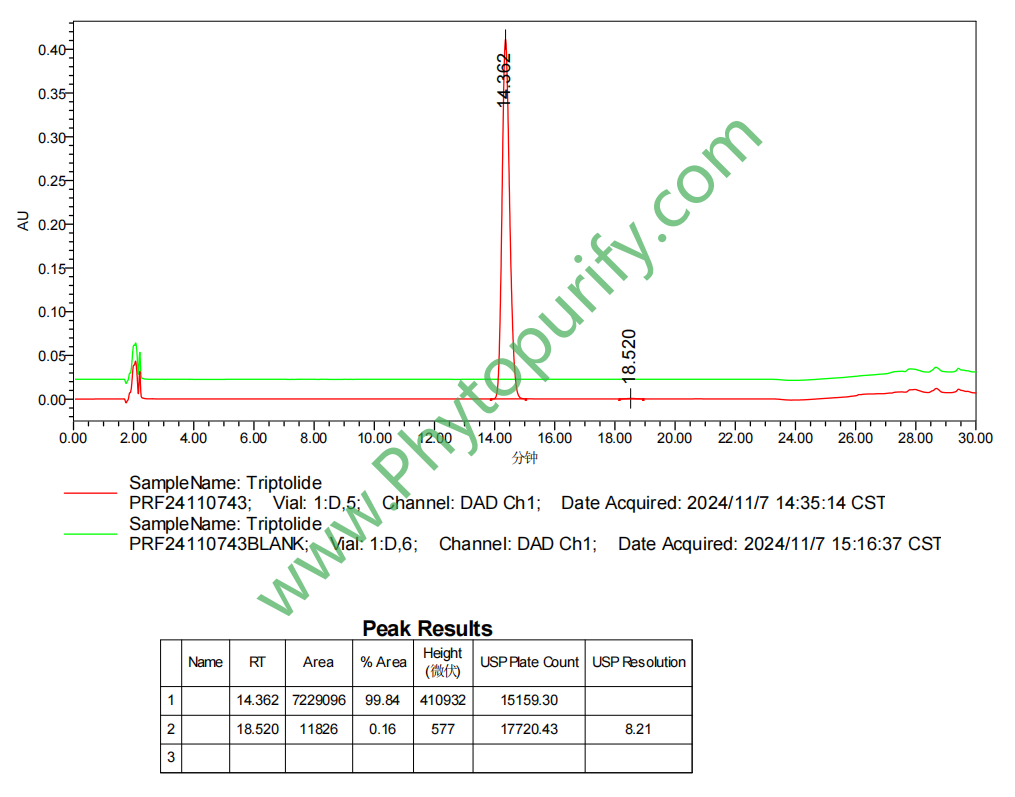
Purity: 95%~99%
Analysis Method: HPLC-DAD or/and HPLC-ELSD
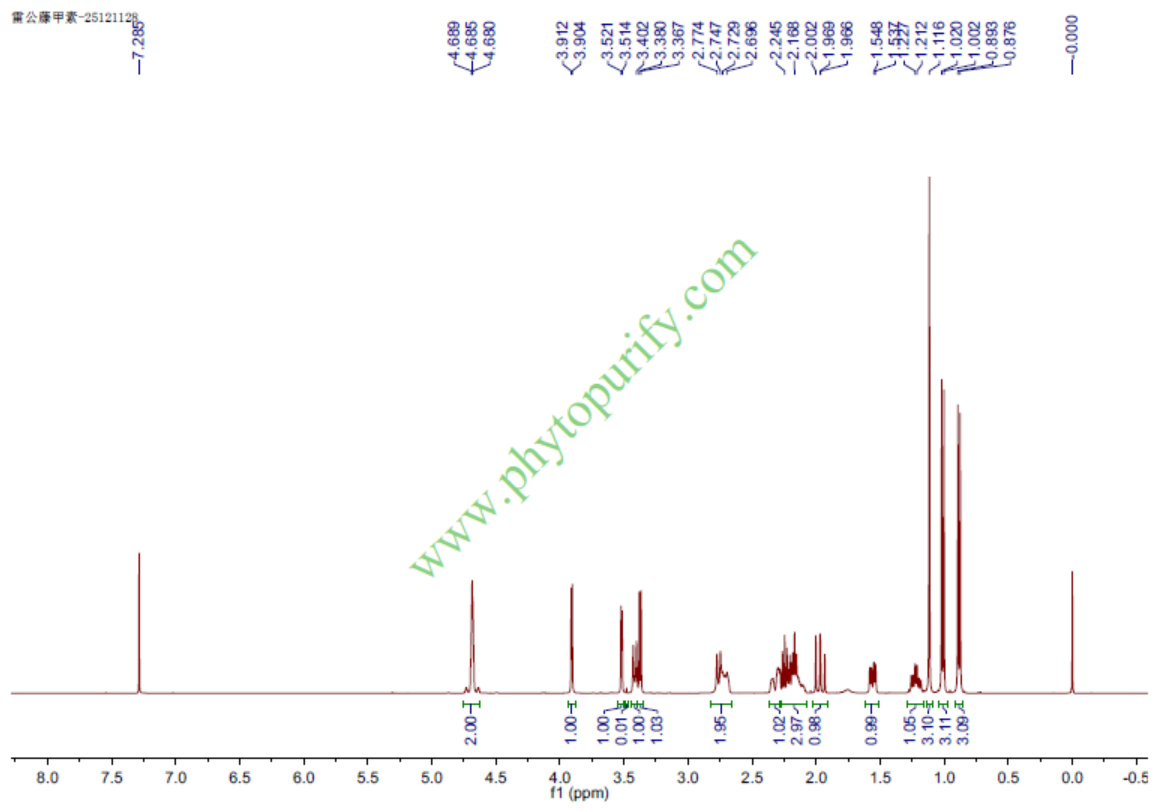
Identification Method: Mass, NMR
Packing: Brown vial or HDPE plastic bottle
The product could be supplied from milligrams to grams, upto kiloframs.
Inquire for bulk scale.
Triptolide is a diterpenoid epoxide which is produced by the thunder god vine, Tripterygium wilfordii. It has in vitro and in vivo activities against mouse models of polycystic kidney disease and pancreatic cancer, but its physical properties and severe toxicity limit its therapeutic potential.
Consequently, a synthetic water-soluble prodrug, minnelide, is being studied clinically instead.
Several putative target proteins of triptolide have been reported, including polycystin-2, ADAM10,DCTPP1, TAB1, and XPB. Multiple triptolide-resistant mutations exist in XPB (ERCC3) and its partner protein GTF2H4. However, no triptolide-resistant mutations were found in polycystin-2, ADAM10, DCTPP1 and TAB1. Cys342 of XPB was identified as the residue that undergoes covalent modification by the 12,13-epoxide group of triptolide, and the XPB-C342T mutant rendered the T7115 cell line nearly completely resistant to triptolide. The level of resistance conferred by the C342T mutation is about 100-fold higher than the most triptolide-resistant mutants previously identified. Together, these results validate XPB as a target responsible for the antiproliferative activity of triptolide.
Triptolide has been used to treat a variety of ailments, including rheumatoid arthritis, nephritic syndrome and Lupus erythematosus. It is also a strong antitumor agent. Several angiogenesis assays in numerous research studies have shown that triptolide is an angiogenesis inhibitor. Numerous preclinical studies have shown that TPL inhibits cell proliferation, induces apoptosis and limits tumor metastasis. TPL also has a synergistic action with other treatment methods whereby, it enhances the effects of other antitumor treatments, as studied in various cancer cell lines. This review summarizes the recent developments and discussion of antiangiogenic mechanisms of TPL in cancer, brief outline of its clinical trials and its future in cancer therapeutics.
HPLC of Triptolide
HNMR of Triptolide
Storage conditions:Short-term storage at 2~8℃, long-term storage at -20 ~ -80℃
Triptolide, CAS number 38748-32-2, is a diterpenoid tricyclic oxide extracted from the roots of the traditional Chinese medicine Tripterygium wilfordii Hook. f. As one of the main active ingredients of Tripterygium wilfordii, Triptolide has attracted widespread attention in the fields of natural product pharmacology and new drug development in recent years due to its significant immunosuppressive, anti-inflammatory, anti proliferative, and anti-tumor activities. Triptolide is not only used in traditional Chinese medicine to treat autoimmune diseases such as rheumatoid arthritis and systemic lupus erythematosus, but also has become a hot spot in modern pharmacological research because of its inhibitory effect on a variety of malignant tumor cells, especially its potential therapeutic value in solid tumors such as breast cancer.
The purpose of this paper is to systematically review the chemical structure, physicochemical properties, plant sources and extraction methods of triptolide, deeply explore its pharmacological activity and mechanism of action, focus on analyzing its molecular targets in the treatment of breast cancer, at the same time, evaluate its pharmaceutical properties and pharmacokinetic characteristics, and finally look forward to its clinical application prospects and future research directions, providing theoretical basis and practical guidance for the drug development of triptolide.
Triptolide is a typical diterpenoid tricyclic oxide with a molecular formula of C20H24O6 and a molecular weight of 360.4060. Its chemical structure consists of a complex tricyclic skeleton with multiple epoxy groups and lactone rings, which endow it with high biological activity. The LogP value of Triptolide is 1.7323, indicating its moderate lipid solubility, which is beneficial for membrane penetration. Its topological polar surface area (TPSA) is 84.12 Å ², indicating that it has a certain polarity that facilitates binding with biomolecules such as proteins.
The low water solubility (0.0929 mg/mL) limits its solubility in the aqueous phase and affects its bioavailability. It is worth noting that Triptolide has a high blood-brain barrier penetration ability, which provides the possibility for its potential application in central nervous system diseases. In addition, the hERG channel inhibition experiment results were negative, indicating a low risk of cardiac toxicity. The Ames test result is 2.1, indicating a low risk of genotoxicity, but further safety evaluation is still needed.
The main source of Tripterygium wilfordii Hook. f. is Tripterygium wilfordii Hook. f. Thunder God Vine is a plant of the Thunder God Vine genus in the family Celastraceae, widely distributed in southern China and East Asia. In traditional Chinese medicine, Tripterygium wilfordii is used to treat various inflammatory and immune related diseases. Its roots contain abundant active diterpenoid compounds, among which Tripterygium wilfordii has a higher content of Triptolide.
The traditional methods for extracting Triptolide mainly include solvent extraction, ultrasound assisted extraction, and high-performance liquid chromatography separation. Generally, ethanol or methanol is used as the extraction solvent, and high-purity Triptolide is obtained through multi-step solvent separation and column chromatography purification. In recent years, the application of supercritical CO2 extraction technology and microwave-assisted extraction technology has improved extraction efficiency and purity, reduced the use of organic solvents, and is in line with the concept of green chemistry.
Triptolide exhibits various pharmacological activities, including immune regulation, anti-inflammatory, anti proliferative, and anti-tumor effects.
Immunosuppressive effect
Triptolide exerts significant immunosuppressive effects by inhibiting the activation of T cells and B cells, reducing the release of inflammatory mediators. Its mechanism of action involves inhibition of the NF - κ B signaling pathway, reducing the expression of pro-inflammatory cytokines such as TNF - α, IL-1 β, and IL-6, and alleviating immune-mediated tissue damage.
anti-inflammatory effect
Triptolide can inhibit key enzymes and signaling pathways in inflammatory response, reduce inflammatory cell infiltration and release of inflammatory mediators. Its anti-inflammatory activity has been validated in various inflammatory models, such as rheumatoid arthritis, inflammatory bowel disease, etc.
Anti proliferative and anti-tumor effects
Triptolide has a strong inhibitory effect on many cancer cell lines, especially in breast cancer cells, showing significant cell cycle arrest and apoptosis induction. Its anti-tumor mechanism involves the regulation of multiple signaling pathways, including activation of apoptosis related proteins, inhibition of transcription factors, and downregulation of multidrug resistance proteins.
The pharmacological action of triptolide is closely related to its multi target regulation, especially in the treatment of breast cancer, multiple key molecular targets have been confirmed to participate in its anti-tumor effect.
AMPK(PRKAA1)
Triptolide activates the AMPK signaling pathway, promotes cellular energy metabolism regulation, and inhibits cancer cell proliferation and migration. The activation of AMPK can also induce autophagy and promote cancer cell apoptosis.
BCL2
As an anti apoptotic protein, BCL2 is highly expressed in breast cancer cells. Triptolide downregulates BCL2 expression, disrupts mitochondrial membrane potential, and activates endogenous apoptotic pathways.
STAT3
The STAT3 signaling pathway plays a central role in tumor cell proliferation and immune escape. Triptolide inhibits the phosphorylation and nuclear translocation of STAT3, blocks its transcriptional activity, and suppresses tumor growth.
ESR2
Triptolide regulates the expression of estrogen receptor beta (ESR2) and interferes with signal transduction in hormone dependent breast cancer.
ABCB1 and ABCG2
These two multidrug resistance transporters are important reasons for chemotherapy failure of breast cancer. Triptolide can inhibit the expression and function of ABCB1 and ABCG2, reverse multidrug resistance, and improve the sensitivity of chemotherapy drugs.
MAPT
The microtubule associated protein Tau (MAPT) is involved in cytoskeletal stability, and Triptolide affects cell division and migration by regulating MAPT.
TOP1 and TOP2A
Topoisomerase I (TOP1) and II α (TOP2A) are key enzymes involved in DNA replication and transcription. Triptolide inhibits their activity and blocks DNA metabolism in tumor cells.
SIRT1
The deacetylase SIRT1 plays a role in cellular stress response and metabolic regulation. Triptolide regulates SIRT1 activity, affects cell apoptosis and metabolic homeostasis.
In addition, as an inhibitor of NF - κ B activation, Triptolide blocks the key role of this transcription factor in inflammation and tumors, further enhancing its anti-inflammatory and anti-tumor effects.
The pharmacological evaluation of Triptolide shows that it has certain potential for drug development, but there are also challenges.
Physicochemical properties
Moderate molecular weight and LogP value are beneficial for the in vivo absorption and distribution of drugs. The lower water solubility limits its oral bioavailability, and it is necessary to improve solubility and stability through dosage form modification or nanocarrier technology.
Blood-brain barrier penetration
Triptolide has high blood-brain barrier permeability, indicating its potential application in central nervous system diseases, but attention should also be paid to the risk of neurotoxicity.
safety
The negative inhibition of hERG channel reduces the risk of cardiac toxicity, and Ames test results show that its genotoxicity is low. However, preclinical toxicology research still needs to be systematically carried out, especially focusing on liver and kidney toxicity and immune suppression related side effects.
pharmacokinetics
Existing research indicates that Triptolide is rapidly metabolized in the body, with a short half-life and limited bioavailability. Its main metabolic pathways include liver enzyme mediated oxidation and hydrolysis, and the activity and safety of metabolites need to be further clarified. Nanoformulations and liposome encapsulation techniques have been attempted to improve their pharmacokinetic properties.
Triptolide has become an important candidate for the development of natural product anti-tumor drugs due to its multi target and multi mechanism pharmacological activities, especially its therapeutic potential in solid tumors such as breast cancer. Its immunomodulatory and anti-inflammatory effects also provide new ideas for the treatment of autoimmune diseases.
However, the clinical application of Triptolide still faces problems such as narrow dose window, significant toxic side effects, and unsatisfactory pharmacokinetics. Future research should focus on:
Formulation innovation
Develop nanocarriers, liposomes, and sustained-release formulations to improve bioavailability and reduce toxicity.
Structural modification
Improving water solubility and selectivity through chemical modification, enhancing therapeutic efficacy, and reducing side effects.
combination therapy
Combined use with chemotherapy drugs or targeted drugs to overcome multidrug resistance and improve treatment efficacy.
clinical trial
Conduct systematic clinical research to evaluate its safety, efficacy, and optimal dosing regimen.
mechanism research
Thoroughly analyze its molecular action network and discover new therapeutic targets and biomarkers.
Triptolide, as a natural diterpenoid tricyclic oxide with multiple pharmacological activities, has shown a wide range of immunosuppressive, anti-inflammatory and anti-tumor potential, especially in the treatment of breast cancer, which has an important role in molecular target regulation. Although there are certain limitations to its pharmacological properties, through modern drug design and dosage form improvement, Triptolide is expected to become an important source of new generation anti-tumor and immunomodulatory drugs. Future research needs to integrate pharmacology, pharmacokinetics, and clinical science to promote the transition of Triptolide from laboratory to clinical use, bringing more benefits to patients.
