| Catalog No | Package | Original Price | Price | Inventory | Quantity | Operating |
|---|---|---|---|---|---|---|
| BP5137-5mg | 5mg | $650.00 | Sign in |
|


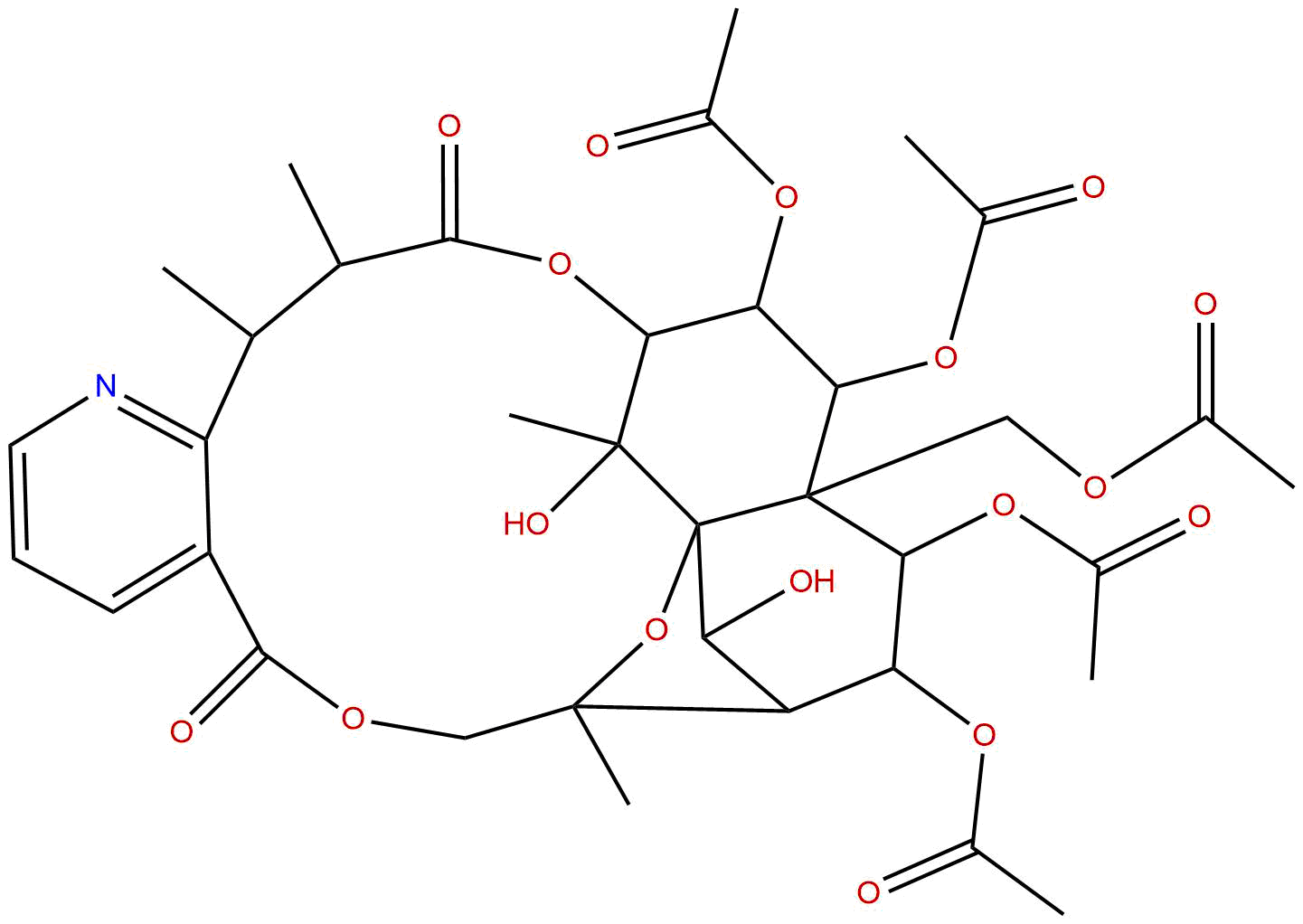
Product name: Neoeuonymine
Synonym name: 8α-acetoxy-O6-deacetyl-8-deoxo-evonine
Catalogue No.: BP5137
Cas No.: 33510-25-7
Formula: C36H45NO17
Mol Weight: 763.746
Botanical Source:
Type of Compound: Alkaloids
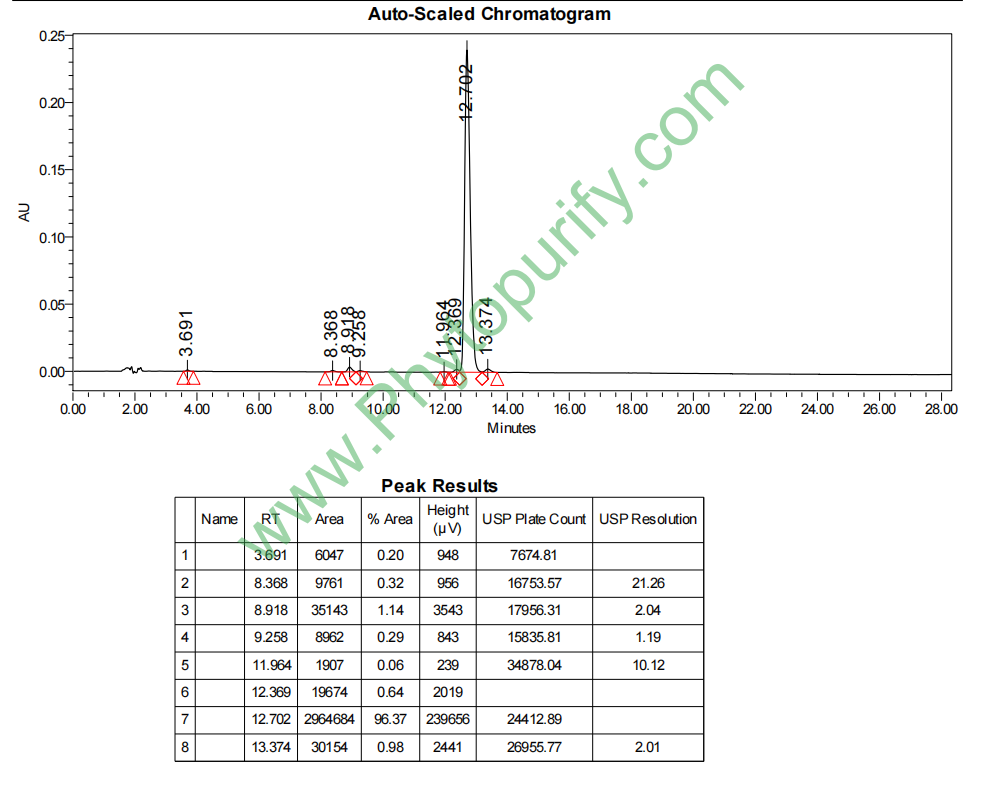
Purity: 95%~99%
Analysis Method: HPLC-DAD or/and HPLC-ELSD
Identification Method: Mass, NMR
Packing: Brown vial or HDPE plastic bottle
Storage: Store in a well closed container, protected from air and light. Put into refrigerate or freeze for long term storage.
Whenever possible, you should prepare and use solutions on the same day. However, if you need to make up stock solutions in advance, we recommend that you store the solution as aliquots in tightly sealed vials at -20℃. Generally, these will be useable for up to two weeks.
The product could be supplied from milligrams to grams
Inquire for bulk scale.
For Reference Standard and R&D, Not for Human Use Directly.
HPLC of Neoeuonymine
Storage conditions:Short-term storage at 2~8℃, long-term storage at -20 ~ -80℃
Neoeuonymine is a natural alkaloid isolated from the Euonymus sieboldiana plant in the genus Euonymus. In recent years, with the continuous development of anti malaria drugs, natural products have become important resources for drug discovery due to their unique chemical structure and diverse biological activities. As a natural compound with potential anti malarial activity, berberine has gradually attracted widespread attention in the pharmacological community. Malaria, as a serious infectious disease affecting hundreds of millions of people worldwide, is facing resistance challenges to traditional antimalarial drugs, and there is an urgent need to develop new and effective antimalarial drugs. This article will provide a systematic review of the chemical structure and physicochemical properties, plant sources and extraction methods, pharmacological activity and mechanism of action, pharmacological evaluation, pharmacokinetic characteristics, and clinical application prospects of berberine. The aim is to provide theoretical basis and research direction for the in-depth study and drug development of this natural product.
The molecular formula of berberine has not been clearly reported in the literature, but its molecular weight is 763.7460, indicating that it is a complex alkaloid with a relatively large molecular weight. Its LogP value is 1.0332, indicating that the compound has moderate lipid solubility, which is beneficial for cell membrane penetration but not too hydrophobic. The TPSA (Topological Polarity Surface Area) is 246.6800, indicating that the molecule contains a large number of polar groups, which may affect its bioavailability and penetration ability. The water solubility is 0.0889, indicating its low water solubility, which to some extent limits its oral absorption and in vivo distribution. The low permeability of the blood-brain barrier indicates that berberine is difficult to enter the central nervous system, which may reduce central nervous system related toxicity. The hERG channel inhibition experiment showed a negative result, indicating a low risk of cardiac toxicity. The Ames test result is 0.0, indicating that berberine has no significant mutagenicity and good safety.
From a chemical structure perspective, as an alkaloid, it is expected to contain multiple nitrogen-containing heterocyclic structures and may have multiple polar groups such as hydroxyl, ether, or ester bonds, which is consistent with its high TPSA value. Its complex molecular structure provides the possibility for its multi-target action.
The main source of new berberine is Euonymus sieboldiana, a plant of the Euonymus genus, which is widely distributed in East Asia and traditionally used for various folk medicines. Euonymus sieboldiana contains abundant alkaloid components in its roots, stems, and leaves, from which berberine was isolated.
During the extraction process, dry plant materials are usually used. Organic solvents such as methanol or ethanol are first used for extraction, followed by separation techniques such as liquid-liquid distribution and column chromatography to enrich the target compounds. The specific steps include:
This method ensures the yield and purity of berberine, providing sufficient material basis for subsequent pharmacological research.
The most significant pharmacological activity of berberine is its anti malaria effect. Malaria is caused by the malaria parasite (Plasmodium spp.), and the problem of drug resistance in the malignant malaria parasite (Plasmodium falciparum) poses a serious threat to global public health. The new berberine exhibits inhibitory activity against multiple drug-resistant strains through a multi-target mechanism of action.
In vitro experiments have shown that berberine can significantly inhibit the growth of P. falciparum, with IC50 values in the low micromolar concentration range. Its targets include multiple key proteins of Plasmodium, including PFCRT (Plasmodium chloroquine transporter), PFMDR1 (multidrug resistance protein 1), PFDHFR (dihydrofolate reductase), PFK13 (ketokinase 13), PFATP6 (calcium ATPase), PFCYTBC (cytochrome bc1 complex), PFPK (phosphokinase), PFCYT (cytochrome c), PFCYTb (cytochrome b), and PfATG8 (autophagy related protein 8). This multi-target characteristic gives new berberine an advantage in overcoming single target resistance.
At present, there are few reports on the other pharmacological activities of berberine, but given its structural characteristics and the diversity of alkaloid compounds, it is expected to be further studied in the fields of antibacterial, anti-inflammatory, and anti-tumor in the future.
The anti malaria mechanism of berberine is mainly based on its inhibition of key proteins in malaria parasites. The specific targets and mechanisms of action are as follows:
PFCRT(Plasmodium falciparum Chloroquine Resistance Transporter)PFCRT is a transporter protein on the malaria parasite membrane that participates in the excretion of chloroquine and is a key factor in chloroquine resistance. Neoberberine binds to PFCRT, blocking its transport function and restoring the antimalarial activity of chloroquine.
PFMDR1(Plasmodium falciparum Multidrug Resistance Protein 1)This protein is involved in multidrug resistance and reduces drug concentration by regulating drug efflux. Neoberberine inhibits PFMDR1 activity and enhances drug accumulation in cells.
PFDHFR (dihydrofolate reductase)PFDHFR is a key enzyme in folate metabolism, and inhibiting its activity can block nucleic acid synthesis. Neoberberine has an inhibitory effect on PFDHFR and interferes with the synthesis of malaria parasite DNA.
PFK13(Kelch 13)Closely related to drug resistance of malaria parasites. Neoberberine may weaken drug resistance by affecting the PFK13-mediated signaling pathway.
PFATP6 (Calcium ATPase)Regulating intracellular calcium homeostasis and affecting the physiological functions of malaria parasites. Neoberberine inhibits PFATP6, leading to calcium ion imbalance and inducing cell death.
PFCYTBC, PFCYT, PFCYTb (cytochrome related proteins)Involved in the mitochondrial electron transport chain, the new berberine interferes with its function and disrupts energy metabolism.
PfATG8 (autophagy related protein 8)Regulating the autophagy process of malaria parasites, berberine affects the autophagy pathway and promotes cell apoptosis.
In summary, the synergistic effect of berberine on multiple targets and pathways inhibits the growth and reproduction of malaria parasites, reduces the risk of drug resistance, and demonstrates good anti malaria potential.
The pharmacological parameters of berberine demonstrate its potential for drug development. A high molecular weight (763.7460) may pose a challenge to oral bioavailability, but a moderate LogP value (1.0332) is beneficial for membrane penetration. A higher TPSA (246.68) suggests stronger polarity, which may limit passive diffusion absorption.
Low water solubility (0.0889) may affect the dissolution and absorption of oral formulations, which needs to be improved through formulation process optimization or structural modification. Low blood-brain barrier permeability reduces the risk of central nervous system toxicity. The negative and non mutagenic results of hERG channel inhibition provide support for safety.
At present, there is a lack of in vivo pharmacokinetic data on berberine. Based on its physicochemical properties, it is speculated that its oral absorption may be limited, and its distribution in the body is relatively restricted, mainly through liver metabolism and renal excretion. In the future, in vivo pharmacokinetic and metabolic studies need to be conducted to clarify their absorption, distribution, metabolism, and excretion (ADME) characteristics, providing a basis for clinical development.
As a multi-target anti malaria natural product, berberine has significant potential to overcome resistance to traditional antimalarial drugs. Its multi-target mechanism not only improves the anti malaria effect, but also reduces the risk of drug resistance, which meets the current needs of anti malaria drug development.
The future clinical application prospects are mainly reflected in the following aspects:
Development of new antimalarial drugs New berberine can be used as a lead compound to improve its pharmacokinetic properties and bioavailability through structural optimization, and develop into a new drug with clinical application value.
Combination therapy strategy Combining existing antimalarial drugs and utilizing their multi-target properties, design a combination therapy plan to improve efficacy and delay the development of drug resistance.
Broad spectrum antiparasitic drugs Given that its target involves multiple key proteins of parasites, its therapeutic potential for other parasitic diseases can be explored in the future.
Security advantage No mutagenicity and low risk of cardiac toxicity, providing safety assurance for clinical application.
However, the clinical translation of berberine still faces challenges, including pharmacokinetic limitations due to its high molecular weight, difficulties in scaling up extraction and purification processes, and insufficient systematic research on in vivo toxicity and efficacy evaluation. In the future, it is necessary to strengthen pharmacological, toxicological, pharmacokinetic, and formulation research to promote its clinical application.
As a natural alkaloid isolated from Euonymus sieboldiana, berberine exhibits significant anti malarial activity and multi-target mechanism of action, with good safety and potential for drug development. Its unique chemical structure and multi-target inhibitory effect provide new ideas and directions for the development of anti malaria drugs. Although its pharmacokinetics and clinical application research are still in the preliminary stage, with the development of natural product pharmacology and modern medicinal chemistry technology, berberine is expected to become an important candidate drug in the field of anti malaria. In the future, it is necessary to strengthen the pharmacological and toxicological evaluation, structural optimization, and preclinical research of its system, promote its clinical translation, and contribute to the global prevention and control of malaria.
