


Synonym name: Hypodiolide A
Catalogue No.: BP1410
Cas No.: 139122-81-9
Formula: C20H30O3
Mol Weight: 318.457
Botanical Source:
Purity: 95%~99%
Analysis Method: HPLC-DAD or/and HPLC-ELSD
Identification Method: Mass, NMR
Packing: Brown vial or HDPE plastic bottle
Can be supplied from milligrams to grams.
For Reference Standard and R&D, Not for Human Use Directly.
Inquire for bulk scale.
HPLC of Tripterifordin
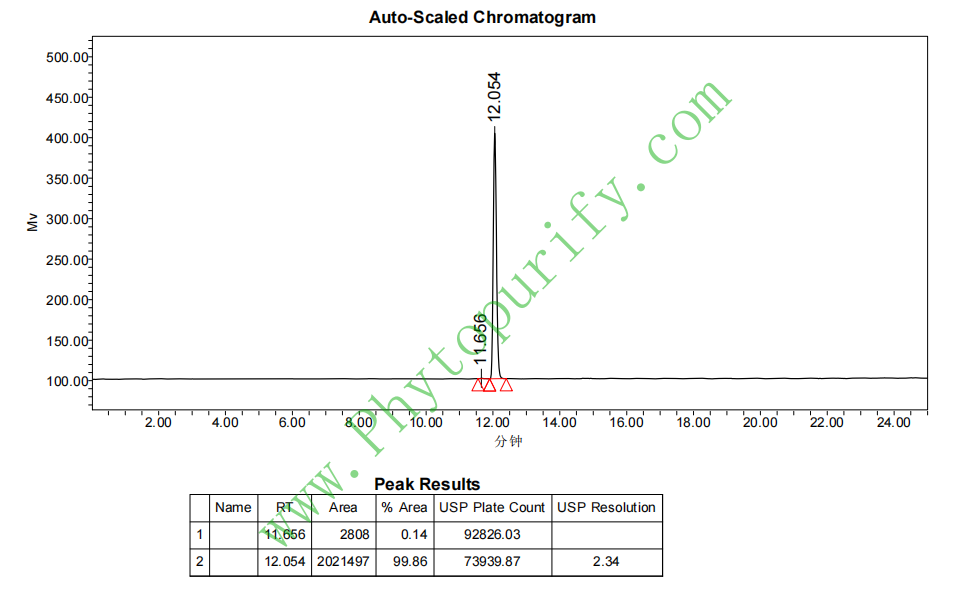
Storage conditions:Short-term storage at 2~8℃, long-term storage at -20 ~ -80℃
46.5300
3.7726
3.7729
.0127
6.4706
12.5088
High
84.4800
6.2452
No
No
No
No
Yes
No
0.0
No
No
No
No
As an important treasure house for drug discovery, natural products have played an irreplaceable role in the history of human's fight against infectious diseases, cancer and autoimmune diseases. Thunder God Vine(Tripterygium wilfordii Hook. f., as a traditional Chinese medicine, is renowned for its significant anti-inflammatory, immunosuppressive, and anti-tumor activities. Its complex chemical composition is the material basis for various biological activities. Tripterifordin (CAS number: 139122-81-9) is a diterpenoid compound isolated from Tripterygium wilfordii. Since its discovery, it has attracted the attention of pharmacological researchers due to its unique chemical structure and potential biological activity. Early studies revealed that it has significant anti human immunodeficiency virus (HIV) replication activity in H9 lymphocytes, with a half effective concentration (EC50) of 3100 nM, providing preliminary clues for its application in the field of antiviral therapy. However, its pharmacological effects go far beyond this, and subsequent studies have gradually revealed its core role in regulating immune responses, closely related to multiple key immune related targets such as STAT3, NF - κ B, IL-2, TGF - β 1, etc., suggesting that it has broad research prospects in the field of immunosuppressive therapy for autoimmune diseases, organ transplant rejection, and so on. This article aims to systematically review the chemical properties, plant sources, pharmacological activities, mechanisms of action, medicinal properties, and clinical application prospects of Tripterygium wilfordii Hook. f., in order to provide comprehensive academic references for the in-depth research and development of this compound.
Tripterygium wilfordii var. wilfordii belongs to the class of diterpenoid compounds of the rosin alkane type. Its molecular formula is C20H30O3 and its molecular weight is 318.4570. Structurally speaking, it possesses a typical tetracyclic triterpenoid skeleton (a tricyclic core in diterpenes, but often derived from multiple ring systems in the rosin alkane type, which needs to be confirmed based on the specific structure. Generally, Tripterifordin is a highly oxidized tricyclic or pentacyclic structure in Tripterygium wilfordii diterpenes, but Tripterifordin is often classified as a diterpene with a specific ring system in literature), with multiple chiral centers and complex stereochemistry. The epoxy groups, hydroxyl groups, and specific unsaturated bonds in its structure are the key pharmacophores that exert its biological activity.
In terms of physicochemical properties, the calculated lipid water partition coefficient (LogP) is 3.7726, indicating that the compound has moderate lipophilicity, which is beneficial for its penetration of cell membranes and interaction with intracellular targets, but may also affect its water solubility and formulation development. Its topological polar surface area (TPSA) is 46.5300 Å ², which is relatively small, further confirming its good membrane permeability. The predicted value of water solubility is relatively low, about 0.0127 mg/mL, indicating that strategies such as salt formation, preparation of cyclodextrin inclusion complexes, nanocrystals, or liposomes may be needed in subsequent drug formulation research to improve its solubility and bioavailability. It is worth noting that its predicted blood-brain barrier permeability is "high", which means that Tripterygium wilfordii has the potential to act on immune or inflammatory diseases related to the central nervous system, but potential central neurotoxicity risks should also be monitored. In early safety screening, the hERG inhibition risk was predicted as' no ', and the Ames test predicted a value of 0.0 (indicating no mutagenicity). These preliminary computer predicted data provide optimistic clues for its relatively good safety profile, but still need to be validated through rigorous in vitro and in vivo experiments.
The main source of Tripterygium wilfordii Fuding comes from the Tripterygium wilfordii plant in the family Celastraceae(Tripterygium wilfordii)The root bark part. Thunder God Vine is mainly distributed in the southern and southwestern regions of the Yangtze River Basin in China. Its medicinal part, the root bark, is called "Thunder God Vine" in traditional Chinese medicine. It has a bitter and pungent taste, and is highly toxic. It belongs to the liver and kidney meridians and is traditionally used to treat rheumatism, rheumatism, swelling, and boils.
Isolating high-purity Tripterygium wilfordii from such a complex plant matrix is a challenge. The conventional extraction and separation process is usually as follows: first, the dried Tripterygium wilfordii root bark is crushed, and organic solvents such as methanol, ethanol, or acetone are used for cold soaking or reflux extraction. After concentration, the crude extract is obtained. The crude extract is then subjected to gradient extraction using solvents such as petroleum ether, ethyl acetate, n-butanol, etc., and preliminarily separated based on polarity. Tripterygium wilfordii usually accumulates in the moderately polar ethyl acetate extraction site. Further purification is highly dependent on various chromatographic techniques. Silica gel column chromatography is commonly used for preliminary separation, with gradient elution using different ratios of petroleum ether ethyl acetate or chloroform methanol mixed solvents. The collected fractions containing the target components are repeatedly refined by reverse phase silica gel column chromatography (such as ODS, using methanol water or acetonitrile water as mobile phase), high performance liquid chromatography (HPLC), or preparative thin layer chromatography (PTLC) until the purity of the monomeric compound of Lei Gong Teng Fu meets the research requirements. Modern separation technologies such as high-speed countercurrent chromatography (HSCCC) are increasingly being used for the separation and purification of natural products due to their advantages of irreversible adsorption and high recovery rates. The entire separation process requires real-time monitoring and identification using thin-layer chromatography (TLC) or high-performance liquid chromatography (HPLC).
Leigongteng Fuding exhibits diverse pharmacological activities, and its research has gradually expanded from the initial antiviral field to the field of immune regulation.
Antiviral activity The earliest reported activity of Tripterygium wilfordii Hook. f. was anti HIV. Research has shown that in H9 lymphocyte models, it can effectively inhibit HIV-1 replication with an EC50 of 3100 nM. Although its efficacy is not the strongest compared to some first-line antiretroviral drugs, it provides important clues for the search for novel anti HIV lead compounds from natural products, and its mechanism of action may be different from classical reverse transcriptase or protease inhibitors, which is worth further investigation.
Immunosuppressive and anti-inflammatory activity This is currently the most promising research direction for Tripterygium wilfordii Fuding. Numerous in vitro and in vivo studies have confirmed that it has a powerful immunomodulatory effect.
Potential anti-tumor activity Due to its immune regulatory properties and ability to regulate signaling pathways closely related to tumor occurrence and development, such as STAT3 and NF - κ B, Tripterygium wilfordii Hook. f. has also received attention in the field of anti-tumor therapy. Preliminary research suggests that it may exert anti-tumor effects by inducing tumor cell apoptosis, inhibiting cell proliferation and invasion, and reversing the immunosuppressive tumor microenvironment. However, research in this area is still in its infancy and requires more evidence to support it.
The immunosuppressive and anti-inflammatory effects of Tripterygium wilfordii Hook. f. are not achieved through a single target, but rather through the synergistic effects of multiple targets and pathways. Its functional network involves multiple key signaling molecules and transcription factors:
Nuclear factor kappa B (NF - κ B) signaling pathway NF - κ B is a core regulatory factor in inflammation and immune response. Triptolide has been shown to inhibit the activation of NF - κ B. It may intervene in upstream signals (such as inhibiting the activity of I κ B kinase IKK) to prevent the phosphorylation and degradation of I κ B protein, thereby causing NF - κ B dimers to remain in the cytoplasm and unable to enter the nucleus to initiate the transcription of a large number of pro-inflammatory genes such as TNF - α, IL-6, IL-1 β, etc.
Signal transduction and transcription activator 3 (STAT3) pathway STAT3 is another key pro-inflammatory and pro survival signaling pathway. Abnormal sustained activation in various autoimmune diseases and cancers. Research has shown that Tripterygium wilfordii can inhibit tyrosine phosphorylation of STAT3 (such as Tyr705 site), block its dimerization, nuclear translocation, and DNA binding ability, thereby downregulating the expression of downstream target genes (such as Bcl-2, Cyclin D1, VEGF, etc.), which is closely related to its induction of cell cycle arrest, promotion of apoptosis, and inhibition of inflammation.
T cell receptor (TCR) and calcineurin signaling axis The activation of T cells depends on the increase in intracellular calcium ion concentration triggered by TCR signaling. Calcium ions bind to calmodulin (CALN1 encoded product) and activate calcium regulated neurophosphatase (encoded by PPP3CA, etc.). Activated calcium regulated phosphatase dephosphorylates transcription factors NFAT (such as NFATC1), allowing them to enter the nucleus and drive gene expression such as IL-2. Triptolide may inhibit the production of IL-2 and complete activation of T cells by interfering with this signaling process (possibly acting on the CALN1/PP3CA/NFATC1 pathway), similar to the mechanism of action of classical immunosuppressants cyclosporine A and tacrolimus, but the specific site of action may be different.
Direct regulation of key immune cytokines In addition to indirectly affecting through signaling pathways, Tripterygium wilfordii Hook. f. may directly regulate the expression of genes such as IFNG (encoding IFN - γ), IL10, TGFB1, etc. Its potential impact on the expression of FOXP3 (a key transcription factor regulating T cells) is one of the possible mechanisms for regulating Treg cell function and maintaining immune tolerance.
In summary, Tripterygium wilfordii Hook. f. f. f. f. rexed acts on core signaling networks such as STAT3, NF - κ B, and calcineurin NFAT, and regulates key cytokines such as IL-2, IFN - γ, TGF - β 1, and IL-10, forming a multi-target regulatory network that ultimately achieves the effect of inhibiting excessive immune response and inflammation.
It is crucial to conduct a systematic pharmacological evaluation of Tripterygium wilfordii Hook. f. based on its physicochemical properties and preliminary biological data.
Absorption, distribution, metabolism, excretion (ADME):
Pharmacokinetic (PK) research needs Currently, there is a lack of publicly available pharmacokinetic research data on the Tripterygium wilfordii Hook. f. system. In the future, single and multiple dose PK studies need to be conducted in mouse, rat, and even higher-level animal models to obtain key parameters such as blood drug concentration time curves, peak time (Tmax), peak concentration (Cmax), half-life (t1/2), and area under the drug time curve (AUC), providing a basis for drug administration design.
Safety evaluation (toxicology)Thunder God Vine itself has well-known toxicity (such as hepatotoxicity and reproductive toxicity). Although the Ames test prediction of Tripterygium wilfordii Hook. f. f. is negative and there is no hERG inhibition warning, as one of the active ingredients of Tripterygium wilfordii Hook. f., a comprehensive preclinical toxicological evaluation is necessary. This includes studies on acute toxicity, repeated administration toxicity (28 days, 90 days), genetic toxicity (experimentally validated), reproductive developmental toxicity, and organ specific toxicity (especially liver, kidney, cardiovascular, and immune system). Clarifying its treatment window (safety range) is a prerequisite for promoting its clinical translation.
As a natural small molecule with clear immunosuppressive activity, the clinical application prospects of Tripterygium wilfordii Hook. f. mainly focus on diseases that require immune regulation:
Autoimmune diseases This is the most direct application direction. Including rheumatoid arthritis, systemic lupus erythematosus, psoriasis, ankylosing spondylitis, inflammatory bowel disease (such as Crohn's disease, ulcerative colitis), and multiple sclerosis. Its multi-target mechanism of action may have a synergistic therapeutic effect on such complex diseases, or it can be used for patients with poor response to existing biologics or traditional disease modifying antirheumatic drugs (DMARDs).
Anti rejection reactions in organ transplantation As a potential regulator of the calcineurin NFAT signaling pathway, Triptolide Tripterygium wilfordii is expected to be developed as a novel immunosuppressant for the prevention and treatment of acute rejection after solid organ transplantation in the kidney, liver, heart, and other organs. It may serve as a supplement or alternative to existing regimens such as tacrolimus and mycophenolate mofetil, especially for patients who are intolerant or develop resistance to existing drugs.
Inflammatory diseases Such as atopic dermatitis, asthma, chronic obstructive pulmonary disease (COPD), etc., their strong anti-inflammatory properties may bring therapeutic benefits.
Combination therapy strategy Given its unique mechanism of action, the combination of Tripterygium wilfordii Hook. f. and existing immunosuppressants (such as methotrexate, leflunomide) or biologics (such as anti TNF - α antibodies) may produce synergistic effects, reduce their respective dosages, thereby reducing toxic side effects and improving efficacy.
However, pushing it from the laboratory to clinical practice faces many challenges:First It is necessary to address the issues of poor water solubility and potential low bioavailability, which rely on innovative drug delivery systems such as nanomedicine and prodrug design.secondly It is necessary to complete systematic and standardized preclinical pharmacological and toxicological studies, fully evaluate their effectiveness and safety, especially clarify their therapeutic indices.Again It is necessary to thoroughly elucidate its precise molecular targets and mechanisms of action, which can help predict side effects, discover biomarkers, and guide precision medication.finally Standardized clinical trials (phases I, II, III) are needed to verify its safety, pharmacokinetic characteristics, and efficacy in specific diseases in humans.
Leigongteng Fuding is a diterpenoid compound with significant research value isolated from the traditional Chinese medicine Leigongteng. It not only exhibits anti HIV activity in the early stages, but more importantly, it exerts strong immunosuppressive and anti-inflammatory effects through multi-target intervention of key signaling pathways such as STAT3, NF - κ B, and calcineurin NFAT, demonstrating encouraging therapeutic potential in preclinical models of various autoimmune diseases and transplant rejection. Although there are challenges such as low water solubility and incomplete pharmacokinetic and toxicological data in terms of its pharmacological properties, these have not obscured its potential as a new lead compound for immunomodulators. Future research should focus on using modern medicinal chemistry methods for structural optimization to enhance its activity and drug properties, adopting advanced formulation technologies to improve its delivery efficiency, and gradually promoting the targeted clinical translation of Tripterygium wilfordii through in-depth mechanism research and standardized preclinical development. It is expected to provide a new treatment option for many patients with immune related diseases and continue the legend of natural products in drug discovery.
