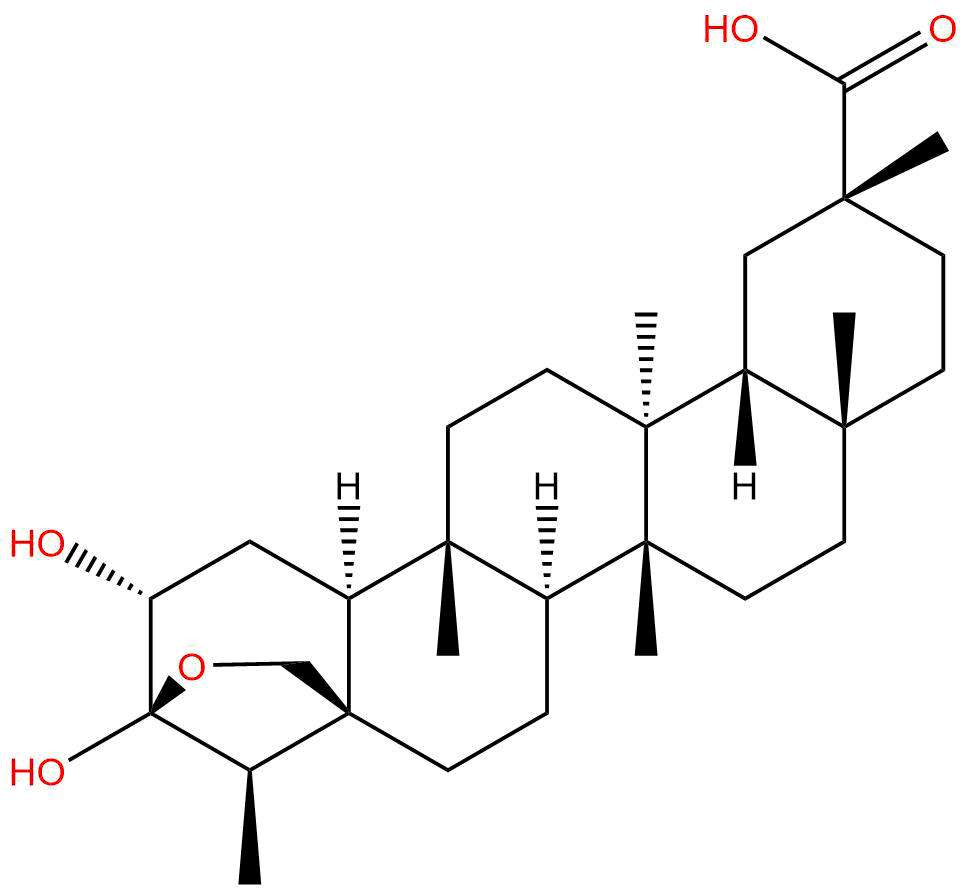


Product name: Orthosphenic acid
Synonym name: Orthophenic acid
Catalogue No.: BP4537
Cas No.: 86632-20-4
Formula: C30H48O5
Mol Weight: 488.709
Botanical Source:
Type of Compound:
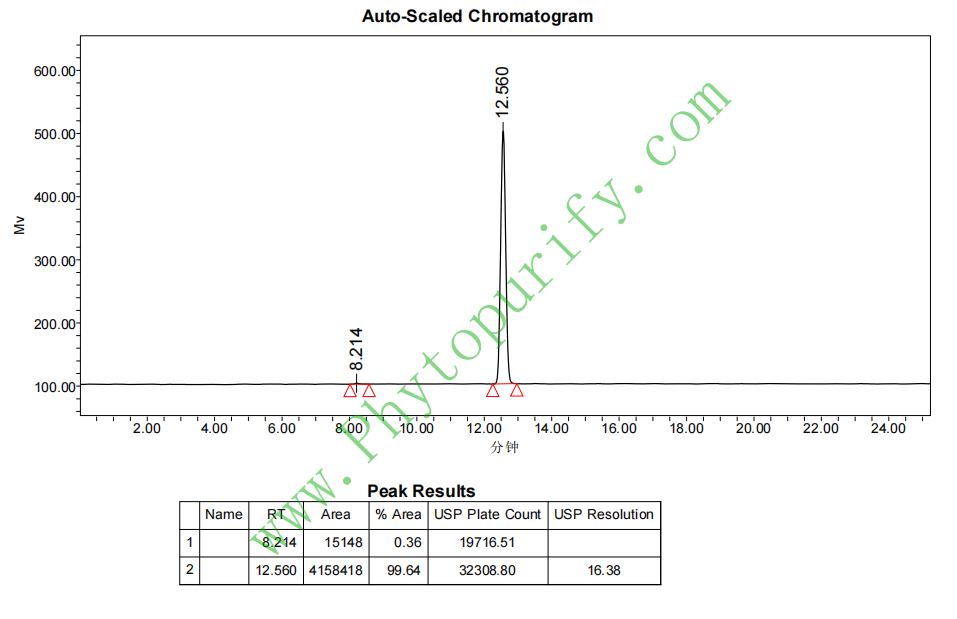
Purity: 95%~99%
Analysis Method: HPLC-DAD or/and HPLC-ELSD
Identification Method: Mass, NMR
Packing: Brown vial or HDPE plastic bottle
Storage: Store in a well closed container, protected from air and light. Put into refrigerate or freeze for long term storage.
Whenever possible, you should prepare and use solutions on the same day. However, if you need to make up stock solutions in advance, we recommend that you store the solution as aliquots in tightly sealed vials at -20℃. Generally, these will be useable for up to two weeks.
The product could be supplied from milligrams to grams
Inquire for bulk scale.
For Reference Standard and R&D, Not for Human Use Directly.
HPLC of Orthosphenic acid
Storage conditions:Short-term storage at 2~8℃, long-term storage at -20 ~ -80℃
86.9900
4.9676
3.1615
.0027
2.8412
6.8504
Low
90.9578
6.4432
No
No
No
No
No
No
0.0
No
No
Yes
No
Natural products, as an important source of drug discovery, play an irreplaceable role in the history of human disease treatment. Among them, triterpenoids have always been a hot topic in medicinal chemistry and pharmacology research due to their structural diversity and wide range of biological activities. Orthophytic acid (CAS: 86632-20-4), as a traditional medicinal plant derived from Tripterygium wilfordii(Tripterygium wilfordii The tricyclic diterpenes isolated from Hook. f. have attracted much attention in recent years due to their significant anti-inflammatory activity. Thunder God Vine has a long history of being used in traditional Chinese medicine to treat autoimmune diseases such as rheumatoid arthritis and nephritis. The excavation of its active ingredients is the key to elucidating its pharmacological substance basis. As one of the many active diterpenes in Tripterygium wilfordii, oxalic acid has a unique chemical structure (C30H48O5) that combines functional groups such as diols, hydroxymonocarboxylic acids, and cyclic semiketones, indicating its potential complex biological activity spectrum and unique mechanism of action. This article aims to systematically review the chemical properties, plant sources, pharmacological activities, molecular mechanisms of action, pharmacological evaluation, and clinical application prospects of oxalic acid, in order to provide comprehensive scientific references for the in-depth research and potential drug development of this natural product.
Straight wedge oxalic acid is a hexacyclic triterpenoid compound, whose chemical structure is derived from the Friedland skeleton. Its molecular formula is C30H48O5 and its molecular weight is 488.7090. Structural analysis shows that it is a tricyclic diterpene, with a core skeleton containing multiple fused ring systems and modified with hydroxyl, carboxyl, and a key cyclic semiketide structure. This semi ketal structure is relatively rare in natural products and may have a significant impact on its biological activity and chemical stability. The presence of hydroxyl and carboxyl groups gives it a certain polarity, while the large triterpenoid hydrophobic skeleton dominates its lipophilicity.
The physicochemical property data revealed the preliminary characteristics of its medicinal properties: the calculated lipid water partition coefficient (LogP) was 4.9676, indicating that the compound has high lipophilicity; The topological polar surface area (TPSA) is 86.99 Å ², reflecting the area occupied by polar functional groups in its molecule. These parameters collectively determine its extremely low water solubility (approximately 0.0027 mg/mL), which is often one of the main challenges faced by natural products in formulation development. The high LogP value and low water solubility suggest that the absorption and distribution of oxalic acid in organisms may tend to follow the rules of lipophilic compounds, but it may also bring problems in solubility and bioavailability. Its complex polycyclic structure and multiple chiral centers also pose challenges and opportunities for its chemical synthesis and structural modification.
Straight wedge oxalic acid is mainly derived from the plant Tripterygium wilfordii in the family Celastraceae(Tripterygium wilfordii)Separated from the root bark or bark. Thunder God Vine is mainly distributed in the southern region of the Yangtze River Basin in China. Its medicinal parts contain hundreds of chemical components, including diterpenes, triterpenes, alkaloids, etc. Among them, diterpenes are considered to be its main active substance group.
The extraction and separation of oxalic acid from plant materials usually follow the conventional process of natural product chemistry. Firstly, organic solvents such as methanol, ethanol, or acetone are used to extract or reflux the dried root bark of Tripterygium wilfordii to obtain crude extract. Subsequently, the crude extract was preliminarily separated using solvent partitioning method (such as extraction with petroleum ether, ethyl acetate, and n-butanol in sequence), and oxalic acid was often enriched in the ethyl acetate extraction site due to its equipolarity. Further purification relies on various chromatographic techniques. Silica gel column chromatography is commonly used for preliminary separation, with different ratios of petroleum ether ethyl acetate or chloroform methanol gradient elution. Then, fine purification is carried out in combination with reversed-phase silica gel column chromatography (such as C18 packing, methanol water or acetonitrile water as mobile phase), gel column chromatography (such as Sephadex LH-20), and high performance liquid chromatography (HPLC, usually using semi prepared or preparative C18 columns) to finally obtain high-purity straight wedge oxalic acid monomer. During the separation process, thin layer chromatography (TLC), high-performance liquid chromatography-mass spectrometry (HPLC-MS), and nuclear magnetic resonance (NMR) are commonly used for tracking and structural identification. Optimizing the extraction solvent, chromatographic conditions, and separation strategy is the key to improving the yield of oxalic acid.
The most notable pharmacological activity of oxalic acid is its extensive anti-inflammatory effect, which is highly consistent with the traditional use of its source plant, Tripterygium wilfordii. Numerous in vitro and in vivo studies have confirmed its strong anti-inflammatory potential.
In vitro models, oxalic acid can significantly inhibit the production of pro-inflammatory mediators by macrophages (such as RAW264.7 cells) induced by stimuli such as lipopolysaccharide (LPS). Research has shown that it can dose dependently inhibit the production of nitric oxide (NO) and prostaglandin E2 (PGE2), two key effectors in inflammatory responses. Meanwhile, it also has a strong inhibitory effect on the expression and release of various pro-inflammatory cytokines.
In various animal inflammation models, oxalic acid has shown good therapeutic effects. For example, in mouse ear xylene or TPA induced acute inflammation models, local or systemic administration can significantly reduce ear swelling. In the rat paw swelling model induced by carrageenan or formalin, oxalic acid can also effectively inhibit the formation and development of edema. More importantly, in more complex autoimmune disease models, such as the collagen induced arthritis (CIA) mouse model, oxalic acid treatment can significantly improve joint swelling, reduce clinical scores of arthritis, and alleviate pathological damage to joint tissue, such as synovial hyperplasia and cartilage destruction. These studies collectively point to oxalic acid as a natural compound with broad-spectrum anti-inflammatory activity, which has intervention effects on both acute and chronic inflammation.
The anti-inflammatory effect of oxalic acid is not achieved through a single pathway, but involves multidimensional regulation of multiple inflammation related signaling pathways and molecular targets, reflecting the multi-target nature of natural products. Existing research has preliminarily revealed its complex functional network:
Inhibition of nuclear factor kappa B (NF - κ B) signaling pathway NF - κ B is the core transcription factor of inflammatory response. Research has shown that oxalic acid can inhibit LPS induced degradation of I κ B α protein and nuclear translocation of p65 subunit, thereby blocking the activation of NF - κ B. This directly leads to the inhibition of transcription of a series of downstream pro-inflammatory genes, such as tumor necrosis factor - α (TNF - α), interleukin-6 (IL-6), inducible nitric oxide synthase (iNOS/NOS2), and cyclooxygenase-2 (COX-2/PTGS2).
Regulating the STAT3 signaling pathway STAT3 is another important pro-inflammatory and pro survival signaling pathway. Oxalic acid has been shown to inhibit STAT3 phosphorylation (activation) induced by cytokines such as IL-6, blocking JAK-STAT3 signaling, which helps to suppress the persistence and amplification of inflammation.
Affects inflammasome activity The activation of inflammasomes (such as NLRP3) leads to the activation of caspase-1 (CASP1), which in turn promotes the maturation and release of IL-1 β and IL-18. There is evidence suggesting that oxalic acid may inhibit the activity of caspase-1 by intervening in the assembly or activation of inflammasomes, thereby reducing the production of these key pro-inflammatory cytokines.
Adjusting ion channels The study also found that oxalic acid may act on transient receptor potential vanillic acid subtype 1 (TRPV1) and transient receptor potential anchor protein subtype 1 (TRPA1) channels. These channels are involved in the regulation of pain sensation and neurogenic inflammation, and their inhibition may contribute to the anti-inflammatory and potential analgesic effects of oxalic acid.
Inhibition of cyclooxygenase (COX) activity The inhibition of prostaglandin synthesis by oxalic acid is partly due to its inhibition of COX-2 (PTGS2) expression, and may also include direct or indirect effects on COX-1 (PTGS1) enzyme activity.
In summary, oxalic acid acts on multiple key inflammatory nodes such as NF - κ B, STAT3, and inflammasomes simultaneously, and may affect TRP channels, forming a synergistic anti-inflammatory network. This multi-target characteristic enables it to inhibit the inflammatory cascade reaction from multiple levels such as gene transcription, protein expression, enzyme activity, and cell signaling, which may be the structural basis for its highly effective anti-inflammatory and potentially better safety window (compared to single target potent inhibitors).
The pharmacological evaluation based on calculations and preliminary experimental data shows that oxalic acid as a drug lead compound has both potential and challenges.
Advantage aspects Its molecular weight (488.7) is within the acceptable range for drug like molecules. The key toxicity warning indicators show that it has no significant inhibitory tendency on hERG potassium channels (hERG inhibition: No), which reduces the potential risk of causing QT interval prolongation and apical torsion type ventricular tachycardia. In addition, the Ames test result was 0.0, indicating that it may not have direct genetic toxicity, which is an important preliminary safety signal. Its blood-brain barrier permeability is predicted to be 'low', which may help reduce central nervous system side effects for drugs primarily targeting peripheral inflammatory diseases.
Challenge aspect The most prominent issue is its extremely low water solubility and high LogP value, which may lead to poor oral absorption and low bioavailability. High lipophilicity may also pose a risk of tissue accumulation. At present, there is very limited public data on the pharmacokinetic studies of the oxalic acid system, such as absorption, distribution, metabolism, and excretion, which is a knowledge gap that must be filled for its development. It can be speculated that as a triterpenoid compound, it may undergo metabolism by the liver cytochrome P450 enzyme system, and its carboxyl group may also undergo glucuronic acid binding reaction.
To overcome its drug defects, future research may consider the following strategies: 1)Prodrug design Modify its carboxyl or hydroxyl groups through esterification to prepare precursor drugs with higher water solubility or bioavailability, and release the original drug through hydrolysis in vivo. 2)Formulation technology By utilizing advanced drug delivery systems such as nanocrystals, liposomes, micelles, and cyclodextrin inclusion complexes, their solubility and dissolution rate can be significantly improved, and absorption can be enhanced. 3)Simplification and Modification of Structure Simplify or locally modify its complex skeleton to optimize its LogP, solubility, and metabolic stability while retaining its pharmacophores (such as hemiketones, specific hydroxyl groups).
Oxalic acid has shown broad clinical application prospects in anti-inflammatory, especially in the treatment of autoimmune and chronic inflammatory diseases. Its most direct application direction is as Rheumatoid arthritis (RA)、Ankylosing spondylitis (AS) Potential therapeutic drugs for diseases. Given its significant effect in the CIA model and its multi-target anti-inflammatory mechanism that is compatible with the complex pathological network of these diseases, it has the potential to be developed as a novel disease modified anti rheumatic drug (DMARD). In addition, preclinical and clinical exploration is also worthwhile for diseases mediated by immune inflammation such as psoriasis, inflammatory bowel disease (IBD), and certain dermatitis.
In addition to being developed directly as a new chemical entity drug, oxalic acid can also be used as lead compound Provide valuable structural templates for pharmaceutical chemists. By systematically modifying its structure and studying its structure-activity relationship, it is expected to obtain derivatives or analogues with stronger activity, higher selectivity, and better drug properties. Its unique multi-target mode of action also contributes to the development of targeted therapies for complex disease networks Multi targeted anti-inflammatory drugs Provided new ideas.
Looking ahead to the future, research on oxalic acid needs to be further explored in the following directions: 1)In depth mechanism research Using chemical biology methods such as affinity fishing and molecular probes to accurately identify its direct target proteins and draw clearer pharmacological action maps. 2)Comprehensive evaluation of drug properties Conduct in vitro ADMET (absorption, distribution, metabolism, excretion, and toxicity) experiments and in vivo pharmacokinetic studies to clarify its metabolic fate and potential toxicity. 3)Conduct preclinical development On the basis of completing sufficient pharmacological and safety evaluations, promote Good Laboratory Practice (GLP) toxicology research that complies with regulations, laying the foundation for its application for Clinical Research Approval (IND). 4)Exploring the potential of combination therapy Studying its synergistic effect with existing anti-inflammatory drugs may help reduce their respective doses, minimize side effects, and improve efficacy.
As a natural tricyclic diterpenoid compound discovered from the traditional Chinese medicine Tripterygium wilfordii, oxalic acid has become a valuable target in the pharmacological research of natural products due to its unique chemical structure and significant broad-spectrum anti-inflammatory activity. Its mechanism of exerting multi-target anti-inflammatory effects by intervening in multiple key signaling nodes such as NF - κ B, STAT3, and inflammasomes provides a new potential strategy for the treatment of complex inflammatory diseases such as rheumatoid arthritis. Although it currently faces challenges such as poor water solubility and unclear pharmacokinetic properties, these challenges are expected to be gradually overcome through the intervention of modern medicinal chemistry, pharmacology, and pharmacology. The continuous in-depth research on oxalic acid not only helps to clarify the scientific connotation of the traditional pharmacological effects of Tripterygium wilfordii, but also may give rise to a new class of anti-inflammatory drugs with independent intellectual property rights, bringing new treatment hope to inflammatory disease patients worldwide. The exploration journey of oxalic acid from natural treasure trove to modern pharmacy is a vivid example of the integration and innovation of traditional wisdom and modern science.
