


Synonym name: Hypolide
Catalogue No.: BP1413
Cas No.: 74285-86-2
Formula: C20H24O3
Mol Weight: 312.409
Botanical Source: Tripterygium hypoglaucum and Tripterygium wilfordii
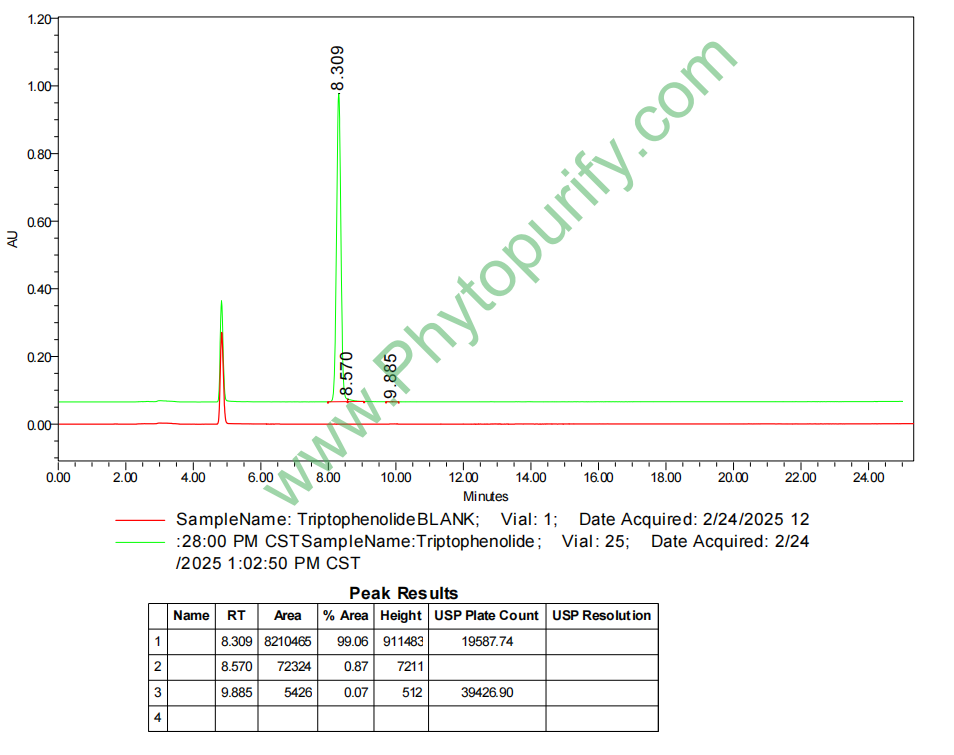
Purity: 95%~99%
Analysis Method: HPLC-DAD or/and HPLC-ELSD
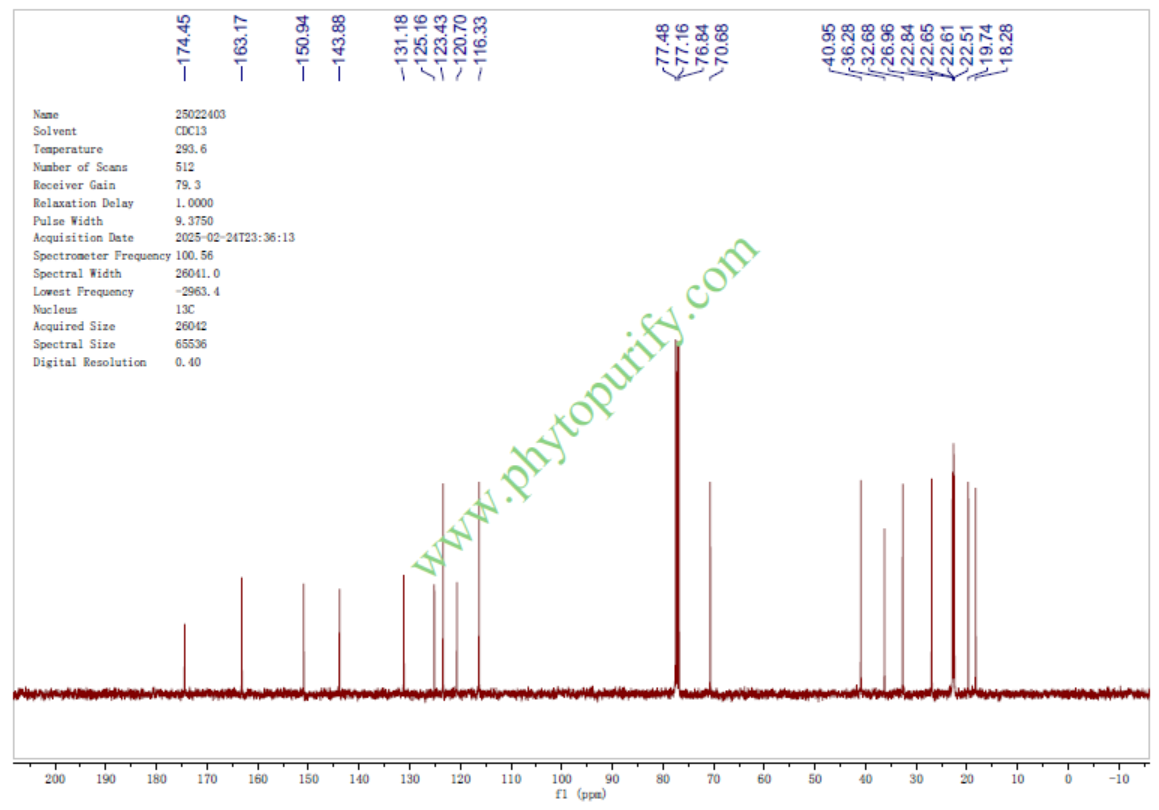
Identification Method: Mass, NMR
Packing: Brown vial or HDPE plastic bottle
Can be supplied from milligrams to grams.
For Reference Standard and R&D, Not for Human Use Directly.
Inquire for bulk scale.
Description:
Triptophenolide is a natural product from Tripterygium wilfordii Hook. f.
References:
Yao Xue Xue Bao. 1992;27(11):867-70.
The crystal structure of triptophenolide revisited.
Triptophenolide, C20H24O3, has been assigned two isomeric structures. DF Yu et al reported the X-ray analytical structure II in 1990. In 1982, however, FX Deng et al had already reported the spectrometric assignment of structure I. Now, we report again the single crystal analysis of Triptophenolide (I). The crystal belongs to space group P2(1)2(1)2(1) of orthorhombic system, with a = 7.270(6), b = 12.509(8), c = 36.20(1) A, Z = 8. The structure was solved by direct method and refined by the full-matrix least-square method to a final R factor 0.055, based on 2322 intensities with I > or = 3 sigma (I). It is highly probable that the result of DF Yu was in error with only 1292 available intensities.
J Org Chem. 2000 Apr 7;65(7):2208-17.
Enantioselective total synthesis of (-)-triptolide, (-)-triptonide, (+)-triptophenolide, and (+)-triptoquinonide.
The first enantioselective total synthesis of (-)-triptolide (1), (-)-triptonide (2), (+)-Triptophenolide (3), and (+)-triptoquinonide (4) was completed. The key step involves lanthanide triflate-catalyzed oxidative radical cyclization of (+)-8-phenylmenthyl ester 30 mediated by Mn(OAc)3, providing intermediate 31 with good chemical yield (77%) and excellent diastereoselectivity (dr 38:1). (+)-Triptophenolide methyl ether (5) was then prepared in > 99% enantiomeric excess (> 99% ee), and readily converted to natural products 1-4. In addition, transition state models were proposed to explain the opposite chiral induction observed in the oxidative radical cyclization reactions of chiral beta-keto esters 17 (without an alpha-substituent) and 17a (with an alpha-chloro substituent).
NMR of Triptophenolide
HPLC of Triptophenolide
Storage conditions:Short-term storage at 2~8℃, long-term storage at -20 ~ -80℃
46.5300
4.6330
4.6325
.0201
5.2550
24.3562
High
91.1178
3.8707
No
No
No
No
No
No
0.0
No
No
No
No
Natural products, as an important source of drug discovery, play an irreplaceable role in the history of human disease treatment. Thunder God Vine(Tripterygium wilfordii Hook. f., as a traditional Chinese medicine, has various biological activities such as anti-inflammatory, immunosuppressive, and anti-tumor effects, and its complex chemical composition has always been a research hotspot. Triptophenolide (CAS number: 74285-86-2) is an oxygen-containing terpenoid lactone compound with a unique chemical skeleton isolated from Tripterygium wilfordii. Early research mainly focused on diterpenoid compounds such as resveratrol, while resveratrol, as a relatively novel compound, has gradually attracted attention for its pharmacological activity, especially in the field of anti-tumor. Lung cancer is one of the malignant tumors with the highest incidence rate and mortality in the world. Its treatment faces many challenges, such as drug resistance and metastasis. It is urgent to develop new treatment strategies. Existing studies have shown that resveratrol exhibits significant anti proliferative and pro apoptotic activities in lung cancer models, involving multi-target and multi pathway regulation, and has the potential to become a novel lead compound or candidate drug for anti lung cancer. This article aims to systematically review the chemical properties, plant sources, pharmacological activities, mechanisms of action, pharmacological properties, and application prospects of resveratrol in the treatment of lung cancer, in order to provide comprehensive scientific references for the in-depth research and development of this compound.
The chemical name of resorcinol lactone is (3bR, 9bS) -6-hydroxy-9b-methyl-7-propan-2-yl-3,3b, 4,5,10,11-hexahydronaphtho [2,1-e] isobenzofuran-1-one. Its molecular formula is C20H24O3 and its molecular weight is 312.4090. Structurally, it belongs to the group of naphthoisobenzofuranone, which is a highly oxidized steroid like compound with a condensed polycyclic system. Its core skeleton consists of a fused naphthalene ring and a lactone ring (isobenzofuran-1-one), with substituents such as hydroxyl, methyl, and isopropyl. This structure has a clear chiral center (3bR, 9bS), and its stereoconfiguration is crucial for its biological activity.
In terms of physical and chemical properties, catechol lactone is a colorless crystal at room temperature. The calculated lipid water partition coefficient (LogP) is 4.6330, indicating that the compound has high lipophilicity. The topological polar surface area (TPSA) is 46.53 Å ², which is relatively small. These parameters collectively determine its poor apparent water solubility (approximately 0.0201 mg/mL), which may pose challenges in formulation development. On the other hand, higher lipophilicity and smaller TPSA also indicate that it may have good membrane permeability. The predictive model shows that it has a high blood-brain barrier permeability, which provides a structural basis for its potential application in central nervous system related diseases or lung cancer brain metastases. Importantly, preliminary pharmacological risk assessment showed that resveratrol exhibited good safety signals in Ames test (0.0, indicating no mutagenicity) and hERG inhibition (no), reducing the risk of cardiac and genetic toxicity in its early development.
Rapinolide mainly comes from the root bark of the plant Tripterygium wilfordii in the family Celastraceae. The chemical composition of Tripterygium wilfordii is extremely complex, including diterpenes (such as Triptolide), triterpenes, alkaloids, and sesquiterpenes. Rapinolide is usually isolated from organic solvent extracts of the roots of Tripterygium wilfordii.
The conventional extraction and separation process is as follows: first, the dried root bark of Tripterygium wilfordii is crushed and subjected to reflux extraction or cold soaking extraction using a moderately polar organic solvent (such as ethyl acetate or 95% ethanol). Ethyl acetate is often used to enrich lactone compounds due to its good selectivity for moderately polar components. After vacuum concentration, the crude extract obtained was subjected to systematic separation and purification using various chromatographic techniques, including silica gel column chromatography (using petroleum ether ethyl acetate or chloroform methanol gradient elution), reverse phase silica gel column chromatography (such as ODS, methanol water system), and high performance liquid chromatography (HPLC). Rapinolide has a specific Rf value on silica gel thin-layer chromatography and a characteristic retention time in high-performance liquid chromatography. It can be confirmed for its final structure by comparison with standard samples or by using mass spectrometry (MS) and nuclear magnetic resonance (NMR, especially 1H-NMR and 13C-NMR). Modern technologies such as high-speed countercurrent chromatography (HSCCC) can also be used for efficient preparative separation. Due to the low content of active ingredients and the abundance of structurally similar compounds in Tripterygium wilfordii, obtaining high-purity crystals of resveratrol requires precise separation processes.
Numerous in vitro and in vivo studies have confirmed that resveratrol has a wide range of pharmacological activities, with anti-tumor activity being the most prominent, especially in lung cancer models where it has been extensively studied.
1. Antitumor activity:
* In vitro anti proliferative effect: Rapinolide exhibits significant concentration dependent growth inhibitory activity on various human lung cancer cell lines, such as A549, NCI-H460, NCI-H1299, etc. Its half maximal inhibitory concentration (IC50) is usually at the micromolar or even sub micromolar level, and its activity is stronger than that of some conventional chemotherapy drugs in certain models. In addition to inhibiting cell proliferation, it can also effectively induce cell cycle arrest, typically blocking cells in the G0/G1 or G2/M phase, preventing them from entering the stages of DNA synthesis or mitosis.
* Inducing cell apoptosis: Rapinolide is an effective inducer of apoptosis. Typical apoptotic morphological changes can be observed in lung cancer cells treated with it, such as cell shrinkage, chromatin agglutination, and nuclear fragmentation. Flow cytometry with Annexin V/PI double staining can confirm a significant increase in the proportion of early and late apoptotic cells. This process is closely related to the decrease in mitochondrial membrane potential, release of cytochrome c, and activation of caspase cascade reactions (especially caspase-3 and -9).
* Inhibition of migration and invasion: The high mortality rate of lung cancer is closely related to metastasis. Research has shown that resveratrol can inhibit the migration and invasion ability of lung cancer cells in a concentration dependent manner. Transwell and chamber experiments have shown that it can downregulate protein expression related to cell movement and matrix degradation.
* In vivo anti-tumor effect: In nude mouse transplant tumor models (such as A549 cell subcutaneous transplant tumors), intraperitoneal injection or gavage of resveratrol can significantly inhibit tumor growth in a dose-dependent manner. The reduction in tumor volume and weight is consistent with in vitro results. Histopathological analysis showed that there were a large number of apoptotic cells and reduced expression of proliferation markers (such as Ki-67) in the tumor tissue of the treatment group, and the effect on mouse body weight was relatively small, indicating that it has a certain therapeutic window.
2. Other pharmacological activities:
In addition to anti-tumor effects, resveratrol also exhibits anti-inflammatory and immunomodulatory activities. It can inhibit the excessive production of inflammatory mediators (such as nitric oxide, prostaglandin E2, tumor necrosis factor - α, interleukin-6) in macrophages induced by stimuli such as lipopolysaccharide (LPS). These activities suggest that they may play a role in inflammation related diseases and even in regulating the tumor microenvironment.
The anti lung cancer effect of resveratrol is not achieved through a single target, but through networked regulation by intervening in multiple key signaling pathways and molecular targets. Based on existing research, its mechanism of action can be summarized as follows:
1. Inducing apoptosis and regulating the BCL2 family: BCL2 is an important anti apoptotic protein. Rapinolide can downregulate the expression of BCL2 and may upregulate the expression of pro apoptotic proteins such as BAX, disrupting the BCL2/BAX balance, leading to increased mitochondrial outer membrane permeability, release of apoptotic factors, and activation of endogenous apoptotic pathways. This is one of the core mechanisms by which it induces cancer cell death.
2. Inhibition of STAT3 signaling pathway: Signal transducer and activator of transcription factor 3 (STAT3) is continuously activated in lung cancer, promoting cell proliferation, survival, and immune escape. Rapinolide can effectively inhibit the phosphorylation (activated form) of STAT3, prevent its nuclear translocation and the transcription of downstream target genes (such as Cyclin D1, Survivor, BCL2), thereby exerting various anti-tumor effects.
3. Regulating the NF - κ B signaling pathway: Nuclear factor kappa B (NF - κ B) is another key pro survival and inflammatory transcription factor. Rapinolide can inhibit the transcriptional activity of NF - κ B by suppressing the activation or nuclear translocation of its key subunit RELA (p65), thereby downregulating the expression of genes related to proliferation, apoptosis resistance, invasion, and inflammation that it regulates.
4. Intervention of PI3K/AKT pathway: The phosphatidylinositol 3-kinase (PI3K)/AKT pathway is a core regulator of cell growth and metabolism. Rapinolide may inhibit the activity of PI3K catalytic subunits (such as PIK3CG) or downregulate the phosphorylation level of AKT, thereby suppressing the overactivation of this pathway and weakening its downstream pro survival and proliferation signals.
5. Affects other key targets:
* Matrix metalloproteinases (MMP2): Rapinolide can downregulate the expression and activity of MMP2, which is an important mechanism for its inhibition of lung cancer cell invasion and metastasis.
* ATP binding cassette transporter A1 (ABCA1): Cholesterol transporter ABCA1 is associated with cell membrane lipid rafts and signal transduction, and may affect tumor progression. Resveratrol may involve metabolic reprogramming in its regulation.
* Estrogen receptor beta (ESR2) and microtubule associated protein tau (MAPT): These targets suggest that the action of resveratrol may involve the regulation of hormone signaling and cytoskeletal stability, but its specific role in anti lung cancer needs further clarification.
* Topoisomerase II alpha (TOP2A): Resveratrol may interfere with the function of TOP2A, affecting DNA replication and repair, leading to DNA damage and cell death.
* Toll like receptor 4 (TLR4): By intervening in TLR4 mediated inflammatory signaling, resveratrol may regulate immune and inflammatory responses in the tumor microenvironment.
In summary, resveratrol synergistically induces apoptosis, inhibits proliferation, blocks the cell cycle, inhibits metastasis, and regulates the tumor microenvironment through a "multi-target" mode of action, jointly exerting anti lung cancer effects.
Although resveratrol has shown excellent pharmacological activity, its pharmacological properties still need to be comprehensively evaluated.
Pharmacokinetic (PK): At present, research on the pharmacokinetics of the resveratrol system is relatively limited. Based on its physicochemical properties (high LogP, low water solubility), it can be inferred that its oral absorption may be affected by solubility and first pass effects, and its bioavailability may be moderate or low. Its distribution in the body may be widespread, and high blood-brain barrier permeability prediction suggests that it may be distributed to the central nervous system. In terms of metabolism, as a compound containing hydroxyl and lactone rings, it is likely to undergo oxidation and binding reactions (such as glucuronidation) through the liver cytochrome P450 enzyme system (CYP450), and the metabolites need to be identified. The main pathways of excretion may be through bile and urine. Future research requires the use of technologies such as liquid chromatography-mass spectrometry (LC-MS/MS) to accurately measure key PK parameters such as absolute bioavailability, distribution volume, clearance rate, and half-life in animal models (rats, mice).
Challenges and optimization of drug formulation (DMPK):
1. Poor water solubility: This is the main development obstacle. Possible strategies include: developing nano formulations such as nanocrystals, liposomes, and micelles; Preparation of phospholipid complexes or cyclodextrin inclusion complexes; Alternatively, prodrug design can be carried out by introducing hydrophilic groups (such as phosphate esters and amino acid esters) into the molecule, which can be hydrolyzed in vivo to release the original drug.
2. Potential metabolic stability: It is necessary to evaluate its metabolic stability and identify the main metabolic enzymes through in vitro liver particle temperature incubation experiments. If metabolism is too fast, it may be considered to block easily metabolized sites through structural modification.
3. Preliminary safety assessment: The existing computational predictions (no hERG inhibition, no Ames mutagenicity) are positive signals, but comprehensive evaluation of its therapeutic index and target organ toxicity still needs to be conducted through in vitro cytotoxicity profile assessment, as well as in vivo acute toxicity and repeated administration toxicity experiments. Other components derived from Tripterygium wilfordii, such as Triptolide, have strong toxicity, and it is necessary to determine whether the toxicity of resveratrol is significantly reduced.
Raponolactone has demonstrated the advantages of multi-target and multi pathway intervention in the treatment of lung cancer, which helps to overcome the problem of resistance to single target drugs. Its clinical application prospects may be reflected in the following aspects:
However, there are still many challenges to clinical application: systematic preclinical pharmacological, pharmacokinetic, and toxicological studies need to be completed; Clarify its exact main target and off target effects; Addressing the challenges of its formulation; And ultimately, its safety and effectiveness were verified through rigorous clinical trials.
Rapinolide is a natural product with unique chemical structure and rich pharmacological activity discovered from the traditional Chinese medicine Tripterygium wilfordii. Its role in anti lung cancer is particularly prominent, by regulating multiple key signaling pathways and targets such as BCL2, STAT3, NF - κ B, PI3K/AKT, etc., it comprehensively exerts multiple effects such as inhibiting proliferation, inducing apoptosis, and anti metastasis. Although it faces challenges such as poor water solubility in drug development, preliminary safety predictions and clear multi-target mechanisms provide a solid foundation for its further development. Future research should focus on delving into the details of its molecular action, optimizing its structure using modern medicinal chemistry methods to improve its physicochemical properties and pharmacokinetic behavior, and actively exploring its potential for combination therapy. The study of resveratrol not only provides new candidate molecules for the treatment of lung cancer, but also once again confirms the enormous value of searching for multi-target drug lead compounds from natural products. With the continuous deepening of research, resveratrol and its derivatives are expected to make important breakthroughs in the field of anti-tumor drug development.
