


Synonym name:
Catalogue No.: BP0477
Cas No.: 107316-88-1
Formula: C29H36O6
Mol Weight: 480.601
Botanical Source: Kokoona zeylanica
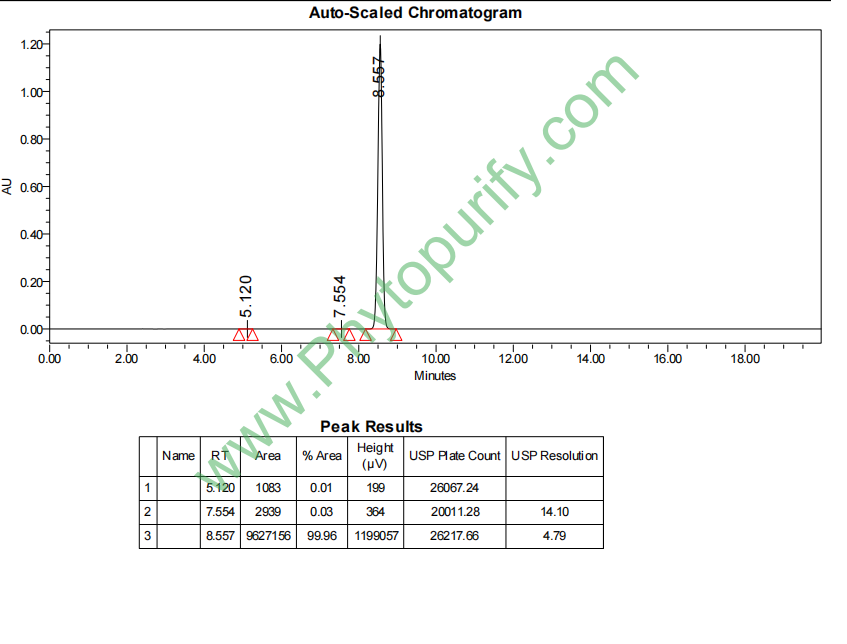
Purity: 95%~99%
Analysis Method: HPLC-DAD or/and HPLC-ELSD
Identification Method: Mass, NMR
Packing: Brown vial or HDPE plastic bottle
Can be supplied from milligrams to grams.
For Reference Standard and R&D, Not for Human Use Directly.
Inquire for bulk scale.
Description:
Demethylzeylasteral exhibits strong inhibition towards UDP-glucuronosyltransferase (UGT) 1A6 and 2B7, and the inhibition kinetic parameters (Ki) are calculated to be 0.6 uM and 17.3 uM for UGT1A6 and UGT2B7, respectively. Demethylzeylasteral has antimicrobial, strong immunosuppressive, and antifertility activities; it concentration-dependently and in a partially reversible manner can inhibit the Ca(2+) current in spermatogenic cells with an IC(50) of 8.8 microg/ml, and it also can inhibit significantly the sperm acrosome reaction initiated by progesterone.
References:
Eur J Drug Metab Pharmacokinet. 2014 Jun;39(2):99-102.
Demethylzeylasteral exhibits dose-dependent inhibitory behaviour towards estradiol glucuronidation.
The disturbance of estradiol level might induce the occurence of some diseases, including cancer. Estradiol is mainly metabolized through the conjugation reactions, including the sulfation and glucuronidation reactions. The present study tried to evaluate the inhibition of estradiol glucuronidation by the major ingredients of Tripterygium wilfordii Hook F. Demethylzeylasteral.
METHODS AND RESULTS:
Selective ion monitoring at negative ion mode ([M⁺ H⁻] = 447) was employed to monitor the two glucuronides of estradiol. The reaction rate was determined through comparison of peak area of these two glucuronides. Lineweaver-Burk plot and Dixon plot were utilized to determine the inhibition kinetic type, and the inhibition kinetic parameters (K i) were calculated using the second plot. Competitive inhibition of Demethylzeylasteral towards the formation of two glucuronides of estradiol was demonstrated, and the K i values were calculated to be 453.3 and 110.9 μM, respectively.
CONCLUSIONS:
All these results will remind us the risk of elevated serum concentrations of estradiol due to the inhibition of estradiol glucuronidation by Demethylzeylasteral.
Eur J Pharmacol. 2003 Mar 7;464(1):9-15.
Effects of demethylzeylasteral and celastrol on spermatogenic cell Ca2+ channels and progesterone-induced sperm acrosome reaction.
The male antifertility effect of a water-chloroform extract of Tripterygium wilfordii Hook. f. (GTW) and several monomers isolated from GTW has attracted worldwide interest.
METHODS AND RESULTS:
In the present study, the effects of two isolated monomers from GTW, Demethylzeylasteral and celastrol, on the Ca(2+) channels in mouse spermatogenic cells and on the sperm acrosome reaction were investigated by whole-cell patch-clamp recording and chlortetracycline staining methods, respectively. The results showed that Demethylzeylasteral concentration-dependently and in a partially reversible manner inhibited the Ca(2+) current in spermatogenic cells with an IC(50) of 8.8 microg/ml. Celastrol decreased the Ca(2+) current in the cells time-dependently and irreversibly. The changes in the activation and inactivation time constants of Ca(2+) currents after application of these two compounds were also examined. Demethylzeylasteral increased both activation and inactivation time constants of Ca(2+) currents, and celastrol had no significant effect on them. The two compounds also inhibited significantly the sperm acrosome reaction initiated by progesterone.
CONCLUSIONS:
These data suggest that inhibition of Ca(2+) currents could be responsible for the antifertility activity of these compounds.
Planta Med. 2005 Apr;71(4):313-9.
Antimicrobial activity of 6-oxophenolic triterpenoids. Mode of action against Bacillus subtilis.
Zeylasteral and Demethylzeylasteral are 6-oxophenolic triterpenoids isolated from the root of Maytenus blepharodes, which have antimicrobial activity against Gram-positive bacteria and the yeast Candida albicans.
METHODS AND RESULTS:
The time-kill curves for zeylasteral and Demethylzeylasteral at concentrations twice their MICs, against Bacillus subtilis showed that the colony forming units were reduced in 3-log10 and > 4-log10 respectively. This reduction was dependent on inoculum size and the growth phase of cells, and was greater when the compounds were incorporated in the exponential phase, indicating a bacteriolytic effect. Treatment with both agents, particularly with zeylasteral (20 microg/mL) caused a reduction of optical density at 550 nm. With regard to the synthesis of DNA, RNA, protein and cell wall, the compounds exhibited the fastest inhibition against cell wall synthesis.
CONCLUSIONS:
Thus, the predisposition to lysis, the morphological changes seen by microscopy, and the complete inhibition in the incorporation the N-acetyl-d-[1 - 14C]glucosamine, suggest that the phenolic compounds compromise the cell wall synthesis and/or cytoplasmic membrane.
HPLC of Demethylzeylasteral
Storage conditions:Short-term storage at 2~8℃, long-term storage at -20 ~ -80℃
111.9000
5.3072
2.7056
.0025
4.9026
3.6988
Low
93.5303
4.8710
No
No
No
No
Yes
No
0.0
Yes
No
No
No
Demethylzeylasteral (CAS number: 107316-88-1) is a triterpenoid active ingredient isolated from the traditional Chinese medicine Tripterygium wilfordii Hook. f. As a classic traditional Chinese medicine herb, Tripterygium wilfordii has attracted much attention due to its significant anti-inflammatory, immune regulating, and anti-tumor activities. As an important active monomer in this plant, demethylated lignin has attracted widespread research interest in the field of natural product pharmacology in recent years. Its multi-target and multifunctional pharmacological properties make it exhibit unique potential in anti-inflammatory, anti-tumor, immunosuppressive, and hormone metabolism regulation, especially in the treatment of complex diseases such as prostate cancer, showing good application prospects.
This article aims to provide a systematic review of the chemical structure and physicochemical properties, plant sources and extraction methods, pharmacological activities, and mechanisms of action of desmopyraldehyde. The focus is on exploring its regulatory role in prostate cancer-related targets, evaluating its clinical translational potential based on drug parameters and pharmacokinetic data, and looking forward to future research directions and application prospects.
Norazone belongs to the triterpenoid class, with a molecular formula of C30H40O6 and a molecular weight of 480.6010. Its structure is based on a typical triterpenoid skeleton, which removes the methyl group from the molecule of zeraldehyde, hence it is named "demethylated" zeraldehyde. This compound has multiple hydroxyl and aldehyde groups, giving it a certain polarity, while its larger hydrophobic triterpenoid skeleton makes it highly lipophilic.
In terms of physical and chemical properties, the LogP value of formaldehyde is 5.3072, indicating its strong lipid solubility, which helps it penetrate cell membranes but may limit its water solubility. Its topological polar surface area (TPSA) is 111.9 Å ², indicating that its molecules have moderate polarity, which is conducive to binding with biomolecules. Very low water solubility (0.0025 mg/mL) suggests possible solubility limitations during oral absorption in vivo. The low permeability of the blood-brain barrier means its distribution in the central nervous system is limited. The negative result of hERG channel inhibition experiment indicates a low risk of cardiac toxicity. The Ames mutagenicity test result is 0.0, indicating a low risk of genotoxicity and high safety.
The structural characteristics make demethylated lignin both lipophilic and polar in drug design, which is beneficial for targeting various protein targets within cells, especially in inflammation and tumor signaling pathways.
The main source of formaldehyde is Tripterygium wilfordii Hook. f., a traditional medicinal plant widely distributed in southern China. Thunder God Vine is rich in triterpenoid compounds, particularly known for its anti-inflammatory and immunomodulatory activities. Norazone, as an important active ingredient in Tripterygium wilfordii, was isolated and identified at the end of the 20th century.
The extraction method usually uses organic solvent extraction combined with chromatographic separation technology. The specific process includes:
In recent years, with the advancement of separation and purification technology, supercritical fluid extraction (SFE) and membrane separation technology have also been attempted to be applied to the extraction of formaldehyde, aiming to improve extraction efficiency and purity, reduce the use of organic solvents, and promote the development of green pharmaceutical processes.
Norazelaic aldehyde exhibits various pharmacological activities, including anti-inflammatory, anti-tumor, immune regulation, and hormone metabolism regulation, as follows:
Norzepril can significantly inhibit the production of inflammatory mediators such as tumor necrosis factor - α (TNF - α), interleukin-6 (IL-6), and nitric oxide (NO). The mechanism involves inhibiting the activation of the nuclear factor kappa B (NF - κ B) signaling pathway, reducing the expression of pro-inflammatory genes, and thus alleviating the inflammatory response. In animal models, formaldehyde has shown good therapeutic effects on inflammatory diseases such as arthritis and inflammatory bowel disease.
Norazone has shown inhibitory effects on cell proliferation and induction of apoptosis in various tumor cell lines, particularly in prostate cancer cells. Its anti-tumor mechanism includes regulating the cell cycle, activating apoptosis related proteins, inhibiting tumor cell migration and invasion. In vivo experiments have shown that formaldehyde can significantly inhibit tumor growth and prolong the survival of tumor model animals.
As a natural immunomodulatory agent, demethylaldehyde can regulate the function of T cells and B cells, inhibit overactive immune responses, and reduce pathological damage in autoimmune diseases. It exerts immunosuppressive effects by regulating the secretion of immune cytokines and signaling pathways, and has been applied in basic research on diseases such as rheumatoid arthritis and systemic lupus erythematosus.
Norzepril can regulate the activity of estrogen metabolism related enzymes, affect the estrogen receptor (ER) signaling pathway, and has potential regulatory effects on hormone related diseases. Its regulation of CYP19A1 (aromatase) and ESR2 (estrogen receptor beta) suggests that it has potential application in hormone dependent tumors such as prostate cancer and breast cancer.
Some studies have reported that formaldehyde has anti fertility effects, which may be achieved by regulating hormone levels and affecting reproductive cell function, suggesting its potential application value in the field of reproductive health. However, the relevant mechanisms still need further clarification.
The multi-target mechanism of action of desmopyraldehyde is the basis for its diverse pharmacological activities. For diseases such as prostate cancer, the relevant targets mainly include:
The synergistic regulation of these targets constitutes the molecular basis for the multidimensional anti-tumor and immune regulation of demethyl zeraldehyde. By regulating cell apoptosis, proliferation, inflammatory response, and hormone metabolism, desmopyraldehyde exhibits broad-spectrum therapeutic potential.
The pharmacological parameters of demethylated xylenol provide important references for its clinical development:
In terms of pharmacokinetics, existing studies have shown that the absorption of demethylated chlorfenapyr is slow after oral administration, and its bioavailability is limited. It is mainly metabolized by the liver and has a moderate half-life. Its metabolic pathway involves oxidation and reduction reactions, and the activity of metabolites still needs further research. In the future, it is necessary to optimize the administration route and formulation design to improve its in vivo stability and targeting.
Due to its multi-target and multifunctional pharmacological properties, demethylated lignan has demonstrated broad clinical application potential. Especially in the treatment of hormone dependent tumors such as prostate cancer, desmopyraldehyde is expected to become a novel adjuvant therapy drug by regulating key targets such as AR, ESR2, and CYP19A1. In addition, its anti-inflammatory and immunomodulatory effects make it potentially applicable in autoimmune and inflammatory diseases.
Future research should focus on:
In summary, as a multifunctional natural product, demethylaldehyde has the potential to become a candidate molecule for novel drugs and deserves more resources and attention in the field of drug development.
As an important triterpenoid active ingredient in Tripterygium wilfordii, demethylated lignin exhibits multiple biological functions such as anti-inflammatory, anti-tumor, immune regulation, and hormone metabolism regulation due to its unique chemical structure and multi-target pharmacological activity. Its mechanism of action in diseases such as prostate cancer involves multiple key signaling pathways, providing a theoretical and practical basis for the development of new natural medicines. Despite challenges such as low water solubility and limited bioavailability in drug development, the optimization of modern drug design and formulation technology has the potential to become a powerful supplement to the clinical treatment field for demethylated xylaldehyde.
In the future, by combining interdisciplinary research, we will delve into the pharmacological mechanism of demethylated lignan, optimize its pharmacokinetic properties, and conduct systematic clinical evaluations, laying a solid foundation for its clinical translation and promoting the development and innovation of natural product pharmacology.
