


Synonym name: Crategolic acid; Crataegolic acid
Catalogue No.: BP0926
Cas No.: 4373-41-5
Formula: C30H48O4
Mol Weight: 472.71
Botanical Source: From many spp. including Crataegus oxycantha and Chamaenerion angustifolium
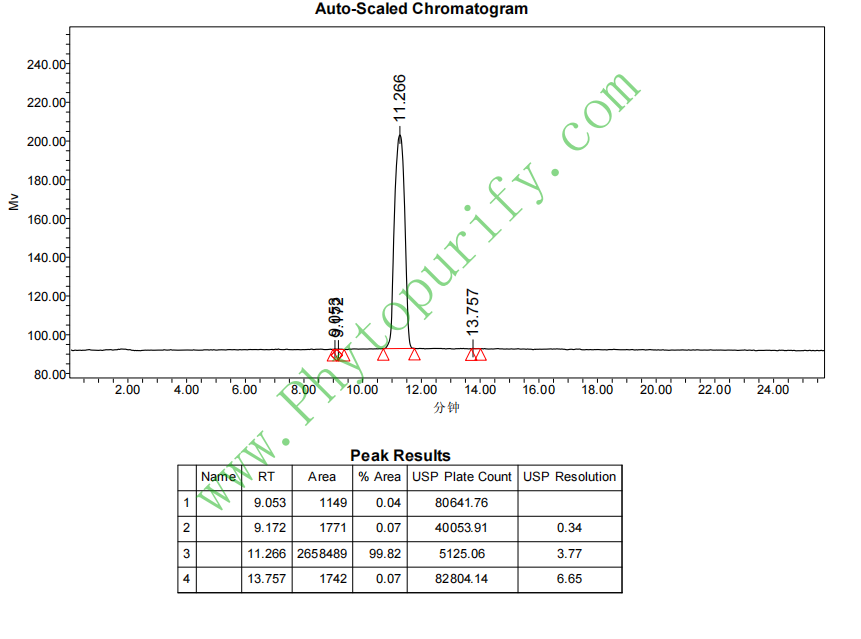
Purity: 95%~99%
Analysis Method: HPLC-DAD or/and HPLC-ELSD
Identification Method: Mass, NMR
Packing: Brown vial or HDPE plastic bottle
Can be supplied from milligrams to grams,customized for large scale(Upto Kgs scale, for 90%, 95% upto Ton).
References:
1, Maslinic acid from olives shows anti-cancer properties
THE MEDICAL NEWS Feb 14 2008
2, Maslinic acid, a natural triterpene from Olea europaea L., induces apoptosis in HT29 human colon-cancer cells via the mitochondrial apoptotic pathway.
Cancer Lett. 2009 Jan 8;273(1):44-54. Epub 2008 Sep 14.
HPLC of Maslinic acid
Storage conditions:Short-term storage at 2~8℃, long-term storage at -20 ~ -80℃
77.7600
5.8179
4.0615
.0035
2.8307
3.6911
Low
92.1174
4.7850
No
No
No
No
No
No
0.0
No
No
Yes
No
Natural products, as an important source of drug discovery, play an irreplaceable role in the long history of human fight against diseases. Among the diverse natural products, pentacyclic triterpenoids have attracted much attention due to their extensive biological activities. Maslinic acid (MA), also known as 2 α, 3 β - dihydroxyoleanan-12-en-28-oic acid, is a naturally occurring pentacyclic triterpenoid acid belonging to the oleanane type triterpenoid compounds. Its CAS number is 4373-41-5. Hawthorn acid originated from olive oil(Olea europaea)And Canary Sage(Salvia canariensis)It was separated and subsequently discovered in various plants, especially in the fruit, leaves, and pomace of olives, where it is abundant.
For a long time, hawthorn acid, as a minor component in olive oil, has lagged behind major phenolic compounds such as oleuropein and hydroxytyrosol in terms of its biological activity research. However, in the past two decades, with the advancement of separation and purification technology and the improvement of pharmacological evaluation systems, the rich pharmacological activities contained in hawthorn acid have gradually been revealed. Research has shown that hawthorn acid has significant pharmacological effects such as anti-inflammatory, antioxidant, anti-tumor, hypoglycemic, lipid-lowering, antimicrobial, and neuroprotective effects. Its mechanism of action involves regulating multiple key signaling pathways, particularly by inhibiting the activation of nuclear factor kappa B (NF - κ B), which in turn affects the expression of downstream inflammatory factors and apoptosis related proteins. In addition, the improving effect of hawthorn acid on metabolic diseases, especially hyperlipidemia, makes it a potential candidate molecule for developing new lipid-lowering drugs or functional food additives. This article will systematically review the research progress of hawthorn acid from the aspects of chemical structure, plant origin, pharmacological activity, mechanism of action, medicinal properties, and clinical application prospects, in order to provide reference for the in-depth research and development of this natural product.
The chemical structure of hawthorn acid is the basis for its diverse biological activities. Its molecular formula is C ∝₀ H ₄₈ O ₄, and its molecular weight is 472.71 g/mol. Structurally, hawthorn acid belongs to the pentacyclic triterpenoid class, with its core skeleton being olean-12-ene. Compared with the parent compound oleanolic acid, hawthorn acid has an additional hydroxyl group at positions C-2 and C-3, specifically in the 2 α, 3 β - dihydroxy configuration, and a carboxyl group at position C-28. This specific three-dimensional configuration and functional group combination endow hawthorn acid with unique physicochemical properties and biological activity.
In terms of physical and chemical properties, hawthorn acid is a white or off white crystalline powder. It has strong lipid solubility, with a calculated lipid water partition coefficient (LogP) of approximately 5.82, indicating its high lipophilicity, which is beneficial for its penetration into biological membranes, but may also lead to poor water solubility. The water solubility of hawthorn acid is extremely low, about 0.0035 mg/mL, which to some extent limits its oral bioavailability and the choice of administration route. Its topological polar surface area (TPSA) is 77.76 Å ², indicating that it has a certain polarity, but not enough to easily penetrate the blood-brain barrier (BBB), and its BBB permeability is predicted to be low. In terms of stability, hawthorn acid is relatively stable under conventional conditions, but it may degrade in strong acid, strong alkali, or high temperature environments. In addition, key indicators in the evaluation of drug properties showed that hawthorn acid has a low risk of inhibiting hERG potassium channels (hERG inhibition: no), and the result in Ames test was negative (0.0), indicating that it does not have significant genetic toxicity, which provides an important safety basis for it as a candidate drug.
Hawthorn acid is widely distributed in nature, mainly found in plants such as Oleaceae and Lamiaceae. Among them, olive oil(Olea europaea)It is its most abundant and economical source. The content of hawthorn acid varies significantly in different parts of olive trees. Olive fruit (especially the skin and flesh) has a high content, and olive leaves and pomace also contain a considerable amount of hawthorn acid. In addition, in Canary Sage(Salvia canariensis)Purple Wisteria(Lagerstroemia speciosa)Hawthorn(Crataegus pinnatifida)Hawthorn acid can also be detected in various medicinal plants. Due to the large amount of by-products generated by the olive oil industry, such as olive pomace and olive leaves, these by-products become ideal raw materials for extracting triterpenoids such as hawthorn acid, in line with the concepts of green chemistry and circular economy.
The extraction method of hawthorn acid is mainly based on its physical and chemical properties, usually using organic solvent extraction method. Common solvents include ethanol, methanol, or their aqueous solutions. In order to improve extraction efficiency and selectivity, researchers have developed various modern extraction techniques. For example, ultrasound assisted extraction (UAE) utilizes the cavitation effect of ultrasound to destroy plant cell walls, accelerate solvent permeation and solute diffusion, thereby achieving higher extraction rates in a shorter period of time. Microwave assisted extraction (MAE) utilizes the body heating effect of microwaves to rapidly increase the internal temperature of plants, promoting the dissolution of target compounds. Supercritical fluid extraction (SFE), especially using carbon dioxide as a solvent, is used to extract thermosensitive components due to its non-toxic, residue free, and low operating temperature advantages, but the cost is relatively high. After obtaining the crude extract, separation and purification are required. Common methods include silica gel column chromatography, macroporous adsorption resin column chromatography, preparative high-performance liquid chromatography (Prep HPLC), and high-speed countercurrent chromatography (HSCCC). By optimizing the elution conditions and chromatographic parameters, high-purity hawthorn acid monomers can be obtained.
Hawthorn acid exhibits extensive and significant pharmacological activities, covering multiple aspects such as anti-inflammatory, antioxidant, anti-tumor, metabolic regulation, and neuroprotection.
1. Anti inflammatory activity
Inflammation is the common pathological basis of many diseases, such as cardiovascular diseases, diabetes, cancer and neurodegenerative diseases. Hawthorn acid has been proven to be an effective anti-inflammatory agent. In a macrophage model stimulated by lipopolysaccharide (LPS), hawthorn acid can significantly inhibit the production of pro-inflammatory cytokines such as tumor necrosis factor - α (TNF - α), interleukin-6 (IL-6), and interleukin-1 β (IL-1 β). The core mechanism of its anti-inflammatory effect is to inhibit the activation of the NF - κ B signaling pathway. Specifically, hawthorn acid can inhibit the phosphorylation and degradation of I κ B - α, thereby preventing the nuclear translocation of NF - κ B p65 subunit and its binding activity with DNA, ultimately downregulating the expression of various inflammation related genes. In addition, hawthorn acid can inhibit the expression of cyclooxygenase-2 (COX-2) and inducible nitric oxide synthase (iNOS), reduce the production of prostaglandin E ₂ (PGE ₂) and nitric oxide (NO).
2. Antioxidant activity
Oxidative stress is an important factor leading to cell damage and aging. Hawthorn acid exhibits direct free radical scavenging ability and indirect antioxidant enzyme regulatory activity. In vitro experiments have shown that hawthorn acid can effectively scavenge 1,1-diphenyl-2-trinitrophenylhydrazine (DPPH) free radicals, 2,2 '- diazo-bis-3-ethylbenzothiazoline-6-sulfonic acid (ABTS) cationic free radicals, and hydroxyl free radicals. More importantly, hawthorn acid can activate the nuclear factor E2 related factor 2 (Nrf2)/antioxidant response element (ARE) signaling pathway. Nrf2 is a key transcription factor that regulates the intracellular antioxidant defense system. Hawthorn acid promotes the dissociation and translocation of Nrf2 from Keap1 protein into the nucleus, thereby initiating the transcription of downstream antioxidant enzyme genes such as heme oxygenase-1 (HO-1), quinone oxidoreductase 1 (NQO1), superoxide dismutase (SOD), and glutathione peroxidase (GPx), thereby enhancing the overall antioxidant capacity of the cell.
3. Antitumor activity
Numerous studies have confirmed that hawthorn acid has inhibitory effects on proliferation, induces apoptosis, and suppresses metastasis in various cancer cell lines. The types of cancer involved include liver cancer, colorectal cancer, breast cancer, lung cancer, prostate cancer and melanoma. Its anti-tumor mechanism is multifaceted: firstly, hawthorn acid can induce cell apoptosis through the mitochondrial pathway (endogenous pathway), manifested as a decrease in mitochondrial membrane potential, release of cytochrome c, and cascade activation of caspase-9 and caspase-3. Secondly, it can also act through the death receptor pathway (exogenous pathway), upregulating the expression of Fas and FasL. In addition, hawthorn acid can inhibit the PI3K/Akt/mTOR signaling pathway, block cell proliferation, and promote autophagic cell death. In terms of anti metastasis, hawthorn acid can inhibit the activity of matrix metalloproteinases (MMPs), thereby reducing the invasion and migration ability of cancer cells. It is worth noting that hawthorn acid has relatively low toxicity to normal cells and exhibits certain selective anti-tumor potential.
4. Hypoglycemic and lipid-lowering activity
Hawthorn acid shows great potential in the treatment of metabolic diseases, especially type 2 diabetes and hyperlipidemia. In the animal model of diabetes, hawthorn acid can significantly reduce the fasting blood glucose level, improve insulin resistance, and protect the function of islet β cells. Its hypoglycemic mechanism may involve activating the AMP activated protein kinase (AMPK) signaling pathway, promoting the translocation of glucose transporter 4 (GLUT4), and increasing peripheral tissue uptake and utilization of glucose. In terms of lowering blood lipids, hawthorn acid can significantly reduce serum total cholesterol (TC), triglycerides (TG), and low-density lipoprotein cholesterol (LDL-C) levels, while increasing high-density lipoprotein cholesterol (HDL-C) levels. Its target is related to multiple key lipid metabolism regulatory factors, such as inhibiting the activity of 3-hydroxy-3-methylglutaryl-CoA reductase (HMGCR), the rate limiting enzyme for cholesterol synthesis, upregulating the expression of low-density lipoprotein receptor (LDLR) to promote LDL-C clearance, and promoting beta oxidation of fatty acids by activating peroxisome proliferator activated receptor alpha (PPAR alpha). In addition, hawthorn acid may also improve the lipoprotein profile by inhibiting the activity of cholesterol ester transfer protein (CETP).
5. Other activities
In addition to the main activities mentioned above, hawthorn acid has also been reported to have neuroprotective effects, which can alleviate the neurotoxicity induced by β - amyloid protein (A β) and improve cognitive function in Alzheimer's disease model animals; Has antimicrobial activity and has inhibitory effects on certain bacteria and fungi; And it also has liver protection, kidney protection, and anti osteoporosis effects.
The pharmacological activity of hawthorn acid is the result of its interaction with multiple molecular targets. Its mechanism of action exhibits the characteristics of multi-target and multi pathway.
1. Regulation of core signaling pathways
- Inhibition of NF - κ B pathway This is one of the core mechanisms of hawthorn acid's anti-inflammatory and anti-tumor effects. Hawthorn acid inhibits the activity of I κ B kinase (IKK) directly or indirectly, preventing the phosphorylation and ubiquitination degradation of I κ B - α, causing NF - κ B dimer (p50/p65) to remain in the cytoplasm and unable to enter the nucleus to initiate the transcription of downstream pro-inflammatory and anti apoptotic genes (such as TNF - α, IL-6, COX-2, Bcl-2, Cyclin D1, etc.).
- Nrf2/ARE pathway activation This is the main mechanism by which hawthorn acid exerts antioxidant effects. Hawthorn acid may modify cysteine residues on Keap1 protein, disrupt the stability of Keap1-Nrf2 complex, promote nuclear translocation of Nrf2, and activate the expression of a series of antioxidant enzymes and phase II detoxifying enzymes.
- AMPK pathway activation AMPK is a key sensor for cellular energy metabolism. Hawthorn acid can inhibit the downstream mTOR signaling pathway by activating AMPK, thereby inducing autophagy and inhibiting protein synthesis, which plays an important role in anti-tumor and metabolic regulation. Meanwhile, AMPK activation can also promote GLUT4 translocation and increase glucose uptake.
- Inhibition of PI3K/Akt/mTOR pathway This pathway plays a central role in cell proliferation, survival, and metabolism. Hawthorn acid can inhibit the phosphorylation of PI3K and Akt, thereby inhibiting their downstream effector molecule mTOR, inducing cancer cell apoptosis and autophagy.
2. Key molecular targets
- Blood lipid lowering targets As mentioned earlier, hawthorn acid regulates lipid metabolism through multi-target synergistic effects. It can directly inhibit the activity of HMGCR and reduce endogenous cholesterol synthesis; Upregulation of LDLR expression accelerates the clearance of plasma LDL-C; Activate PPAR α to promote fatty acid oxidation; And it may improve the function of HDL-C by inhibiting CETP. In addition, the expression of apolipoprotein B (APOB) and apolipoprotein E (APOE) may also be affected, thereby altering the assembly and metabolism of lipoproteins. The regulation of proprotein convertase subtilisin 9 (PCSK9) is also one of the potential lipid-lowering mechanisms.
- Apoptosis related proteins Hawthorn acid regulates the balance of Bcl-2 family proteins (downregulating anti apoptotic proteins Bcl-2 and Bcl xL, upregulating pro apoptotic proteins Bax and Bad), as well as activating caspase family proteases, to perform mitochondrial pathway cell apoptosis.
- Cell cycle regulatory protein Hawthorn acid can inhibit cancer cell proliferation by upregulating cell cycle inhibitory proteins such as p21 and p27, downregulating Cyclin D1 and CDK4, and blocking the cell cycle in G0/G1 or G2/M phases.
Although hawthorn acid has various remarkable pharmacological activities, its medicinal properties face some challenges, mainly focused on pharmacokinetic (ADME) characteristics.
1. Absorption and bioavailability
The water solubility of hawthorn acid is extremely poor (0.0035 mg/mL), which severely limits its dissolution and absorption in the gastrointestinal tract. Although its high lipophilicity (LogP 5.82) is beneficial for transmembrane transport, its high lipophilicity can also lead to its retention in intestinal epithelial cells and lymphatic system transport, rather than directly entering the portal vein. Therefore, after oral administration, the absolute bioavailability of hawthorn acid is usually very low. Animal experiments have shown that after oral administration of hawthorn acid, its peak blood concentration (Cmax) and area under the drug time curve (AUC) are both lower. In order to improve its bioavailability, researchers have attempted various strategies, such as preparing new drug delivery systems such as phospholipid complexes, cyclodextrin inclusion complexes, solid dispersions, nanoemulsions, or liposomes, which have to some extent improved its solubility and oral absorption.
2. Distribution, metabolism, and excretion
Due to its strong lipophilicity, hawthorn acid may be widely distributed in various tissues in the body, especially in the liver and adipose tissue, after oral absorption. Its plasma protein binding rate may be high. There is currently insufficient research on the metabolism of hawthorn acid. Preliminary studies have shown that hawthorn acid mainly undergoes phase I and phase II metabolic reactions in the liver. Phase I metabolism may involve hydroxylation, oxidation, and other reactions catalyzed by the cytochrome P450 enzyme system (CYP450); Phase II metabolism mainly combines with glucuronic acid or sulfuric acid to form more water-soluble metabolites, which are easy to excrete from urine or bile. Hawthorn acid and its metabolites are mainly excreted from the body through feces and urine. Its half-life (t ₁/₂) may vary depending on the species and mode of administration, but is usually shorter.
3. Safety evaluation
The key to evaluating drug properties is safety. As mentioned earlier, both hERG inhibition test and Ames test were negative, indicating that hawthorn acid has a low risk of cardiac toxicity and genetic toxicity. In animal acute toxicity experiments, the oral LD50 of hawthorn acid is relatively high, demonstrating good safety. Long term toxicity studies have also shown that within a certain dose range, hawthorn acid does not cause significant liver or kidney toxicity or other serious adverse reactions. However, its long-term safety still needs to be validated through more systematic preclinical and clinical studies.
Based on the rich pharmacological activity and preliminary safety data of hawthorn acid, its application prospects in multiple therapeutic fields are broad.
1. Metabolic diseases field
Hawthorn acid has dual effects in reducing blood sugar and blood lipid, making it an ideal candidate for the treatment of type 2 diabetes with hyperlipidemia. Its multi-target mechanism of action (inhibition of HMGCR, activation of PPAR α and AMPK, upregulation of LDLR, etc.) may have better comprehensive efficacy and lower risk of side effects compared to single target drugs currently used in clinical practice. The development of hawthorn acid or its derivatives as oral hypoglycemic and lipid-lowering drugs, or as functional food ingredients for the prevention and adjuvant treatment of metabolic syndrome, has enormous market potential.
2. In the field of inflammation related diseases
Given its strong anti-inflammatory activity, hawthorn acid is expected to be used for the treatment of chronic inflammatory diseases such as rheumatoid arthritis, inflammatory bowel disease (IBD), chronic bronchitis, etc. Inhibiting the NF - κ B pathway and reducing inflammatory responses through local or systemic administration may provide new options for the treatment of these diseases.
3. In the field of adjuvant therapy for tumors
Hawthorn acid has selective killing effects on various cancer cells and can enhance the sensitivity of chemotherapy drugs. Therefore, it is expected to be used as an adjuvant therapy for tumors, in combination with conventional chemotherapy or radiotherapy, to improve efficacy and reduce toxic side effects. Its characteristics of inducing apoptosis and inhibiting metastasis are also of great significance for preventing tumor recurrence and metastasis.
4. In the field of neurodegenerative diseases
The antioxidant and anti-inflammatory properties of hawthorn acid, as well as its low blood-brain barrier permeability (although low, there is still a small possibility of permeability), make it potential for the prevention and treatment of neurodegenerative diseases such as Alzheimer's disease and Parkinson's disease. Although low BBB permeability is a challenge, strategies such as nano drug delivery systems have the potential to increase its concentration in the brain.
Challenges and Future Directions Faced:
Despite the bright prospects, the clinical translation of hawthorn acid still faces many challenges. The primary issue is its extremely low oral bioavailability. The future research focus should be on developing efficient and safe drug delivery systems, such as targeted delivery systems based on nanotechnology, to significantly improve their bioavailability and targeting. Secondly, it is necessary to conduct in-depth research on its metabolic pathways and metabolites to clarify its active forms in vivo. Thirdly, although the Ames test and hERG test results are good, a more comprehensive toxicological evaluation is still needed, including reproductive toxicity, immunotoxicity, etc. Finally, high-quality clinical studies are needed to validate its effectiveness and safety in humans, and determine the optimal dosage and regimen for administration. In addition, modifying the structure of hawthorn acid and developing derivatives with higher activity and better pharmacokinetic properties is also an important research direction.
Hawthorn acid, as a natural pentacyclic triterpenoid compound with abundant sources and diverse activities, has been extensively studied for its pharmacological effects in anti-inflammatory, antioxidant, anti-tumor, and metabolic regulation. Its mechanism of action involves multiple key signaling pathways such as NF - κ B, Nrf2, AMPK, etc., exhibiting a multi-target and multi pathway regulatory characteristic. Although there are significant shortcomings in drug efficacy, especially in oral bioavailability, this does not conceal its enormous potential as a lead compound or candidate drug. With the development of modern pharmaceutical technologies such as nano drug delivery systems and a deeper understanding of their pharmacological mechanisms, hawthorn acid and its derivatives are expected to play an important role in the prevention and treatment of metabolic diseases, inflammatory diseases, and tumors. Future research should focus on overcoming its pharmacokinetic bottlenecks and promoting its transition from laboratory research to clinical applications, ultimately contributing to human health.
