
| Catalog No | Package | Original Price | Price | Inventory | Quantity | Operating |
|---|---|---|---|---|---|---|
| BP1426-20mg | 20mg | $30.00 | Sign in |
|


Product name: Ursolic acid
Synonym name: Micromerol; Formosolic acid; Forucosolic acid; Bungeolic acid; Prunol; Urson; Malol; Masterin
Catalogue No.: BP1426
Cas No.: 77-52-1
Formula: C30H48O3
Mol Weight: 456.711
Botanical Source: Eriobotrya japonica (Thunb.) Lindl.
Physical Description:
Type of Compound: Triterpenoids
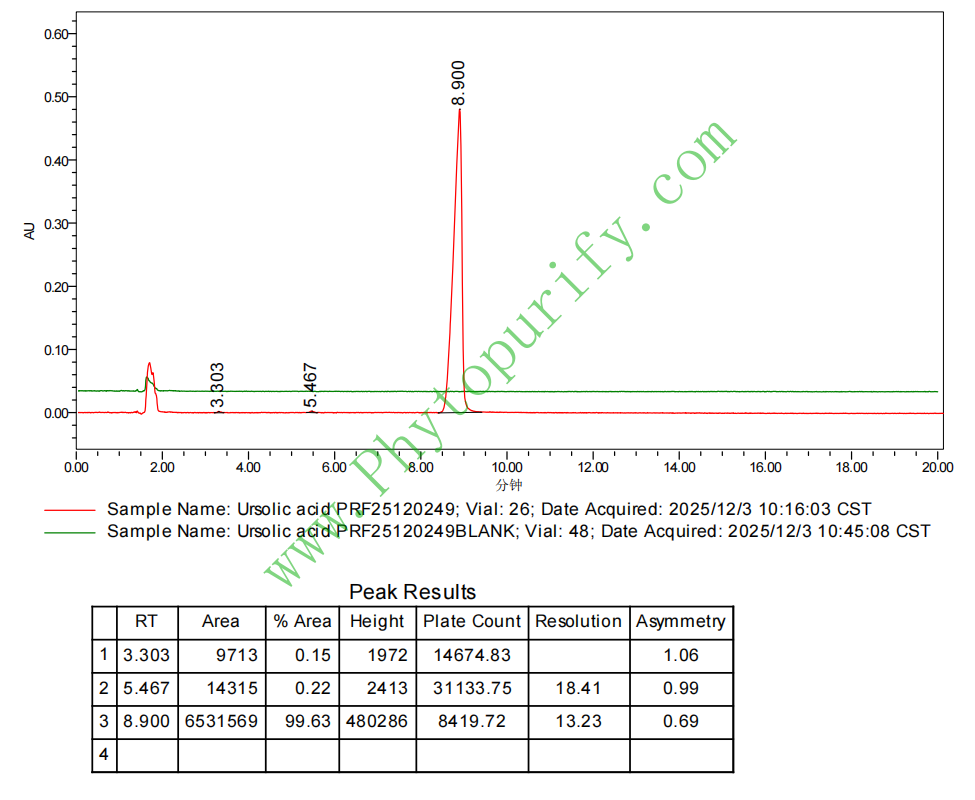
Purity: 95%~99%
Analysis Method: HPLC-DAD or/and HPLC-ELSD
Identification Method: Mass, NMR
Packing: Brown vial or HDPE plastic bottle
Storage: Store in a well closed container, protected from air and light. Put into refrigerate or freeze for long term storage.
Whenever possible, you should prepare and use solutions on the same day. However, if you need to make up stock solutions in advance, we recommend that you store the solution as aliquots in tightly sealed vials at -20℃. Generally, these will be useable for up to two weeks.
The product could be supplied from milligrams to grams
Inquire for bulk scale.
Chengdu Biopurify Phytochemicals Ltd. is a leading company in the research, development, manufacture and marketing of High Quality Phytochemicals and Extracts(especially Active Ingredients from Traditional Chinese Medicine,TCM), Natural Active Pharmaceutical Ingredients worldwide.
The main services:
A. Supply active ingredients and reference standards of TCM, from mgs to kgs scale
B. Custom extraction and purification, target Herb Active Ingredients
C. Custom synthesis and semi-synthesis for Natural Active Ingredients
D. CR(contract research), CM(contract manufacture) and PD(process development) services from lab scale, pilot scale to commercial scale(GMP is also available)
E. TCM compounds library for drug screen,more than 3000 compounds available, many of them are rare and unique.
HPLC of Ursolic acid
Storage conditions:Short-term storage at 2~8℃, long-term storage at -20 ~ -80℃
Ursolic acid (CAS number: 77-52-1) is a natural product of pentacyclic triterpenoids widely found in various plants, and has attracted much attention due to its diverse biological activities. As a β - hydroxy substituted derivative of urs-12-en-28-oic acid, ursolic acid has a typical triterpenoid skeleton in structure, endowing it with unique pharmacological properties. In recent years, ursolic acid has become a hot topic in natural product pharmacology research due to its significant anti-cancer, anti-inflammatory, antioxidant, and metabolic regulatory effects. Especially in the prevention and treatment of digestive system tumors such as colon cancer, ursolic acid has shown great potential, with related molecular targets covering key pathways such as AMPK, BCL2, STAT3, TOP1, MAPK1, TNF, PIK3CA, EGFR, PTGS2, and TP53, revealing its multi-target and multi mechanism pharmacological basis.
This article aims to systematically review the chemical structure and physicochemical properties, plant sources and extraction methods, pharmacological activity and mechanism of action, pharmacological evaluation and pharmacokinetic characteristics of ursolic acid, and explore its potential value and future development trends in clinical applications, providing reference for scientific research and drug development in the field of natural product pharmacology.
Ursolic acid is a pentacyclic triterpenoid carboxylic acid with the chemical formula C30H48O3 and a molecular weight of 456.7110. Its core structure is based on the ursane skeleton, specifically urs-12-en-28-oic acid, with the 3rd carbon atom replaced by a β - hydroxyl group. This structure endows ursolic acid with high hydrophobicity, with a LogP value of up to 6.6298, indicating its strong lipophilicity. It is difficult to dissolve in water (solubility of about 0.0011 mg/mL), but easily soluble in organic solvents such as ethanol and dichloromethane. Its topological polar surface area (TPSA) is 57.53 Å ², indicating moderate molecular polarity that facilitates membrane penetration.
Ursolic acid has a stable structure and presents a typical pentacyclic triterpenoid skeleton, containing one carboxyl group and one hydroxyl group, which provide key sites for its biological activity. Its low blood-brain barrier permeability and lack of hERG channel inhibition suggest a lower risk of neurological side effects. The Ames test result is negative, indicating that ursolic acid has no significant genotoxicity.
Ursolic acid is widely present in the epidermis, leaves, fruits, and roots of various plants, especially from apple peels, rosemary, sage, honeysuckle, and bear fruit leaves. Its content varies depending on the type, location, maturity, and growth environment of the plant. The content of ursolic acid in apple peel is relatively high and easy to obtain, making it an important raw material for industrial extraction.
Traditional extraction methods mainly use organic solvents such as ethanol, methanol, or ethyl acetate for extraction, combined with modern technologies such as ultrasound assisted extraction and microwave-assisted extraction to improve extraction efficiency and purity. The extraction process usually includes plant crushing, solvent soaking, filtration, concentration, and purification (such as silica gel column chromatography, high-performance liquid chromatography separation). In recent years, supercritical CO2 extraction technology has gradually been applied to the extraction of ursolic acid due to its green environmental protection and strong selectivity.
During the extraction and purification process, controlling temperature and pH values is crucial for the stability of ursolic acid, avoiding high-temperature degradation and acid-base hydrolysis. The final obtained ursolic acid is a white to light yellow crystalline powder, with a purity typically exceeding 95%.
The pharmacological activities of ursolic acid cover multiple aspects such as anti-cancer, anti-inflammatory, antioxidant, metabolic regulation, antibacterial, and neuroprotective effects, demonstrating broad clinical application potential.
Ursolic acid has shown significant inhibitory effects in various tumor models, especially in colon cancer cell lines such as HCT116 and SW480. Ursolic acid can induce cell apoptosis, block cell cycle, inhibit tumor cell proliferation and migration. Its mechanism of action involves the regulation of multiple signaling pathways, including activating the AMPK signaling pathway, inhibiting the STAT3 and PI3K/Akt pathways, regulating the expression of BCL2 family proteins, and promoting TP53 mediated cell cycle arrest and apoptosis.
Ursolic acid reduces inflammation by inhibiting the expression of PTGS2 (COX-2) and the release of pro-inflammatory factors such as TNF - α. In addition, its antioxidant capacity is mainly achieved by clearing free radicals and enhancing intracellular antioxidant enzyme activity, which helps to alleviate the pathological process of oxidative stress-related diseases.
Ursolic acid, as a natural metabolic regulator, can activate AMPK, promote lipid metabolism and energy balance, showing potential for anti obesity and improving metabolic syndrome. It inhibits the expression of genes related to fat production in adipose tissue, promotes fat breakdown, and has a protective effect on cardiovascular and liver function.
Ursolic acid also exhibits certain antibacterial, antiviral, and neuroprotective activities, which can alleviate neuroinflammation and promote the survival of nerve cells, demonstrating its potential application value in neurodegenerative diseases.
Ursolic acid achieves its pharmacological effects through multi-target and multi pathway regulation, especially in the prevention and treatment of colon cancer, and its mechanism of action has been widely studied.
AMPK, as a cellular energy sensor, is an important target for ursolic acid to regulate metabolism and inhibit tumor growth. Ursolic acid activates AMPK, promotes cellular energy metabolism balance, inhibits fat synthesis and cell proliferation, induces autophagy and apoptosis.
Ursolic acid regulates the expression of BCL2 and its related proteins, disrupts mitochondrial membrane potential, and promotes cell apoptosis. By reducing the expression of anti apoptotic protein BCL2 and enhancing the activity of pro apoptotic protein BAX, programmed cell death of tumor cells is induced.
Ursolic acid inhibits the phosphorylation and nuclear translocation of STAT3, blocks its transcriptional activity, reduces the expression of tumor promoting genes, and inhibits tumor cell proliferation and invasion.
Ursolic acid has an inhibitory effect on DNA topoisomerase I, hindering DNA replication and transcription processes, leading to tumor cell death.
Ursolic acid regulates the MAPK signaling pathway, affects cell proliferation and differentiation, and inhibits abnormal growth of tumor cells.
By regulating the expression of TNF - α, ursolic acid alleviates the inflammatory microenvironment and inhibits tumor associated inflammatory responses.
Ursolic acid inhibits the PI3K/Akt signaling pathway, blocks cell proliferation and survival signals, and promotes apoptosis.
Ursolic acid interferes with EGFR signaling, inhibiting the growth and migration of tumor cells.
Ursolic acid inhibits COX-2 expression, reduces the production of pro-inflammatory prostaglandins, and exerts anti-inflammatory and anti-tumor effects.
Ursolic acid activates TP53, promotes cell cycle arrest and DNA repair, and induces tumor cell apoptosis.
In summary, ursolic acid exhibits a complex and effective anti-cancer mechanism by synergistically regulating the proliferation, apoptosis, migration, and inflammatory microenvironment of tumor cells through multi-target interactions.
The pharmacological evaluation of ursolic acid shows that it has certain advantages and challenges.
Ursolic acid has a moderate molecular weight (456.7 Da), but its high LogP value (6.63) and extremely low water solubility (0.0011 mg/mL) limit its oral bioavailability. Its lower TPSA (57.53 Å ²) facilitates membrane penetration, but hydrophobicity limits its distribution in vivo.
Ursolic acid has no hERG channel inhibitory effect, indicating a low risk of cardiac toxicity. The Ames test is negative, indicating no significant mutagenicity. Preclinical toxicology studies have shown that it has a wide safety window and good tolerability.
Ursolic acid has poor oral absorption and low bioavailability, mainly due to its hydrophobicity and low solubility. Widely distributed in the body, but with low blood-brain barrier permeability, it limits its application in the central nervous system. Metabolism is mainly through the liver cytochrome P450 enzyme system, and metabolites include hydroxylation and glucuronic acid conjugates. The main excretion pathways are bile and feces.
To overcome the problem of low bioavailability, researchers have developed various drug delivery systems, such as nanoparticles, liposomes, solid dispersions, and complexes, to improve solubility and in vivo stability.
Ursolic acid, as a multifunctional natural product, has shown great potential in the prevention and treatment of colon cancer and other tumors. The multi-target mechanism of action provides a theoretical basis for combination therapy and multi drug targeted therapy. Combining modern drug delivery technology, the bioavailability and targeting of ursolic acid are expected to be significantly improved.
At present, clinical research on ursolic acid is still in its early stages, mainly focusing on safety evaluation and in vitro and animal model validation. In the future, pharmacokinetic studies should be strengthened to clarify the optimal dosing regimen and dosage. At the same time, combining precision medicine strategies with molecular targets, exploring the synergistic effects of ursolic acid with chemotherapy drugs or immunotherapy, and promoting its clinical translation.
In addition, the potential applications of ursolic acid in anti-inflammatory, metabolic diseases, and neuroprotection fields are also worth exploring, providing new ideas for the comprehensive treatment of various chronic diseases.
Ursolic acid, as a typical pentacyclic triterpenoid natural product, has become an important object of natural product pharmacology research due to its unique chemical structure and diverse pharmacological activities. Its multi-target mechanism of action in various diseases such as colon cancer reveals the potential of natural products to regulate diseases in multiple dimensions. Despite the challenges of poor water solubility and low bioavailability, the development of modern drug delivery technology provides new possibilities for its clinical application.
In the future, interdisciplinary research combining systems pharmacology, molecular biology, and medicinal chemistry will further promote the pharmacological mechanism analysis and clinical translation of ursolic acid, and assist in the widespread application of natural products in modern medicine. The study of ursolic acid not only expands the pharmacological perspective of triterpenoid natural products, but also provides valuable natural molecular templates for the development of new anti-cancer and metabolic regulating drugs.
