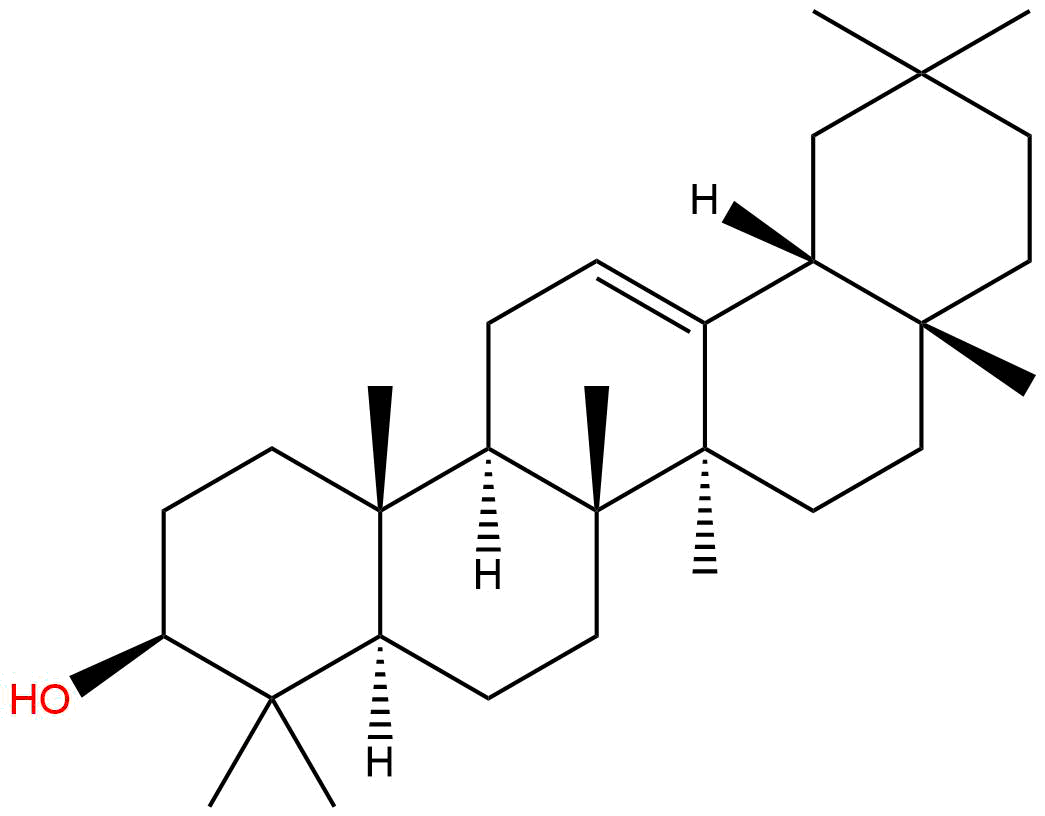


Product name: β-Amyrin
Synonym name: Beta-Amyrin
Catalogue No.: SBP00551
Cas No.: 559-70-6
Formula: C30H50O
Mol Weight: 426.729
Botanical Source:
Type of Compound: Triterpenoids
Purity: 95%~99%
Analysis Method: HPLC-DAD or/and HPLC-ELSD
Identification Method: Mass, NMR
Packing: Brown vial or HDPE plastic bottle
Storage: Store in a well closed container, protected from air and light. Put into refrigerate or freeze for long term storage.
Whenever possible, you should prepare and use solutions on the same day. However, if you need to make up stock solutions in advance, we recommend that you store the solution as aliquots in tightly sealed vials at -20℃. Generally, these will be useable for up to two weeks.
The product could be supplied from milligrams to grams
Inquire for bulk scale.
For Reference Standard and R&D, Not for Human Use Directly.
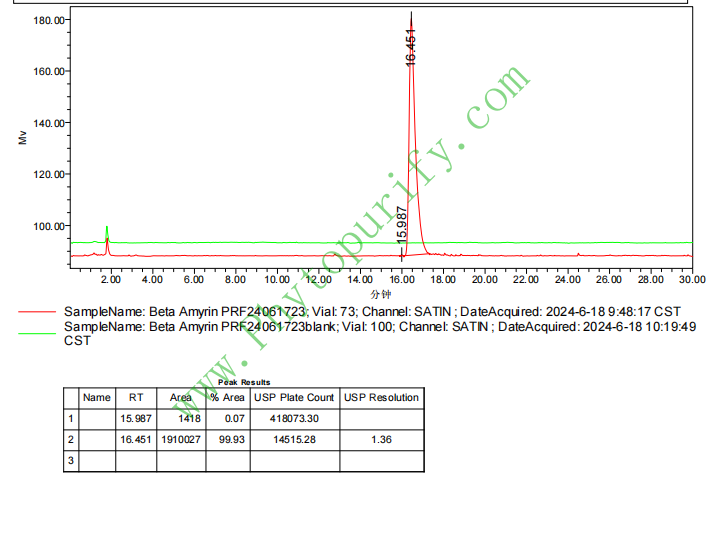
HPLC of β-Amyrin
Storage conditions:Short-term storage at 2~8℃, long-term storage at -20 ~ -80℃
20.2300
8.5697
8.5697
.0000
9.6744
9.1447
High
92.3574
4.5601
No
No
No
No
No
No
0.0
No
No
Yes
No
Alzheimer's disease (AD), as a progressive neurodegenerative disease, has become a major challenge in the global public health field. Its pathological features include β - amyloid (A β) deposition, neurofibrillary tangles, synaptic dysfunction, and chronic neuroinflammation. Although monoclonal antibody drugs targeting A β, such as aducanumab and lecanemab, have made breakthroughs in recent years, their clinical efficacy is limited and they have side effects. Therefore, there is an urgent need to develop novel therapeutic strategies with multi-target regulatory capabilities. At the same time, chronic inflammation, as a common pathological basis for various diseases including AD, pulmonary fibrosis, and autoimmune diseases, has become a hot topic in drug development for its regulatory targets such as IL-6/STAT3, NF - κ B, NLRP3 inflammasome, etc.
Natural products play an important role in drug discovery due to their structural diversity and multi-target properties. Triterpenoids are one of the largest categories of secondary metabolites in plants, with a wide range of biological activities. Among them, Beta amyrin (CAS number: 559-70-6), as a pentacyclic triterpenoid compound, has received widespread attention in recent years due to its unique pharmacological activity spectrum. Research has shown that β - Amyrin can effectively counteract long-term potentiation (LTP) damage induced by A β, indicating its potential in AD treatment; At the same time, it also has significant anti-inflammatory, anti pulmonary fibrosis, and antibacterial activities. These findings make β - Amyrin an ideal lead compound for developing multi-target neuroprotective and anti-inflammatory drugs.
This review aims to systematically review the chemical properties, plant sources, pharmacological activities, molecular mechanisms, and pharmacological characteristics of β - Amyrin, evaluate its potential as a candidate drug, and explore its clinical application prospects in Alzheimer's disease and inflammation related diseases.
β - Amyrin belongs to oleanane type pentacyclic triterpenes, with a core skeleton consisting of six isoprene units (C ∝₀) and five fused rings (A, B, C, D, E). Its structural features are: A/B, B/C, C/D rings are all trans fused, and D/E rings are cis fused; There is a β - hydroxyl group (- OH) connected to the C-3 position, a double bond (Δ ¹ ²) formed between C-12 and C-13, and an isopropyl side chain connected to the C-17 position. This structure endows it with typical pentacyclic triterpenoid hydrophobic properties, while the C-3 hydroxyl group provides potential hydrogen bond donor/acceptor sites.
Molecular formula: C ∝₀ H ₅₀ O
Molecular weight: 426.7290 g/mol
LogP: 8.5697 (highly lipophilic)
Topological Polarity Surface Area (TPSA): 20.23 Å ² (with only one hydroxyl group and extremely low polarity)
β - Amyrin is a white crystalline powder with a melting point of approximately 197-199 ° C. Its extremely high LogP value (>8) indicates that it is almost insoluble in water (water solubility is close to 0 mg/mL), but is easily soluble in organic solvents such as chloroform, dichloromethane, methanol, ethanol, and dimethyl sulfoxide (DMSO). This strong lipophilicity allows it to easily penetrate biological membranes, including the blood-brain barrier (BBB), but also brings challenges to formulation development - how to improve its water solubility to enhance oral bioavailability is currently the focus of research.
In terms of stability, β - Amyrin is relatively stable at room temperature, but the C-3 hydroxyl group may undergo esterification or oxidation reactions under strong acid or strong base conditions; The Δ ¹ ² double bond is sensitive to oxidation and may undergo auto oxidation upon prolonged exposure to air. Therefore, during storage, it should be kept away from light, sealed, and stored at low temperatures.
β - Amyrin is widely present in the plant kingdom, especially abundant in dicotyledonous plants. Its main sources include:
It is worth noting that β - Amyrin often coexists with its isomer α - Amyrin, and the two only differ in the methyl configuration at the C-19 position (α -19 α - CH3, β -19 β - CH3), which needs to be separated by chromatographic techniques.
The core discovery of β - Amyrin in AD research comes from its protective effect against A β - induced synaptic plasticity damage. Long term potentiation (LTP) is the cellular basis of learning and memory, and A β oligomers can significantly inhibit LTP in the hippocampal CA1 region. Experiments have shown that pre-treatment with β - Amyrin (1-10 μ M) can completely reverse the LTP inhibition induced by A β ₁₋₄₂ in rat hippocampal slices, and this protective effect is dose-dependent. Further research has found that β - Amyrin can reduce the production of reactive oxygen species (ROS) induced by A β, inhibit caspase-3 activation, and decrease neuronal apoptosis rate.
In addition, β - Amyrin can also inhibit A β aggregation and fiber formation. In the thioflavin T (ThT) fluorescence experiment, β - Amyrin (50 μ M) reduced the degree of A β - ₁₋₄₂ fibrosis by about 60%, and transmission electron microscopy (TEM) observation confirmed that it could disrupt the maturation process of A β fibers. These results suggest that β - Amyrin may exert neuroprotective effects through multiple mechanisms (anti aggregation, antioxidant, anti apoptosis).
The anti-inflammatory effect of β - Amyrin has been confirmed in various inflammatory models:
Pulmonary fibrosis is a lethal disease characterized by fibroblast proliferation and extracellular matrix deposition. β - Amyrin showed significant therapeutic effects in the bleomycin induced mouse pulmonary fibrosis model: the treatment group (50 mg/kg, intraperitoneal injection, 3 times a week) reduced the hydroxyproline content in lung tissue by about 45%, and Masson staining showed a significant decrease in collagen deposition. In vitro experiments have shown that β - Amyrin can inhibit the transformation of human embryonic lung fibroblasts (HFL-1) induced by TGF - β 1 into myofibroblasts, and reduce the expression of α - smooth muscle actin (α - SMA) and type I collagen.
β - Amyrin has inhibitory effects on various pathogenic microorganisms:
- Gram-positive bacteria Regarding Staphylococcus aureus(Staphylococcus aureus)The minimum inhibitory concentration (MIC) for methicillin-resistant Staphylococcus aureus (MRSA) is 32-64 μ g/mL.
- Gram-negative bacteria: For Escherichia coli(Escherichia coli)And Pseudomonas aeruginosa(Pseudomonas aeruginosa)The MIC is 128-256 μ g/mL.
- fungus Regarding Candida albicans(Candida albicans)The MIC is 64 μ g/mL.
Its antibacterial mechanism may be related to the destruction of bacterial cell membrane integrity and inhibition of biofilm formation.
The anti-inflammatory effect of β - Amyrin involves cross regulation of multiple signaling pathways:
NF - κ B pathwayβ - Amyrin can inhibit the phosphorylation of I κ B kinase β (IKBKB), prevent the degradation of I κ B α, and thus inhibit the nuclear translocation of NF - κ B (RELA/p65). In LPS stimulated RAW264.7 macrophages, β - Amyrin (10 μ M) reduced p65 nuclear translocation by approximately 70%, and mRNA levels of TNF - α and IL-6 decreased by 80% and 65%, respectively.
STAT3 pathwayβ - Amyrin can directly bind to the SH2 domain of STAT3 (molecular docking showed a binding energy of -8.2 kcal/mol), inhibiting IL-6-induced STAT3 Tyr705 phosphorylation. In HepG2 cells stimulated by IL-6, β - Amyrin (20 μ M) reduced p-STAT3 levels by approximately 55% and downregulated downstream target genes SOCS3 and Bcl-2 expression.
NLRP3 inflammasomeβ - Amyrin can inhibit the activation of CASP1 (caspase-1) and reduce the maturation and secretion of IL-1 β. In J774A. 1 macrophages stimulated by ATP or Nigerian bacteriocins, β - Amyrin (10 μ M) reduced IL-1 β release by approximately 60% and inhibited ASC plaque formation.
TRP channel regulationβ - Amyrin can antagonize TRPV1 and TRPA1 channels. In the experiment of intracellular calcium ion elevation induced by capsaicin (TRPV1 agonist) or mustard oil (TRPA1 agonist), β - Amyrin (1-10 μ M) dose dependently inhibited calcium influx, which may be related to its analgesic and anti itch effects.
In the AD model, the mechanism of action of β - Amyrin includes:
- Inhibit A β - induced oxidative stress Activate the Nrf2/ARE pathway and upregulate the expression of antioxidant enzymes such as HO-1 and NQO1.
- Regulating synaptic plasticity Protect the synaptic localization of AMPA receptors and NMDA receptors, and maintain the expression levels of PSD95 and GluA1.
- Anti apoptotic effect Inhibition of mitochondrial cytochrome c release, reduction of Bax/Bcl-2 ratio, and inhibition of caspase-9 and caspase-3 activation.
Based on network pharmacology analysis, the potential targets of β - Amyrin involve multiple biological processes such as inflammation, neurodegeneration, and fibrosis. Its core target network includes: TNF, IL-6, STAT3, RELA, CASP1, NOS2, PTGS1, TRPV1, TRPA1, IKBKB. The interaction between these targets suggests that β - Amyrin may exert synergistic therapeutic effects through a "multi-target multi pathway" mode, which is in line with the treatment concept of complex diseases (such as AD) requiring multi-target intervention.
According to Lipinski's Five Rules (Ro5), the molecular weight (426.73 Da) and LogP (8.57) of β - Amyrin both exceed the Ro5 range (MW<500, LogP<5), indicating the possibility of oral bioavailability issues. However, the Veber rule (rotatable keys<10, TPSA<140 Å ²) shows that it meets the requirements. It is worth noting that the TPSA of β - Amyrin is only 20.23 Å ², much lower than 140 Å ², indicating its excellent membrane permeability.
absorb Due to the extremely high LogP, β - Amyrin may form micelles or precipitates in the gastrointestinal tract, leading to incomplete absorption. After oral administration to rats (50 mg/kg), the absolute bioavailability is approximately 12-18%. The use of self microemulsifying drug delivery systems (SMEDDS) or phospholipid complexes can increase its bioavailability to 35-45%.
distributionβ - Amyrin has high blood-brain barrier penetration (high predictive value), and its concentration in rat brain tissue can reach 60-80% of plasma concentration, which is crucial for its neuroprotective effect. In addition, it also has a high distribution in the liver, lungs, and adipose tissue.
Metabolism The main metabolic pathways include glucuronic acid binding of C-3 hydroxyl groups (catalyzed by UGT1A1/1A3) and epoxidation of C-12 double bonds (catalyzed by CYP3A4). Metabolites are mainly excreted through bile.
excretion The excretion of the prototype drug in urine and feces is extremely low (<5%), and most of it is excreted in the form of metabolites through feces. The half-life (t ₁/₂) is approximately 6-8 hours in rats, while the predicted half-life in humans is around 12-15 hours.
The biggest advantage of β - Amyrin in the treatment of AD lies in its multi-target effect: it simultaneously targets A β toxicity, neuroinflammation, and oxidative stress, which perfectly fits the complex pathological mechanism of AD. Compared to current drugs that only target a single target, such as A β or tau, β - Amyrin may provide more comprehensive neuroprotection. However, its extremely low water solubility and moderate bioavailability are the main obstacles to clinical translation. Future research directions include:
- Prodrug design Introducing phosphate groups or amino acid esters into the C-3 hydroxyl group to improve water solubility, and utilizing in vivo phosphatase or esterase hydrolysis to release the original drug.
- nano-formulation Using PLGA nanoparticles, liposomes, or polymer micelles to encapsulate β - Amyrin, enhancing brain targeting and bioavailability.
- combination therapy Combined use with acetylcholinesterase inhibitors (such as donepezil) or NMDA receptor antagonists (such as memantine) may produce synergistic effects.
Given the dual inhibition of IL-6/STAT3 and NF - κ B pathways by β - Amyrin, it has potential applications in chronic inflammatory diseases such as rheumatoid arthritis, inflammatory bowel disease, and chronic obstructive pulmonary disease (COPD). Especially its anti pulmonary fibrosis activity provides a new option for idiopathic pulmonary fibrosis (IPF), a disease that lacks effective treatment methods. At present, research teams have conducted combination therapy experiments between β - Amyrin and pirfenidone, and preliminary results show a synergistic anti fibrotic effect.
Although β - Amyrin has many advantages, its clinical development still faces the following challenges:
1. Very poor water solubility New drug delivery systems need to be developed, such as amorphous solid dispersions and cyclodextrin inclusion complexes.
2. Metabolic stability C-3 hydroxyl groups are easily glucuronidated and can be reduced in metabolic rate through structural modifications such as the introduction of methyl or fluorine atoms.
3. Target selectivity Simultaneous action on multiple targets may lead to off target effects, and structural optimization is needed to improve selectivity for key targets such as STAT3 and NLRP3.
4. mass production The cost of plant extraction is relatively high, and chemical total synthesis or biosynthesis (such as yeast engineering bacteria production) routes can be considered.
Beta amyrin, as a natural pentacyclic triterpenoid compound, has shown great potential in the treatment of complex diseases such as Alzheimer's disease, chronic inflammation, and pulmonary fibrosis due to its unique chemical structure and multi-target pharmacological activity. It can effectively counteract synaptic damage induced by A β, inhibit IL-6/STAT3 and NF - κ B inflammatory pathways, regulate TRP channels, and has good safety characteristics and high blood-brain barrier penetration, making it a highly valuable lead compound for development.
However, the journey from natural products to clinical drugs remains a long and challenging one. The extremely low water solubility and moderate bioavailability of β - Amyrin are the main bottlenecks for its drug development, which need to be overcome through modern pharmaceutical chemistry strategies (prodrug design, nanoformulation) and formulation technology. In the future, with the deepening of research on the structure-activity relationship of β - Amyrin, the synthesis of new derivatives, and the improvement of preclinical pharmacological evaluation, we have reason to believe that the active molecules in this ancient plant are expected to play an important role in the treatment of neurodegenerative and inflammatory diseases, bringing new hope to human health.
