


Synonym name: Mycoporphyrin
Catalogue No.: BP0752
Cas No.: 548-04-9
Formula: C30H16O8
Mol Weight: 504.45
Botanical Source: the mealy bug Nipaecoccus aurilanatus. Widespread in Hypericum spp. esp. Hypericum perforatum (St John's wort)
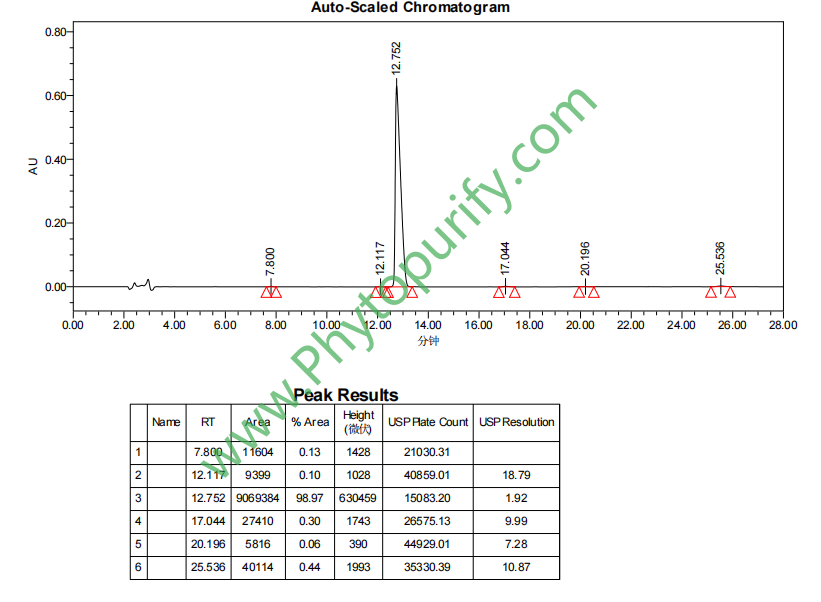
Purity: 95%~99%
Analysis Method: HPLC-DAD
Identification Method: Mass, NMR
Can be supplied from milligrams to grams, up to kilograms.
Inquire for bulk scale.
It can be produced in GMP factory as per customer's requiring.
About Hypericn
Solubility: good soluble in ethanol, methanol, pyridine, aceton, ethyl acetate, butanone, DMSO and aqueous alkali solutions; and insoluble in water and methylene chloride.
Hypericin, a photochemical extracted from St. Johns Wort (Hypericum perforatum) and related species. Hypericin has been shown to have potent, broad spectrum antimicrobial activity. Hypericin is an aromatic polycyclic anthrone, a class of colored or pigmented chemical substances which have photosensitizing activity. In both in vitro (laboratory) and in vivo (animal) studies, low, non-toxic doses of hypericin significantly inhibited the replication of several viruses, including HIV, influenza A, cytomegalovirus (CMV), Herpes simplex 1 and 2 (HSV-1 and HSV-2), and Epstein-Barr virus (EBV). Hypericin and its chemical relative, pseudohypericin, produce antiviral activity through a different mechanism of action than do AZT and other nucleoside antiviral agents. Hypericin does not appear to directly alter the activity of reverse transcriptase although it does block the formation of HIV synctium. Recent findings have shown that the antiretroviral action of this compound disrupts uncoating of the lipid envelope of both DNA and RNA viruses, thus preventing infected cells from releasing HIV copies. Theoretically, hypericin and AZT, in combination, may have synergistic antiviral effects against HIV. On the other hand, hypericin actually may increase the toxicity of antiretroviral nucleosides such as AZT, ddI, or ddC.
Traditionally, extracts of St. Johns Wort (which contain hypericin) have been used as an antidepressant, possibly by acting as a MAO inhibitor. The psychotropic effects attributed to hypericin in St. Johns Wort extract suggest that the pigment compound can cross the blood brain barrier (possibly treating neuropsychological symptoms such as dementia). Laboratory investigations indicate that hypericin may be beneficial as an HIV therapy. However, its administration should be carefully monitored by a physician. The levels of hypericin found in most commercially available extracts of St. Johns Wort generally are not sufficient to be therapeutically effective against viral infections.
Liver function should be tested periodically in persons taking hypericin. Also, extreme photosensitivity has been observed in a few cases of people taking this high doses (in excess of 10 mg per day) of this compound. Finally, there is a very small possibility that adverse reactions could occur on occasion between hypericin and other foods or drugs which interfere with MAO inhibitors.
Dosage
Clinical trials currently being conducted by Dr. Bihari in New York City recommend the following regimen. For the first two weeks, patients take one 10 mg. capsule once a day for two weeks. During the second two weeks, the dosage alternates between one 10 mg. capsule per day on the first day, two 10 mg. capsules on the second day, one 10 mg. capsule on the third day, and so forth. The ultimate dosage is given during the fifth and sixth weeks when patients are given two 10 mg. capsules per day.
Future regimens for optimal dosage are presently being devised by researchers and clinicians involved in pilot trials of hypericin for the treatment of HIV. It has been proposed that beta-carotene, a known free radical quencher, be administered in combination with hypericin. Theoretically, this might reduce any toxic side-effects associated with hypericin’s generation of free radicals. Some investigators, however, have warned that quenchers also may lessen the anti-viral properties of hypericin. The role of beta-carotene and other free-radical scavengers in hypericin therapy deserves further clarification.
HPLC of Hypericin
Storage conditions:Short-term storage at 2~8℃, long-term storage at -20 ~ -80℃
155.5200
4.4086
3.7792
.0000
2.7434
6.1089
Low
91.7842
3.0565
No
No
Yes
No
Yes
Yes
1.2
Yes
Yes
Yes
Yes
Hypericin (CAS number: 548-04-9), as a natural photosensitive compound with a unique condensed anthraquinone structure, has long been highly regarded for its extensive biological activity. It mainly comes from the traditional medicinal plant Hypericum perforatum L., which has been used in folk medicine for hundreds of years to treat depression and wound healing. Since the late 20th century, with the deepening of modern pharmacological research techniques, hypericin has transformed from a traditional herbal ingredient to a star molecule that has been extensively studied in multiple cutting-edge fields such as oncology, virology, and neuropsychopharmacology. Its core pharmacological activities include anti-tumor, antiviral (especially anti HIV), and potential antidepressant effects. Its mechanism of action involves the regulation of multiple key enzymes and signaling pathways, and can induce cell apoptosis. This article aims to systematically review the chemical properties, plant sources, pharmacological activities, multi-target mechanisms of action, pharmacological evaluation, and clinical application prospects of hypericin, in order to provide comprehensive academic references for the in-depth development and transformation research of this natural product.
The chemical structure of hypericin is the basis for its unique biological activity. Its molecular formula is C30H16O8, with a molecular weight of 504.4500 Da. Structurally, hypericin belongs to the class of anthraquinone compounds, specifically derivatives of naphthoquinone. Its core skeleton is composed of seven fused benzene rings, forming a highly planar and rigid conjugated π - electron system. This special structure makes it an efficient photosensitizer that can be excited under appropriate wavelengths of light (usually 590-600 nm) to produce reactive oxygen species (ROS), which is key to its photodynamic therapy anti-tumor and antiviral activity.
From the analysis of physical and chemical properties, hypericin exhibits typical hydrophobic characteristics. Its calculated lipid water partition coefficient (LogP) is 4.4086, indicating strong lipophilicity. The topological polar surface area (TPSA) is 155.5200 Å ², reflecting the presence of multiple polar groups such as hydroxyl and carbonyl groups in the molecule. However, its extremely strong hydrophobic skeleton dominates its dissolution behavior, and literature reports indicate that its water solubility is extremely low, close to 0.0000 mg/mL, which poses the primary challenge for its formulation development. In the solid state, hypericin appears as dark red to dark brown crystals or powder. Its physicochemical properties determine its absorption, distribution, and metabolic characteristics in organisms, and are the core considerations for subsequent drug evaluation.
The main natural source of hypericin is Hypericum perforatum L., commonly known as St. John's wort, a plant in the Primulaceae family. Hypericin is not evenly distributed in various parts of the plant, but mainly enriched in black glandular spots on flowers, flower buds, and leaves. In addition to Forsythia suspensa, it also exists in some other plants of the Primula genus, but the content is usually low.
Efficient extraction of hypericin from plant raw materials is a prerequisite for research and application. Due to its low water solubility and instability to light and heat, the extraction process needs to be carefully designed. Traditional methods include organic solvent extraction, with commonly used solvents including methanol, ethanol, acetone, or their mixed solutions with water. For example, using 70-80% ethanol for reflux or ultrasound assisted extraction can achieve higher extraction rates. In order to obtain higher purity of hypericin, the extract usually needs to undergo a series of purification steps, such as liquid-liquid extraction (commonly using ethyl acetate or chloroform), column chromatography (using silica gel, polyamide, or Sephadex LH-20 fillers), and high performance liquid chromatography (HPLC) preparation. In recent years, some green extraction techniques such as supercritical CO2 extraction and microwave-assisted extraction have also been explored for the extraction of hypericin. These methods are expected to improve efficiency while reducing the use of organic solvents and thermal degradation. Attention must be paid to avoiding light during the extraction process to prevent photodegradation of hypericin.
Hypericin exhibits various pharmacological activities, which constitute its potential for multi-purpose development.
1. Antitumor activity: One of the most notable activities of hypericin is its anti-tumor effect. Its function can be divided into two pathways: light dependent and non light dependent. Under light irradiation (photodynamic therapy, PDT), hypericin acts as a highly efficient photosensitizer, producing a large amount of singlet oxygen and other ROS, leading to damage to tumor cell membranes, dysfunction of organelles, and ultimately causing cell necrosis or apoptosis. A large number of in vitro and in vivo studies have confirmed that it has significant inhibitory and killing effects on a variety of cancer cell lines, such as leukemia, glioma, breast cancer, bladder cancer, etc. Under non light conditions, hypericin can also inhibit tumor cell proliferation and induce apoptosis by suppressing protein kinase C (PKC), telomerase activity, and other mechanisms.
2. Antiviral activity: Hypericin has broad-spectrum antiviral potential, especially significant effects on enveloped viruses. Its antiviral mechanism also involves both light dependent and non light dependent pathways. ROS generated by light activation can directly damage the viral envelope and capsid. Under non light conditions, it can inhibit various enzymes necessary for virus replication, such as reverse transcriptase (RT), integrase (INT), and protease (HIV1-PR). In the field of anti human immunodeficiency virus (HIV), research is particularly in-depth. Hypericin not only inhibits viral enzymes, but also interferes with the binding of the virus to host cells (such as acting on targets such as gp120, CCR5, CXCR4), and promotes apoptosis of infected cells.
3. Antidepressants and Neuropsychiatric Activity: The antidepressant efficacy of extracts from Forsythia suspensa has been supported by multiple clinical studies, and hypericin is considered one of the key active ingredients. The mechanism may involve inhibition of monoamine oxidase (MAO, especially MAO-A) and dopamine - β - hydroxylase, thereby regulating the levels of monoamine neurotransmitters (such as serotonin, norepinephrine, dopamine) in the brain. In addition, its inhibition of PKC may also be involved in regulating neural signal transduction. However, more rigorous clinical research is still needed to confirm the antidepressant effect of hypericin alone and its weight in the overall extract.
4. Other activities: The study also showed that hypericin has potential activities such as antibacterial, anti-inflammatory, and neuroprotective properties, further expanding its application scope.
The multiple pharmacological activities of hypericin stem from its interactions with multiple key molecular targets in cells, forming a complex multi-target action network.
1. Enzyme inhibition:
- Protein kinase C (PKC): Hypericin is an effective inhibitor of PKC, which may interfere with its binding to ATP or substrates by binding to the catalytic domain of the enzyme, thereby affecting downstream signaling pathways related to cell proliferation, differentiation, and apoptosis.
- Monoamine oxidase (MAO): The inhibition of MAO, especially MAO-A, is a classic explanation for its potential antidepressant effect, which can increase the concentration of monoamine neurotransmitters in synaptic cleft.
- Virus related enzymes: Directly inhibit HIV reverse transcriptase (RT), integrase, and protease (HIV1-PR), blocking the virus replication cycle.
- Cytochrome P450 (CYP): Hypericin is an inhibitor of various CYP isoenzymes (such as CYP3A4), which is the main molecular basis for its interactions with many drugs (such as reducing the efficacy of warfarin, cyclosporine, and oral contraceptives), and is also an important safety hazard in clinical applications.
- Telomerase: Inhibiting telomerase activity may help limit the unlimited proliferation potential of cancer cells.
2. Mechanism of photodynamic action:
Under specific wavelength illumination, hypericin absorbs light energy and transitions from the ground state to the excited state, converting ground state oxygen into highly toxic singlet oxygen through energy transfer (type II mechanism), triggering oxidative stress, leading to lipid peroxidation, protein cross-linking, DNA damage, and ultimately cell death. This mechanism is the core of its anti-tumor and antiviral photodynamic therapy.
3. Interference with virus entry process:
Research has shown that hypericin can bind to the envelope glycoprotein gp120 of HIV and may downregulate or interfere with the function of the co receptors CCR5 and CXCR4 on the host cell surface, thereby preventing the initial attachment and fusion of the virus with the cell.
4. Inducing cell apoptosis:
Whether through photodynamic therapy to generate ROS or by inhibiting targets such as PKC, hypericin can ultimately activate the mitochondrial apoptosis pathway and death receptor pathway, leading to the activation of caspase cascade reactions and triggering typical cell apoptosis. In the fight against HIV infection, it can specifically induce apoptosis in HIV infected cells, with minimal impact on uninfected cells and a selective advantage.
Despite its broad pharmacological activity, the pharmacological development of hypericin faces significant challenges, mainly due to its unfavorable physicochemical properties and complex in vivo behavior.
1. Absorption, distribution, metabolism, and excretion (ADME):
- Absorption: The extremely low water solubility results in extremely poor oral bioavailability. In animal experiments, oral absorption is slow and incomplete. Making special formulations (such as nano formulations, phospholipid complexes) is a key strategy to improve their absorption.
- Distribution: Hypericin has a high plasma protein binding rate. Due to its strong lipophilicity, it may be distributed in tissues rich in lipids. It is worth noting that its ability to penetrate the blood-brain barrier (BBB) is evaluated as "low", which is a disadvantageous factor for its central nervous system related effects (such as antidepressant), but may also reduce its potential toxicity to the central nervous system.
- Metabolism: The liver is its main metabolic site, mainly undergoing oxidative metabolism through the CYP450 enzyme system. At the same time, hypericin itself is a strong inhibitor of CYP450, and this "self inhibition" and inhibitory effect on other drugs constitute a complex drug drug interaction risk.
- Excretion: Mainly excreted through bile and feces, with less excretion by the kidneys.
2. Safety evaluation:
- Phototoxicity: This is the most prominent adverse reaction of hypericin. After systemic administration, hypericin in the skin and eyes can cause severe photosensitive reactions under sunlight or strong light, manifested as erythema, edema, itching, and even burns. Strict avoidance of light is necessary during clinical application.
- Drug interactions: As mentioned earlier, its strong inhibitory effect on CYP450 enzymes (especially CYP3A4) and P-glycoprotein can significantly increase the blood drug concentration of combination drugs, leading to toxicity risks or reducing the efficacy of prodrugs.
- Genetic toxicity: The Ames test value provided is 1.2 (usually considered positive if>2), indicating a low risk of mutagenicity under standard testing conditions, but not completely safe. It needs to be comprehensively judged in conjunction with other in vitro and in vivo genetic toxicity tests.
- Cardiac toxicity: The data shows that it has no significant inhibition on hERG potassium channels, indicating a low risk of cardiac toxicity in inducing apical torsion ventricular tachycardia.
3. Challenges and Strategies in Pharmaceutical Science:
To overcome the problems of poor water solubility, low stability, and insufficient targeting, new drug delivery systems have been widely studied, including liposomes, nanoemulsions, polymer nanoparticles, cyclodextrin inclusion complexes, solid dispersions, etc. These technologies aim to enhance their solubility and stability, improve pharmacokinetic behavior, and enable targeted delivery to tumor or infection sites through functional modifications, while reducing systemic exposure and phototoxicity risks.
The clinical application prospects of hypericin are closely related to its active fields and current challenges, and may develop in the following directions in the future:
1. Photodynamic therapy (PDT) for tumors: This is one of the most promising directions. Using its highly effective photosensitive properties, we can develop local PDT drugs for superficial tumors (such as skin cancer, head and neck tumors, bladder cancer). The research focuses on the development of local dosage forms (such as gel and perfusion solution) and the targeted delivery of solid tumors through nanotechnology to treat deeper tumors. Combining it with radiotherapy, chemotherapy, or immune checkpoint inhibitors is also a research hotspot for enhancing efficacy.
2. Antiviral therapy, especially local anti HIV/HPV: Given its ability to directly inactivate the virus and clear infected cells, hypericin PDT can be used for local treatment of HIV related oral leukoplakia, cervical HPV infection, and the resulting precancerous lesions. As a local topical therapy, it can minimize systemic adverse reactions and drug interactions to the greatest extent possible.
3. As a chemopreventive or adjuvant therapy agent: Explore its value in cancer chemoprevention or as a traditional chemosensitizer by utilizing its multi-target properties, such as inhibition of PKC and telomerase.
4. Re evaluation of antidepressant applications: More precise clinical trials are needed to clarify the specific contribution of hypericin in the antidepressant effect of Forsythia suspensa extract. The development of new derivatives or prodrugs that can effectively penetrate the blood-brain barrier and have no phototoxicity is the key to promoting their application in the central nervous system.
Challenges and Future Directions Faced:
- Reduce phototoxicity: Design "smart" photosensitizer prodrugs that are specifically activated only in target tissues (such as tumors), or develop hypericin derivatives that exhibit potent anti-tumor/antiviral activity without the need for light exposure.
- Improving pharmacokinetics and targeting: Continue to deepen research on new nano drug delivery systems to achieve precise delivery and controlled release.
- Elucidate the complex mechanism: Using systems biology and chemical biology methods, comprehensively map the interaction group and signal network of hypericin in cells.
- Strict clinical translational studies: Promote clinical trials of hypericin PDT based on high-quality formulations in specific indications, and establish standardized photoprotection and drug interaction management protocols.
As a natural product with unique structure and diverse mechanisms, hypericin exhibits great charm as an innovative drug lead compound due to its biological activities spanning multiple fields such as anti-tumor, antiviral, and neural regulation. From the traditional medicinal use of Forsythia suspensa, modern science has gradually revealed its complex pharmacological network acting on multiple targets such as PKC, MAO, viral enzymes, and its excellent photodynamic therapy potential. However, its inherent physical and chemical property defects, significant phototoxicity, and complex drug interactions constitute the main barriers to its transformation into safe and effective drugs. The core of future research will focus on optimizing drug properties through advanced medicinal chemistry and pharmaceutical strategies, such as structural modification to reduce toxicity and the development of intelligent targeted delivery systems. With the breakthroughs in these key technologies, hypericin is expected to transform from a promising "versatile" molecule into a unique drug applied in clinical tumor photodynamic therapy, local antiviral therapy, and other fields, contributing its unique value to human health.
