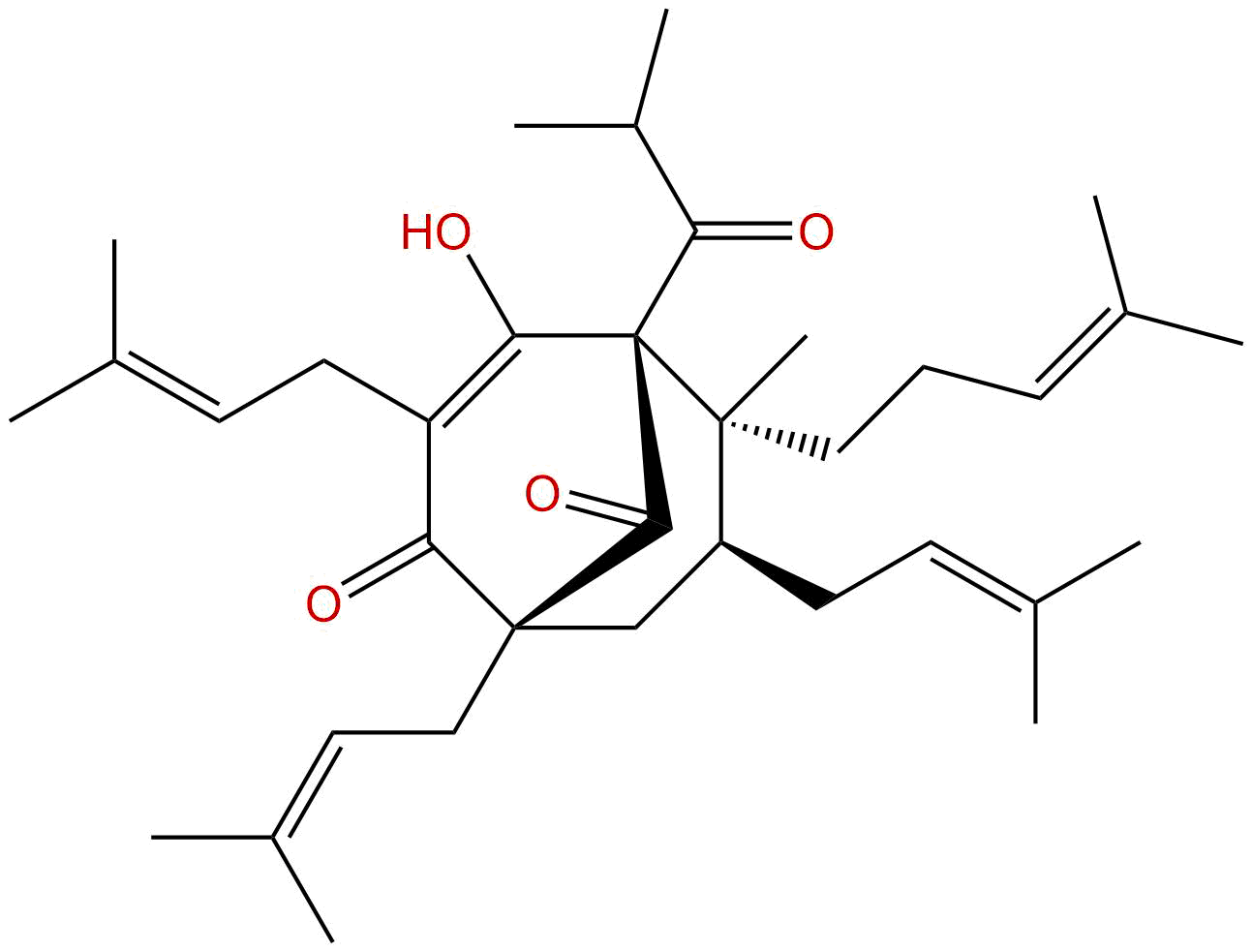


Synonym name:
Catalogue No.: BP0751
Cas No.: 11079-53-1
Formula: C35H52O4
Mol Weight: 536.797
Botanical Source: Hypericum perforatum (St John's Wort)
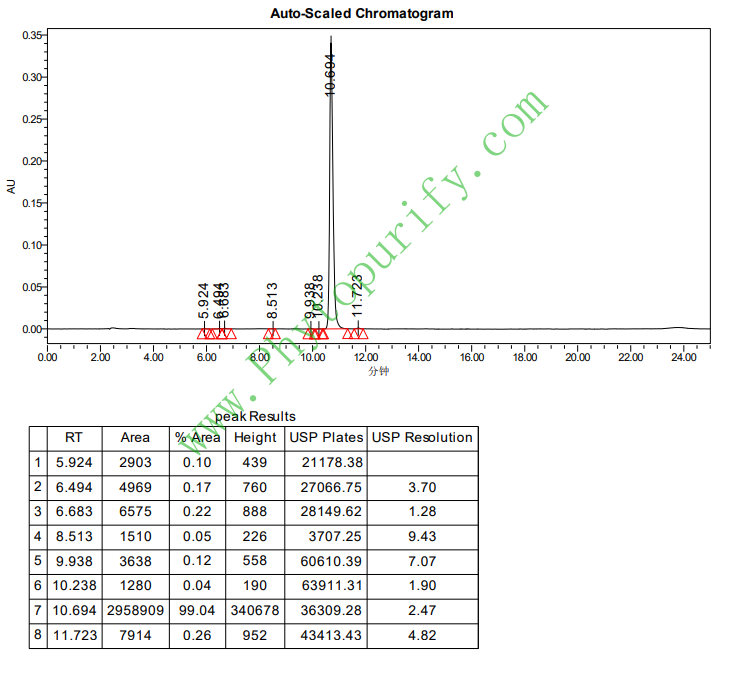
Purity: 95%~99%
Analysis Method: HPLC-DAD or/and HPLC-ELSD
Identification Method: Mass, NMR
Packing: Brown vial or HDPE plastic bottle
Can be supplied from milligrams to grams.
For Reference Standard and R&D, Not for Human Use Directly.
Inquire for bulk scale.
Hyperforin is a polyprenylated acylphloroglucinol derivative from Hypericum perforatum (St. John's wort), it is a member of the Polycyclic polyprenylated acylphloroglucinol family, also known as the PPAP family. Hyperforin is unstable in the presence of light and oxygen. Frequent oxidized forms contain a C3 to C9 hemiketal/heterocyclic bridge or will form furan/pyran derivatives.
Hyperforin exhibits antidepressant activity by a novel mechanism of action, antibiotic activity against gram-positive bacteria, and antitumoral activity in vivo. However, it also produces drug-drug interactions by activation of the pregnan X receptor. No total synthesis has been described. Some natural and semisynthetic analogues are available to study structure-activity relationships. Enzymatically, the skeleton of hyperforin is formed by isobutyrophenone synthase from isobutyryl-CoA and three molecules of malonyl-CoA. The first prenylation step is catalyzed by a soluble and ion-dependent dimethylallyltransferase. Hyperforin mainly accumulates in pistils and fruits where it probably serves as defensive compound.
HPLC of Hyperforin
Storage conditions:Short-term storage at 2~8℃, long-term storage at -20 ~ -80℃
71.4400
7.1272
4.9735
.0007
6.3897
5.1357
High
91.0911
5.6915
Yes
Yes
Yes
No
No
No
0.0
Yes
Yes
Yes
Yes
Hyperforin (CAS number: 11079-53-1) is one of the main lipophilic active ingredients isolated from Hypericum perforatum L., also known as St. John's wort, and belongs to the class of polyisoprenylated phloroglucinol derivatives. Since its structure was elucidated, Hypericin has attracted much attention due to its outstanding and extensive biological activities, and its research has far exceeded its scope as a core component of traditional herbal antidepressants. Initially, its antidepressant effect was attributed to extensive inhibition of reuptake of monoamine neurotransmitters. However, with the deepening of research, especially its discovery as a highly selective activator of transient receptor type 6 (TRPC6) channel, a new molecular perspective has been opened up for understanding its pleiotropic pharmacological effects. In addition to antidepressant, Hypericum perforatum has shown significant potential in anti-tumor, neuroprotection (anti dementia), anti diabetes, anti-inflammatory and anti obesity fields. This article aims to systematically review the chemical properties, plant sources, multidimensional pharmacological activities, mechanisms of action, pharmacological evaluation, and clinical application prospects of Hypericin, in order to provide comprehensive academic references for the in-depth development and transformation research of this natural product.
Hypericin is a structurally complex polyisoprenylated triphenylphenol derivative with a molecular formula of C35H52O4 and a molecular weight of 536.7970. Its core structure is a triphenylene ring (A ring), which is connected to multiple isopentenyl side chains, including a long-chain monocyclic monoterpene structure (B ring), forming a unique "double ring" skeleton. This highly lipophilic structure determines its basic physicochemical properties: its calculated LogP value is as high as 7.1272, indicating its extremely strong lipophilicity; Correspondingly, its water solubility is extremely low, about 0.0007 mg/mL. Its topological polar surface area (TPSA) is 71.44 Å ².
This strong lipophilicity has a profound impact on its biological behavior. On the one hand, it makes it easy to penetrate cell membranes, including the blood-brain barrier (predicted to be highly permeable), which is closely related to the activity of the central nervous system. On the other hand, it also brings challenges to drug development, such as unstable oral absorption and complex metabolism in the body. In addition, Hypericin is relatively sensitive to light, oxygen, and heat, and is prone to oxidation and polymerization reactions in solution, leading to deactivation. This poses special requirements for its extraction, purification, formulation, and storage.
Hypericin is almost exclusively present in the flowers, leaves, and fruits of Hypericum perforatum, and is its characteristic component. In the plant body, its content is influenced by various factors, including variety, place of origin, harvest season (highest content during peak flowering period), and storage conditions.
Due to its lipophilicity and instability, the extraction and purification of Hypericin from Osmanthus fragrans require precise techniques. The traditional method mainly uses organic solvents for extraction:
1. Solvent extraction Common solvents include methanol, ethanol, acetone, or their mixed solvents with dichloromethane and petroleum ether. Supercritical CO2 extraction technology has become an efficient method for obtaining high-purity Hypericin due to its advantages of low temperature, no solvent residue, and good selectivity, especially suitable for large-scale production.
2. Purification and Separation Crude extracts are usually purified through a series of chromatographic techniques, such as silica gel column chromatography, reverse phase high performance liquid chromatography (RP-HPLC), etc. Due to its sensitivity to light, all operations should be carried out in the avoidance of light as much as possible.
3. standardization In standardized extracts of Forsythia suspensa (such as those used in antidepressant formulations), Hypericin and Hypericin are often used as key quality markers. However, the instability of amygdalin in the formulation makes its long-term maintenance a technical challenge, often requiring formulation techniques such as microencapsulation and liposome encapsulation to stabilize it.
Hypericin exhibits remarkable multi-target and multi pathway pharmacological activity, and its effects go far beyond antidepressant.
Antidepressant activity This is its earliest confirmed and most extensively studied core activity. Numerous preclinical and clinical studies have confirmed that the antidepressant efficacy of extracts from Forsythia suspensa is positively correlated with the content of hypericin in the leaves. Unlike traditional selective serotonin reuptake inhibitors (SSRIs), it can simultaneously and non selectively inhibit the presynaptic reuptake of multiple neurotransmitters such as serotonin (5-HT), norepinephrine (NE), dopamine (DA), gamma aminobutyric acid (GABA), and glutamate, thereby rapidly increasing the concentration of neurotransmitters in the synaptic cleft.
Antitumor activity Hypericin inhibits proliferation, induces apoptosis and differentiates many tumor cell lines (such as leukemia, melanoma, breast cancer, lung cancer, prostate cancer, etc.). Its mechanism involves mitochondrial dysfunction, reactive oxygen species (ROS) generation, cell cycle arrest (such as G0/G1 phase), and inhibition of tumor cell invasion and metastasis.
Neuroprotection and anti dementia potential In neurodegenerative disease models such as Alzheimer's disease, Hypericin has shown protective effects. It can reduce the neurotoxicity of beta amyloid protein (A β), inhibit tau protein hyperphosphorylation, and promote neuronal survival and synaptic plasticity by activating the neurotrophic factor signaling pathway.
Anti diabetes and anti obesity activity The latest research has revealed its potential in metabolic diseases. Hypericin can activate the TRPC6-Ca2+signal, thereby triggering the Dlat AMPK signaling axis, promoting heat production in adipose tissue and browning of white fat, increasing energy expenditure, and improving obesity, insulin resistance, and liver steatosis induced by high-fat diet.
Anti inflammatory and immune regulatory activity Hypericin has significant anti-inflammatory effects. For example, in a psoriasis like mouse model, it can regulate the secretion of IL-17 α by gamma delta T cells and alleviate skin inflammation. In addition, it can also inhibit the expression of various pro-inflammatory factors (such as TNF - α, IL-1 β, IL-6), and its effect is related to the inhibition of inflammatory pathways such as NF - κ B.
Antibacterial and antiviral activity It has a strong inhibitory effect on Gram positive bacteria (such as Staphylococcus aureus), and its mechanism may be related to the destruction of bacterial membrane structure. In addition, it also exhibits inhibitory activity against certain enveloped viruses such as influenza virus and hepatitis C virus.
The pleiotropy of Hypericin is due to its interaction with multiple molecular targets, among which the activation of TRPC6 channel is one of its core mechanisms.
Core target: TRPC6 channel activation Hypericin is a highly efficient and selective natural agonist of TRPC6 channel. By activating TRPC6, it induces extracellular Ca2+influx and increases intracellular Ca2+concentration ([Ca2+] i). This event is a common starting point for many downstream signaling pathways:
Inhibition of neurotransmitter reuptake The mechanism of its broad-spectrum inhibition of neurotransmitter reuptake is unique, and it does not directly act on the classical binding sites of transporters such as SLC6A4, which is the 5-HT transporter. Research has shown that it may indirectly affect the function of various monoamine and amino acid neurotransmitter transporters by reducing the Na+gradient within the presynaptic membrane terminals or affecting the pH gradient of vesicles.
Enzyme and receptor regulation:
Nuclear receptors and transcription factors Hypericin is a potent agonist of the pregnane X receptor (PXR), which significantly induces the expression of cytochrome P450 enzymes (especially CYP3A4) in the liver and intestine, which is the main cause of drug interactions. In addition, it can also affect the activity of transcription factors such as NF - κ B and Nrf2, and participate in anti-inflammatory and antioxidant stress.
Despite its broad pharmacological activity, the pharmacological properties of Hypericin are significantly challenged due to its complex pharmacokinetic properties.
Absorption and distribution Due to its extremely high lipophilicity, it is well absorbed after oral administration but varies greatly among individuals, and is significantly influenced by food (a high-fat diet can greatly improve its bioavailability). After absorption, it is widely distributed in various tissues throughout the body. Due to its high lipid solubility and small molecular weight, it can efficiently penetrate the blood-brain barrier and reach effective concentrations in the central nervous system.
Metabolism and excretion Hypericin is rapidly and widely metabolized in the body. It is not only a substrate for enzymes such as CYP3A4, which are oxidized and metabolized into various hydroxylated products, but also a strong agonist of PXR, which can self induce its metabolism and lead to a decrease in blood drug concentration after long-term administration (self metabolism induction). It is mainly excreted through bile and feces, with very little excretion by the kidneys.
Drug Challenge:
The development of Hypericin from traditional herbal ingredients to modern precision medicine has broad prospects, but the road is winding.
Direct application and improvement:
Structural optimization and derivative development Structural modification is an inevitable trend to address its shortcomings such as poor stability, fast metabolism, and strong drug interactions. By synthesizing or semi synthesizing its derivatives or analogues, with the aim of:
As a molecular probe As the strongest known natural TRPC6 selective agonist, Hypericin is a valuable tool for studying the physiological and pathological functions of the TRPC6 channel. It helps to reveal the role of this channel in the nervous system, cardiovascular system, metabolism, and immunity, and may discover new disease treatment targets.
Challenges and Future Directions:
Hypericin is a "star" natural product derived from traditional herbs, with a unique chemical structure and a wide range of potent pharmacological activities. From the initial broad-spectrum inhibition of neurotransmitter reuptake to now being confirmed as a key natural agonist of TRPC6 channel, the continuous revelation of its mechanism of action provides a unified molecular basis for its pleiotropy. Its potential in the fields of antidepressant, anti-tumor, anti metabolic disease, and anti-inflammatory makes it an important bridge connecting traditional medicine with modern precision treatment. However, its inherent unstable physicochemical properties, complex pharmacokinetic characteristics, and prominent drug interaction risks constitute the main bottlenecks for its transformation into modern drugs. Future research should focus on overcoming these challenges through structural modification, development of novel drug delivery systems, and exploration of indications based on precise mechanisms. I believe that with the advancement of science and technology, Hypericin and its optimized derivatives have the potential to transform from a multifunctional "tool molecule" to a series of safe and efficient innovative drugs in the journey of meeting unfinished medical needs.
