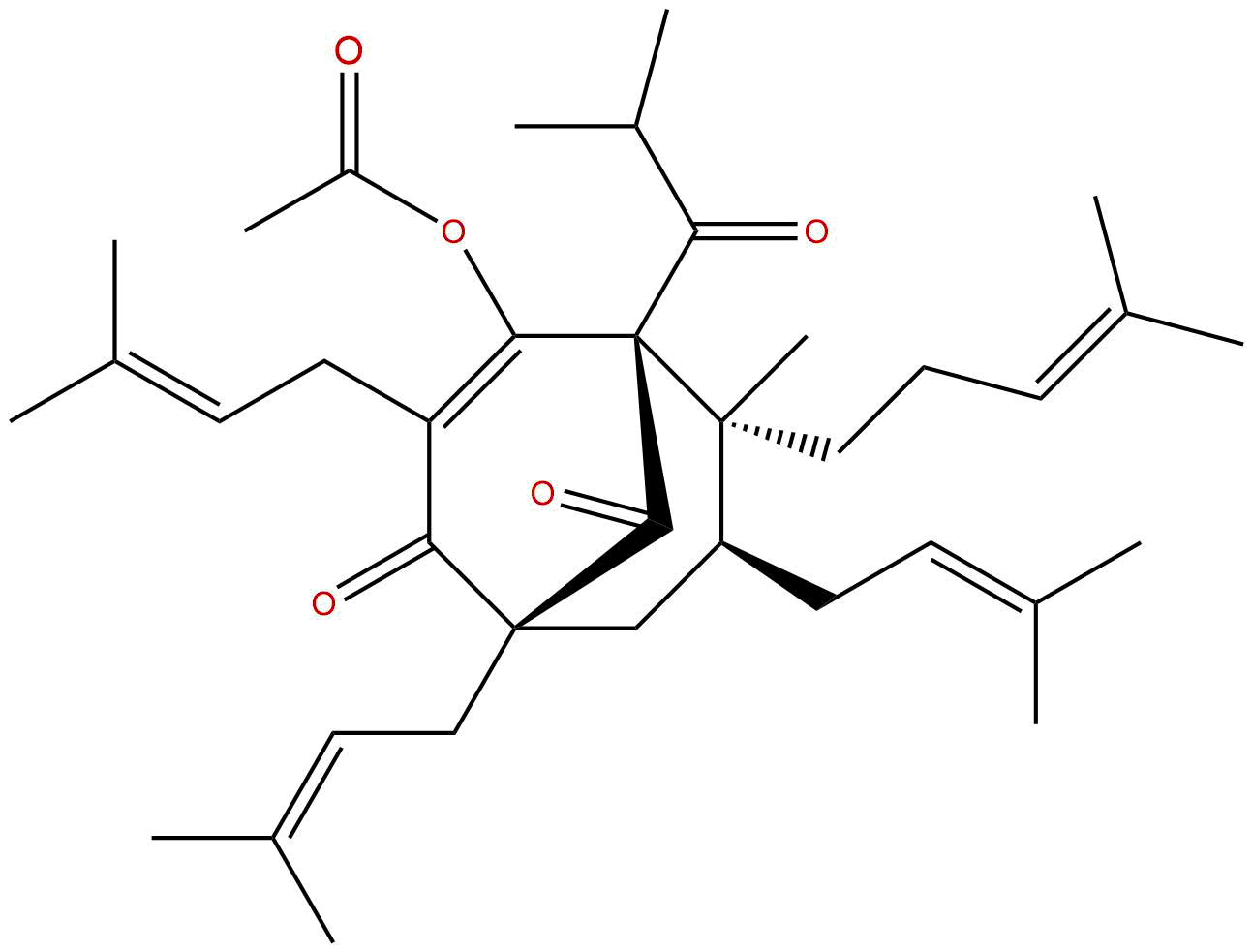


Product name: Hyperforin acetate
Synonym name:
Catalogue No.: BP2230
Cas No.: 68324-06-1
Formula: C37H54O5
Mol Weight: 578.834
Botanical Source:
Type of Compound:
Purity: 95%~99%
Analysis Method: HPLC-DAD or/and HPLC-ELSD
Identification Method: Mass, NMR
Packing: Brown vial or HDPE plastic bottle
Storage: Store in a well closed container, protected from air and light. Put into refrigerate or freeze for long term storage.
Whenever possible, you should prepare and use solutions on the same day. However, if you need to make up stock solutions in advance, we recommend that you store the solution as aliquots in tightly sealed vials at -20℃. Generally, these will be useable for up to two weeks.
The product could be supplied from milligrams to grams
Inquire for bulk scale.
For Reference Standard and R&D, Not for Human Use Directly.
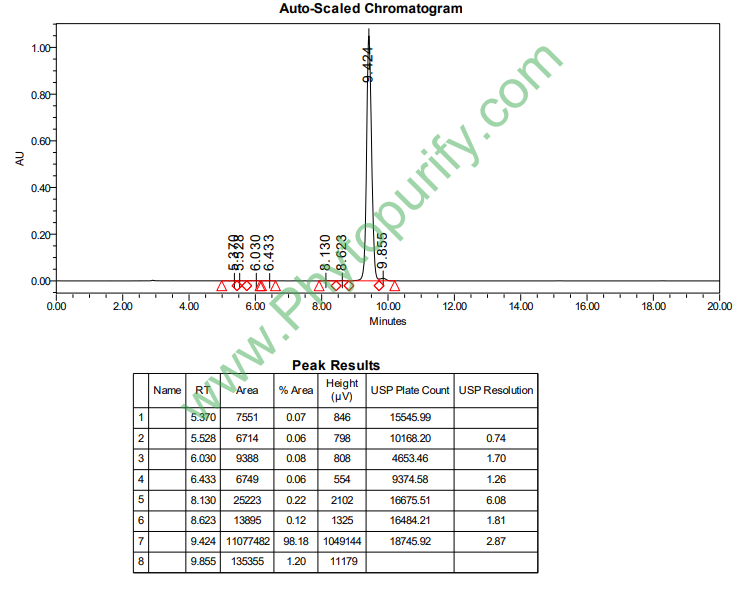
HPLC of Hyperforin acetate
Storage conditions:Short-term storage at 2~8℃, long-term storage at -20 ~ -80℃
77.5100
7.3720
7.3720
.0006
6.1343
4.9377
High
89.9715
5.7239
Yes
Yes
No
No
No
No
0.0
Yes
Yes
Yes
Yes
Hyperforin acetate, CAS number 68324-06-1, is an acetylated derivative of Hyperforin, the main active ingredient in Hypericum perforatum L. As the core material basis of the antidepressant effect of this traditional herb, the research on Hypericin has been ongoing for decades. However, the chemical properties of Hypericin are extremely unstable and prone to oxidation and photolysis, which severely limits its in-depth research and clinical applications. The introduction of Hypericin Acetate aims to improve the stability of the parent compound through structural modification, while retaining or even optimizing its biological activity. In recent years, with the deepening of research, the pharmacological spectrum of Hypericum perforatum Acetate has gone far beyond the original antidepressant category, showing multiple potential including anti-tumor, anti diabetes, neuroprotection and immune regulation. Of particular note is its identity as a channel specific activator of transient receptor type 6 (TRPC6), providing a new molecular perspective for understanding its pleiotropic pharmacological effects. This article aims to systematically review the chemical properties, plant sources, wide pharmacological activities, multi-target mechanisms of action, pharmacological characteristics, and clinical translation prospects of Hypericin Acetate, in order to provide scientific references for the deep development of this natural product derivative.
The molecular formula of Hypericin Acetate is C ∝₅ H ₅₄ O ₄, with a molecular weight of 578.8340. Its structure is derived from Hypericin, which is a complex polyisoprene derivative of triphenylphenol. Hypericin acetate is formed by introducing an acetyl group (- OCOCH3) onto a phenolic hydroxyl group in the molecular structure of Hypericin. Although this modification is small, it significantly changes the physicochemical properties of the compound.
Firstly, acetylation reduces the polarity of the original phenolic hydroxyl group, leading to a significant increase in its lipophilicity. The calculated lipid water partition coefficient (LogP) is as high as 7.3720, indicating that the compound has extremely strong lipophilicity. Correspondingly, its water solubility is extremely low, only 0.0006 mg/mL, which poses challenges for its dissolution and delivery in conventional aqueous media. The molecular topological polar surface area (TPSA) is 77.51 Å ², which is relatively small and consistent with its high lipid solubility characteristics. High lipid solubility and smaller polar surface area are usually advantageous for penetrating biological membranes, which is consistent with its evaluation of "blood-brain barrier penetration: high", indicating that it may be easy to enter the central nervous system and exert its effects. In the preliminary safety screening, the compound did not show significant inhibition of hERG potassium channels (hERG inhibition: No), indicating a low potential risk of cardiac toxicity; Meanwhile, the Ames test result was 0.0, indicating preliminarily that it has no direct genetic toxicity.
Overall, Hypericin acetate is a stable small molecule with high lipid solubility, low water solubility, and high efficiency in penetrating the blood-brain barrier. Its pharmacological advantages (such as central accessibility) and disadvantages (such as poor solubility) are prominent.
The direct plant source of amygdalin acetate is not widely available, it is mainly prepared from amygdalin through a semi synthetic method. Therefore, its origin can be traced back to the production of its precursor, coumarin.
Hypericin is mainly extracted from the flowers and top leaves of the medicinal plant Hypericum perforatum (also known as St. John's wort). The content of this ingredient in plants is influenced by various factors, including variety, place of origin, harvest season (with the highest content during flowering), and dry storage conditions. Due to its extreme sensitivity to light, oxygen, and high temperature, traditional extraction and processing processes require strict control of the environment, typically involving inert gas (such as nitrogen or argon) protection and light avoidance operations.
The extraction method often uses organic solvent extraction. The common process includes crushing the dried aerial parts of Hypericum perforatum and using solvents such as methanol, ethanol, acetone, or a mixture of them with hexane for cold soaking or percolation extraction. After vacuum concentration, the crude extract can be separated and purified using various chromatographic techniques, such as silica gel column chromatography, high-performance liquid chromatography (HPLC), etc., to obtain high-purity Hypericin. After obtaining Hypericin, Hypericin Acetate can be prepared through the classic acetylation reaction (usually reacting with acetic anhydride under alkaline conditions). Subsequently, purification will be carried out through crystallization or preparative HPLC. To ensure the stability of the final product, the entire semi synthesis and purification process should also be carried out in a dark, low-temperature, and inert atmosphere as much as possible.
Hypericin acetate inherits the multi-target and multifunctional characteristics of the parent compound, and exhibits unique or stronger activity in multiple directions.
Antidepressant and neuroprotective activity As a derivative of Hypericin, its antidepressant potential is of primary concern. Research has shown that it may exert rapid antidepressant like effects by regulating the monoamine neurotransmitter system, such as inhibiting the reuptake of serotonin, norepinephrine, dopamine, etc. by the presynaptic membrane. In addition, its role in neuroprotection is becoming increasingly prominent. In dementia models such as Alzheimer's disease, it has been shown to reduce beta amyloid toxicity, inhibit tau protein hyperphosphorylation, alleviate neuroinflammation, and improve cognitive function, which is consistent with its "anti dementia" activity description.
Antitumor activity Hypericin acetate exhibits growth inhibition and pro apoptotic effects on various tumor cell lines. Its mechanism involves inducing tumor cell cycle arrest, activating mitochondrial apoptosis pathway, inhibiting tumor cell invasion and metastasis, etc. The study suggests that it has certain effect on prostate cancer, leukemia, breast cancer and other models.
Metabolic regulation and anti obesity/anti diabetes activity This is a highly anticipated new direction for this compound in recent years. Research has confirmed that Hypericin Acetate can effectively activate the thermogenic program in adipose tissue, increase energy expenditure, and significantly reduce weight, improve insulin resistance, and glucose intolerance in a high-fat diet induced obese mouse model. Its "anti diabetes" activity is closely related to this.
Immune regulation and anti-inflammatory activity The latest research reveals its regulatory role in autoimmune diseases. In a psoriasis like mouse model, it has been demonstrated that resveratrol acetate can regulate the function of gamma delta T cells in the skin, inhibit their secretion of pro-inflammatory cytokine IL-17 α, and significantly reduce pathological manifestations such as skin thickening and inflammatory cell infiltration, demonstrating the potential for treating Th17 cell-related immune diseases such as psoriasis.
The multiple pharmacological effects of Hypericin Acetate stem from its direct or indirect regulation of multiple molecular targets, among which the activation of TRPC6 channel is one of its core mechanisms of action.
Core mechanism: TRPC6 channel activation Transient receptor typical channel 6 (TRPC6) is a non selective cation channel that primarily permeates calcium ions (Ca ² ⁺). Hypericin acetate has been identified as a specific TRPC6 chemical activator. By activating TRPC6, it promotes the influx of extracellular Ca ² ⁺, leading to an increase in intracellular Ca ² ⁺ concentration. This fundamental event is the hub that triggers multiple downstream signaling pathways.
Interaction with monoamine neurotransmitter system Although as a derivative, its direct inhibition of monoamine reuptake may be weaker than that of Hypericin, studies still suggest that it may contribute to anti anxiety and anti depression effects by affecting the activity of monoamine oxidase A/B (MAOA/B), catechol-O-methyltransferase (COMT), or indirectly regulating the function of serotonin transporter (SLC6A4), 5-HT1A receptor (HTR1A), and GABA_A receptor (GABRA1).
In summary, Hypericin Acetate activates the TRPC6 Ca ² ⁺ signaling pathway as its core, affecting multiple downstream pathways such as CREB/BDNF, AMPK, GSK3B, and synergistically regulating the neurotransmitter system, forming a complex networked mechanism of action, which is the molecular basis for its "one drug, multiple effects".
Based on its physical and chemical parameters and existing research, a preliminary evaluation can be conducted on the pharmacological properties of Hypericin Acetate.
Advantage:
challenge:
Improvement strategy Advanced drug delivery technology is essential to overcome the problem of poor water solubility. This includes: ① making nano formulations (such as liposomes, nano micelles, solid lipid nanoparticles); ② Forming inclusion complexes (such as cyclodextrin inclusion complexes); ③ Pre development drug strategy, introducing hydrophilic groups; ④ Use self microemulsion drug delivery systems (SMEDDS), etc. These technologies can significantly improve its solubility and oral bioavailability.
The diverse pharmacological activities of Hypericin Acetate have brought broad application prospects in multiple therapeutic fields, but they are also accompanied by clear development challenges.
Prospect areas:
Future research directions and challenges:
Hypericum perforatum acetate, as a stable derivative of the natural active ingredient hypericum perforatum, has evolved from a traditional antidepressant active molecule to a star compound with a novel mechanism of action (TRPC6 activator) and a broad pharmacological spectrum (including antidepressant, neuroprotective, anti obesity, anti diabetes, immune regulation, etc.). It exhibits remarkable therapeutic potential in multi system disease models by regulating key signaling axes such as CREB/BDNF and AMPK, with an initial event of increasing intracellular calcium ion concentration. Although its extremely poor solubility and other drug defects pose significant challenges for development, advances in modern medicinal chemistry and formulation technology provide feasible solutions for this. In the future, through in-depth mechanism research, rational dosage form design, and systematic preclinical development, Hypericin Acetate is expected to be successfully transformed from an excellent research tool molecule into a new drug candidate for treating multiple major public health problems such as metabolic syndrome, neurological and psychiatric disorders, and autoimmune diseases, demonstrating the sustained vitality of natural products and their derivatives in innovative drug development.
