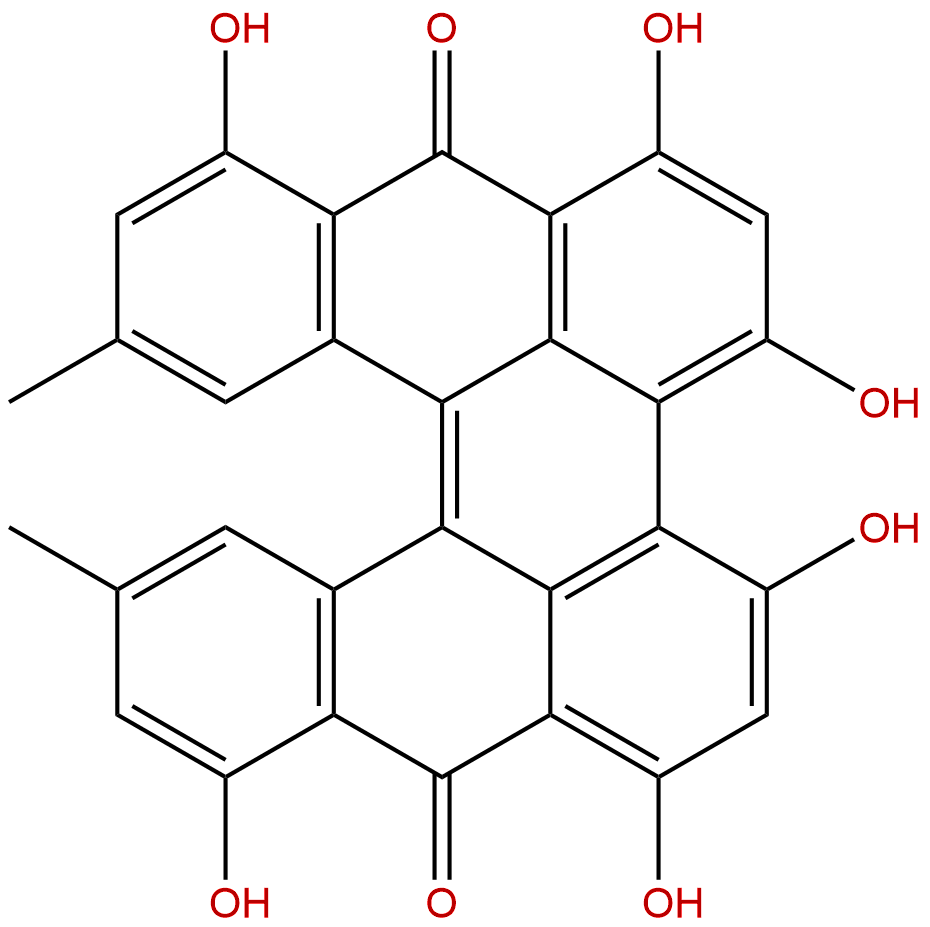


Product name: Protohypericin
Synonym name:
Catalogue No.: BP1808
Cas No.: 548-03-8
Formula: C30H18O8
Mol Weight: 506.466
Botanical Source:
Physical Description:
Type of Compound: Anthraquinones
Purity: 95%~99%
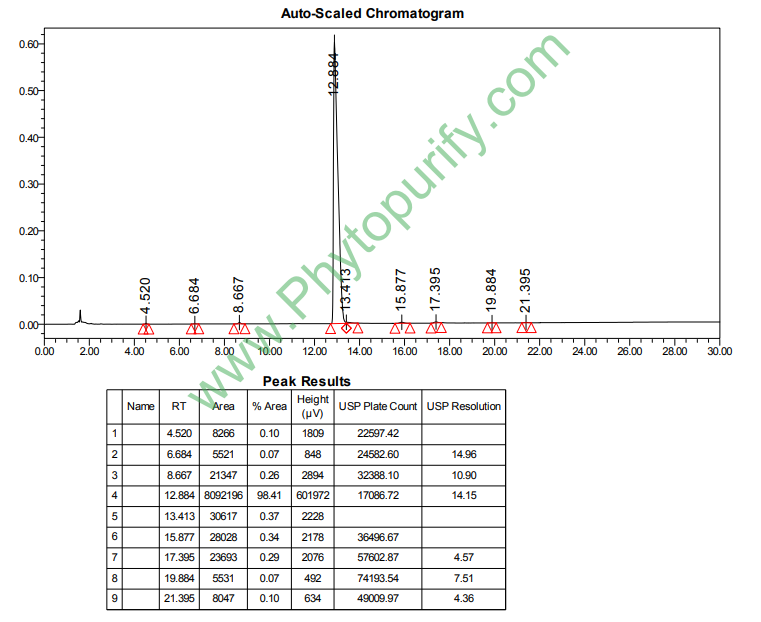
Analysis Method: HPLC-DAD or/and HPLC-ELSD
Identification Method: Mass, NMR
Packing: Brown vial or HDPE plastic bottle
The product could be supplied from milligrams to grams. Inquire for bulk scale.
We provide solution to improve the water-solubility of compounds, thereby facilitating the variety of activity tests and clinic uses.
For Reference Standard and R&D, Not for Human Use Directly.
Description:
Protohypericin exhibits photocytotoxicity.
References:
Planta Med. 1999 Dec;65(8):719-22.
Photocytotoxicity of protohypericin after photoconversion to hypericin.
In the present study, Protohypericin was synthesised in order to compare its intrinsic photocytotoxicity with that of hypericin.
METHODS AND RESULTS:
The experimental work was performed in specific filtered light conditions that prevented both an unintended photoconversion of Protohypericin and photosensitization of the cells. Assessing the photocytotoxicity as a function of irradiation time, it was found that the photocytotoxicity of both compounds converged after a long irradiation time (i.e., 15 min), while the difference between the photocytotoxicities was maximal after a short irradiation time (i.e., 1 min).
CONCLUSIONS:
Since this could not be accounted for by a redistribution of Protohypericin during irradiation, and the different irradiation times corresponded to different degrees of photoconversion of Protohypericin into hypericin, the results clearly suggest that Protohypericin exhibits intrinsically a dramatically lower photoactivity as compared to hypericin.
J AOAC Int. 2005 Nov-Dec;88(6):1607-12.
Simultaneous determination of protopseudohypericin, pseudohypericin, protohypericin, and hypericin without light exposure.
St. John's wort products are commonly standardized to total naphthodianthrones and hyperforin. Determination of these marker compounds is complicated because of the photochemistry of the naphthodianthrones pseudohypericin and hypericin and the instability of hyperforin in solution.
METHODS AND RESULTS:
Protopseudohypericin and Protohypericin have been identified as naturally occurring naphthodianthrones and, when exposed to light, they are converted into pseudohypericin and hypericin, respectively. However, exposure to light and the resulting naphthodianthrone free-radical reactions oxidize hyperforin. A mathematical relationship between the response of the proto compound and the resulting naphthodianthrone can be established by comparing the analytical response of the proto compound in a solution protected from light with the increase in the analytical response of naphthodianthrone in the same solution after exposure to light. By mathematically converting the proto compounds to their respective products, exposure to light can be avoided while still including proto compounds in a single assay.
CONCLUSIONS:
The method presented here details the reporting of all significant naphthodianthrones, including protopseudohypericin and Protohypericin, without exposure to light. This approach includes the benefits of improved naphthodianthrone precision and protection of hyperforin from oxidation.
J Drug Target. 2015 Jun;23(5):417-26.
Radiopharmaceutical evaluation of (131)I-protohypericin as a necrosis avid compound.
Hypericin is a necrosis avid agent useful for nuclear imaging and tumor therapy. Protohypericin, with a similar structure to hypericin except poorer planarity, is the precursor of hypericin.
METHODS AND RESULTS:
In this study, we aimed to investigate the impact of this structural difference on self-assembly, and evaluate the necrosis affinity and metabolism in the rat model of reperfused hepatic infarction. Protohypericin appeared less aggregative in solution compared with hypericin by fluorescence analysis. Biodistribution data of (131)I-Protohypericin showed the percentage of injected dose per gram of tissues (%ID/g) increased with time and reached to the maximum of 7.03 at 24 h in necrotic liver by gamma counting. The maximum ratio of target/non-target tissues was 11.7-fold in necrotic liver at 72 h. Pharmacokinetic parameters revealed that the half-life of (131)I-Protohypericin was 14.9 h, enabling a long blood circulation and constant retention in necrotic regions. SPECT-CT, autoradiography, and histological staining showed high uptake of (131)I-Protohypericin in necrotic tissues.
CONCLUSIONS:
These results suggest that (131)I-Protohypericin is a promising necrosis avid compound with a weaker aggregation tendency compared with hypericin and it may have a broad application in imaging and oncotherapy.
HPLC of Protohypericin
Storage conditions:Short-term storage at 2~8℃, long-term storage at -20 ~ -80℃
155.5200
4.1699
3.3813
.0001
3.4970
6.0026
Low
92.3040
3.0322
No
No
Yes
No
Yes
Yes
1.2
Yes
Yes
Yes
No
Natural products, as an important treasure trove for drug discovery and development, continue to provide modern medicine with lead compounds with novel structures and unique mechanisms. Plants of the Primula genus, especially Hypericum perforatum(Hypericum perforatum L.), Known for its significant antidepressant activity, its complex photoactive anthraquinone components are a research focus. Among them, Hypericin, as a characteristic component of this genus of plants, has been widely studied for its strong photodynamic activity and antiviral and anti-tumor potential. However, Protohyoderin (CAS: 548-03-8), as a direct precursor of hyperoxin, has long been underestimated in its biological value and is often regarded as an unstable intermediate. In recent years, research has shown that the original hypericin itself has a unique pharmacological activity spectrum that is distinct from hypericin, especially showing potential in the field of neurological and psychiatric disorders. At the same time, its characteristic as a "prodrug" of hypericin provides a new strategy for photodynamic therapy of tumors. This article aims to provide a systematic review of the chemical properties, plant sources, pharmacological activities, multi-target mechanisms of action, pharmacological evaluation, and clinical application prospects of original hypericin, in order to provide a comprehensive scientific perspective for the deep development of this promising natural product.
Protonaringin is a naphthoquinone compound with a molecular formula of C30H16O8 and a molecular weight of 506.4660. Structurally, protonaringin is a non planar, incompletely aromatized precursor of naringin. Unlike the highly conjugated planar structure of hypericin, the two methyl bridges at the center of the original hypericin molecule (located at positions C-7 and C-14) have not yet been oxidized into methylene bridges, resulting in a decrease in molecular rigidity and incomplete conjugation system. This key structural difference profoundly affects its physicochemical properties.
The lipid water partition coefficient (LogP) of the original hypericin is 4.17, indicating its high lipophilicity. Its topological polar surface area (TPSA) is 155.52 Å ², reflecting the presence of multiple polar groups such as hydroxyl and carbonyl groups in the molecule. The extremely high lipophilicity and moderate polar surface area together determine its extremely low water solubility (about 0.0001 mg/mL), which poses a challenge to its formulation development. This compound is relatively stable in solid or solution, but under visible light irradiation (especially at wavelengths>500 nm), efficient light conversion reactions occur, where the central methyl bridge is oxidized and rapidly converted into canarin with a completely planar conjugated structure. This light conversion property is the core basis for its use as a prodrug for photodynamic therapy. The predicted blood-brain barrier permeability is' low ', which is consistent with the characteristics of most high molecular weight and high polarity surface area polyphenolic compounds.
The original hypericin mainly comes from plants in the Primulaceae family, including Forsythia suspensa(Hypericum perforatum L. The content is the most abundant. In the plant body, protonaringin coexists with naringin, pseudonaringin, and other compounds in its unique black gland, and is a key intermediate in the biosynthesis pathway of naringin. Its biosynthetic pathway begins with acetyl CoA and malonyl CoA, which are catalyzed by polyketide synthase to form an anthraquinone skeleton. Then, it undergoes specific cyclization, oxidation, and methylation steps to generate original hypericin, which is ultimately converted to hypericin either enzymatically or non enzymatically under light irradiation.
The extraction method usually uses organic solvent extraction. Common solvents include methanol, ethanol, acetone, or their mixed solutions with water. In order to simultaneously obtain the original hypericin and prevent its conversion to hypericin, the extraction process needs to be carried out under light avoidance or red light conditions. For example, using 70-80% ethanol to extract in the dark at room temperature, and then concentrating under reduced pressure to obtain the crude extract. Further purification relies on chromatographic techniques such as silica gel column chromatography, preparative thin-layer chromatography, and high-performance liquid chromatography (HPLC). The gradient elution of reverse phase C18 chromatography column combined with methanol water or acetonitrile water (with a small amount of formic acid or acetic acid to adjust the pH) is an effective method for separating and purifying crude hypericin. The extraction yield is significantly affected by the plant's place of origin, harvest season, location (with higher flower bud and fruit content), and drying treatment method.
The pharmacological activity research of original hypericin can be roughly divided into two categories: one is its direct biological activity under non light conditions; The second is its indirect photodynamic activity as a precursor of hypericin, which is exerted through light conversion under illumination.
1. Antidepressant and neuroprotective activity:
Unlike hypericin, which is mainly used as a photosensitizer, protohypericin exhibits more significant neuropharmacological activity under light avoidance conditions. In various animal models of depression, such as chronic unpredictable mild stress models and forced swimming experiments, the original or pure extract of hypericin has shown antidepressant like behavioral improvement effects. Its strength of action may be weaker than classical peach extract, but due to its significantly lower phototoxicity than hypericin, it may have an advantage in long-term medication safety. In addition, research suggests that it has neuroprotective potential and may alleviate neuronal damage through antioxidant and anti-inflammatory pathways.
2. Antitumor activity (photodynamic therapy):
The phototoxicity of original hypericin itself is relatively low, which reduces its dark toxicity risk during in vivo administration. However, under visible light irradiation at specific wavelengths (usually 550-600 nm), it can efficiently and in situ convert into highly phototoxic hypericin. The transformed hypericin acts as an efficient photosensitizer, producing reactive oxygen species (such as singlet oxygen) under light excitation, selectively killing tumor cells. This "prodrug" strategy (original hypericin → phototransformation → hypericin) is expected to improve the selectivity and safety of photodynamic therapy, as light can precisely control the site and timing of active drug generation.
3. Other activities:
Preliminary studies also suggest that original hypericin may have certain anti-inflammatory and antioxidant activities. It inhibits the production of pro-inflammatory factors and enhances the antioxidant defense ability of cells by regulating relevant signaling pathways.
The pharmacological effects of original hypericin, especially its antidepressant activity, involve a complex multi-target network, which is consistent with the characteristic of "multi-component and multi-target" effects of extracts from Forsythia suspensa. According to existing research, its mechanism of action may be related to the following key targets:
In photodynamic therapy for tumors, its mechanism of action mainly relies on the production of hypericin after light conversion. Hypericin produces a large amount of reactive oxygen species under light excitation, directly damaging the lipids, proteins, and DNA of tumor cells, while destroying tumor blood vessels and activating anti-tumor immune responses.
Based on its physicochemical properties and preliminary in vitro data, a preliminary evaluation of the pharmacological properties of original hypericin is conducted
The original hypericin has unique dual application prospects:
As a new type of antidepressant candidate drug: In the field of depression treatment, existing drugs have problems such as slow onset, insufficient efficacy, and multiple side effects. Protonaringin acts on multiple targets closely related to the pathophysiology of depression, such as MAOA, IDO1, NF - κ B, Nrf2, etc., which is in line with the "multi-target" treatment strategy. Its low phototoxicity makes it promising for the development of long-term oral formulations, avoiding the photosensitive side effects associated with hypericin. Future research needs to clarify its effective dose, contribution of main targets in vivo, and long-term medication safety.
2. As an intelligent prodrug for photodynamic therapy of tumors: In the field of tumor treatment, the characteristic of low dark toxicity and high light conversion efficiency of original hypericin is an ideal photodynamic prodrug. It can be combined with targeted delivery systems such as folate and antibody modified nanoparticles to achieve drug enrichment at the tumor site. By precisely controlling the timing and range of external light sources, in-situ activation of hypericin can be achieved, thereby maximizing therapeutic benefits and minimizing systemic toxicity. This provides a new treatment option for superficial tumors (such as skin cancer, oral cancer) and intracavitary tumors accessible by endoscope (such as esophageal cancer, bladder cancer cancer).
3. Combination therapy strategy: The combination of original hypericin with other antidepressants or anti-tumor drugs (such as chemotherapy and immune checkpoint inhibitors) may produce synergistic effects, which is worth exploring.
The challenges faced mainly include: ① the pharmaceutical difficulties in improving its water solubility and oral bioavailability; ② Elucidate its precise metabolic fate and major active forms in complex biological systems; ③ Conduct standardized preclinical pharmacological and safety evaluations to lay a solid foundation for its clinical translation.
Protonaringin, which was once considered a minor precursor of naringin, is gradually demonstrating its independent medicinal value. It cleverly balances activity and safety: in the field of neurological and psychiatric disorders, its multi-target effect and low phototoxicity provide new ideas for the development of antidepressant drugs; In the field of tumor treatment, its unique photo controlled prodrug properties provide a new tool for precise photodynamic therapy. Despite challenges in terms of solubility, stability, and in vivo processes in drug development, these obstacles are expected to be gradually overcome with advances in modern pharmacy, molecular pharmacology, and clinical research methods. In the future, in-depth research on the original hypericin will not only help deepen the scientific understanding of the traditional pharmacological material basis of Forsythia suspensa, but may also give rise to new drugs with independent intellectual property rights, achieving breakthroughs in the fields of mental health and tumor treatment.
