


Synonym name: Ursonic acid;3-Ketone
Catalogue No.: BP0072
Cas No.: 6246-46-4
Formula: C30H46O3
Mol Weight: 454.695
Botanical Source: dammar resin, Rubus fruticosus Hopea sp., Shorea sp., Xylanche himalaica and other plants
Purity: 95%~99%
Analysis Method: HPLC-DAD or/and HPLC-ELSD
Identification Method: Mass, NMR
Packing: Brown vial or HDPE plastic bottle
Can be supplied from milligrams to grams.
For Reference Standard and R&D, Not for Human Use Directly.
Inquire for bulk scale.
HPLC of 3-oxo-urs-12-en-28-oic acid
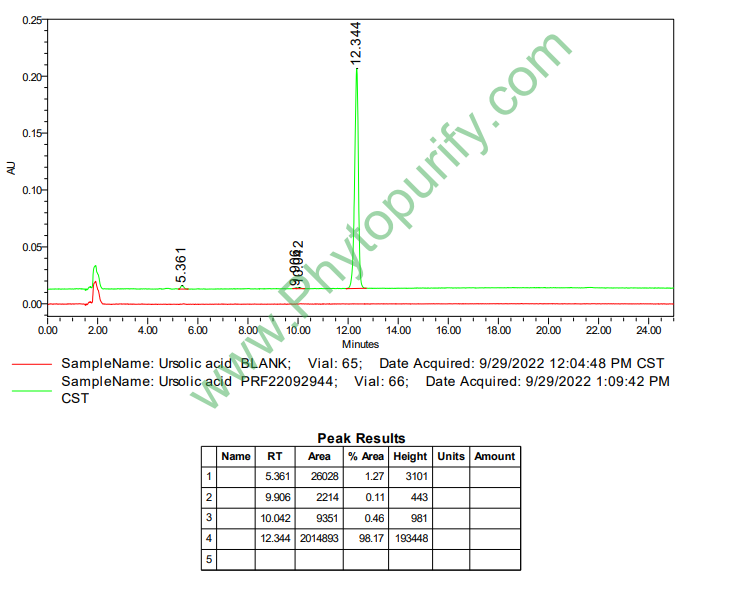
Storage conditions:Short-term storage at 2~8℃, long-term storage at -20 ~ -80℃
57.5300
6.0000
Low
No
No
No
Unknown
No
Unknown
Ursonic acid (CAS number: 6246-46-4) is a naturally occurring triterpenoid compound that has attracted widespread attention in pharmacology and natural product chemistry in recent years due to its diverse biological activities. As an important member of triterpenoid compounds, ursolic acid not only exhibits significant potential in anti-tumor and antiviral effects, but has also been found to interact with molecular targets related to various metabolic diseases, demonstrating its potential applications in metabolic regulation and treatment of neurological and psychiatric disorders. This article will provide a systematic review of the chemical structure, natural sources, pharmacological activity, mechanism of action, pharmacological evaluation, and future clinical application prospects of ursolic acid, aiming to provide theoretical basis and reference for related research.
Ursolic acid belongs to the triterpenoid class, with a molecular formula of C30H46O4 and a molecular weight of 454.68. Its structural characteristics include a multi ring skeleton and multiple oxygen functional groups, endowing it with unique physicochemical properties. The LogP value of ursolic acid is about 6.0, indicating its strong hydrophobicity, which has a significant impact on its cell membrane penetration and drug distribution. Its polar surface area (TPSA) is 57.53 and the number of hydrogen bond acceptors is 3, indicating that it has certain hydrophilic sites in intermolecular interactions. The blood-brain barrier penetration ability of ursolic acid is relatively low, and there is no significant risk of hepatotoxicity, cardiotoxicity, or hERG channel inhibition, demonstrating good safety potential. However, the results of the Ames mutagenicity test are still unclear and further research is needed to assess its genetic toxicity risk.
Ursolic acid mainly exists in the bark, leaves, and fruits of various plants, especially in the Ursolic genus (such as Ursolic leaves) and some Eucommia plants as the main sources. Plants containing ursolic acid in traditional Chinese medicinal materials are often used for anti-inflammatory, antibacterial, and metabolic regulation purposes. The extraction method usually uses organic solvent extraction combined with column chromatography purification, and commonly used solvents include ethanol, methanol, and ethyl acetate. In recent years, in order to improve extraction efficiency and purity, ultrasound assisted extraction, microwave-assisted extraction, and high-performance liquid chromatography (HPLC) purification techniques have gradually been applied to the separation and preparation of ursolic acid. In addition, the chemical synthesis and semi synthesis methods of ursolic acid are constantly developing to meet its large-scale production needs.
Ursolic acid exhibits significant anti proliferative and pro apoptotic effects in various human cancer cell lines. It exhibits broad anti-cancer potential by regulating cell cycle related proteins, activating endogenous apoptosis pathways, and inhibiting tumor cell migration and invasion. In vitro studies have shown that ursolic acid can induce mitochondrial membrane potential loss in cancer cells, activate the caspase cascade reaction, and promote cell apoptosis. In addition, ursolic acid can enhance the sensitivity of chemotherapy drugs and has potential adjuvant therapeutic value.
Ursolic acid exhibits good inhibitory effects on herpes simplex virus (HSV) types I and II. Its antiviral mechanism may involve inhibiting virus replication and blocking the binding process between the virus and host cells. In vitro experiments have shown that ursolic acid can significantly reduce viral load and alleviate virus mediated cellular lesions, indicating its potential as an antiviral drug for development.
In recent years, research on ursolic acid in the field of neurological and psychiatric disorders has gradually increased. It exhibits antidepressant potential by regulating neurotransmitter balance, antioxidant stress, and inflammatory response. Some studies have shown that ursolic acid can affect the metabolism of neurotransmitters such as serotonin (5-HT) and dopamine in the brain, improve depressive symptoms, and become a candidate compound for developing new antidepressant drugs.
Ursolic acid can regulate metabolic diseases such as diabetes, obesity and nonalcoholic fatty liver disease. It improves energy metabolism, inhibits fat synthesis, promotes fatty acid oxidation, reduces inflammatory response, and thus improves metabolic abnormalities by activating the AMPK signaling pathway. In addition, ursolic acid also regulates key targets such as PTPN1, STAT3, ABCB1, and participates in insulin signaling and lipid metabolism regulation.
The multi-target mechanism of action of ursolic acid is the basis for its broad biological activity. The main molecular targets and their mechanisms of action include:
In summary, ursolic acid exerts multiple biological effects such as anti-tumor, antiviral, and metabolic regulation through multi-target and multi pathway synergistic effects.
The pharmacological evaluation of ursolic acid shows that it has certain advantages and challenges. Its high hydrophobicity (LogP=6.0) facilitates membrane penetration, but may limit its water solubility and bioavailability. The TPSA is 57.53 and the number of hydrogen bond acceptors is 3, indicating that its molecular polarity is moderate and conducive to binding with target proteins. The low blood-brain barrier penetration ability of ursolic acid suggests that its direct effect in the central nervous system may be limited, but it can still exert antidepressant effects through peripheral mechanisms.
In terms of safety, ursolic acid did not show significant hepatotoxicity, cardiotoxicity, or hERG channel inhibition, reducing the risk of cardiovascular side effects. The results of Ames mutagenicity test are not yet clear, and further toxicological studies are needed to ensure genetic safety. Pharmacokinetic studies are relatively limited, and preliminary data suggests that oral absorption may be limited. The main metabolic pathways in the body involve the liver CYP450 enzyme system, and the metabolites and their activities need to be further explored.
To improve the drug properties of ursolic acid, its solubility and bioavailability can be optimized through structural modification, nanocarrier encapsulation, and drug delivery systems in the future, promoting its clinical translation.
Ursolic acid, as a multifunctional natural product, has broad clinical application potential. Its anti-tumor activity makes it a powerful candidate for cancer adjuvant therapy, especially in overcoming chemotherapy resistance and regulating the tumor microenvironment, with unique advantages. The antiviral activity provides a foundation for the development of new anti HSV drugs and meets the diverse needs of clinical antiviral drugs.
In the field of metabolic diseases, ursolic acid is expected to become a new therapeutic drug for diabetes, obesity, fatty liver and other diseases by regulating AMPK and related signaling pathways. In addition, its antidepressant effect has opened up new directions for the treatment of neurological and psychiatric disorders, especially suitable for patients with depression accompanied by metabolic abnormalities.
Future research should focus on pharmacokinetic optimization, formulation development, and preclinical safety evaluation of ursolic acid, combined with modern drug design and precision medicine strategies, to promote its clinical application. Meanwhile, in-depth analysis of its mechanism of action and multi-target synergistic effects will contribute to the development of more selective and efficient derivatives of ursolic acid.
Ursolic acid, as a natural triterpenoid compound with rich biological activity, exhibits multiple pharmacological effects such as anti-tumor, antiviral, antidepressant, and metabolic regulation. The multi-target and multi pathway mechanism of action provides a theoretical basis for the development of new therapeutic drugs. Despite certain pharmaceutical challenges, its excellent safety and unique biological activity make it an important candidate for the development of natural product drugs. In the future, by combining structural optimization with drug delivery technology, ursolic acid is expected to have a wider range of clinical applications, promoting the development and innovation of natural product pharmacology.
