


Product name: Betulinaldehyde
Synonym name:
Catalogue No.: BP0270
Cas No.: 13159-28-9
Formula: C30H48O2
Mol Weight: 440.712
Botanical Source: Betula platyphylla Suk.
Physical Description:
Type of Compound: Triterpenoids
Purity: 95%~99%
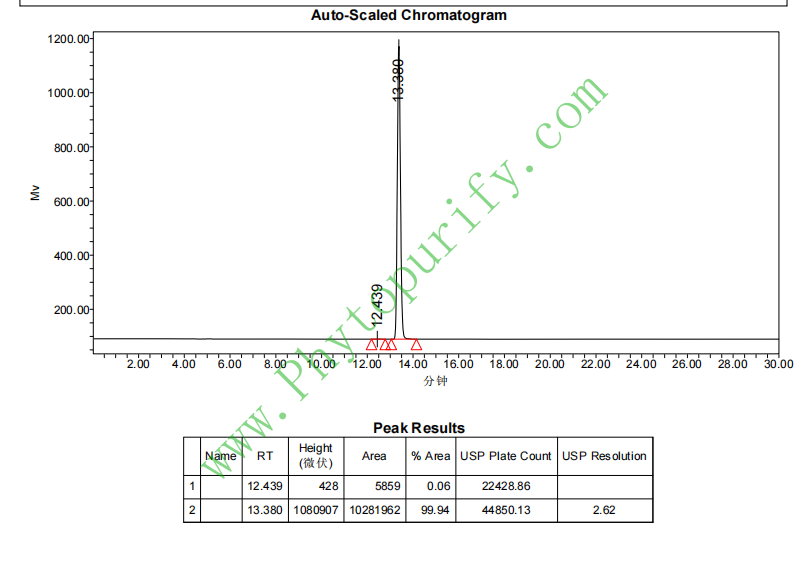
Analysis Method: HPLC-DAD or/and HPLC-ELSD
Identification Method: Mass, NMR
Packing: Brown vial or HDPE plastic bottle
Storage: Store in a well closed container, protected from air and light. Put into refrigerate or freeze for long term storage.
Whenever possible, you should prepare and use solutions on the same day. However, if you need to make up stock solutions in advance, we recommend that you store the solution as aliquots in tightly sealed vials at -20℃. Generally, these will be useable for up to two weeks.
The product could be supplied from milligrams to grams
Inquire for bulk scale.
Description:
Betulinaldehyde exhibits antimicrobial activity against reference strains of methicillin-resistant and methicillin-sensitive S. aureus. It shows antimycobacterial activity against with values of 25 microg/ml.
References:
Chem Pharm Bull (Tokyo). 2006 Apr;54(4):535-7.
Ceanothane- and lupane-type triterpenes with antiplasmodial and antimycobacterial activities from Ziziphus cambodiana.
One new and eight known ceanothane- and lupane-type triterpenes were isolated from the root bark of Ziziphus cambodiana PIERRE (Rhamnaceae).
METHODS AND RESULTS:
Based on spectral analyses, the structure of the new compound was elucidated as 3-O-(4-hydroxy-3-methoxybenzoyl)ceanothic acid (3-O-vanillylceanothic acid) (1), while the known compounds were identified as lupeol (2), Betulinaldehyde (3), betulinic acid (4), 2-O-E-p-coumaroyl alphitolic acid (5), alphitolic acid (6), zizyberanalic acid (7), zizyberenalic acid (8) and ceanothic acid (9). Compounds 1, 5 and 8 exhibited significant in vitro antiplasmodial activity against the parasite Plasmodium falciparum, with inhibitory concentration (IC50) values of 3.7, 0.9 and 3.0 microg/ml, respectively. Compounds 1 and 3-8 showed antimycobacterial activity against Mycobacterium tuberculosis with respective MIC values of 25, 25, 25, 12.5, 50, 50 and 100 microg/ml.
HPLC of Betulinaldehyde
Storage conditions:Short-term storage at 2~8℃, long-term storage at -20 ~ -80℃
Betulinaldehyde, CAS number 13159-28-9, is a typical natural product of pentacyclic triterpenoids, mainly found in plants of the Betula genus. As a complex and biologically active natural triterpenoid compound, betulinic aldehyde has received widespread attention in pharmacology and natural product chemistry in recent years due to its significant anti-cancer, antibacterial, and cardiovascular protective effects. Numerous studies have shown that betulinic aldehyde not only inhibits the proliferation and migration of various tumor cells, but also regulates multiple key cellular signaling pathways, such as Akt, MAPK, STAT3, and PLC γ 1/Ca2+/MP9, demonstrating its potential application value in tumor therapy and prevention and treatment of cardiovascular disease (CVD).
This review aims to systematically summarize the chemical structure and physicochemical properties, plant sources, and extraction methods of betulinic aldehyde, with a focus on analyzing its pharmacological activity and mechanism of action, evaluating its pharmacological properties and pharmacokinetic characteristics, and exploring its clinical application prospects and future research directions, providing theoretical basis and practical guidance for natural product pharmacology and new drug development.
Betulinic aldehyde belongs to the pentacyclic triterpenoid class, with a molecular formula of C30H48O2 and a molecular weight of 440.7. Its structural features include a typical five ring skeleton and aldehyde functional groups, endowing it with unique chemical activity. The LogP value of betulinic aldehyde is as high as 6.0, indicating strong hydrophobicity, which may affect its absorption and distribution in the body. Its topological polar surface area (TPSA) is 37.3 and the number of hydrogen bond acceptors is 2, indicating that it has moderate polarity and is conducive to binding with biomolecules.
In terms of physical and chemical properties, betulinic aldehyde has strong hydrophobicity, but the aldehyde groups contained in its molecular structure provide reactive sites for it, which may participate in covalent or non covalent binding with target proteins. Its blood-brain barrier permeability is relatively low, indicating that its effect is mainly limited to peripheral tissues. According to in vitro toxicology evaluation, betulinic aldehyde has no hepatotoxicity, cardiotoxicity, or hERG channel inhibition effect. The Ames mutagenicity test result is negative, indicating good safety and potential for drug development.
Betulinal mainly exists in the bark, leaves, and lipid gland secretions of Betula spp. plants. Birch plants are widely distributed in temperate and cold regions of the Northern Hemisphere, and are an important source of traditional medicinal and industrial raw materials. The content of natural betulinic aldehyde is greatly influenced by factors such as plant species, collection season, and geographical environment.
The common methods for extracting betulinic aldehyde include solvent extraction, ultrasound assisted extraction, and liquid-liquid partitioning. Ethanol or methanol is usually used as the extraction solvent to obtain high-purity betulinic aldehyde through multi-step separation and purification (such as silica gel column chromatography, HPLC). In recent years, green extraction technologies such as supercritical CO2 extraction and microwave-assisted extraction have also been applied to improve extraction efficiency and purity, reduce the use of organic solvents, and meet the environmental requirements of modern natural product extraction.
Betulinic aldehyde exhibits significant anti proliferative and pro apoptotic effects in various tumor cell lines. Especially in lung cancer A549 cells, betulinic acid can effectively inhibit cell viability, proliferation, and migration ability. Its anti-cancer effect is closely related to regulating the cell cycle, inducing apoptosis, and enhancing autophagy. Related studies have shown that betulinic aldehyde reduces the survival signal transduction of tumor cells and promotes cell death by inhibiting the Akt, MAPK, and STAT3 signaling pathways.
In addition, betulinic aldehyde also exhibits potential inhibitory effects on solid tumors such as liver cancer. Its targets involve multiple key oncogenes and signaling molecules, including BCL2, STAT3, TOP1, TERT, PIK3CA, MMP9, EGFR, TP53, NFKB1, and AKT1, indicating its multi-target synergistic regulation characteristics.
Betulinic aldehyde exhibits significant inhibitory effects on Staphylococcus aureus, especially against drug-resistant strains. Its antibacterial mechanism may involve cell membrane disruption, inhibition of cell wall synthesis, and interference with intracellular signaling, and further research is needed to determine the specific mechanism.
Betulinic aldehyde exerts cardiovascular protection by inhibiting the PLC γ 1/Ca2+/MMP9 signaling pathway, regulating the process of vascular remodeling. Vascular remodeling is the key pathological process of many cardiovascular diseases (such as atherosclerosis, hypertension and myocardial fibrosis). Betulin is expected to become a potential therapeutic drug for cardiovascular diseases by inhibiting the migration of vascular smooth muscle cells and the activity of matrix metalloproteinases.
The pharmacological effects of betulinic aldehyde depend on its regulation of multiple signaling pathways, and the specific mechanisms are as follows:
Akt signaling pathway inhibition
Akt, as a core regulatory factor for cell survival and metabolism, is inhibited by betulinic aldehyde. It blocks downstream mTOR and NF - κ B signals, induces tumor cell apoptosis and autophagy, and inhibits proliferation by inhibiting Akt phosphorylation.
MAPK signaling pathway regulation
Betulinic aldehyde can affect the activity of ERK, JNK, and p38 MAPK, regulate cell proliferation, differentiation, and stress response, and promote cancer cell apoptosis.
STAT3 signaling pathway inhibition
STAT3 is abnormally activated in various tumors, promoting tumor growth and immune escape. Betulinic aldehyde inhibits the phosphorylation of STAT3, blocks its nuclear transcriptional activity, and reduces the survival ability of tumor cells.
PLC γ 1/Ca2+/MMP9 signal pathway
This pathway plays a crucial role in vascular remodeling. Betulinic aldehyde inhibits the activity of PLC γ 1, reduces intracellular Ca2+concentration, decreases the expression and activity of MMP9, suppresses the migration of vascular smooth muscle cells, and slows down the progression of vascular lesions.
Multi target synergistic effect
Birch aldehyde also achieves multi-level regulation of tumor cells and enhances anti-cancer effects by regulating molecules such as BCL2, TOP1, TERT, PIK3CA, EGFR, TP53, NFKB1, and AKT1.
The pharmacological evaluation of betulinic aldehyde shows that it has good safety and pharmacokinetic characteristics. Its molecular weight is 440.7, which meets the basic requirements of Lipinski rule, but its high LogP value (6.0) suggests strong hydrophobicity, which may affect oral bioavailability and in vivo distribution. The TPSA is 37.3 and there are only 2 hydrogen bond receptors, indicating that its polarity is moderate and conducive to membrane permeation.
Toxicological evaluation shows that Betulinic Aldehyde has no significant hepatotoxicity or cardiotoxicity. The hERG channel inhibition test is negative, and the Ames mutagenicity test is also negative, supporting its good safety. The low permeability of the blood-brain barrier suggests that it mainly acts on peripheral tissues, reducing the risk of central nervous system side effects.
At present, there is limited pharmacokinetic data on betulinic aldehyde. Preliminary studies have shown that its metabolism in vivo is mainly carried out through the liver enzyme system, and the metabolites and excretion pathways need to be further clarified. In the future, systematic ADME (absorption, distribution, metabolism, excretion) research needs to be conducted to optimize dosing regimens and dosage form design.
Based on the multiple pharmacological activities of betulinic aldehyde in anti-cancer, antibacterial, and cardiovascular protection, its clinical application prospects are broad. Especially in the field of lung cancer and liver cancer treatment, betulinic aldehyde is expected to become a candidate molecule for new natural anti-tumor drugs through multi-target and multi pathway synergistic effects. In addition, its inhibitory effect on drug-resistant Staphylococcus aureus provides new ideas for the development of antibiotic alternatives.
In terms of cardiovascular diseases, betulinic aldehyde has potential vascular protective effects by regulating signaling pathways related to vascular remodeling, and can be used as a natural medicinal ingredient for adjuvant therapy of cardiovascular diseases in the future.
However, the clinical translation of betulinic aldehyde still faces many challenges, including low bioavailability due to hydrophobicity, unclear metabolic mechanisms in vivo, and lack of systematic preclinical safety and efficacy evaluation. Future research should focus on:
Betulinic aldehyde, as a natural product of pentacyclic triterpenoids with multiple biological activities, exhibits significant anti-cancer, antibacterial, and cardiovascular protective effects. It effectively inhibits tumor cell proliferation, migration, and vascular remodeling by regulating multiple key cellular signaling pathways, and has a good basis for drug efficacy and safety. Although its clinical application is still in its infancy, with the deepening of extraction and purification technology, drug formulation optimization, and mechanism research, betulinic aldehyde is expected to become an important candidate molecule in the development of natural product drugs.
In the future, integrating pharmacology, chemical modification, and drug delivery technologies will further promote the clinical translation of betulinic aldehyde, help expand the application of natural products in modern medicine, and provide new strategies and choices for the treatment of tumors and cardiovascular diseases.
