Introduction/Overview
Natural products, as an important source of drug discovery, play an irreplaceable role in the history of human disease prevention and treatment. Among them, polyphenolic compounds derived from tea, especially catechins, have attracted much attention due to their extensive biological activities. Epigallocatechin gallate (EGCG), as the most important and extensively studied active ingredient in green tea catechins, has been widely reported for its antioxidant, anti-inflammatory, and anti-tumor pharmacological effects. However, the poor stability and low bioavailability of EGCG in vivo limit its clinical application potential. In this context, methylated derivatives of EGCG are gradually entering the research field. 3 "- O-Methyl Epigallocatechin-3- (3 '' - O-methyl) gallate, abbreviated as 3 '' - Me EGCG, CAS number 83104-87-4, is one of the important naturally occurring or in vivo metabolites. Compared with EGCG, the methylation modification of the 3 '' hydroxyl group on its B ring not only changes its physicochemical properties, but also potentially endows it with unique pharmacological properties and superior drug properties. This article aims to systematically review the chemical structure, plant origin, pharmacological activity, mechanism of action, and medicinal properties of 3 '' - Me EGCG, in order to provide comprehensive scientific references for the in-depth research and development of this potential natural product compound.
Chemical structure and physicochemical properties
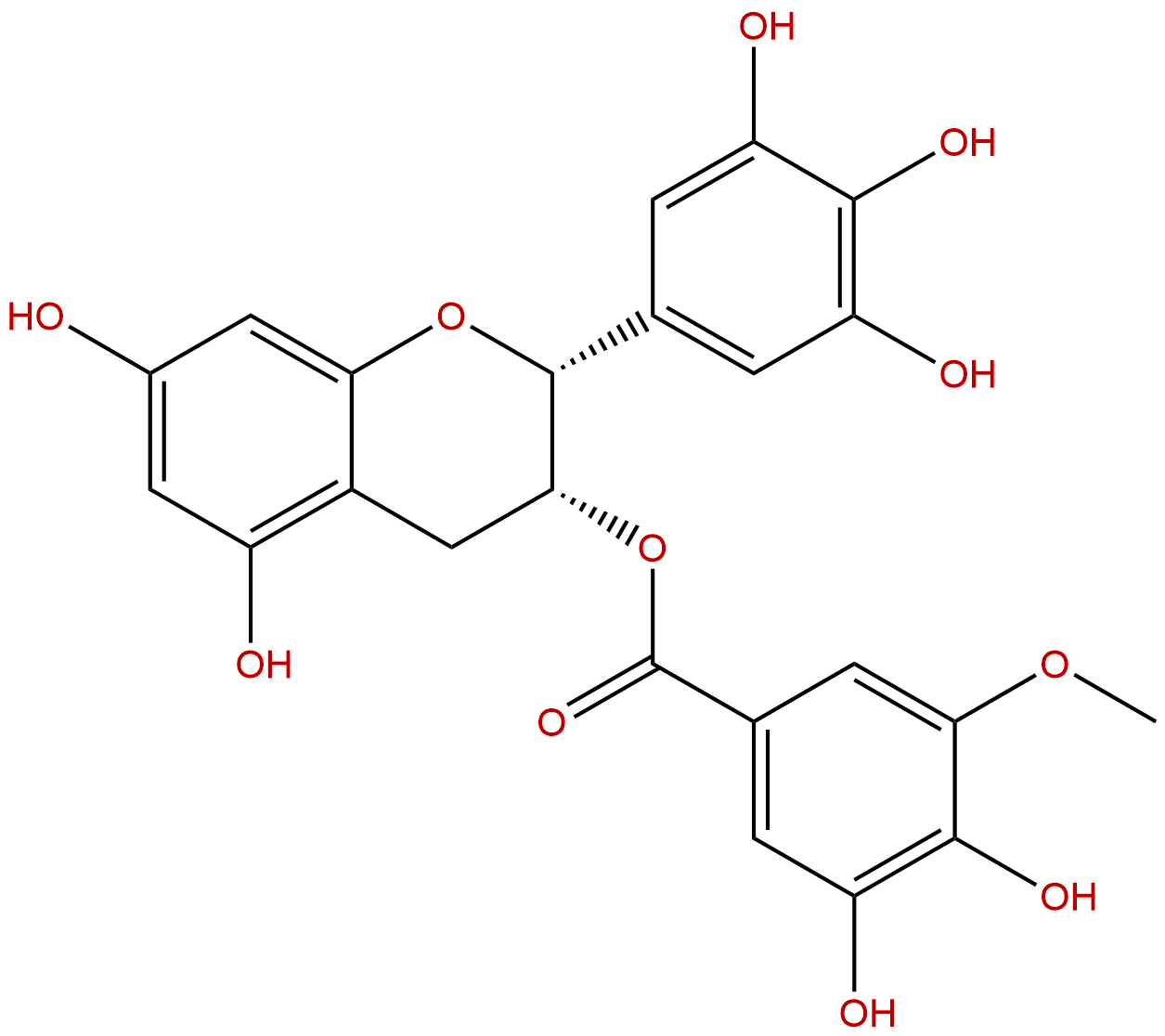
3 '' - O-methyl epigallocatechin gallate is a catechin flavonoid compound with a molecular formula of C23H20O11 and a molecular weight of 472.4020. Structurally, it belongs to the epicatechin class, with a core structure of 2-phenylbenzodihydropyran (flavan-3-ol). Its specific structural features are:
1. Stereochemistry The C-2 and C-3 positions are in the cis configuration ("table"), and both are in the R configuration, belonging to the (-) - isomer.
2. substituent:
*A-ring: Similar to EGCG, there are two phenolic hydroxyl groups at positions 5 and 7.
*B ring: This is the most significant difference between it and EGCG. The B ring is a triphenylphenol (gallocatechin gallate) structure, but the hydrogen atom at the 3 '' position (the third hydroxyl group on the B ring) is replaced by a methyl group (- CH3) to form a methoxy group (- OCH3), hence the name 3 '' - O-methyl.
*C ring: The C-3 hydroxyl group is connected to gallic acid through an ester bond, forming a gallic acid ester group.
This methylation modification profoundly affects its physicochemical properties. Calculation and experimental data indicate that its lipid water partition coefficient (LogP) is about 2.19, which is more lipophilic compared to EGCG (LogP of about 0.5-1.0). The topological polar surface area (TPSA) is 186.37 Å ², indicating that the molecular polarity is still strong, but methylation may slightly reduce intermolecular hydrogen bonding. Its water solubility parameter is about 0.3339, indicating limited solubility in water, but better than many completely non-polar compounds. These properties collectively determine its absorption, distribution, and metabolic behavior within living organisms.
Plant sources and extraction methods
3 '' - Me EGCG is not the main catechin in tea, and its content is much lower than EGCG, ECG, etc. It mainly exists in specific varieties of tea trees(Camellia sinensis)In the leaves, especially tea leaves that have undergone certain processing techniques. Research has shown that this component can be detected in oolong tea, some green teas, and tea tree shoots. In addition, it is also one of the main methylation products of EGCG in vivo (including humans and animals) catalyzed by catechol-O-methyltransferase (COMT) metabolism. Therefore, its sources include both direct extraction from plants and acquisition through biological transformation or chemical synthesis.
Extracting and separating 3 '' - Me EGCG from tea leaves is a challenging task, mainly due to its low content and difficulty in separating from structurally similar compounds such as EGCG, 4 '' - Me EGCG, etc. The conventional extraction process usually includes:
1. Solvent extraction Extract tea powder using methanol, ethanol, acetone/water mixed solvents or ultrasound assisted extraction.
2. Preliminary enrichment Preliminary enrichment of catechins was achieved through liquid-liquid extraction using solvents such as ethyl acetate and n-butanol.
3. chromatographic separation This is a crucial step in obtaining high-purity monomers. Multiple chromatographic techniques are often used in combination:
* Column chromatography: Use silica gel, polyamide, dextran gel (Sephadex LH-20) and other fillers for coarse separation. Sephadex LH-20 column chromatography utilizes the dual principles of molecular exclusion and adsorption to achieve excellent separation of catechins, making it a commonly used method.
* High performance liquid chromatography Preparation type high-performance liquid chromatography (Prep HPLC) is the core of final purification. Usually, a reverse phase C18 chromatography column is used, with methanol water or acetonitrile water (often containing a small amount of formic acid or acetic acid to adjust the pH) as the mobile phase for gradient elution. The separation of 3 '' - Me EGCG from its isomers and analogues is achieved based on slight differences in retention time.
4. appraisal The isolated compounds need to be structurally confirmed by techniques such as mass spectrometry (MS) and nuclear magnetic resonance (NMR, especially 1H-NMR and 13C-NMR).
In recent years, preparative chromatography techniques such as high-speed countercurrent chromatography have also been applied to the separation and purification of compounds with highly similar structures.
Pharmacological activity research
Numerous in vitro and in vivo studies have shown that 3 '' - Me EGCG retains multiple biological activities of EGCG and exhibits unique or stronger effects in certain aspects.
-
Antioxidant and anti-inflammatory activities As a polyphenolic compound, one of its core activities is to scavenge free radicals and resist oxidation. Although 3 '' methylation may slightly reduce its direct electron supply ability, studies have shown that it still has significant DPPH radical, ABTS radical cation scavenging ability, and iron ion reducing power. In cell models, it can effectively inhibit lipopolysaccharide (LPS) - induced macrophage production of nitric oxide (NO) and prostaglandin E2 (PGE2), downregulate the expression of inducible nitric oxide synthase (iNOS) and cyclooxygenase-2 (COX-2), indicating its clear anti-inflammatory effect.
-
Antitumor activity This is one of its most in-depth research areas. 3 '' - Me EGCG showed growth inhibition and apoptosis induction on a variety of cancer cell lines, including breast cancer, prostate cancer, colon cancer, liver cancer, etc. Its strength of action is sometimes comparable or even stronger than EGCG, which may be related to its higher cellular uptake rate or metabolic stability. For example, in liver cancer cells, it can activate the caspase cascade through the mitochondrial pathway and death receptor pathway, inducing cell apoptosis.
-
Regulatory role of metabolic diseases Research suggests that it has an improving effect on metabolic syndrome related indicators. In animal models, it has shown the potential to reduce weight gain induced by high-fat diet in obese mice, improve insulin resistance, and lower blood glucose and lipid levels. The mechanism may be related to regulating the expression of genes related to fat production, fatty acid oxidation, and activating the AMPK signaling pathway.
-
Neuroprotective effect Although its blood-brain barrier permeability is predicted to be 'low', some studies have still found its neuroprotective potential. In Alzheimer's disease cell models, it can reduce the neurotoxicity induced by β - amyloid protein. Its mechanism may involve inhibiting oxidative stress and inflammatory response, rather than directly acting on the central nervous system.
-
Skin protective effect Due to its antioxidant and anti-inflammatory properties, as well as potentially higher skin permeability (thanks to moderate LogP values), 3 '' - Me EGCG has received attention in cosmetics and skin pharmacology. Research has shown that it can inhibit skin cell damage, inflammation, and collagen degradation induced by ultraviolet (UVB) radiation, and has a protective effect against skin photoaging.
Mechanism of action and molecular targets
The pharmacological effects of 3 '' - Me EGCG are achieved through multi-target and multi pathway mechanisms, some of which are shared with EGCG, but there are also differences.
-
Direct interaction and receptor binding:
- Cell surface receptors Similar to EGCG, it may mediate various anti-tumor effects by binding to the laminin receptor (67LR) on the cell membrane. 67LR has been identified as a high affinity receptor for EGCG, and methylation modification may affect but not completely block this interaction.
- Enzyme inhibition It can inhibit the activity of various enzymes. For example, inhibiting COX-2 and iNOS to exert anti-inflammatory effects; Inhibiting fatty acid synthase (FAS) affects lipid metabolism; Inhibiting matrix metalloproteinases (MMPs, especially MMP-2 and MMP-9) can affect tumor invasion and metastasis.
- Epigenetic regulation There are studies suggesting that catechins may inhibit DNA methyltransferase (DNMT) and histone deacetylase (HDAC), and it is worth exploring whether 3 '' - Me EGCG has similar activity.
-
Signal pathway regulation:
- MAPK pathway It can regulate members of the mitogen activated protein kinase (MAPK) family, such as inhibiting excessive activation of ERK1/2 or activating JNK and p38, which are associated with cell cycle arrest and apoptosis induction.
- PI3K/Akt pathway In many cancer cells, it can inhibit the key survival signaling pathway of phosphatidylinositol 3-kinase (PI3K)/protein kinase B (Akt) and promote apoptosis.
- NF - κ B pathway By inhibiting the activity of I κ B kinase (IKK), the nuclear translocation of nuclear factor kappa B (NF - κ B) is prevented, thereby downregulating the expression of various pro-inflammatory, anti apoptotic, and pro metastatic genes regulated by it. This is one of the core mechanisms of its anti-inflammatory and anti-tumor effects.
- Nrf2/ARE pathway It can activate nuclear factor E2 related factor 2 (Nrf2), promote the expression of downstream antioxidant response element (ARE) driven genes (such as HO-1, NQO1), and enhance the cell's antioxidant defense ability.
-
The impact of metabolic stability Methylation at the 3 '' position makes it resistant to COMT catalyzed methylation metabolism, as this site is already occupied. This may result in a longer half-life of EGCG in vivo, allowing for longer interactions with the target, which may be the chemical basis for some of its superior in vivo activity.
Evaluation of drug properties and pharmacokinetics
Based on the provided parameters and existing research, the preliminary evaluation of the pharmacological properties of 3 '' - Me EGCG is as follows:
-
Absorption, distribution, metabolism, excretion:
- absorb A moderate LogP value (2.19) suggests that it may have better intestinal passive diffusion and absorption ability than EGCG. But its larger TPSA and molecular weight may limit its membrane permeability efficiency. The expected oral bioavailability is still not high, but it may be better than EGCG.
- distribution It is predicted that its blood-brain barrier permeability is low, which is consistent with most polyphenolic compounds and mainly acts on the peripheral system. The distribution characteristics of its organization need to be clarified through in vivo research.
- Metabolism As a methylated metabolite of EGCG, its own metabolic pathway may mainly involve glucuronidation and sulfation binding reactions (targeting the remaining phenolic hydroxyl groups), rather than further O-methylation. This makes it relatively stable in the body.
- excretion Mainly excreted through the kidneys and bile.
-
Preliminary Safety Assessment:
- HERG inhibition A prediction of 'no' indicates a low potential risk of causing QT interval prolongation in the heart, which is a favorable safety feature.
- Genotoxicity The Ames test result is 0.0, indicating no mutagenicity in this testing system, but more comprehensive genetic toxicity testing is needed to confirm.
- General toxicity: As a derivative of tea components, it is expected to have low acute toxicity. However, the chronic toxicity of high-dose long-term use requires systematic evaluation.
-
Drug Challenge:
- Water solubility Although it has a certain degree of water solubility, it is still difficult to dissolve and may affect the development of formulations. Solubilization technologies such as solid dispersion, cyclodextrin inclusion, and nano formulations need to be considered.
- chemical stability Catechins are prone to isomerization and oxidative polymerization in alkaline, high-temperature, and oxygen rich environments. Methylation may slightly improve its chemical stability, but it still needs to be controlled in the formulation process.
- System exposure level Although there have been improvements, the absolute oral bioavailability may still be limited, and it may be necessary to explore other routes of administration (such as transdermal, injectable liposomes, etc.) or develop prodrugs.
Clinical application prospects and prospects
3 '' - Me EGCG exhibits various biological activities, providing possibilities for its application in multiple fields.
-
Potential therapeutic areas:
- Cancer adjuvant therapy and prevention Due to its anti-tumor activity and possible metabolic stability, it can be used as a functional food ingredient or adjuvant therapy for specific cancers (such as liver cancer and prostate cancer) for chemoprevention or in combination with conventional chemotherapy/radiotherapy to enhance efficacy and reduce side effects.
- Metabolic diseases: It has potential in the prevention and management of metabolic diseases such as obesity, type 2 diabetes and nonalcoholic fatty liver disease, and can be developed as a nutritional supplement or herbal medicine.
- Skin diseases and cosmetics The market prospects are broad in preventing and treating skin photoaging caused by ultraviolet radiation, inflammatory skin diseases (such as dermatitis), and as active ingredients in high-end skincare products.
- Neurodegenerative diseases Although BBB permeability is poor, its peripheral anti-inflammatory effect may indirectly affect neuroinflammation or improve brain entry ability through pharmacological means, which is worth exploring.
-
Future research directions:
- In depth mechanism research Using chemical biology methods such as affinity fishing, molecular docking, CRISPR screening, etc. to systematically identify its direct target protein network.
- structural optimization Using it as the parent nucleus, more systematic structural modifications (such as esterification, glycosylation, and preparation of prodrugs) are carried out to further enhance activity, selectivity, and drug properties.
- Advanced delivery system development Develop targeted delivery systems based on nanotechnology (such as liposomes, polymer nanoparticles, metal organic frameworks) to address the issues of insufficient solubility, stability, and targeting.
- Preclinical and clinical research Conduct standardized preclinical studies on pharmacodynamics, pharmacokinetics, and safety evaluation, and promote early clinical trials based on this to verify its human efficacy and safety.
-
Challenges and Opportunities The main challenge lies in how to overcome the inherent physical and chemical limitations and achieve efficient, stable, and targeted delivery. Meanwhile, as a natural derivative, its multi-target properties are both advantageous (pleiotropy) and may also bring unpredictable side effects, requiring precise mechanism research and clinical design. The opportunity lies in the deepening understanding of EGCG research and its limitations, and its optimized derivatives such as 3 '' - Me EGCG are receiving increasing attention. Combining modern medicinal chemistry and formulation techniques, it is expected to transform it from an active natural product into a true candidate drug or high-value functional raw material.
Conclusion
3 "- O-Methylepigallocatechin gallate, as a natural methylated derivative of EGCG, is not only an important in vivo metabolite, but also a natural product molecule with unique pharmacological properties and potential for drug modification. Its significant activities in antioxidant, anti-inflammatory, anti-tumor, and metabolic regulation are partially attributed to its enhanced metabolic stability and potentially altered bioavailability. Although there are still challenges in terms of solubility, stability, and system exposure, 3 '' - Me EGCG is expected to achieve a leap from laboratory to clinical applications in cancer chemoprevention, metabolic disease management, and skin health through in-depth molecular mechanism analysis, rational structural optimization, and innovative drug delivery strategies. It represents a successful example of mining and optimizing lead compounds from traditional medicinal plants (tea), and also provides valuable ideas for innovative drug development based on natural products. Future research should focus on transforming its multi-target and multi effect biological characteristics into clear and controllable therapeutic advantages, ultimately benefiting human health.