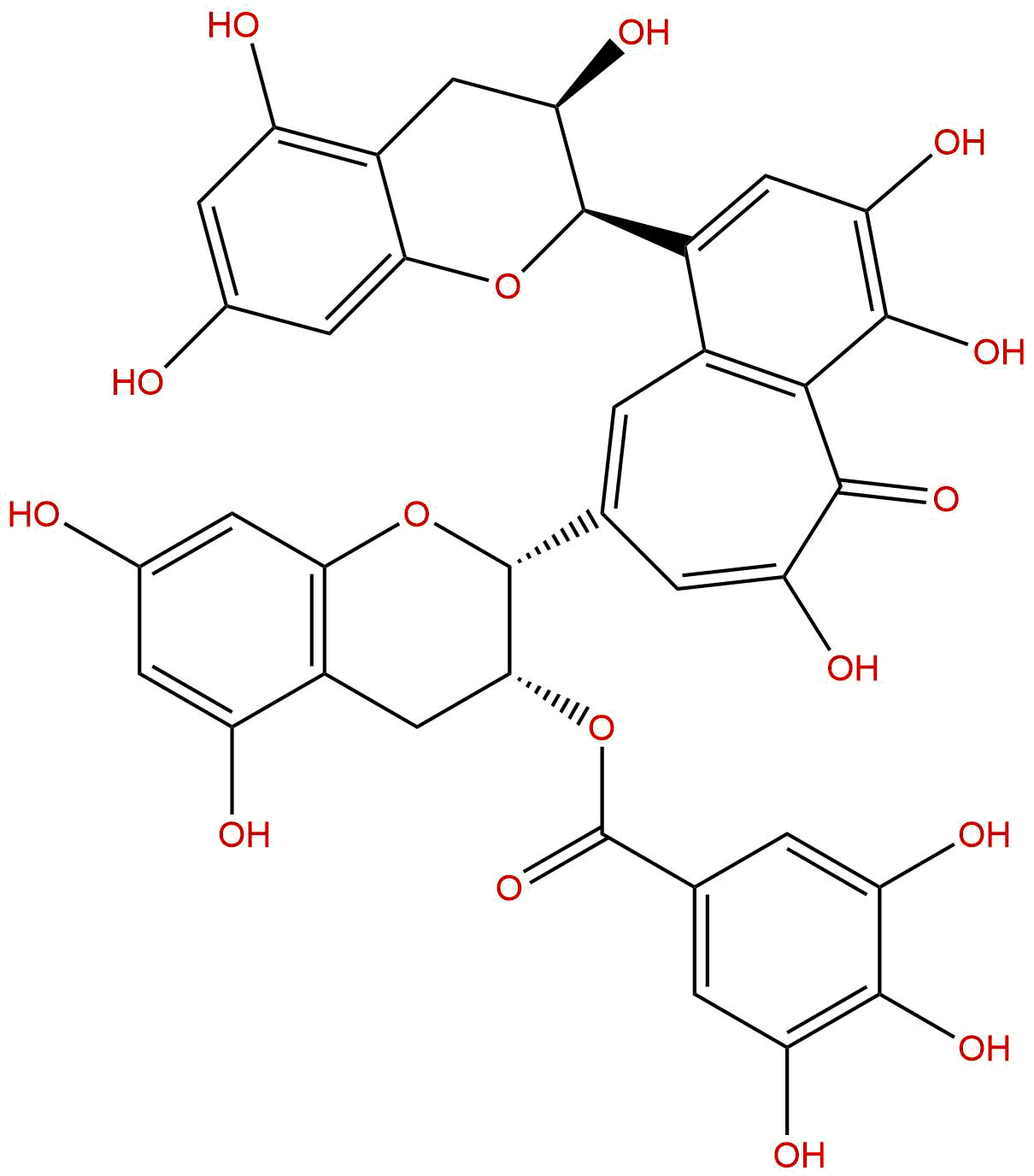


Product name: Theaflavin-3-gallate
Synonym name:
Catalogue No.: BP1387
Cas No.: 30462-34-1
Formula: C36H28O16
Mol Weight: 716.604
Botanical Source: Black Tea
Physical Description:
Type of Compound: Polyphenols
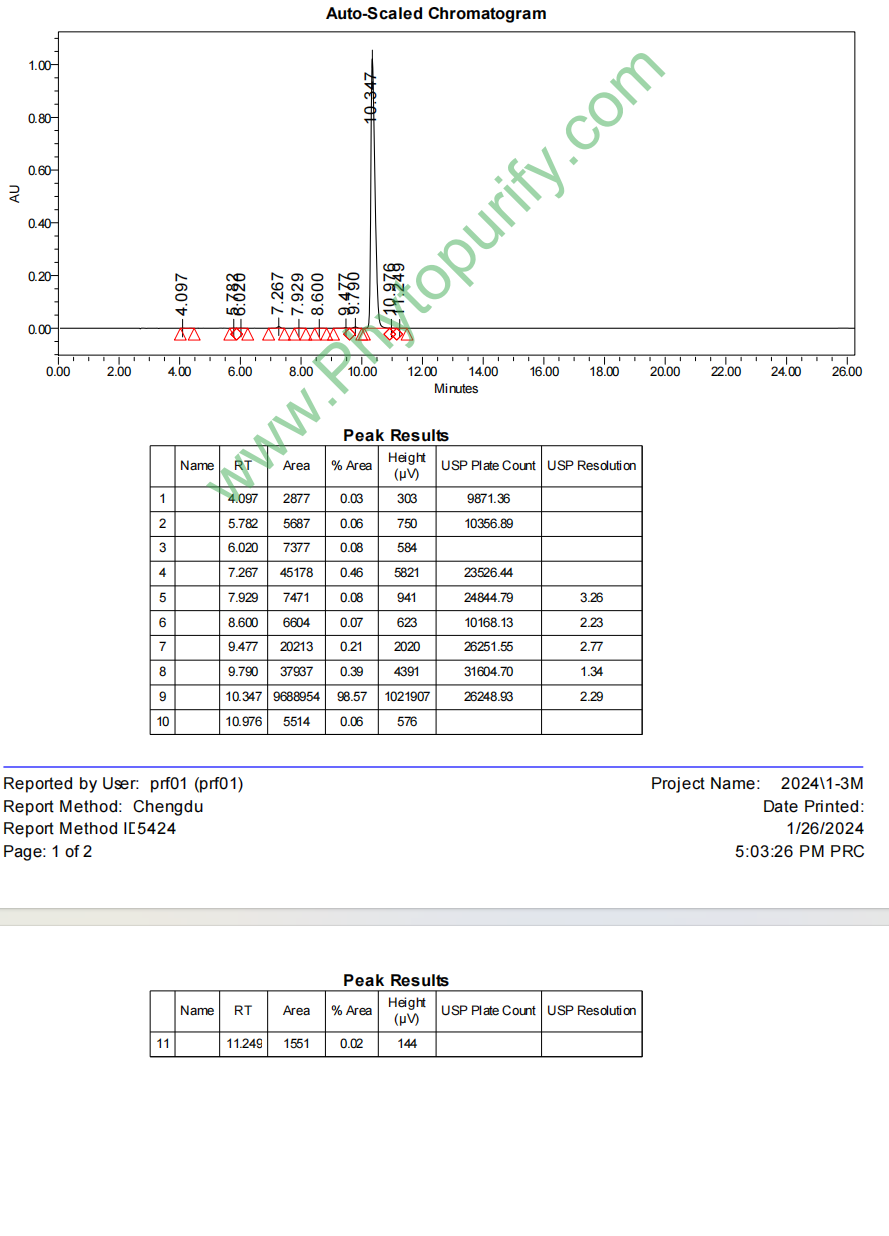
Purity: 95%~99%
Analysis Method: HPLC-DAD or/and HPLC-ELSD
Identification Method: Mass, NMR
Packing: Brown vial or HDPE plastic bottle
Storage: Store in a well closed container, protected from air and light. Put into refrigerate or freeze for long term storage.
Whenever possible, you should prepare and use solutions on the same day. However, if you need to make up stock solutions in advance, we recommend that you store the solution as aliquots in tightly sealed vials at -20℃. Generally, these will be useable for up to two weeks.
The product could be supplied from milligrams to grams
Inquire for bulk scale.
Description:
Theaflavin-3-gallate has anticancer and apoptotic effects in non-small cell lung carcinoma, it acts as prooxidants and induce oxidative stress, with carcinoma cells more sensitive than normal fibroblasts. Theaflavin-3-gallate can play a role in decreased intestinal cholesterol absorption via inhibition of micelle formation.
References:
Basic Clin Pharmacol Toxicol. 2008 Jul;103(1):66-74.
Theaflavin-3-gallate and theaflavin-3'-gallate, polyphenols in black tea with prooxidant properties.
This study compared the in vitro responses of human gingival fibroblasts and of carcinoma cells derived from the tongue to Theaflavin-3-gallate (TF-2A) and theaflavin-3'-gallate (TF-2B), polyphenols in black tea.
METHODS AND RESULTS:
The antiproliferative and cytotoxic effects of the theaflavin monomers were more pronounced to the carcinoma, than to the normal, cells. In phosphate buffer at pH 7.4, the theaflavins generated hydrogen peroxide and the superoxide anion, suggesting that their mode of toxicity may be due, in part, to the induction of oxidative stress. In a cell-free assay, Theaflavin-3-gallate and TF-2B reacted directly with reduced glutathione (GSH), in a time- and concentration-dependent manner. Intracellular storages of GSH were depleted on treatment of the cells with the theaflavin monomers. Depletion of intracellular GSH was more extensive with Theaflavin-3-gallate than with TF-2B and was more pronounced in the carcinoma, than in the normal, cells. The toxicities of the theaflavins were potentiated when the cells were cotreated with the GSH depleter, d,l-buthionine-[S,R]-sulfoximine. In the presence of catalase, pyruvate and divalent cobalt, all scavengers of reactive oxygen species, the cytotoxicities of the theaflavins were lessened. Theaflavin-3-gallate and TF-2B induced lipid peroxidation in the carcinoma cells, whereas in the fibroblasts, peroxidation was evident upon exposure to Theaflavin-3-gallate, but not to TF-2B.
CONCLUSIONS:
These studies demonstrated that the black tea theaflavin monomers, Theaflavin-3-gallate and TF-2B, act as prooxidants and induce oxidative stress, with carcinoma cells more sensitive than normal fibroblasts.
Bangl. J. Pharmacol., 2015, 10(4):3047-53.
Anticancer and apoptotic effects of theaflavin-3-gallate in non-small cell lung carcinoma.
The objective was to determine the antiproliferative and apoptotic effects of Theaflavin-3-gallate in human non-small cell lung cancer cells (A-549) along with determining the effect on cell cycle phase distribution, cell migration and invasion.
METHODS AND RESULTS:
Cell viability was determined by MTT assay while as phase contrast and fluorescence microscopies were involved to study apoptotic morphologi-cal features in these cells. Flow cytometry investigated the effect of Theaflavin-3-gallate on cell cycle phase distribution. Theaflavin-3-gallate treatment led to a substantial cytotoxic effect in A-549 cancer cells with IC50 values of 42.1 μM and 27.9 μM at 24 and 48 hours respectively. Further, 80 and 160 μM dose of Theaflavin-3-gallate induced apoptotic features including chromatin margina-tion and micronuclei presence. The population of cells in G2/M phase increased from 2.7% (control) to 6.8%, 17.2% and finally to 46.5% after treatment with 20, 80 and 160 μM concentration of Theaflavin-3-gallate respectively indicating G2/M phase cell cycle arrest.
HPLC of Theaflavin-3-gallate
Storage conditions:Short-term storage at 2~8℃, long-term storage at -20 ~ -80℃
Theaflavin-3-gallate (TF3G) is one of the important theaflavins in black tea and a derivative of theaflavins monomers. As an important component of tea polyphenols, TF3G has received widespread attention in the field of natural product pharmacology in recent years due to its unique biological activity and potential medicinal value. Numerous studies have shown that TF3G not only exhibits significant antioxidant, anti-inflammatory, and anti-tumor activities, but also effectively resists cell damage caused by ultraviolet B (UVB) and regulates the processes of cell apoptosis and necrosis. In addition, TF3G exhibits pro oxidant effects in cancer cells, inducing oxidative stress and thus exerting anti-cancer effects. Its inhibitory effect on xanthine oxidase (XO) (IC50 of 7.6 μ M) further reveals its potential therapeutic potential for xanthine related diseases.
This article will systematically review the chemical structure and physicochemical properties, plant sources, and extraction methods of TF3G, with a focus on its pharmacological activity and mechanism of action, exploring its molecular targets and pharmacological parameters, and finally looking forward to its clinical application prospects, providing theoretical basis and reference for the in-depth research and drug development of this natural product.
Theaflavin-3-gallate belongs to the class of catechins, with a molecular formula of C37H30O16 and a molecular weight of 716.6040. Its structure is composed of the core skeleton of theaflavins and gallate ester groups connected by ester bonds, with multiple phenolic hydroxyl and ester groups, endowing it with rich chemical activity. The LogP value of TF3G is 2.0844, indicating that it has moderate lipid solubility, which is beneficial for penetrating cell membranes but not too hydrophobic, making it suitable for distribution in organisms. Its topological polar surface area (TPSA) is 284.36 Å ², indicating a high molecular polarity that may affect its cell membrane permeability and bioavailability.
Low water solubility (0.0395 mg/mL) may limit its oral absorption and in vivo distribution. The low blood-brain barrier penetration ability of TF3G suggests its limited role in the central nervous system. The negative result of hERG channel inhibition experiment indicates a low risk of cardiac toxicity. The Ames test result is 0.6, indicating a low risk of genotoxicity and a good safety basis.
TF3G mainly exists in black tea (Camellia sinensis) and is an important component of theaflavins in the tea fermentation process. The fermentation process of black tea generates theaflavins and their derivatives through the oxidation and condensation reactions of catechins in tea leaves, among which TF3G content is relatively high.
Traditional extraction methods often combine water extraction with organic solvent extraction, followed by purification by high performance liquid chromatography (HPLC) to obtain high-purity TF3G. Modern extraction techniques include ultrasound assisted extraction, microwave-assisted extraction, and solid-phase extraction, which can improve extraction efficiency and purity. The extraction process usually controls pH, temperature, and fermentation time to optimize the yield of TF3G.
In addition, studies on the biosynthetic pathway have shown that the formation of TF3G depends on the oxidase activity of catechins in tea. Adjusting fermentation conditions can effectively regulate the TF3G content, providing theoretical guidance for industrial production.
TF3G has a significant protective effect on skin cell damage induced by ultraviolet B (UVB). In vitro cell experiments have shown that TF3G can inhibit UVB induced cell apoptosis and necrosis, alleviate oxidative stress response, and maintain cell membrane integrity. Its anti UVB damage mechanism is mainly achieved by clearing free radicals, inhibiting the release of inflammatory factors, and regulating cellular signaling pathways, providing natural active ingredients for the development of sunscreen and skin protectants.
Numerous studies have confirmed that TF3G exhibits excellent anti proliferative and pro apoptotic effects in various tumor cell lines. It induces oxidative stress in cancer cells, disrupts intracellular redox balance, and promotes cell apoptosis. TF3G can also inhibit cancer cell migration and invasion, and block the process of tumor metastasis.
In the in vivo tumor model, TF3G showed the potential to inhibit tumor growth with low side effects. Its anti-tumor activity involves multiple signaling pathways and key molecular targets, demonstrating the advantage of multi-target synergistic effects.
TF3G has typical polyphenol antioxidant properties, which can clear free radicals and protect normal cells from oxidative damage. However, in the cancer cell environment, TF3G exhibits pro oxidant properties, inducing excessive generation of intracellular reactive oxygen species (ROS) and triggering cell apoptosis. The ability to selectively regulate the redox state is an important foundation for its anti-tumor effect.
Xanthine oxidase (XO) is a key enzyme in purine metabolism, involved in the production of uric acid. The inhibitory effect of TF3G on XO (IC50 of 7.6 μ M) suggests its potential therapeutic value in diseases such as hyperuricemia and gout. By inhibiting XO activity, TF3G can reduce uric acid production and alleviate related inflammatory reactions.
The pharmacological effects of TF3G involve multiple molecular targets and signaling pathways, forming a complex regulatory network.
TF3G activates the caspase family and promotes programmed cell death by regulating the endogenous apoptotic signaling pathway. Meanwhile, TF3G inhibits necrotic cell death, reduces inflammatory response, and protects tissue function.
TF3G exerts antioxidant effects in normal cells, protecting cells from ROS damage; Inducing excessive accumulation of ROS in cancer cells triggers oxidative stress-induced cell death. This dual regulatory mechanism provides a molecular basis for its selective anti-tumor activity.
The molecular weight of TF3G is relatively large (716.6 Da), exceeding the ideal range of traditional oral drugs (generally<500 Da), which may affect its oral absorption. The high TPSA value (284.36 Å ²) indicates strong polarity, further limiting cell membrane penetration and oral bioavailability.
The LogP value is 2.0844, indicating moderate lipid solubility and favorable distribution in the body. Low water solubility (0.0395 mg/mL) may limit its solubility and absorption rate, and it is necessary to improve its bioavailability through formulation modification.
The low penetration ability of the blood-brain barrier suggests that TF3G is not easily able to enter the central nervous system, reducing the risk of central toxicity, but limiting its application in neurological diseases.
The hERG channel inhibition experiment was negative, indicating a low risk of cardiac toxicity. The Ames test results show that its genotoxicity risk is low and its safety is good.
Currently, there is limited systematic pharmacokinetic research on TF3G. Previous studies have shown that theaflavins have poor stability in the intestine after oral administration, are easily degraded by metabolic enzymes, and have limited bioavailability. TF3G may be rapidly metabolized through the liver's first pass effect, affecting its plasma concentration and in vivo half-life.
In the future, in vivo pharmacokinetic and metabolic studies need to be conducted to clarify their absorption, distribution, metabolism, and excretion (ADME) characteristics, providing a basis for clinical translation.
TF3G has shown great potential for application in the fields of anti-tumor and anti UVB damage due to its multi-target and multi mechanism pharmacological activities. Its inhibitory effect on xanthine oxidase also provides new ideas for the treatment of gout and related metabolic diseases.
However, the pharmacological properties of TF3G limit its direct application as an oral drug, and modern drug delivery technologies such as nanocarriers, liposome encapsulation, and structural modification are needed to enhance its bioavailability and targeting.
Future research should focus on the following aspects:
In addition, TF3G, as a natural product, has broad potential for the development of food and health products, and can be used as an active ingredient in functional beverages and skincare products to meet the market's demand for natural health products.
As an important member of the theaflavins in black tea, theaflavin-3-gallate exhibits significant pharmacological effects such as anti UVB damage, anti-tumor, and xanthine oxidase inhibition due to its unique chemical structure and diverse biological activities. Its multi-target and multi mechanism mode of action provides rich examples for the pharmacological research of natural products.
Despite the challenges in drug efficacy and pharmacokinetics, with the development of modern drug delivery technology and structural optimization strategies, TF3G is expected to overcome these limitations and become a new natural medicine or adjuvant therapy. The mechanism research and clinical translation of future systems will further promote the application of TF3G in the field of disease prevention and treatment, contributing the wisdom and power of natural products to human health.
