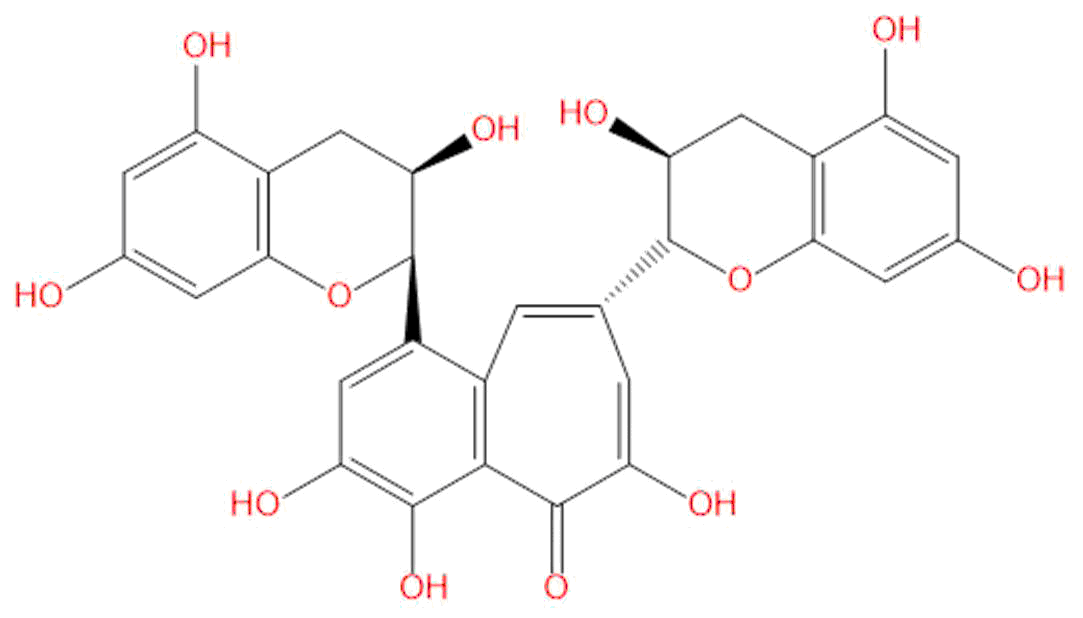


Product name: Isotheaflavin
Synonym name:
Catalogue No.: BP2112
Cas No.: 31701-93-6
Formula: C29H24O12
Mol Weight: 564.499
Botanical Source: Black Tea
Type of Compound:
Purity: 95%~99%
Analysis Method: HPLC-DAD or/and HPLC-ELSD
Identification Method: Mass, NMR
Packing: Brown vial or HDPE plastic bottle
Storage: Store in a well closed container, protected from air and light. Put into refrigerate or freeze for long term storage.
Whenever possible, you should prepare and use solutions on the same day. However, if you need to make up stock solutions in advance, we recommend that you store the solution as aliquots in tightly sealed vials at -20℃. Generally, these will be useable for up to two weeks.
The product could be supplied from milligrams to grams
Inquire for bulk scale.
For Reference Standard and R&D, Not for Human Use Directly.
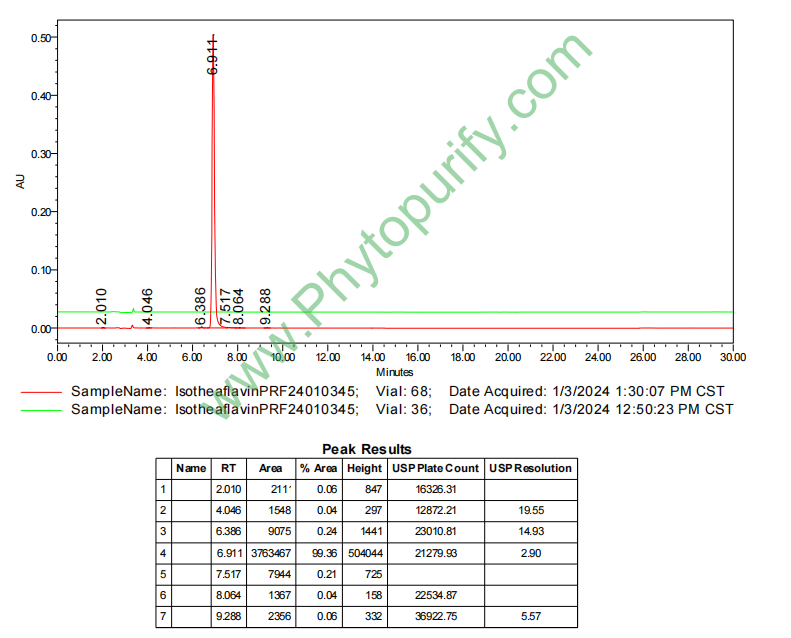
HPLC of Isotheaflavin
Storage conditions:Short-term storage at 2~8℃, long-term storage at -20 ~ -80℃
217.6000
1.4223
1.1506
.1715
1.1483
.1573
Low
87.7189
4.6154
No
No
No
No
Yes
No
0.6
Yes
No
Yes
No
Isotheaflavins are a class of natural polyphenolic compounds found in black tea and are an important member of the Theaflavins family. As a widely consumed beverage worldwide, black tea's unique fermentation process causes the oxidation and polymerization of tea polyphenols in tea leaves, forming various theaflavins, among which isotheaflavins are one of the components with significant biological activity. In recent years, with the deepening development of natural product pharmacology, isotheaflavins have become a research hotspot due to their excellent antioxidant properties and potential anti-aging effects. This article aims to provide a systematic review of the chemical structure and physicochemical properties, plant sources and extraction methods, pharmacological activity and mechanism of action, pharmacological evaluation, and clinical application prospects of isotheaflavins, with the hope of providing scientific basis for the further development and application of this natural product.
The chemical formula of isotheaflavins is C30H24O12, with a molecular weight of 564.4990 and a CAS number of 31701-93-6. Its structure is based on the catechol skeleton of theaflavins, with polyphenolic hydroxyl and phenolic structures, endowing it with strong antioxidant capacity. The LogP value of isotheaflavins is 1.4223, indicating that they have moderate lipid solubility, which helps to penetrate cell membranes, but their low water solubility (0.1715) limits their solubility in aqueous environments. Its topological polar surface area (TPSA) is relatively large, at 217.6 Å ², indicating strong polarity that may affect the permeability of the biofilm.
From a molecular structure perspective, isotheaflavins contain multiple phenolic hydroxyl groups, which are not only key sites for their antioxidant activity, but also affect their binding ability with biomolecules such as proteins and enzymes. In addition, isotheaflavins did not exhibit hERG channel inhibitory activity, indicating a low risk of cardiac toxicity. The Ames test value was 0.6, indicating a low risk of genotoxicity and meeting safety requirements.
Isotheaflavins mainly exist in black tea (Camellia sinensis), especially during the fermentation process of black tea, formed by the catalytic oxidation and polymerization of catechins in tea leaves through polyphenol oxidase. The fermentation process of black tea is a key step in the production of isotheaflavins, and the fermentation time and temperature directly affect its content and composition.
The traditional methods for extracting isotheaflavins include water extraction, ethanol extraction, and their combined extraction, combined with modern technologies such as ultrasound assisted extraction and microwave-assisted extraction, which can improve extraction efficiency and purity. The crude extract after extraction is usually separated, purified, and qualitatively and quantitatively analyzed using techniques such as liquid chromatography (HPLC) and high-performance liquid chromatography-mass spectrometry (HPLC-MS). In recent years, supercritical fluid extraction technology has also been explored for the extraction of isotheaflavins, which has the advantages of being environmentally friendly and efficient.
As an important polyphenolic antioxidant in black tea, isotheaflavins exhibit various pharmacological activities, especially in terms of antioxidant, anti-inflammatory, anti-aging, and neuroprotective potential, which have attracted much attention.
antioxidant activity
Isotheaflavins can clear free radicals, inhibit lipid peroxidation, and protect cells from oxidative stress damage. Its polyphenolic hydroxyl structure enables it to directly capture reactive oxygen species (ROS) and nitrogen free radicals, reducing cellular damage caused by oxidative stress.
Anti aging effect
The aging process is closely related to oxidative stress. Isotheaflavins activate the intracellular antioxidant enzyme system (such as SOD1, CAT, GPX1) and regulate the NFE2L2 signaling pathway, enhancing the cell's antioxidant defense ability and delaying cell aging. In addition, isotheaflavins also regulate lipid metabolism related enzymes (SMPD1, ASAH1, UGCG, CERK, SGMS1), maintain cell membrane lipid homeostasis, and protect cellular function.
anti-inflammatory effect
Yicha Huang Su can inhibit the expression of pro-inflammatory factors, alleviate chronic inflammatory reactions, and has a protective effect on various age-related diseases.
Neuroprotective effect
Although isoquercetin has low blood-brain barrier permeability, it indirectly exerts neuroprotective effects by regulating peripheral antioxidant and anti-inflammatory mechanisms, reducing the risk of neurodegenerative diseases.
The mechanism of action of isotheaflavins is mainly achieved by regulating various molecular targets related to aging:
NFE2L2 (Nuclear Factor Red Blood Cell 2-Associated Factor 2)
NFE2L2 is a key transcription factor for cellular antioxidant stress, and isotheaflavins can activate NFE2L2, promote its nuclear translocation, induce the expression of downstream antioxidant enzymes (SOD1, CAT, GPX1, HMOX1), and enhance cellular antioxidant capacity.
Antioxidant enzyme system (SOD1, CAT, GPX1, HMOX1)
These enzymes play a central role in clearing superoxide anions, hydrogen peroxide, and harmful free radicals. Isotheaflavins alleviate oxidative damage by upregulating the activity of these enzymes.
Lipid metabolism related enzymes (SMPD1, ASAH1, UGCG, CERK, SGMS1)
These enzymes are involved in cell membrane lipid metabolism and signal transduction, maintaining the integrity and function of the cell membrane. Isotheaflavins regulate these targets, aiding in cell membrane lipid homeostasis and preventing cellular dysfunction caused by lipid metabolism disorders.
In summary, isoquercetin exerts its pharmacological effects of anti-aging and cell protection through multi-target and multi-path synergistic effects.
The pharmacological evaluation of isotheaflavins shows that they have certain potential for development:
Molecular weight and physicochemical properties
The molecular weight of 564.5 is slightly higher than the recommended value of 500 by Lipinski's rule, but its LogP value of 1.42 is moderate, which is beneficial for cell membrane permeation. Higher TPSA (217.6) and lower water solubility (0.1715) may limit oral absorption and bioavailability.
Blood-brain barrier permeability
The low blood-brain barrier permeability of isotheaflavins limits their direct effects on central nervous system diseases, but their protective effects on peripheral tissues still have value.
safety
No hERG inhibitory activity, indicating a low risk of cardiac toxicity. The Ames test results show that the genotoxicity risk is relatively low and meets safety requirements.
pharmacokinetics
At present, there is limited data on the in vivo absorption, distribution, metabolism, and excretion (ADME) of isotheaflavins. Its larger molecular weight and polar structure may lead to lower oral bioavailability. In the future, drug carrier systems or structural modifications are needed to improve their in vivo stability and bioavailability.
As a natural antioxidant polyphenol in black tea, isotheaflavins have good safety and multi-target anti-aging effects, and have broad clinical application potential:
Anti aging health products
Based on its ability to resist oxidation and regulate cellular function, isoquercetin can be used as an active ingredient in anti-aging health products to assist in delaying the aging process of the body.
Adjuvant treatment for chronic diseases
By regulating oxidative stress and inflammatory response, isotheaflavins have the potential to assist in the treatment of chronic diseases associated with aging, such as cardiovascular disease, metabolic syndrome, and neurodegenerative diseases.
Functional foods and beverages
As a natural ingredient, isotheaflavins can be widely used in functional foods and beverages to enhance the health value of products.
Future research needs to focus on pharmacokinetic optimization, formulation development, and clinical trial validation of the efficacy and safety of isotheaflavins. In addition, combining modern drug design techniques to develop derivatives or composite formulations of isotheaflavins, enhancing their bioavailability and targeting, will further promote their clinical translation.
As an important natural polyphenol antioxidant in black tea, isoquercetin exhibits significant pharmacological activity and good safety due to its unique chemical structure and multi-target anti-aging mechanism. Despite certain limitations in its water solubility and blood-brain barrier permeability, isotheaflavins have broad application prospects in anti-aging, chronic disease prevention and treatment, and functional food fields through modern extraction techniques and optimization of drug carrier systems. In the future, it is necessary to strengthen its pharmacokinetic research and clinical validation, promote the transformation of isotheaflavins from natural products to clinical drugs, and benefit human health.
