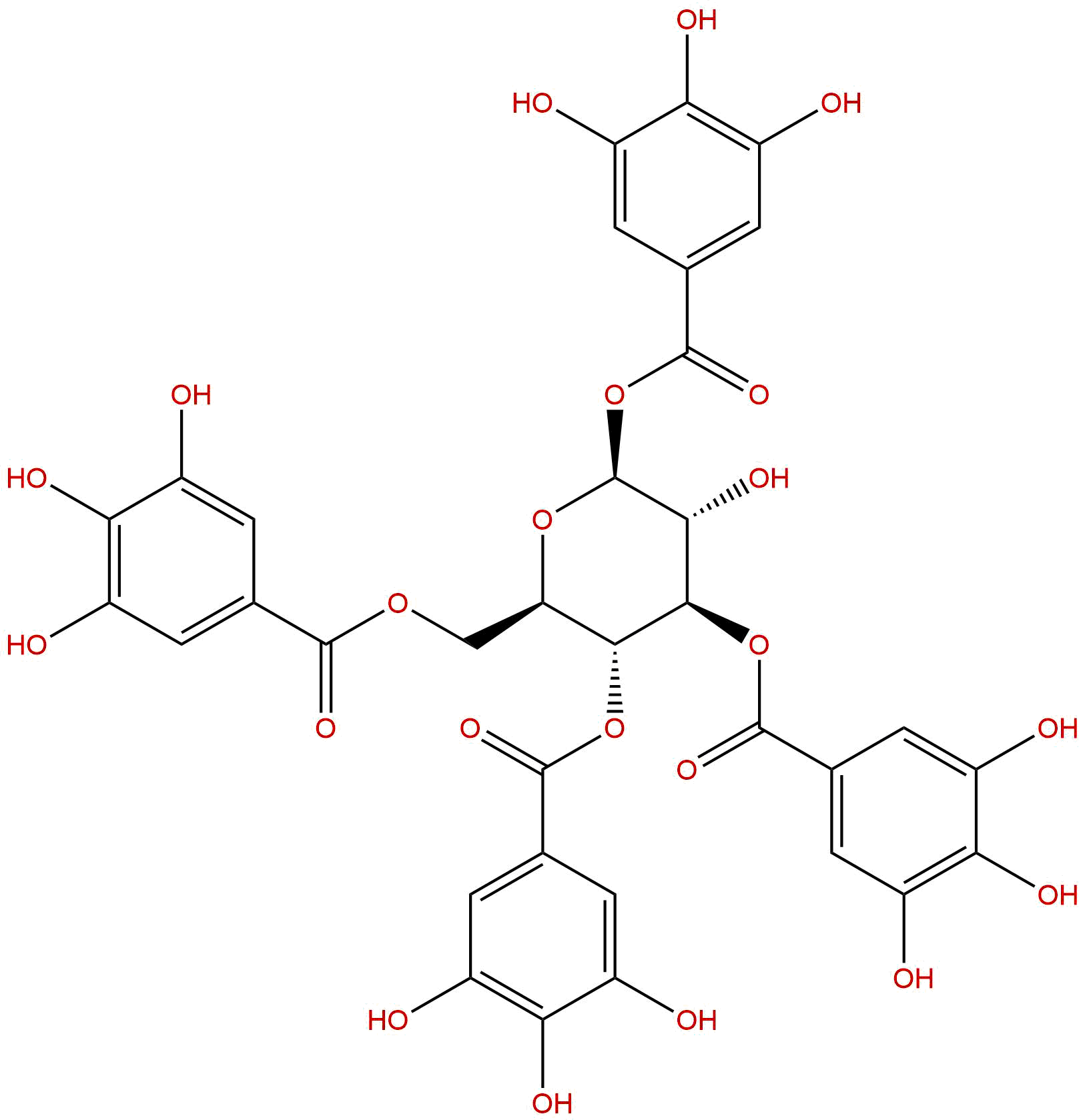


Product name: 1,3,4,6-Tetra-O-galloylglucose
Synonym name:
Catalogue No.: BP5406
Cas No.: 26922-99-6
Formula: C34H28O22
Mol Weight: 788.576
Botanical Source:
Type of Compound: Polyphenols
Purity: 95%~99%
Analysis Method: HPLC-DAD or/and HPLC-ELSD
Identification Method: Mass, NMR
Packing: Brown vial or HDPE plastic bottle
Storage: Store in a well closed container, protected from air and light. Put into refrigerate or freeze for long term storage.
Whenever possible, you should prepare and use solutions on the same day. However, if you need to make up stock solutions in advance, we recommend that you store the solution as aliquots in tightly sealed vials at -20℃. Generally, these will be useable for up to two weeks.
The product could be supplied from milligrams to grams
Inquire for bulk scale.
For Reference Standard and R&D, Not for Human Use Directly.
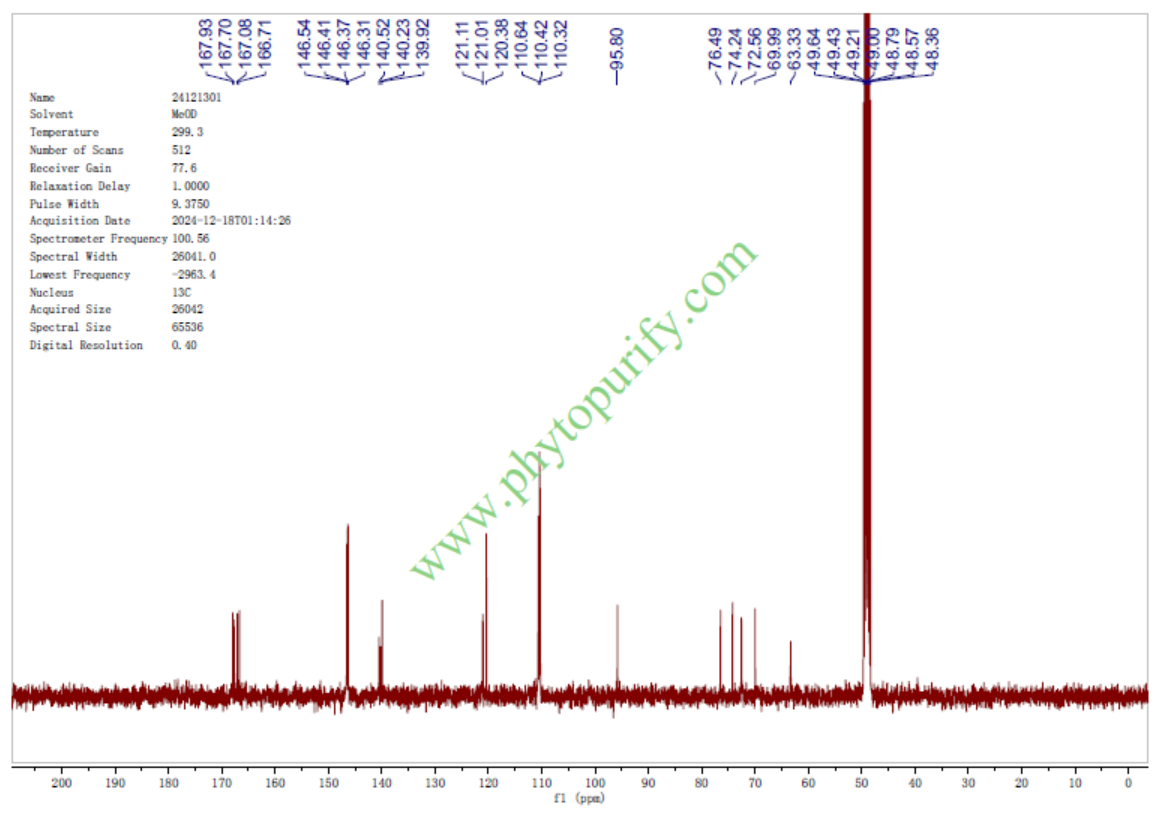
NMR of 1,3,4,6-Tetra-O-galloylglucose
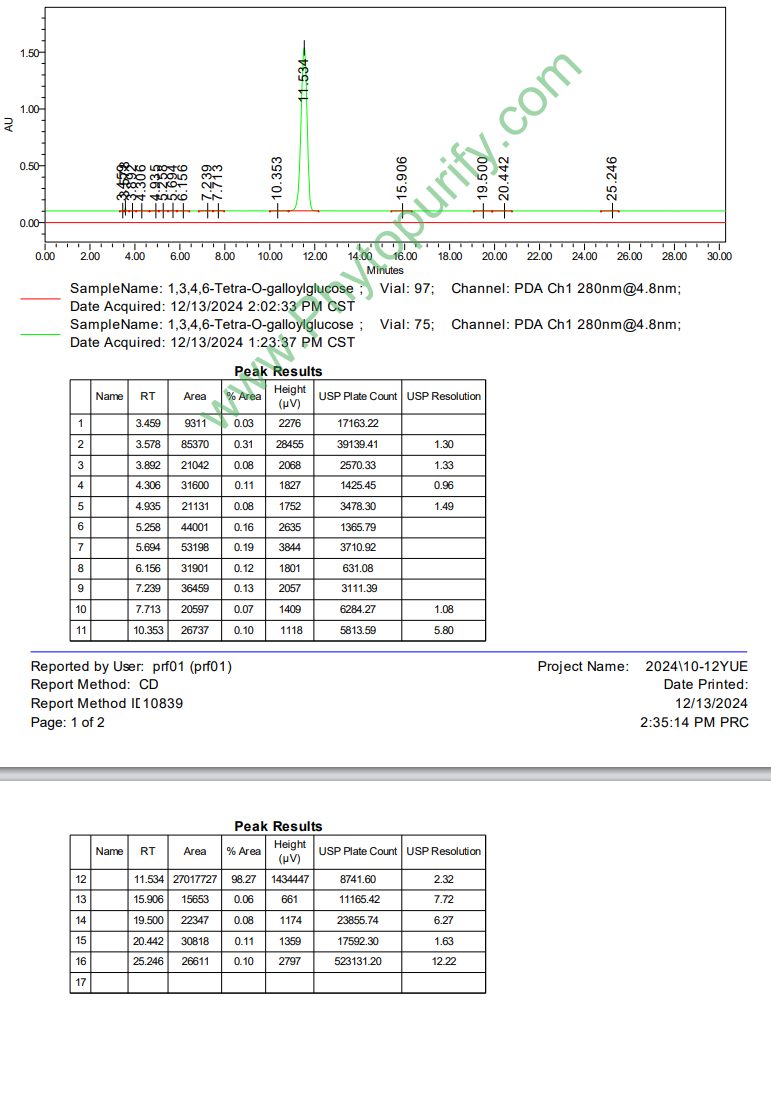
HPLC of 1,3,4,6-Tetra-O-galloylglucose
Storage conditions:Short-term storage at 2~8℃, long-term storage at -20 ~ -80℃
377.4200
1.2252
1.2253
.0874
.6052
.0715
Low
88.0655
4.5327
Yes
Yes
Yes
No
Yes
No
0.6
Yes
No
Yes
No
Natural products, as an important source of drug discovery, play an irreplaceable role in the long history of human struggle against diseases. Polyphenolic compounds, especially hydrolyzed tannins and their precursors, have attracted much attention due to their structural diversity and wide range of biological activities. Among numerous natural polyphenols, 1,3,4,6-tetra-O-galloylglucose (TGG), as a representative derivative of galloylglucose, has attracted strong interest from researchers in the field of natural product pharmacology in recent years. The chemical structure of TGG consists of a β - D-glucose core and four galloyl groups connected by ester bonds at the 1st, 3rd, 4th, and 6th hydroxyl groups, respectively. This unique "core arm" structure endows TGG with rich chemical properties and excellent biological activity.
TGG is widely present in various medicinal plants, especially in plants rich in tannins such as Anacardiaceae, Polygonaceae, and Myrtaceae. In traditional medicine, plant extracts rich in TGG are often used to treat inflammation, oxidative stress-related diseases, and metabolic disorders. Modern pharmacological research has confirmed that TGG has significant pharmacological activities such as antioxidant, anti-inflammatory, anti-tumor, antibacterial, and hepatoprotective effects. Among them, its antioxidant activity is particularly prominent and is considered one of the core mechanisms by which it exerts various biological effects. TGG can exert antioxidant effects by directly clearing free radicals, chelating transition metal ions, and activating endogenous antioxidant defense systems such as nuclear factor E2 related factor 2 and Nrf2 pathway. In addition, the regulatory effect of TGG on key targets such as tyrosinase (TYR) and matrix metalloproteinases (MMPs) provides scientific basis for its application in skin whitening, anti-aging, and anti-tumor metastasis.
Despite the enormous medicinal potential demonstrated by TGG, its development as a candidate drug or functional food ingredient still faces many challenges. Its high molecular weight, high polarity, relatively poor water solubility (0.0874 mg/mL), low oral bioavailability, and unstable metabolism in vivo severely restrict its clinical translation. Therefore, a deep understanding of the chemical structure, pharmacological activity, mechanism of action, and pharmacological characteristics of TGG is of great theoretical value and practical significance for promoting its transition from laboratory research to clinical application. This article aims to systematically review the research progress of TGG in chemistry, phytochemistry, pharmacology, molecular mechanisms, and drug evaluation, and explore its future clinical application prospects and challenges, in order to provide comprehensive references for the in-depth research and development of this natural product.
The chemical essence of 1,3,4,6-tetragalloylglucose (TGG) is a derivative formed by the ester bond condensation of the four hydroxyl groups (C1, C3, C4, C6) of β - D-glucose with gallic acid (3,4,5-trihydroxybenzoic acid). Its molecular formula is C ∝₄ H ₂₈ O ₂, with a molecular weight of 788.5760 Da. Structurally, TGG belongs to the galloyl glucose family and is a key intermediate in the biosynthesis pathway of more complex hydrolysable tannins such as pentagalloyl glucose and tannic acid. The core glucose ring provides a rigid skeleton, while the four galloyl groups extend outward like tentacles, forming a molecular surface rich in phenolic hydroxyl groups. These phenolic hydroxyl groups (each galloyl group contains three phenolic hydroxyl groups, totaling twelve) are the main structural basis for TGG to exert antioxidant activity. They can act as hydrogen atom donors and effectively neutralize free radicals.
In terms of physical and chemical properties, TGG exhibits typical polyphenolic compound characteristics. Its lipid water partition coefficient (LogP) is 1.2252, indicating a certain degree of lipophilicity, but overall leaning towards hydrophilicity. The topologically polar surface area (TPSA) is as high as 377.42 Å ², much higher than the typical threshold for oral drugs (<140 Å ²), indicating poor membrane permeability. The water-soluble experimental data is 0.0874 mg/mL, which belongs to the category of insoluble compounds. This low water solubility is related to its large molecular weight and numerous polar groups, but it also limits its dissolution and absorption in living organisms. TGG is usually an amorphous or crystalline powder in the solid state, with a color ranging from light yellow to brown, depending on purity and source. It is sensitive to light, heat, and alkaline environments, and ester bonds are prone to hydrolysis under alkaline conditions, producing gallic acid and glucose. In addition, TGG has a strong chelating ability for metal ions, especially for transition metal ions such as Fe ² ⁺ and Cu ² ⁺, which is not only part of its antioxidant mechanism, but may also affect its stability and distribution in vivo. In the assessment of blood-brain barrier penetration, TGG is classified as "low" penetration, which limits its application in the treatment of central nervous system diseases but also reduces the potential risk of neurotoxicity. The hERG inhibition assessment result is' no ', indicating a low risk of inducing QT interval prolongation and arrhythmia in the heart. The Ames test result is 0.6, indicating that it may have weak genetic toxicity and further evaluation is needed.
1,3,4,6-tetragalloylglucose is widely distributed in nature and mainly exists in higher plants rich in tannins. One of its most famous sources is gallnuts(Rhus chinensis Mill. or Rhus potaninii Maxim and other lacquer tree plant galls have extremely high tannin content in galls, and TGG is one of the important components. In addition, TGG is also abundant in other medicinal plants, such as:
- Lacquer tree family Salt coated wood(Rhus chinensis)Torch Tree(Rhus typhina)Huanglian Wood(Pistacia chinensis)Wait.
- Polygonaceae family Palm leaf rhubarb(Rheum palmatum)Medicinal rhubarb(Rheum officinale)Wait.
- Taojinniang family Eucalyptus tree(Eucalyptus spp.)、 Thousand layered tree(Melaleuca Spp.), etc.
- Gentleman's Science: Hezi(Terminalia chebula)Lanren tree(Terminalia catappa)Wait.
- Euphorbiaceae Ye Xia Zhu(Phyllanthus urinaria)Wait.
- Other: Peony(Paeonia lactiflora)Peony(Paeonia suffruticosa)TGG is also present in the root bark of plants.
The extraction method of TGG usually follows the classic extraction process of natural polyphenolic compounds, with the core goal of efficiently and selectively isolating target compounds from plant matrices while minimizing their oxidation and hydrolysis. Common extraction methods include:
1. Solvent extraction method This is the most traditional method. Due to the high polarity of TGG, water, methanol, ethanol, acetone, or their mixed solvents are usually used as extractants. For example, using a 70% acetone aqueous solution or a 50% ethanol aqueous solution for leaching or percolation extraction at room temperature or heating conditions (40-60 ° C) can achieve higher extraction rates. Defatting plant materials before extraction (such as using petroleum ether or n-hexane) can help remove fat soluble impurities.
2. Ultrasonic assisted extraction Using the cavitation effect of ultrasound to destroy plant cell walls, accelerate solvent permeation and solute diffusion, can significantly shorten extraction time, improve extraction efficiency, and reduce extraction temperature, which is beneficial for protecting thermosensitive TGG.
3. Microwave assisted extraction By utilizing the penetrability and selective heating of microwaves, the internal temperature and pressure of plant cells rapidly increase, leading to cell wall rupture and rapid release of target compounds. This method is efficient, but attention should be paid to controlling power and time to avoid TGG degradation.
4. Enzyme assisted extraction By adding cell wall degrading enzymes such as cellulase and pectinase, the plant cell wall structure is gently disrupted, thereby increasing the dissolution rate of TGG. This method has mild conditions and is environmentally friendly, but the cost is relatively high.
The crude extract after extraction contains a large amount of impurities and needs to be purified. Common purification methods include:
- Liquid-liquid extraction Preliminary separation of TGG selective distribution using different solvents such as ethyl acetate and n-butanol.
- column chromatography This is the most essential purification method. Commonly used stationary phases include macroporous adsorption resin (such as D101, HPD100), polyamide resin, silica gel, Sephadex LH-20 gel, etc. Macroporous resin and polyamide resin are commonly used for crude separation, and TGG can be enriched by gradient elution with ethanol water solutions of different concentrations. Sephadex LH-20 gel column chromatography can perform fine separation according to molecular size and adsorption, which is a common method to obtain high-purity TGG.
- Preparation type high-performance liquid chromatography For research or applications that require extremely high purity, preparative HPLC is the ultimate choice. Usually, a reverse phase C18 column is used, with methanol water or acetonitrile water system as the mobile phase for isocratic or gradient elution.
In recent years, a large number of in vitro and in vivo studies have revealed that 1,3,4,6-tetragalloyl glucose (TGG) has broad and significant pharmacological activities, among which antioxidant activity is its most core and fundamental function.
1. Antioxidant activity
The antioxidant capacity of TGG is its most notable characteristic. The abundant ortho phenolic hydroxyl groups (galloyl structure) in its molecule are efficient hydrogen atom donors, capable of directly scavenging various free radicals, including 1,1-diphenyl-2-trinitrophenylhydrazine (DPPH) free radical, 2,2 '- diazobis (3-ethylbenzothiazoline-6-sulfonic acid) free radical, hydroxyl free radical (• OH), superoxide anion free radical (O ₂⁻ •), and peroxynitrite anion (ONOO ⁻). Multiple studies have shown that the DPPH free radical scavenging ability of TGG is even stronger than that of classical antioxidants vitamin C and gallic acid. In addition, TGG can indirectly exert antioxidant effects by chelating transition metal ions such as Fe ² ⁺ and Cu ² ⁺, inhibiting metal catalyzed oxidation processes such as Fenton reaction. More importantly, TGG can activate the endogenous antioxidant defense system of cells, enhancing their ability to resist oxidative stress by upregulating the expression of nuclear factor E2 related factor 2 (Nrf2) and its downstream target genes such as heme oxygenase-1 (HMOX1), superoxide dismutase (SOD1, SOD2), catalase (CAT), glutathione peroxidase 1 (GPX1), etc. This dual antioxidant mechanism, both direct and indirect, enables TGG to perform excellently in protecting cells from oxidative damage.
2. Anti inflammatory activity
Oxidative stress is closely related to inflammatory response. The antioxidant activity of TGG lays the foundation for its anti-inflammatory effect. Research has shown that TGG can inhibit the production of nitric oxide (NO) and prostaglandin E2 (PGE2) in macrophages induced by lipopolysaccharide (LPS), and downregulate the expression of inducible nitric oxide synthase (iNOS) and cyclooxygenase-2 (COX-2). The mechanism may be related to the inhibition of the activation of the nuclear factor kappa B (NF - κ B) signaling pathway, thereby reducing the release of pro-inflammatory cytokines such as tumor necrosis factor - α (TNF - α), interleukin-1 β (IL-1 β), and interleukin-6 (IL-6).
3. Antitumor activity
TGG exhibits anti proliferative and apoptosis inducing activity in various tumor cell lines. For example, in liver cancer, breast cancer, colon cancer, melanoma and other cells, TGG can inhibit cell proliferation, block cell cycle in G0/G1 or G2/M phase, and induce apoptosis by activating caspase cascade reaction. In addition, the anti-tumor effect of TGG is also related to its ability to inhibit tumor cell invasion and metastasis. Matrix metalloproteinases (MMPs), especially MMP1 and MMP3, play a crucial role in tumor invasion and metastasis. Research has found that TGG can inhibit the expression and activity of MMP1 and MMP3, thereby weakening the migration and invasion ability of tumor cells.
4. Skin protection and whitening activity
The inhibitory effect of TGG on tyrosinase (TYR) makes it potentially applicable in the field of skin whitening. Tyrosinase is a key rate limiting enzyme in melanin synthesis. TGG can directly inhibit the activity of tyrosinase, thereby reducing the production of melanin. Meanwhile, its antioxidant activity can protect skin cells from oxidative damage and photoaging caused by ultraviolet (UV) radiation. By inhibiting the expression of MMP1 (collagenase), TGG can also reduce the degradation of collagen, helping to maintain skin elasticity and delay wrinkle formation.
5. Other activities
In addition to the aforementioned activities, TGG has also been reported to have antibacterial (especially against Staphylococcus aureus and certain fungi), antiviral (such as against influenza virus and herpes simplex virus), hepatoprotective (reducing chemical liver damage through antioxidant and anti-inflammatory mechanisms), hypoglycemic (inhibiting alpha glucosidase activity), and cardiovascular protective (improving endothelial function) effects.
The pharmacological activity of TGG is the result of its interaction with multiple molecular targets, and its mechanism of action exhibits the characteristics of multiple targets and pathways.
1. The core pathway of antioxidant stress: Nrf2/ARE signaling pathway
The activation of Nrf2 signaling pathway by TGG is one of the core mechanisms by which it exerts cellular protective effects. Under normal physiological conditions, Nrf2 binds to Kelch like ECH related protein 1 (Keap1) and is in an inhibited state. When cells are stimulated by oxidative stress or electrophilic agents (such as TGG or its metabolites), the conformation of Keap1 changes, leading to the dissociation and stabilization of Nrf2. Subsequently, Nrf2 translocates into the nucleus and binds to antioxidant response elements (ARE), initiating the transcription of a series of downstream protective genes, including:
- SOD1, SOD2 Encoding superoxide dismutase, catalyzing the conversion of superoxide anions into hydrogen peroxide.
- CAT Encoding catalase, which decomposes hydrogen peroxide into water and oxygen.
- GPX1 Encode glutathione peroxidase, which uses glutathione to reduce hydrogen peroxide and organic peroxides.
- HMOX1 Encoding heme oxygenase-1, it catalyzes the degradation of heme, producing biliverdin and carbon monoxide with antioxidant activity.
By upregulating the expression of these antioxidant enzymes, TGG significantly enhances the ability of cells to clear reactive oxygen species (ROS) and resist oxidative damage.
2. Regulation of matrix metalloproteinases (MMPs)
MMPs are a class of zinc ion dependent endopeptidases responsible for degrading extracellular matrix (ECM). MMP1 (interstitial collagenase) and MMP3 (lysin-1) play key roles in pathological processes such as skin photoaging, tumor invasion, and arthritis. TGG can inhibit the activity of MMPs through various pathways:
- Direct inhibition TGG may directly inhibit the catalytic activity of MMPs by chelating Zn ² ⁺ ions in their active centers or by non covalent interactions with enzyme proteins.
- Indirect inhibition TGG reduces gene transcription and protein expression of MMP1 and MMP3 by inhibiting upstream signaling pathways such as mitogen activated protein kinase (MAPK, including ERK, JNK, p38) and NF - κ B. In addition, TGG can upregulate the expression of tissue inhibitors of metalloproteinases (TIMPs), which are endogenous inhibitors of MMPs.
3. Inhibition of Tyrosinase (TYR)
Tyrosinase is a key enzyme in the synthesis of melanin, catalyzing the hydroxylation of tyrosine to dopa (DOPA) and further oxidation to dopa quinone. TGG has an inhibitory effect on tyrosinase, and its mechanism may include:
- Competitive inhibition The phenolic hydroxyl structure of TGG is similar to the substrates of tyrosinase (tyrosine, dopa), and may competitively bind to the active site of the enzyme.
- Chelating copper ions The active center of tyrosinase contains two copper ions, and the ortho phenolic hydroxyl group of TGG can chelate these copper ions, inactivating the enzyme.
- Reducing effect TGG may reduce intermediate products (such as dopaquinone) in the process of melanin synthesis, thereby blocking the production of melanin.
4. Other potential targets and pathways
In addition to the main targets mentioned above, TGG may also exert its effects through the following mechanisms:
- Regulating the NF - κ B pathway Inhibit the activity of I κ B kinase (IKK), prevent the phosphorylation and degradation of I κ B α, thereby inhibiting the nuclear translocation of NF - κ B and the expression of pro-inflammatory genes.
- Regulating the PI3K/Akt/mTOR pathway In tumor cells, TGG may inhibit the activity of mTOR, induce autophagy and apoptosis by suppressing the PI3K/Akt signaling pathway.
- Interacting with cell cycle proteins By downregulating cyclin D1 and cyclin dependent kinase 4 (CDK4), the cell cycle is arrested in the G0/G1 phase.
Although TGG has shown great potential in both in vitro and in vivo pharmacological studies, its development as an oral drug faces significant challenges in terms of drug potential. Based on its physicochemical properties and preliminary pharmacokinetic studies, a systematic evaluation of its pharmacological properties can be conducted.
1. Physical and chemical properties and drug like properties
According to Lipinski's "Rule of Five", the molecular weight of TGG (788.58 Da) is much greater than 500, the number of hydrogen bond donors (12 phenolic hydroxyl groups) is much greater than 5, and the number of hydrogen bond acceptors (22 oxygen atoms) is much greater than 10. Although LogP (1.2252) is within an acceptable range, other indicators are severely exceeded. This indicates that TGG does not meet the basic pharmacological characteristics of oral medications. Its extremely high TPSA (377.42 Å ²) and low water solubility (0.0874 mg/mL) indicate poor oral absorption and extremely low bioavailability. In addition, the Ames test result was 0.6, indicating that there may be a certain genetic toxicity risk, which needs to be further confirmed through in vivo experiments.
2. Absorption, distribution, metabolism, and excretion (ADME)
- absorb The oral absorption of TGG is extremely poor. Its high molecular weight, high polarity, and low water solubility make it difficult to passively diffuse through intestinal epithelial cells. In addition, it may be recognized by efflux transporters (such as P-glycoprotein) on the surface of intestinal epithelial cells and pumped into the ileal lumen. Therefore, the oral bioavailability of TGG is usually less than 1%. It may be metabolized by the gut microbiota to produce more easily absorbable metabolites (such as gallic acid, pyrogallol, etc.), which may be the main form of drug efficacy in the body.
- distribution Due to its large molecular weight and high polarity, TGG may have a relatively small distribution volume in the body, mainly distributed in the blood and extracellular fluid. Its binding rate with plasma proteins (especially albumin) may be high. The low penetration of the blood-brain barrier limits its therapeutic application in central nervous system diseases.
- Metabolism TGG undergoes extensive metabolism in the body. The main metabolic pathways include: ① Ester hydrolysis In the intestine and liver, esterases can hydrolyze it into gallic acid and glucose. Gallic acid can be further metabolized into compounds such as pyrogallol and triphenylphenol. ② methylation The phenolic hydroxyl group on gallic acid can be methylated by catechol-O-methyltransferase (COMT). ③ Glucuronidation and sulfation The phenolic hydroxyl groups on TGG and its metabolites can bind with glucuronic acid or sulfuric acid to form more easily excreted complexes.
- excretion TGG and its metabolites are mainly excreted through bile and urine. Due to its high molecular weight, bile excretion may be its main clearance pathway.
3. Optimization strategy for drug properties
Given the inherent pharmacological defects of TGG, future research should focus on the following strategies to improve its pharmacokinetic properties:
- Prodrug design Esterification or etherification modification of the phenolic hydroxyl group of TGG to prepare a prodrug, in order to improve its lipid solubility and membrane permeability. The prodrug releases active parent drug through enzymatic interpretation in the body.
- Nano drug delivery system Using carriers such as liposomes, polymer nanoparticles, and solid lipid nanoparticles to encapsulate TGG can significantly improve its water solubility, stability, and oral bioavailability, and achieve targeted delivery.
- Simplification and optimization of structure Study the pharmacophore of TGG and attempt to synthesize analogs with simpler structures, smaller molecular weights, and better drug like properties, while retaining their key pharmacological activities and improving ADME properties.
- combination therapy Combined use with absorption enhancers (such as surfactants) or P-glycoprotein inhibitors may enhance the oral absorption of TGG.
Despite facing challenges in drug development, the unique pharmacological activity spectrum of 1,3,4,6-tetragalloylglucose (TGG) has shown promising clinical application prospects in multiple therapeutic fields.
1. Skin care and beauty field
This is the field where TGG has the most practical application potential. Its powerful antioxidant, tyrosinase inhibiting, and MMP1 inhibiting activities make it an ideal candidate active ingredient for developing new whitening, anti-aging, and sunscreen cosmetics. By wrapping it in liposomes or nano lotion, the problems of its stability and transdermal absorption can be solved, and skin care products with practical effects can be developed. Compared with synthetic whitening agents such as hydroquinone, TGG, as a natural product, has higher safety and is more easily accepted by consumers.
2. Adjuvant therapy for oxidative stress-related diseases
Oxidative stress is the common pathological basis of many chronic diseases, including cardiovascular diseases, diabetes, neurodegenerative diseases, non-alcoholic fatty liver disease (NAFLD) and chronic kidney disease. TGG, as a potent Nrf2 activator, is expected to be used as a dietary supplement or adjuvant therapy to prevent or delay the occurrence and development of these diseases. For example, in NAFLD patients, TGG may improve liver function by reducing liver oxidative stress and inflammation. For patients with diabetes, its antioxidant and α - glucosidase inhibitory activities may help to control blood sugar and prevent complications.
3. Anti tumor adjuvant therapy
The anti-tumor activity of TGG, especially its ability to inhibit tumor cell invasion and metastasis, makes it a potential adjuvant drug for chemotherapy or radiotherapy. The combined use of TGG may enhance the efficacy of conventional treatment, while reducing normal tissue damage (such as cardiotoxicity and nephrotoxicity) caused by chemotherapy drugs (such as doxorubicin and cisplatin) through its antioxidant activity. However, it should be noted that the antioxidant activity of TGG may theoretically interfere with the efficacy of certain chemotherapy drugs that rely on ROS production, therefore rigorous combination therapy research is needed.
4. Anti inflammatory and immune regulation
Based on its ability to inhibit the NF - κ B pathway and pro-inflammatory cytokines, TGG has the potential to treat chronic inflammatory diseases such as rheumatoid arthritis and inflammatory bowel disease. Local application (such as enema or gel) may be an effective way to avoid poor oral absorption and achieve local high concentration.
Future Prospects
Future research on TGG should focus on the following directions:
1. Thoroughly elucidate the substance basis of drug efficacy in the body After oral administration of TGG, it is clear whether the prototype drug or its intestinal metabolites (such as gallic acid and pyrogallol) exert the main therapeutic effect in the body. This requires a combination of pharmacokinetic pharmacodynamic (PK-PD) studies.
2. Develop an efficient drug delivery system Focus on researching how nanotechnology (such as polymer micelles and mesoporous silica nanoparticles) can improve the oral bioavailability of TGG and achieve targeted delivery (such as liver targeting and tumor targeting).
3. Research on Structure Activity Relationship Systematically synthesize a series of TGG analogs, such as changing the number, position, or substituents of galloyl groups, in order to search for lead compounds with stronger activity and better drug like properties.
4. safety evaluation Conduct long-term toxicity, reproductive toxicity, and genetic toxicity studies on the system, especially conducting in-depth evaluations of potential genetic toxicity suggested by Ames tests.
5. Clinical translational research After completing sufficient preclinical research, cautiously conduct small-scale clinical trials, starting with topical preparations (such as skin care) or safer dietary supplements, gradually exploring their therapeutic value in specific diseases.
1,3,4,6-tetragalloylglucose (TGG), as a brilliant gem in the natural polyphenol family, exhibits various pharmacological potentials such as anti-inflammatory, anti-tumor, and skin protection with its unique chemical structure and excellent antioxidant activity as its core. It has shown important application prospects in the fields of oxidative stress-related diseases, skin beauty, and tumor prevention and treatment by activating the Nrf2/ARE pathway, inhibiting MMPs and tyrosinase, and other multi-target mechanisms. However, the clinical translation of TGG is not a smooth road. As a typical polyphenolic compound, it faces severe pharmaceutical challenges such as low oral bioavailability, unstable metabolism, and poor water solubility. These 'natural product disasters' are the main bottlenecks that restrict their transition from laboratory to clinical applications.
However, with the continuous deepening of modern medicinal chemistry, nanotechnology, and pharmacokinetic research, strategies such as prodrug design, nano delivery systems, and structural optimization are expected to overcome the inherent defects of TGG and unleash its enormous therapeutic potential. Future research should pay more attention to interdisciplinary integration, focusing on developing efficient and safe delivery strategies while deeply understanding the substance basis and mechanism of action of its in vivo efficacy, and systematically evaluating its long-term safety. We have reason to believe that with the unremitting efforts of scientific researchers, this ancient natural product will eventually shine with new vitality and make its due contribution to the cause of human health. The in-depth study of TGG is not only an exploration of a specific compound, but also a breakthrough in the common challenges of natural product drug development. Its experience and lessons will provide valuable references for the research of other similar natural products.
