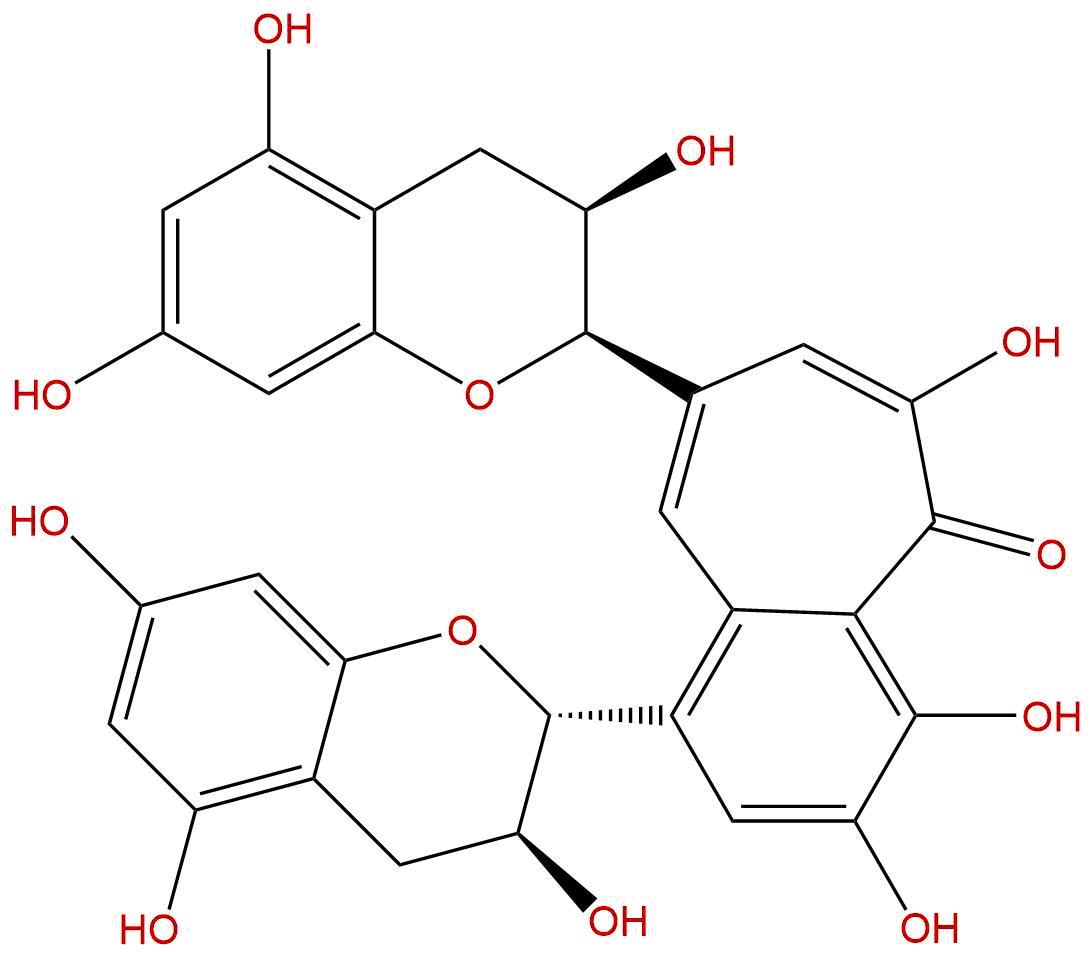


Product name: Neotheaflavin
Synonym name: Epitheaflavin
Catalogue No.: BP2121
Cas No.: 36451-14-6
Formula: C29H24O12
Mol Weight: 564.499
Botanical Source: Black Tea
Type of Compound: Polyphenols
Purity: 95%~99%
Analysis Method: HPLC-DAD or/and HPLC-ELSD
Identification Method: Mass, NMR
Packing: Brown vial or HDPE plastic bottle
Storage: Store in a well closed container, protected from air and light. Put into refrigerate or freeze for long term storage.
Whenever possible, you should prepare and use solutions on the same day. However, if you need to make up stock solutions in advance, we recommend that you store the solution as aliquots in tightly sealed vials at -20℃. Generally, these will be useable for up to two weeks.
The product could be supplied from milligrams to grams
Inquire for bulk scale.
For Reference Standard and R&D, Not for Human Use Directly.
Storage conditions:Short-term storage at 2~8℃, long-term storage at -20 ~ -80℃
217.6000
1.4191
1.1439
.1734
1.1039
.1566
Low
87.6789
4.6154
No
No
No
No
Yes
No
0.6
Yes
No
Yes
No
Neotheaflavin is a natural flavonoid compound derived from black tea (Camellia sinensis), which has received widespread attention in the field of natural product pharmacology in recent years due to its unique biological activity and potential health benefits. As one of the representative components of tea polyphenols, theaflavins not only give black tea its unique color and taste, but also exhibit various biological functions, especially in regulating lipid metabolism and antioxidant defense, demonstrating significant pharmacological activity. Its inhibitory effect on pancreatic lipase provides new ideas for regulating fat absorption, preventing obesity and related metabolic diseases. In addition, new theaflavins have shown great potential in the field of food preservation by regulating the expression of various antioxidant enzymes (such as SOD1, CAT, etc.) and detoxifying enzymes (such as GSTP1, CYP450 family members).
This article provides a systematic review of the chemical structure and physicochemical properties, plant sources and extraction processes, pharmacological activity and mechanism of action, pharmacological evaluation, and application prospects of new theaflavins in clinical and food industries. The aim is to provide theoretical basis and reference for the in-depth research and application development of this natural product.
The molecular formula of neotheaflavins is C30H24O12, with a molecular weight of 564.4990. It belongs to the flavonoid polyphenolic compounds and contains multiple phenolic hydroxyl groups and ester bonds in its structure, endowing it with excellent antioxidant properties. Its chemical structure can be regarded as an isomer derived from Theaflavin, with characteristic bisphenol ring structure and multi hydroxyl modification, complex structure and high polarity.
In terms of physical and chemical properties, the LogP value of neotheaflavins is 1.4191, indicating that they have moderate lipid solubility, which is beneficial for cell membrane penetration but not too hydrophobic, balancing bioavailability and solubility. The TPSA (topological polar surface area) is 217.6000, and a higher polar surface area reflects its strong polarity and hydrogen bonding ability, which may affect its membrane permeability and pharmacokinetic characteristics. The water solubility is 0.1734, indicating limited solubility in water, suggesting the need to consider solubility improvement strategies in formulation development.
In addition, the low blood-brain barrier permeability of neotheaflavins suggests that their main target of action may be limited to peripheral tissues, reducing the risk of central nervous system side effects. The hERG channel inhibition experiment showed a negative result, indicating a low risk of cardiac toxicity. The Ames test result is 0.6, indicating a low risk of genotoxicity and good safety.
New theaflavins mainly exist in black tea, which is an enriched source of theaflavins formed by the oxidation and polymerization of tea polyphenols in green tea through fermentation processes. Its content is influenced by multiple factors such as tea variety, picking season, processing technology, and fermentation degree. Generally speaking, deep fermented black tea has a higher content of theaflavins.
The traditional methods for extracting new theaflavins include solvent extraction, liquid-liquid distribution, and chromatographic purification. The commonly used solvents are ethanol, water, methanol, and their mixtures, and the extraction temperature is controlled at 60-80 ℃ to prevent compound degradation. Ultrasound assisted extraction and microwave-assisted extraction techniques have been applied in recent years to improve extraction efficiency and purity. After concentration and freeze-drying, the extract was separated and identified using high-performance liquid chromatography (HPLC) combined with mass spectrometry (MS) technology.
In addition, molecular imprinting technology and membrane separation technology have also been explored for efficient separation of neotheaflavins, aiming to achieve high purity and yield in industrial production. Optimizing the extraction process not only helps to increase yield, but also maintains the stability of its bioactive components.
One of the most significant pharmacological activities of neotheaflavins is their inhibitory effect on pancreatic lipase. Pancreatic lipase is a key enzyme in fat digestion and absorption, catalyzing the hydrolysis of triglycerides into fatty acids and glycerol. By inhibiting the activity of this enzyme, new theaflavins can effectively reduce fat absorption, lower blood lipid levels, and have potential anti obesity and metabolic syndrome prevention and treatment effects. In vitro enzymatic experiments showed that neotheaflavins exhibited dose-dependent inhibition of pancreatic lipase, with IC50 values superior to some known lipase inhibitors.
New theaflavins are rich in phenolic hydroxyl structures and have good free radical scavenging ability. It enhances the cellular antioxidant defense system and reduces oxidative stress damage by activating the expression of intracellular antioxidant enzymes such as superoxide dismutase SOD1 and catalase CAT. In addition, neotheaflavins can regulate the activity of CYP450 enzyme systems (such as CYP2E1, CYP1A2), reduce the production of harmful metabolites, and protect cells from toxic damage.
In the inflammatory model, neotheaflavins exhibit the ability to inhibit the release of pro-inflammatory cytokines, alleviate tissue inflammatory responses, indicating their potential application value in chronic inflammation related diseases.
The application of new theaflavins in the field of food preservation is receiving increasing attention. It inhibits oxidative reactions and microbial growth in food by regulating the activity of various antioxidant and detoxifying enzymes (such as GSTP1), thereby extending the shelf life of food. Related studies have shown that neotheaflavins can effectively inhibit lipid peroxidation, reduce food spoilage, and their natural sources and low toxicity make them ideal candidates for natural preservatives.
The mechanism of action of new theaflavins mainly involves the following aspects:
Pancreatic lipase inhibition New theaflavins bind to the active site of pancreatic lipase, blocking the interaction between the enzyme and substrate and reducing the efficiency of fat hydrolysis. Molecular docking and dynamic simulations show that neotheaflavins can stably bind to the catalytic pocket of lipase, forming multiple hydrogen bonds and hydrophobic interactions, enhancing the inhibitory effect.
Regulation of antioxidant enzymes New theaflavins activate the nuclear factor E2 related factor 2 (Nrf2) signaling pathway, promote the expression of antioxidant enzyme genes (such as SOD1, CAT), enhance the ability of cells to clear reactive oxygen species (ROS), and alleviate oxidative damage. In addition, its regulation of the CYP450 enzyme system helps to reduce the toxicity of oxidative metabolites.
Regulation of anti-inflammatory signaling pathway New theaflavins can inhibit the activation of the nuclear factor kappa B (NF - κ B) pathway, reduce the expression of pro-inflammatory cytokines such as TNF - α and IL-6, and exert anti-inflammatory effects.
Activation of detoxification enzyme GSTP1 By inducing the expression of glutathione S-transferase (GSTP1), neotheaflavins promote the binding and elimination of harmful substances, protecting cells from chemical toxins and oxidative stress damage.
These multi-target and multi pathway mechanisms of action jointly construct the biological activity basis of neotheaflavins, reflecting their potential as natural multifunctional drug candidate molecules.
The pharmacological evaluation of new theaflavins shows that they have good safety and suitable pharmacokinetic characteristics.
Molecular weight and physicochemical properties The molecular weight of 564.4990 is slightly higher than the Lipinski rule recommendation of 500 or less, but its LogP (1.4191) and TPSA (217.6) indicate strong polarity, which may affect oral absorption, but is also beneficial for water solubility and in vivo distribution.
Blood-brain barrier permeability Low permeability reduces the risk of central nervous system toxicity and is suitable for the treatment of peripheral target diseases.
Cardiac toxicity risk HERG channel inhibition is negative, indicating good cardiac safety.
Genotoxicity The Ames test result is 0.6, indicating a low risk of genotoxicity.
In terms of pharmacokinetics, there is currently limited systematic research on neotheaflavins, but their high polarity and limited water solubility suggest that their oral bioavailability may be restricted. In the future, it is necessary to improve its in vivo absorption and stability through nanocarriers, liposomes, or other pharmaceutical methods.
Due to its unique pancreatic lipase inhibitory effect, neotheaflavins have broad application prospects in the prevention and adjuvant treatment of obesity, metabolic syndrome, and related cardiovascular diseases. Its natural sources and good safety provide strong support for the development of functional foods and nutritional supplements.
In addition, the potential application of new theaflavins in the field of food preservation cannot be ignored. As a natural antioxidant and preservative, it can effectively extend the shelf life of food and reduce the use of chemical preservatives, which is in line with the development trend of modern green and healthy food.
Future research should focus on:
Through interdisciplinary collaboration, promote the transformation of new theaflavins from laboratory research to clinical and industrial applications.
As an important natural flavonoid compound in black tea, neotheaflavins have shown extensive pharmacological potential and application value due to their significant pancreatic lipase inhibitory activity and multi-target antioxidant and anti-inflammatory effects. Its good safety and natural source advantages make it have important development prospects in the fields of metabolic disease prevention and food preservation. Although research on its pharmacokinetics and clinical applications is still limited, with the continuous advancement of extraction technology and drug design, neotheaflavins are expected to become star compounds in the field of natural product pharmacology, contributing new natural drug resources to human health. In the future, we should strengthen basic and applied research, promote its clinical translation, and fully tap into its potential value.
