


Synonym name: 1,3,6-Tri-O-galloyl-beta-D-glucopyranose
Catalogue No.: BP0004
Cas No.: 18483-17-5
Formula: C27H24O18
Mol Weight: 636.471
Botanical Source: the fruit of Terminalia chebula
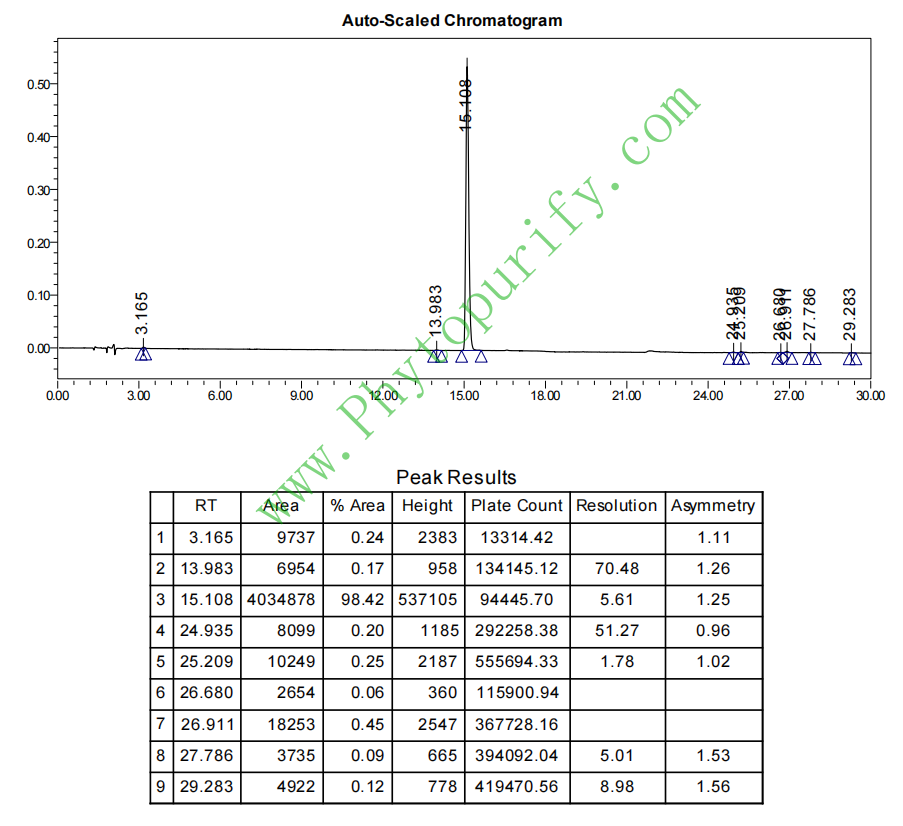
Purity: 95%~99%
Analysis Method: HPLC-DAD or/and HPLC-ELSD
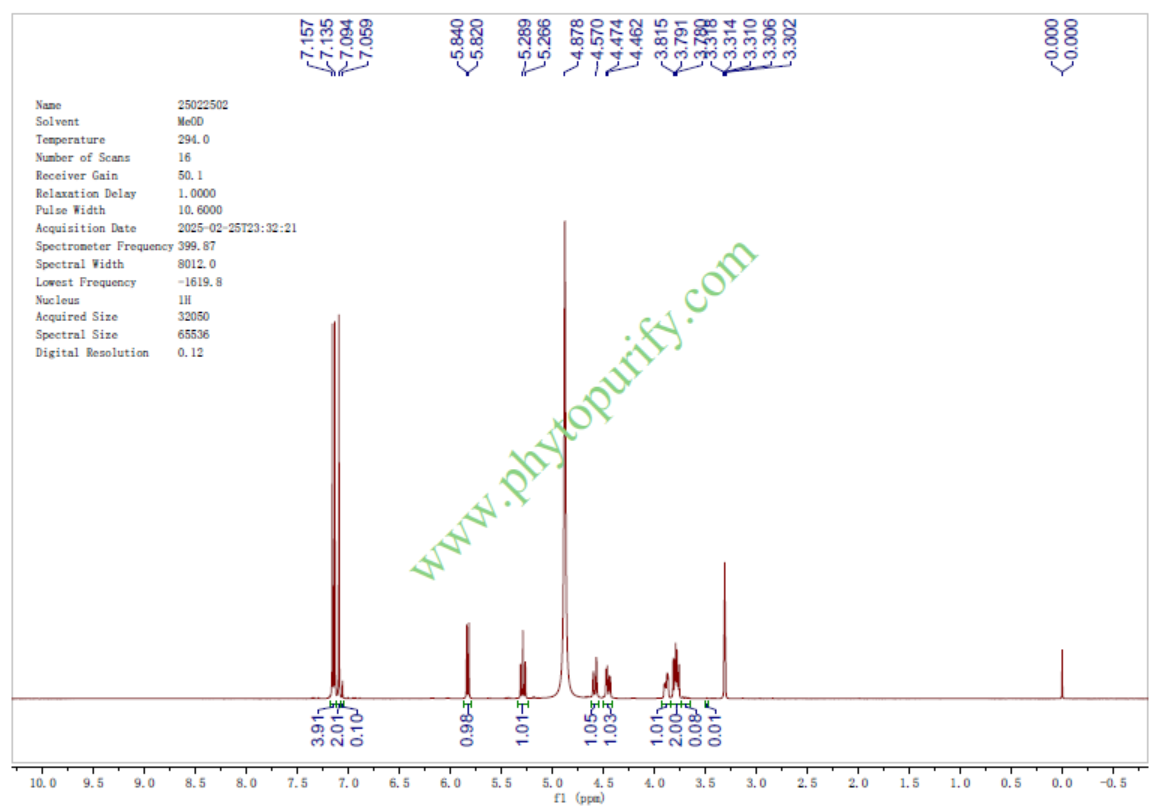
Identification Method: Mass, NMR
Packing: Brown vial or HDPE plastic bottle
Can be supplied from milligrams to grams.
For Reference Standard and R&D, Not for Human Use Directly.
Inquire for bulk scale.
HPLC of 1,3,6-Trigalloylglucose
HNMR of 1,3,6-Trigalloylglucose
Storage conditions:Short-term storage at 2~8℃, long-term storage at -20 ~ -80℃
325.8000
-1.5000
-2.5000
Low
No
No
No
No
No
No
1,3,6-trigalloylglucose (hereafter referred to as 1,3,6-TGG) is a typical natural product of gallate tannins, belonging to the hydrolizable tannins family. Monosaccharide tannin is composed of gallic acid and its polymeric derivatives, which bind with hydroxyl groups of monosaccharide molecules (most commonly glucose) through ester bonds. It is widely present in various plants and has received high attention in the field of natural product pharmacology due to its diverse biological activities and potential medicinal value. 1,3,6-TGG, as a polyphenolic compound, possesses multiple biological functions such as antioxidant, anti-inflammatory, antibacterial, and neuroprotective properties, particularly exhibiting significant pharmacological activity in disease models such as bacterial infections, cerebral ischemia, and cognitive impairment.
This article aims to systematically review the chemical structure and physicochemical properties, plant sources, and extraction methods of 1,3,6-TGG, combined with the latest pharmacological activity research, to deeply explore its mechanism of action and molecular targets, evaluate its pharmacological properties and pharmacokinetic characteristics, and finally look forward to its clinical application prospects, striving to provide theoretical basis and research direction for the drug development of this natural product.
The molecular formula of 1,3,6-trichloroglucuronide is C27H24O18, with a molecular weight of 636.47 Da. Its structural core is a glucose molecule, which is connected to three gallic acid units via ester bonds on the hydroxyl groups at positions 1, 3, and 6, respectively. The multi hydroxyl structure of gallic acid endows the molecule with abundant hydrogen bond donors and acceptors. The TPSA (topological polar surface area) is as high as 325.8 Å ², and the number of hydrogen bond acceptors reaches 18, demonstrating strong polarity and hydrophilicity.
In terms of physical and chemical properties, the LogP value of 1,3,6-TGG is about -1.5, indicating low lipid solubility and good water solubility. This high polarity characteristic makes it stable in aqueous phase, but also limits its ability to pass through lipid membranes, especially with poor blood-brain barrier penetration (BBB permeability is low). In addition, 1,3,6-TGG has shown good safety in vivo, with no significant risks of liver toxicity, cardiac toxicity, or hERG channel inhibition. The Ames mutagenicity test result was negative, indicating a low risk of genotoxicity.
1,3,6-TGG is mainly distributed in various plants rich in gallic tannins, such as the bark, leaves, and fruits of Anacardiaceae, Fagaceae, and Myrtaceae plants. Typical plants include Toxicodendron, Quercus, and Myrtus.
Extraction methods often use water or water alcohol mixed solvent systems, utilizing their good water solubility for efficient extraction. Common steps include:
In recent years, the application of supercritical CO ₂ extraction and membrane separation technology has also provided new ideas for the efficient purification of 1,3,6-TGG, improving the green environmental friendliness and economic benefits of extraction.
The pharmacological activity research of 1,3,6-TGG covers multiple fields such as antibacterial, neuroprotective, and anti-inflammatory, especially in experimental models of bacterial infection, cerebral ischemia, and cognitive impairment.
As a gallnut tannin compound, 1,3,6-TGG exhibits broad-spectrum antibacterial activity. It targets key bacterial proteins such as DNA gyrase GYRA, fatty acid synthase FABI, and cell division protein FTSZ, inhibiting bacterial DNA replication, fatty acid synthesis, and cell division processes, leading to hindered bacterial growth. In addition, 1,3,6-TGG regulates host immune related targets such as TLR4, enhances the body's immune response to bacterial infections, and exhibits synergistic antibacterial effects.
In the cerebral ischemia model, 1,3,6-TGG regulates Alzheimer's disease-related proteins such as APP and BACE1, inhibits abnormal accumulation of β - amyloid protein, and reduces nerve damage. At the same time, regulating signaling pathways such as PTPN1, PRKCA, APEX1, etc., inhibiting inflammatory response and oxidative stress, protecting neuronal survival, and improving brain function recovery.
In the study of cognitive impairment, 1,3,6-TGG has shown the ability to regulate various neurotransmitter metabolic enzymes (such as IDO1, TYR), transporters (ABCB1, ABCG2), and proteases (USP2), promoting neuronal metabolic balance and synaptic function repair. Its anti-inflammatory and antioxidant effects also help slow down cognitive decline.
The mechanism of action of 1,3,6-TGG is complex, involving synergistic regulation of multiple targets and pathways.
In summary, 1,3,6-TGG exerts its broad pharmacological effects through the synergistic action of multiple targets and pathways.
The pharmacological analysis of 1,3,6-TGG shows that it has certain advantages and challenges.
At present, there is limited systematic pharmacokinetic research on 1,3,6-TGG. Previous in vitro and animal experiments have suggested that its oral absorption is limited, its bioavailability is low, and its distribution in the body is mainly concentrated in the blood and liver. The metabolic pathway may involve esterase mediated hydrolysis, generating small molecule metabolites such as gallic acid and glucose. Excretion is mainly through the kidneys and bile.
To overcome its drug limitation, relevant research is exploring strategies such as nanocarriers, liposome encapsulation, and structural modification to improve its bioavailability and brain targeting.
Given the potential of 1,3,6-TGG in antibacterial, neuroprotective, and cognitive function improvement, its clinical development prospects are broad.
With the intensification of antibiotic resistance, 1,3,6-TGG, as a multi-target natural antibacterial agent, is expected to become a new treatment option for drug-resistant strains. It provides a dual antibacterial mechanism by inhibiting key bacterial enzymes and regulating host immunity, making it suitable for combination therapy strategies.
Cerebral ischemia and cognitive impairment are highly prevalent neurological diseases worldwide, and there is a lack of effective treatment drugs. 1,3,6-TGG exhibits promising therapeutic potential by modulating neuroprotective and anti-inflammatory mechanisms through multiple targets. In the future, brain targeted delivery technology can be combined to enhance the efficacy of the central nervous system.
The tannins in gallnuts also have antioxidant, anti-tumor, and immune regulatory effects, and the research on 1,3,6-TGG in these fields is worth further exploration.
1,3,6-trichloroglucuronide, as a typical natural product of gallate tannins, has shown broad application prospects in the treatment of diseases such as antibacterial, cerebral ischemia, and cognitive impairment due to its unique chemical structure and multi-target pharmacological activity. Although there are certain limitations to its pharmacological properties at present, with the assistance of modern drug design and delivery technologies, it is expected to overcome these obstacles and promote its clinical translation. In the future, in-depth pharmacological mechanism research and clinical validation will lay a solid foundation for the drug development of 1,3,6-TGG, and help natural products play a greater role in the modern pharmaceutical field.
